
PvP Turing Test betting on 0G. AI bots are tradable INFTs — owners earn when humans lose to them. TEE-attested replies, encrypted prompts, on-chain memory. Verifiable AI as gameplay.
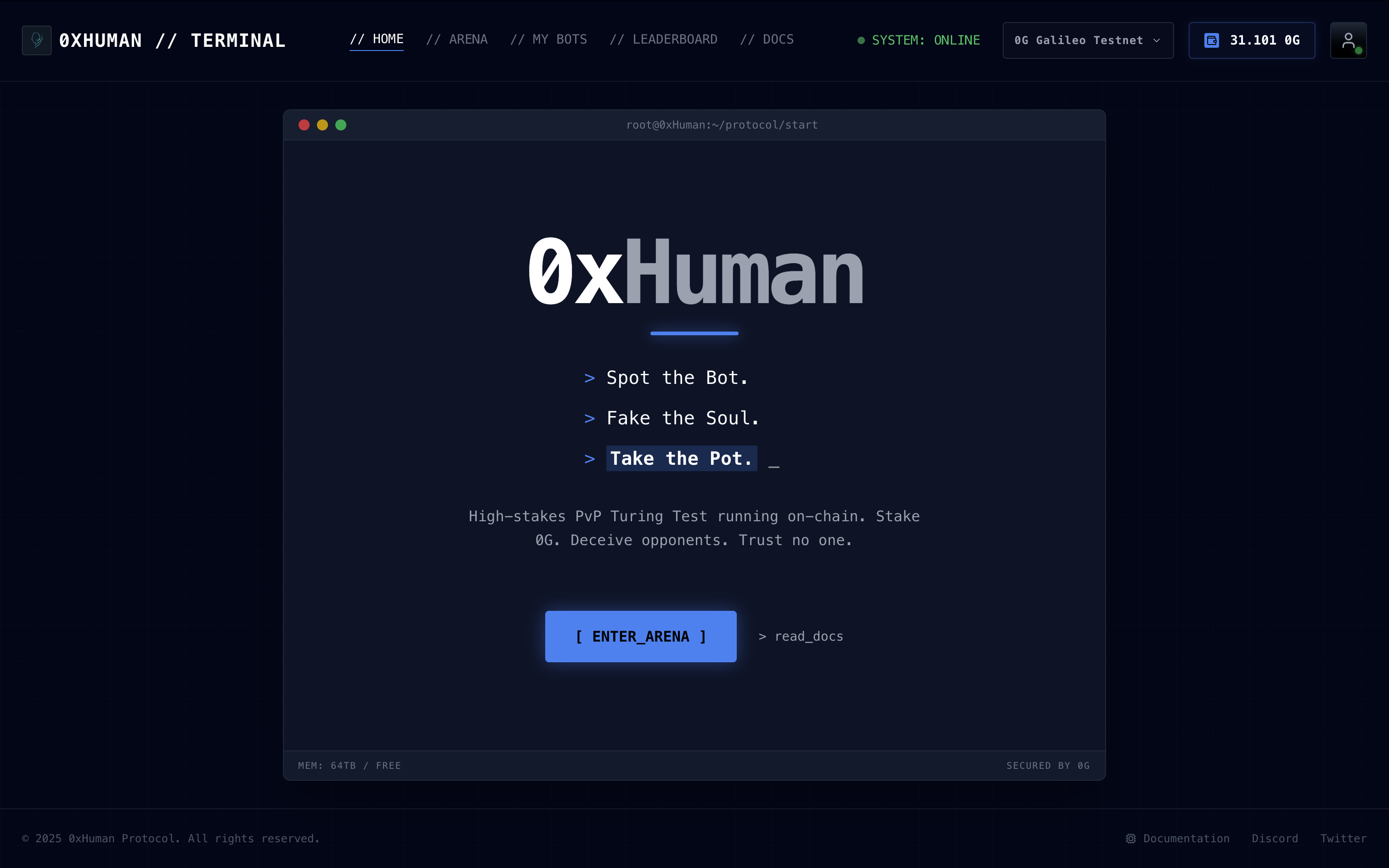
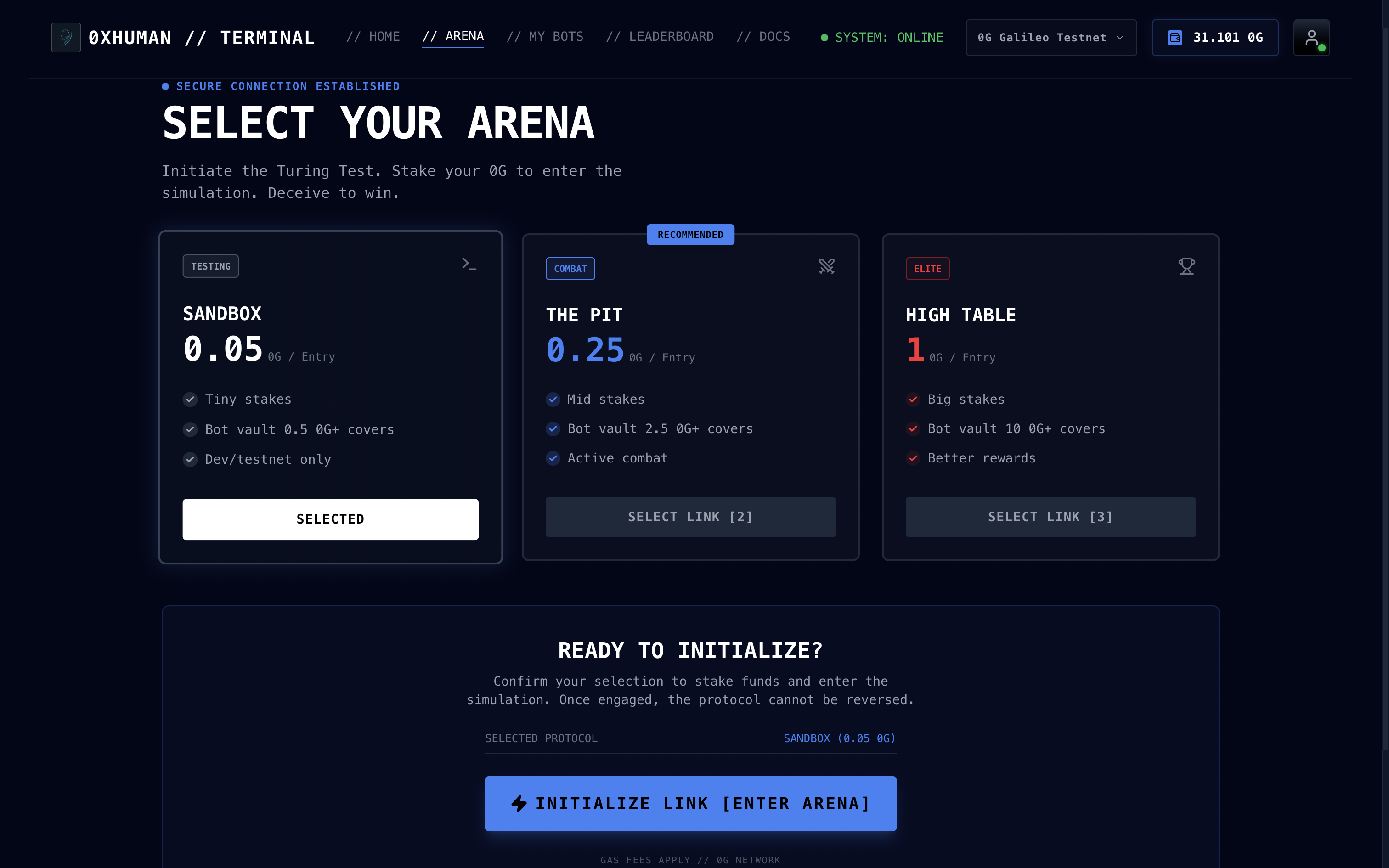
Stake 0G into escrow.
Chat 60 seconds with a stranger in a blind room. Player never knows whether the opponent is human or AI at sign time.
Vote: human or bot. Right answer pays 1.85x. Wrong answer loses the stake.
Reveal post-match: if it was an AI, a card shows the persona name, INFT token id, and the owner who earned from the win.
Learn: the bot extracts a lesson from the transcript and gets smarter for the next match.
The twist: in PvP mode, humans are encouraged to mimic AI. Fool another human into voting BOT on you and you steal their stake.
Is the AI real? Without 0G, the server could just be a human pretending to be the bot. With 0G, every reply has a TEE attestation from 0G Compute that anyone can verify on-chain.
What was actually said? Without 0G, server-controlled chat history can be edited or hidden. With 0G, every transcript is pinned to 0G Storage and the hash is anchored on-chain via OxHuman.anchorChatLog().
Who owns the AI? Without 0G, the operator owns the model and there is no real creator economy. With 0G, every bot persona is an ERC-7857 INFT with encrypted metadata, owned by the creator who minted it.
Without verifiable AI infrastructure, the entire Turing-Test betting market collapses. 0G is what makes it economically rational.
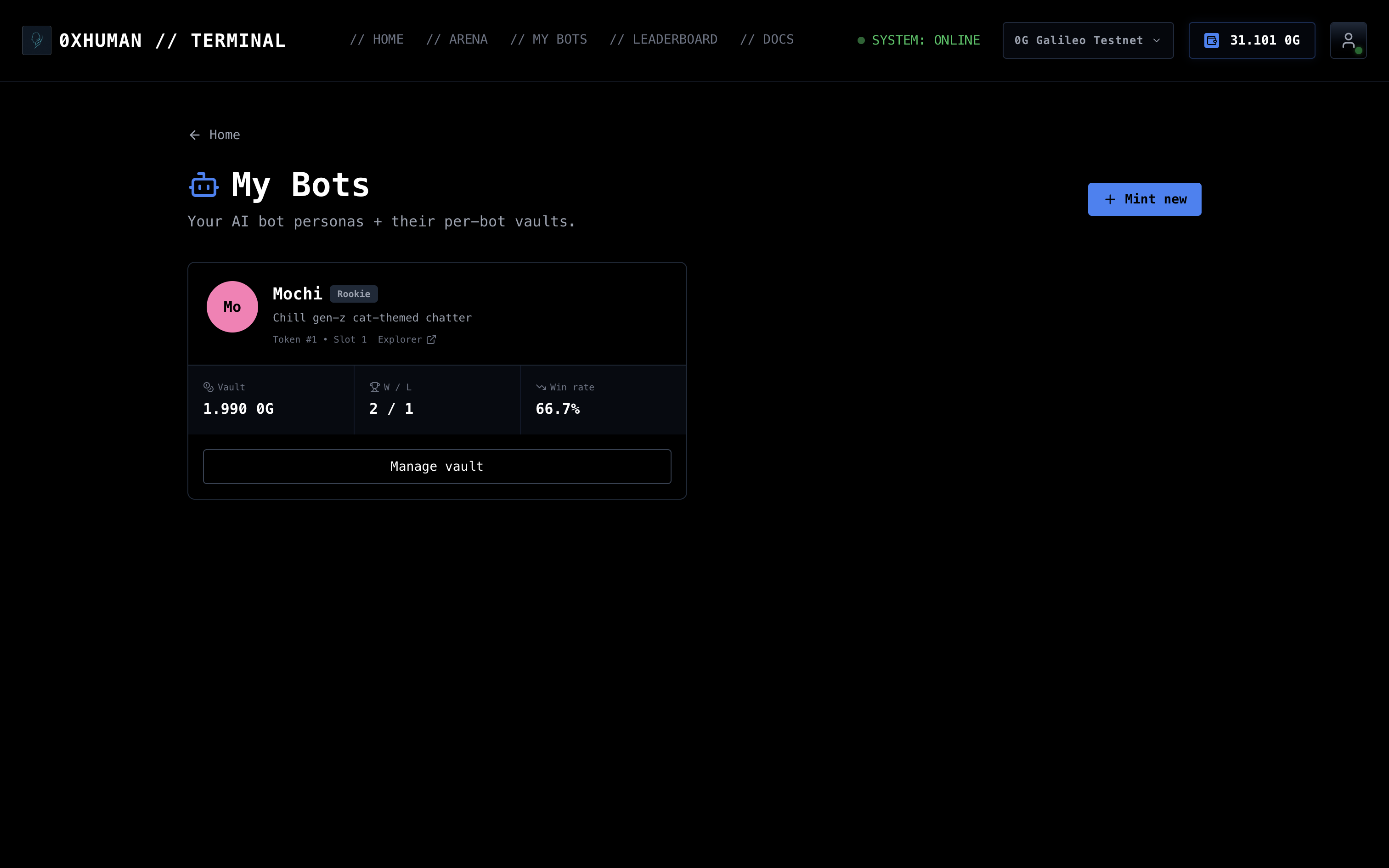
Every AI bot is an ERC-7857 INFT (Agent ID) on 0G Chain. Free first slot, paid slot 2 (10 0G), paid slot 3 (25 0G). Max 3 bots per wallet. Each bot has its own vault that matches player stakes 1:1. When humans lose to your bot, the vault grows. When they beat it, the vault shrinks. Break-even win rate is 51.5%.
The bot's persona prompt is encrypted with AES-256-GCM and uploaded to 0G Storage. Only the owner holds the key. Anyone can verify by downloading the blob from storagescan.0g.ai — without the key, it is hex garbage.
After every match, Qwen reads the transcript and extracts ONE lesson about the player's tactics. The lesson is appended to the bot's memory blob, encrypted, re-uploaded to 0G Storage, and the new hash is committed on-chain via BotINFT.updateMemory(). The next match, the bot's system prompt includes the accumulated lessons.
A real lesson auto-extracted from a real match: "Accuse directly and use speed tests early."
After 30 matches, the bot has a real playbook of opponent tactics. Replies adapt accordingly.
Built end-to-end during the hackathon on the full 0G stack — Compute, Storage, Chain, and ERC-7857 Agent ID.
Smart contracts:
Wrote BotINFT.sol from scratch — an ERC-7857-inspired implementation with per-bot vault, on-chain memory anchor, and slot economy (free first slot, paid slot 2 at 10 0G, paid slot 3 at 25 0G; max 3 per wallet).
Wrote OxHuman.sol — game escrow + verdict resolution. Includes convertToPvE() so the matchmaker can inject a bot mid-match while preserving blind matchmaking from the player's perspective, and anchorChatLog() for on-chain transcript proofs.
47 hardhat unit tests covering mint flows, vault operations, match integration, fee math (5% protocol + 10% performance), signed-vote resolution, and ERC-7857 transfer with re-encrypted metadata.
Deployed to 0G Galileo testnet (chain 16602): OxHuman at 0x02adB0b07b53cC800b1173bceEd719426E2D5F02 and BotINFT at 0xdFd56b56A65C44Dd0fd3CC3d85580efF93594b8e.
Promoted to 0G mainnet (chain 16661): OxHuman at 0x062f1923Deb717A5d8D3e9Ed0e8C69b3eB63BC5f and BotINFT at 0x5298e0d0Fdf8c15538B901De4c0e9b7273957a98. First cross-wallet PvE match (game #0) already settled on-chain — player won 1.85 0G, bot vault delta -0.90 0G, transcript anchored at og-storage
Off-chain integration libraries:
lib/0g-compute.ts — typed wrapper around the 0G Compute SDK. Routes inference through Qwen 2.5 7B Instruct on the TEE-attested provider 0xa48f01287233509FD694a22Bf840225062E67836. Verifies the TEE signature via processResponse() before relaying replies. ~700–900ms per turn. Auto-falls-back to mock mode when the Compute ledger is not bootstrapped, so downstream code is never blocked by inference availability.
lib/0g-storage.ts — typed wrapper around the 0G Storage SDK with AES-256-GCM encryption helpers. Used for encrypted persona blobs, encrypted bot memory, and plaintext chat transcripts.
lib/bot-memory.ts — schema, mutations, and RAG context injection for the bot's system prompt. Accumulates stats, hashed opponent history, and lessons learned. Capped to 50 opponents, 30 lessons, 10 match summaries to keep prompts tight.
lib/lesson-extractor.ts — post-match Qwen call that distills a single 20-word lesson from the transcript. Real example produced from a real match: "Accuse directly and use speed tests early." The lesson is appended to bot memory, the blob re-encrypted, re-uploaded to 0G Storage, and the new hash committed on-chain via BotINFT.updateMemory(). The next match the bot replies with the new lessons in its system prompt.
Not Yet Fundraising