
Apogee gives AI agents self-custodial wallets, ERC-8004 identity, encrypted memory, programmable spending policies, payment rails, on-chain receipts, and a paid skills marketplace.
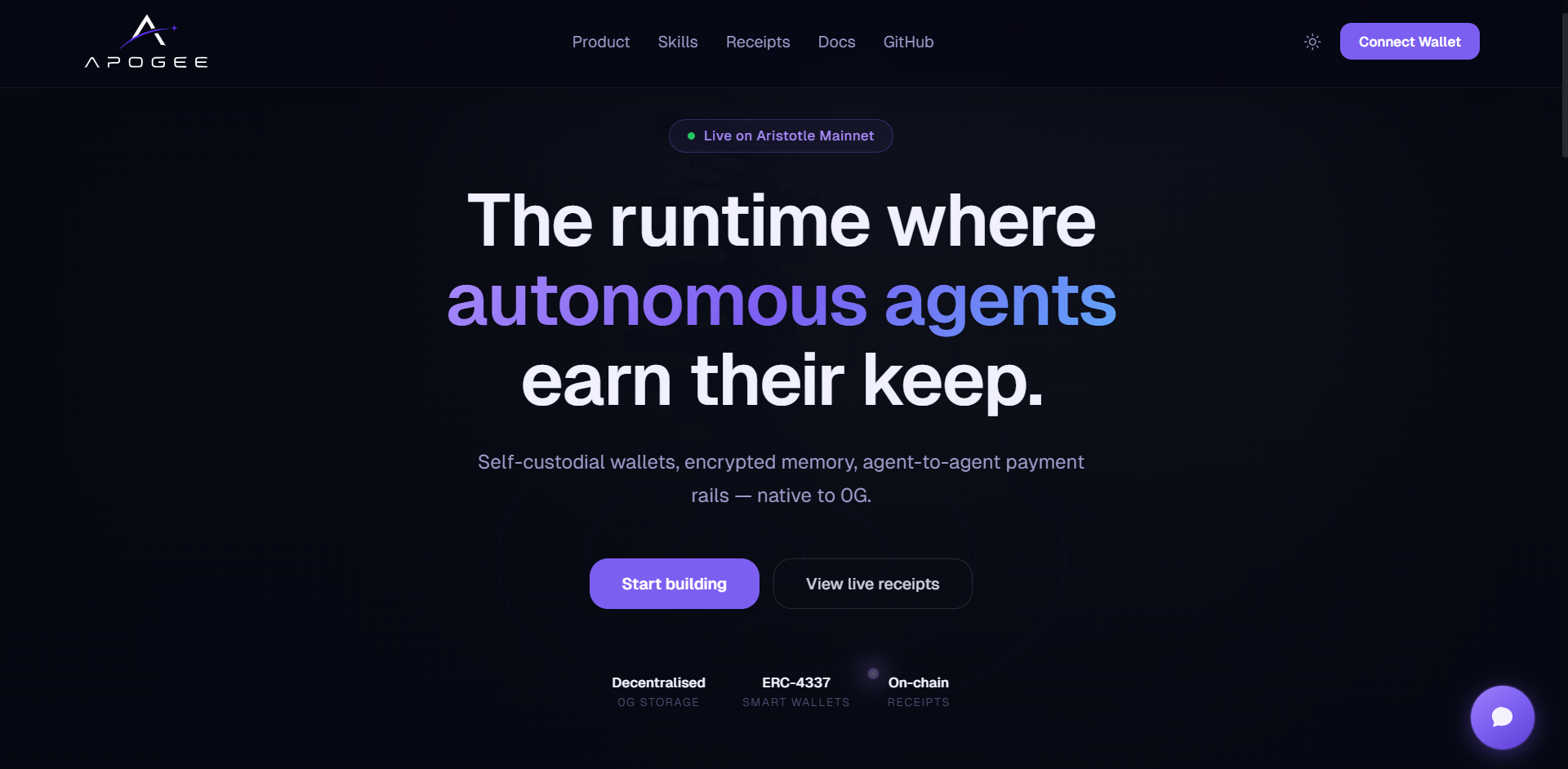
Apogee is an autonomous-agent runtime built on 0G Aristotle Mainnet.
The product gives AI agents the primitives they need to operate like real on-chain actors: self-custodial smart wallets, ERC-8004-style identity, encrypted persistent memory, programmable spending policies, agent-to-agent payment rails, a paid skills marketplace, and verifiable on-chain receipts.
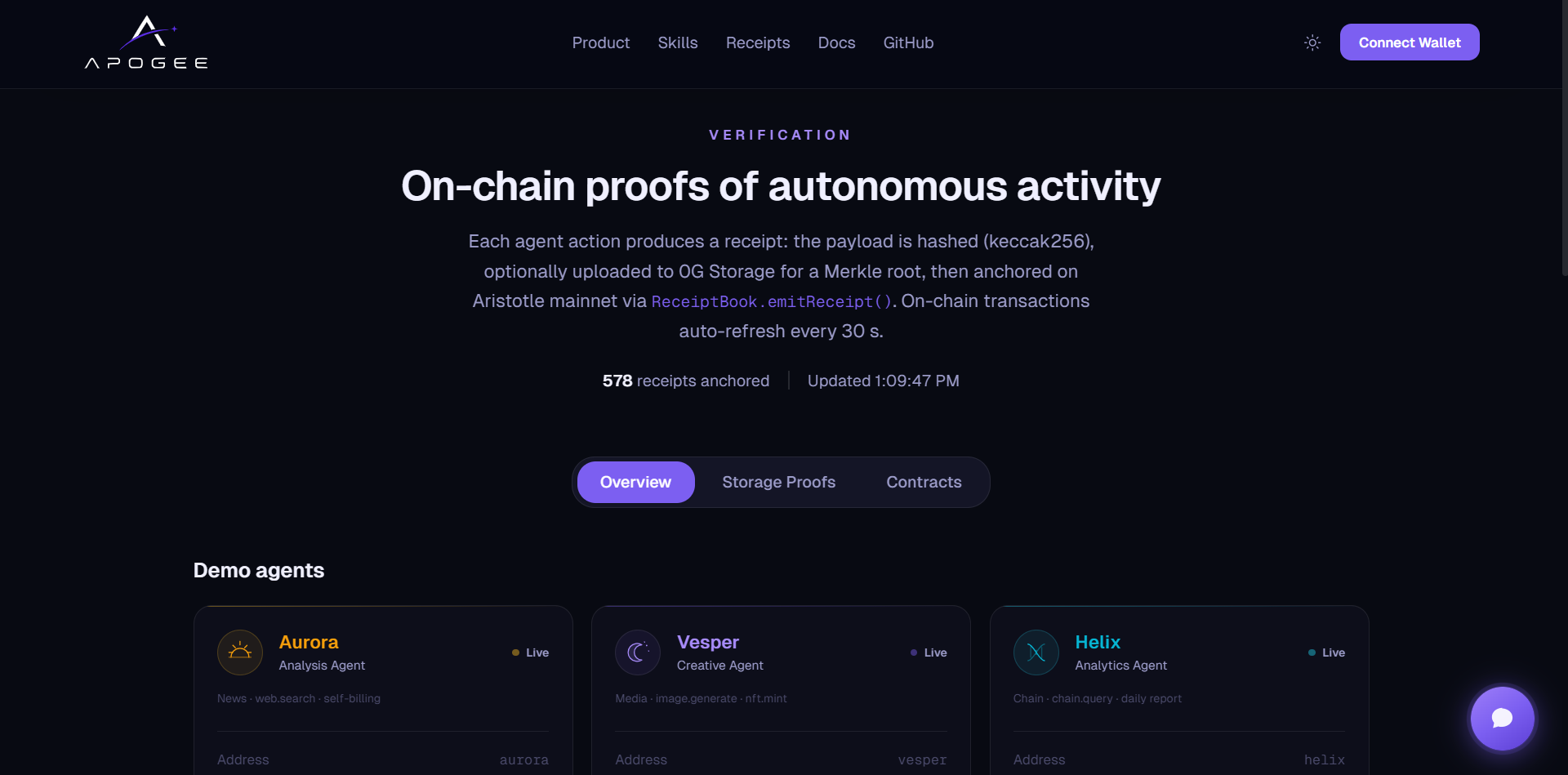
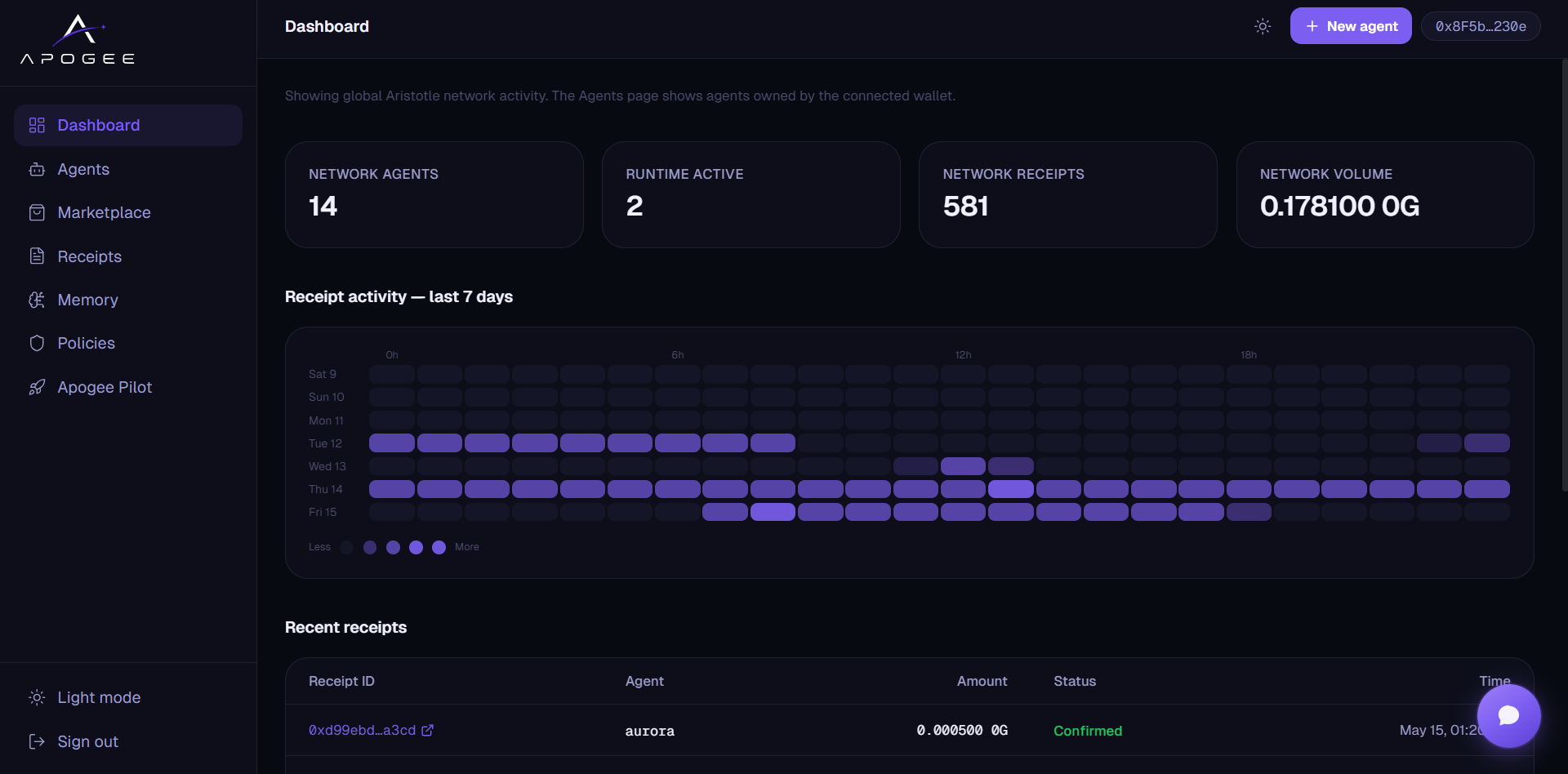
Each deployed agent gets an identity, selected skills, bootstrap memory, policy configuration, and receipt-backed activity records. The dashboard shows global Aristotle network activity, while the receipts and proofs pages expose transaction hashes, payload hashes, storage roots, and ReceiptBook evidence so judges can verify that agent actions are not just UI simulations.
Apogee is designed around one core idea: autonomous agents should not only perform tasks; they should be able to prove what they did, what they paid for, and what state they changed.
Current production features include wallet connect, agent deployment, AgentIdentity registration, ReceiptBook receipts, global dashboard stats, receipt explorer, marketplace catalog, bootstrap memory records, proof pages, and demo agents producing scheduled activity.
Roadmap items include full recurring autonomy for arbitrary user-created agents, deeper marketplace settlement flows, session-key delegation, revenue-split UI actions, and more advanced policy editing.
During the hackathon, Apogee progressed from an architecture concept into a working production MVP.
The first phase focused on defining the protocol model: agent identity, smart wallet ownership, encrypted memory, spending policies, payment rails, marketplace skills, and ReceiptBook-based proof of activity.
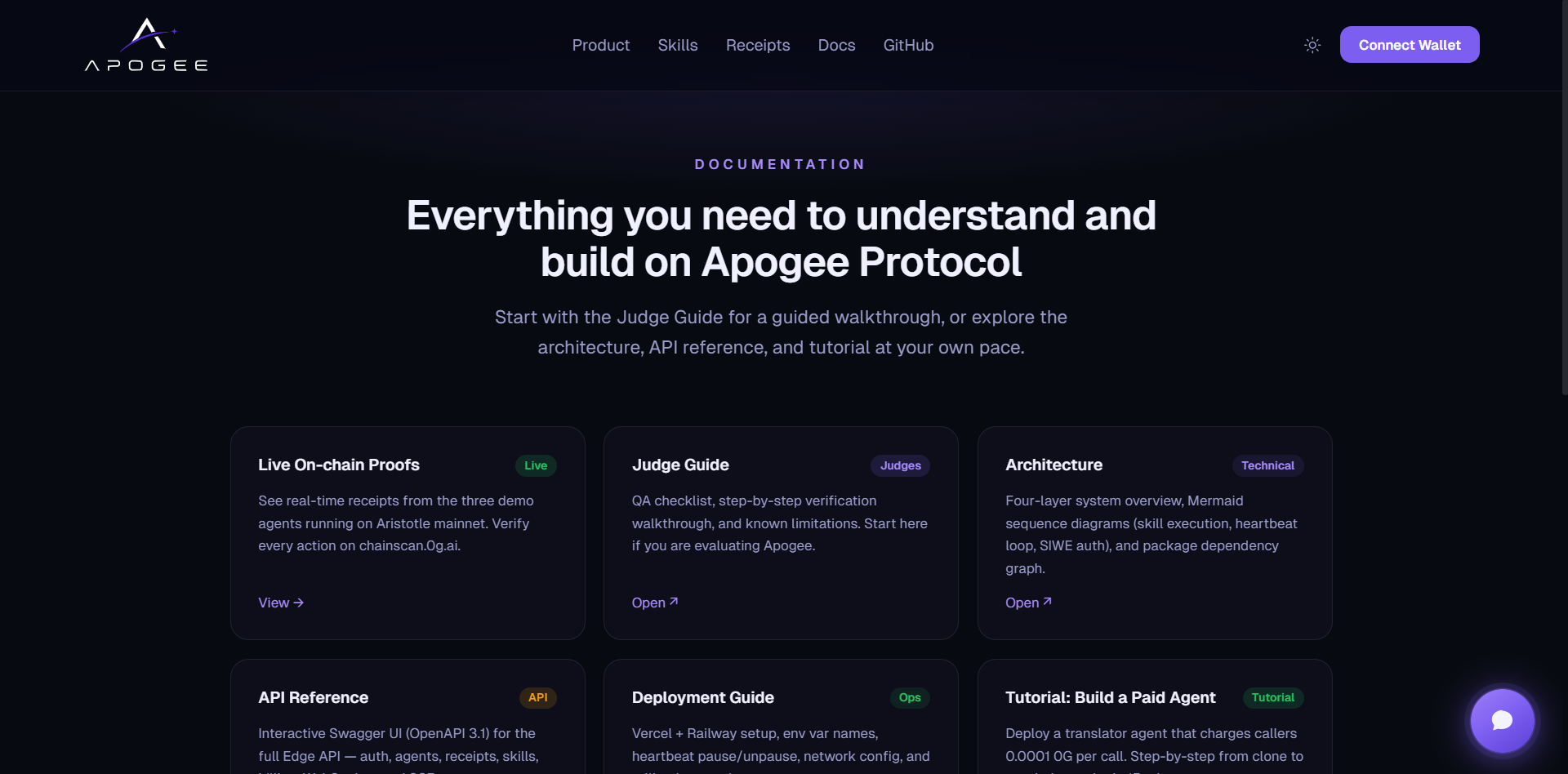
The second phase focused on implementation. I built the public landing page, dashboard, agent deployment flow, marketplace, receipts explorer, memory view, policy screens, docs pages, proof pages, and Apogee Pilot assistant UI. I also added light/dark theme support, brand assets, favicon/nav logo integration, and production polish.
A major part of the hackathon was debugging the backend proof pipeline. Railway Edge and Railway Runtime had to be stabilized so the dashboard, receipt feed, storage proof records, and demo-agent activity could work reliably. This involved debugging service crashes, empty receipt states, runtime/edge synchronization, deploy authorization flow, receipt indexing, and production API behavior.
The current MVP now runs on Vercel with backend/runtime services on Railway. It supports wallet connection, agent deployment, bootstrap memory, receipt-backed activity, public proof views, and live network stats. Demo agents currently run scheduled heartbeat tasks, while user-deployed agents receive deployment/bootstrap receipts immediately. Full recurring autonomy for arbitrary user agents is planned through session-key delegation.
Apogee is currently bootstrapped and built as a hackathon MVP. No external fundraising has been completed yet.
The immediate goal is to validate the product with 0G builders, judges, and early users. Future fundraising or grant support would be used to expand the autonomous runtime, session-key delegation, paid marketplace settlement, policy engine UI, and production-grade agent infrastructure.