
Aegis Vault
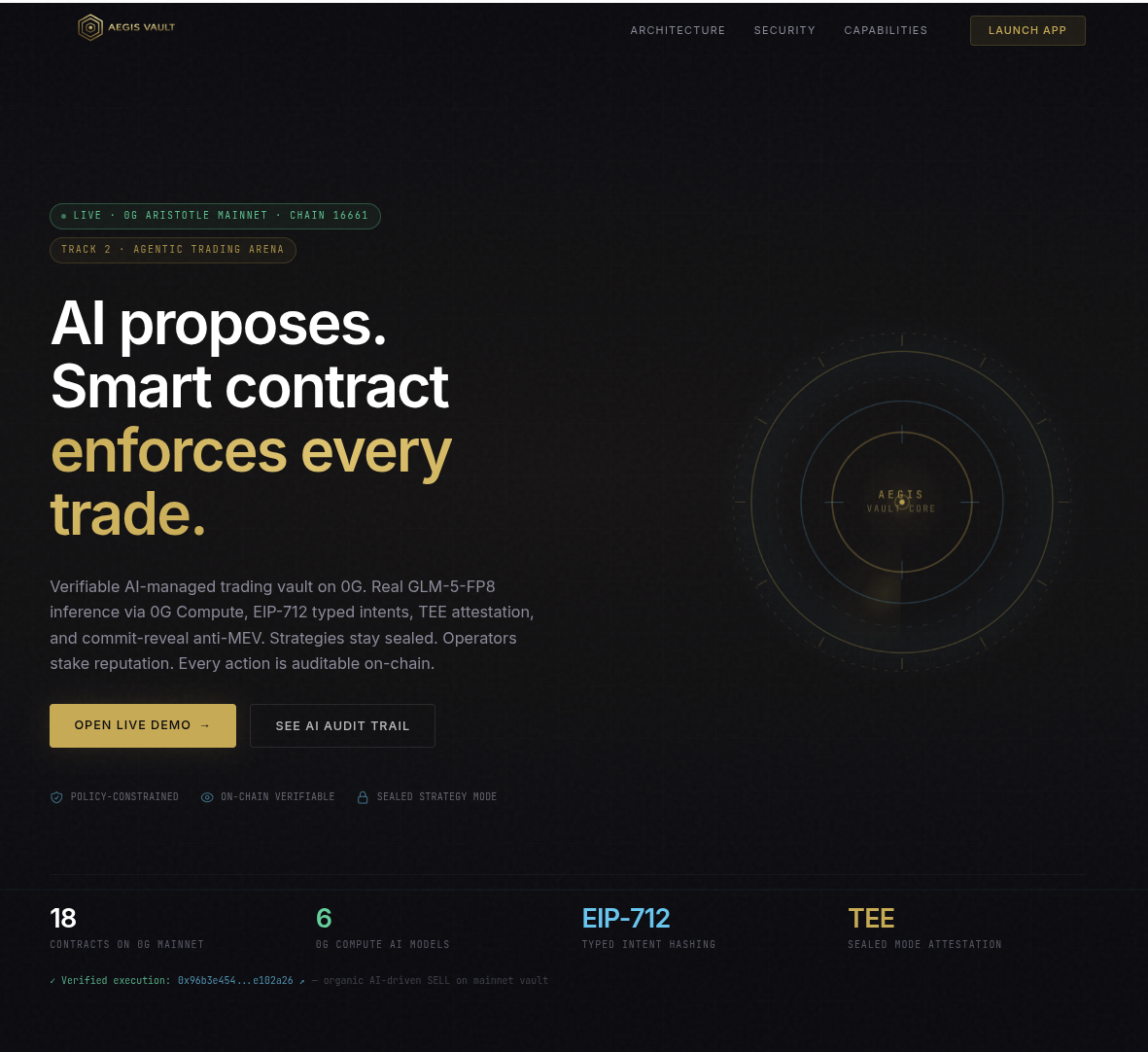
Aegis Vault is a verifiable AI-managed trading vault on 0G where users define strict on-chain risk mandates, operators compete by committing AI models + strategies on-chain
Videos
Tech Stack
Description
Aegis Vault is a non-custodial, AI-managed trading vault for crypto assets running on TWO chains: 0G Aristotle Mainnet (real Jaine V3 DEX) and Arbitrum One (real Uniswap V3). Users deposit capital, choose a risk profile, pick an operator from the marketplace, and let the smart contract enforce guardrails on every AI-proposed trade — without ever taking custody of the funds. Frontend live at https://aegisvaults.xyz.
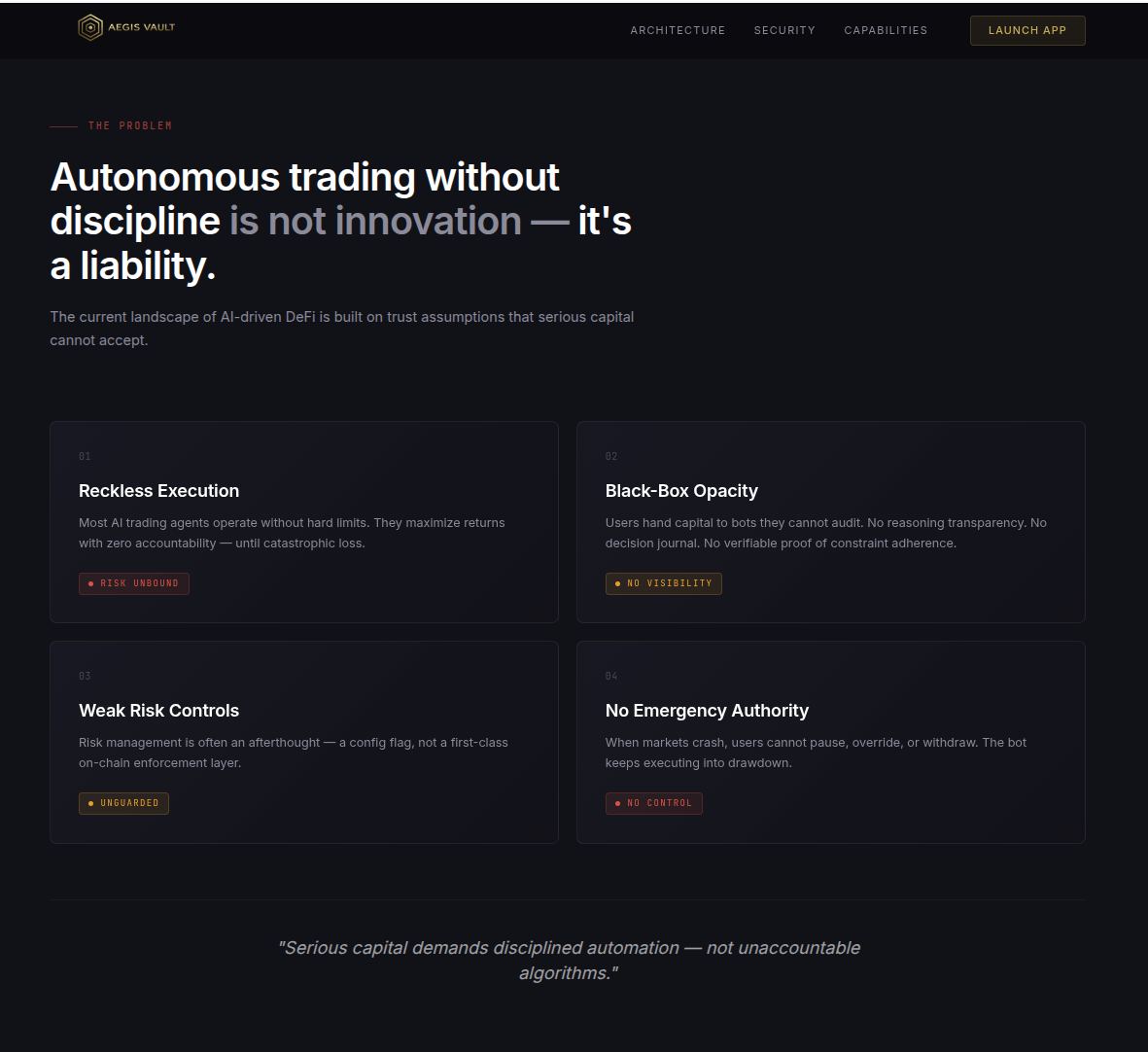
Today, anyone who wants AI-driven trading has two bad options. DeFi protocols are trust-minimized but offer no alpha. Centralized AI bots offer alpha but require giving up custody and trusting an off-chain operator. Aegis Vault is the third option: alpha-seeking strategies with the trust model of DeFi. The user's funds stay in a smart contract they control. Every AI output is cryptographically bound to its execution via EIP-712 — the vault rejects any trade whose attestation hash, strategy manifest, or signer doesn't match what the vault committed to at create time.
V4: Strategy-Manifest Binding (new this hackathon)
V4 makes the AI strategy itself a first-class on-chain commitment. At create time, every vault clone records acceptedManifestHash — the keccak256 of the operator's bonded strategy manifest. The V4 EIP-712 typehash binds strategyHash + strategySchemaVer into the digest itself, so executeIntent reverts the moment intent.strategyHash drifts from what the vault accepted. Manifest upgrades take 24 hours through governance. No other protocol binds AI strategy identity into the EIP-712 typehash this way — cross-version replay between V3 and V4 is impossible by construction.
What's contract-enforced
Eleven of fifteen policy fields are enforced directly by the vault: EIP-712 intent hash match (now strategy-bound in V4), intent expiry, cooldown between trades, AI confidence threshold, max actions per day, assetIn balance, asset whitelist on both sides of the swap (post-audit Finding 1 fix), sealed-mode ECDSA verify, commit-reveal anti-MEV, fee caps, and pause guard. Position size, daily loss cap, and stop-loss are enforced by the orchestrator as pre-submission validation, roadmapped for on-chain enforcement on Arbitrum first.
Two audiences (no governance token)
Vault owners pick an operator from the marketplace, set risk profile, deposit. They retain withdrawal rights permanently. The V4 implementation is init-locked — even the deployer cannot re-initialize a clone (audit H-1 closed). Pause / operator-swap / fee-accrual belong to the full fee-bearing vault variant (roadmapped for Arbitrum where gas is plentier).
Operators register on-chain, publish a bonded strategy manifest (keccak256 committed on-chain), declare an AI model, post stake in USDC.e. Their manifest, performance history, and slashing record are all on-chain and public. The marketplace was redeployed fully fresh at V4 cutover: 0 vaults, 0 operators, 0 claims at t=0, with every contract governance-bound to the AegisGovernor multisig from deploy. No governance token — protocol revenue flows to a ProtocolTreasury.
Differentiated features
Strategy-manifest binding (V4) — keccak256 of operator manifest committed at vault create, AI intent rejected unless
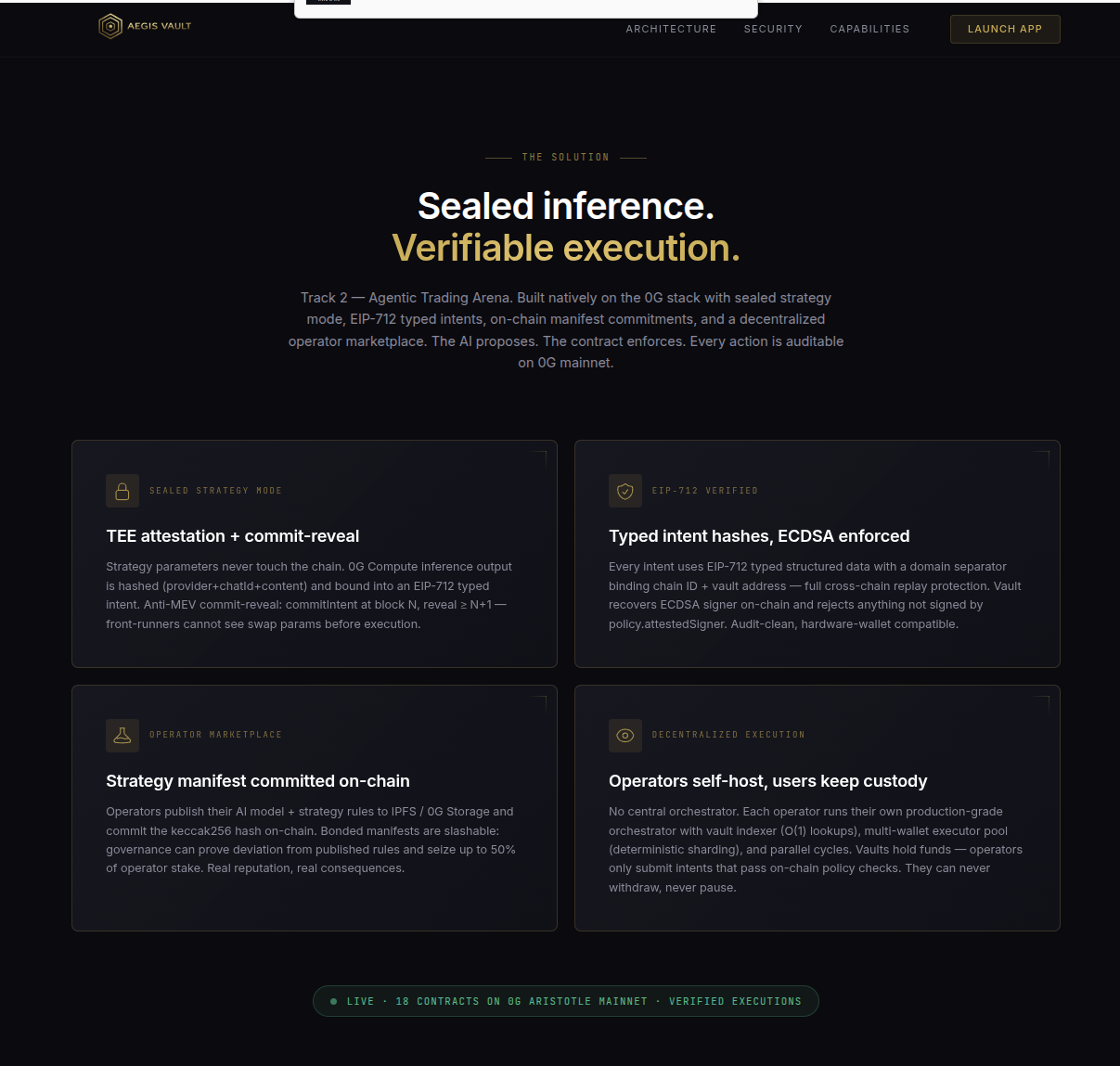
strategyHashmatches. 24-hour timelock on manifest changes. Makes "wrong AI model running your strategy" cryptographically impossible.Sealed strategy mode — AI response hash is a field in the EIP-712 ExecutionIntent struct. Vault runs ecrecover against
policy.attestedSigner; wrong AI → wrong hash → tx reverts. Commit-reveal anti-MEV is built INTO the vault contract (commit at block N, execute at ≥ N+1).TEE attestation surfaced end-to-end — the hash that 0G Compute returns is the same hash bound into the on-chain intent and the same hash
ecrecoverresolves. The frontend exposes all three side-by-side per execution, so users (and judges) can verify the binding visually, not just trust it.Dual-chain without a bridge — same V4 AegisVault bytecode on 0G and Arbitrum. EIP-712
block.chainiddomain separator is the only cross-chain safety mechanism needed; no bridge contract, no message relayer.Cross-chain strategy binding via Khalani adapter — V4 strategyHash commitment propagates through Khalani, so cross-chain intents inherit the same manifest-bound execution guarantees as same-chain ones.
Operator marketplace with bonded manifests, public fee schedules, on-chain reputation, 5 stake tiers (USDC.e-denominated), slashing caps (per-action AND per-rolling-window), 14-day slashable cooldown on unstake.
Insurance pool backstops operator misbehavior beyond individual stake.
Security posture
Pre-V4 line-by-line audit surfaced 127 findings; 11 Highs landed across V4 contracts, V3 stack, adapters, and shared libraries before mainnet cutover. Slither runs fail-on-high in CI on every push. Contract test suite passes 285/285. Full address book + verification path published at [github.com/mdlog/aegis-vault/blob/main/CONTRACTS.md](https://github.com/mdlog/aegis-vault/blob/main/CONTRACTS.md).
Progress During Hackathon
Shipped V4 to production on two mainnets, with a 127-finding pre-deploy audit (11 Highs landed) and a full technical whitepaper. Marketplace re-deployed fully fresh from t=0; every contract governance-bound at deploy time.
Smart contracts — Track 2 sealed mode + V4 strategy-manifest binding + dual-chain
Sealed strategy mode from scratch: VaultPolicy.sealedMode + attestedSigner, ExecutionIntent.attestationReportHash, commitIntent + executeIntent with commit-reveal + ECDSA verify against TEE-attested signer
V4 strategy-manifest binding (new this hackathon): every vault clone commits an
acceptedManifestHashat create time, andexecuteIntentreverts unlessintent.strategyHashmatches. Manifest upgrades go through a 24-hour timelock — fully on-chain governance over which AI strategy is allowedEIP-712 typehash hardened in V4: forks ExecLib → ExecLibV4 and CrossChainLib → CrossChainLibV4 to bind
strategyHash+strategySchemaVerinto the digest, making cross-version replay between V3 ↔ V4 impossible by construction (different typehash → different digest → ecrecover returns wrong signer)Init-locked V4 implementation: 1-of-1 logic clone (0x28F8E1a9…72Ed) reverts on re-init, closing audit H-1
Domain separator binds chainId + vault address for cross-chain replay protection
16 KB vault → 3.4 KB via 3 external DELEGATECALL libraries (SealedLib, ExecLibV4, IOLib) + EIP-1167 minimal-proxy factory (clone cost ~400K gas vs 2.7 MB fresh deploy)
Both-sides allowed-asset whitelist in ExecLib — assetIn AND assetOut must appear in vault's allowedAssets or tx reverts (audit Finding 1)
Khalani cross-chain V4 strategy-binding audit (PR #2) — V4 strategyHash commitment propagated through Khalani adapter so cross-chain intents inherit the same manifest-bound execution guarantees
0G Aristotle Mainnet: V4 stack live at fresh deploy, Jaine V3 real venue active (pools ~$1M TVL: USDC.e/W0G $360K, WETH/W0G $278K, WBTC/W0G $189K, USDC.e/cbBTC $92K). Factory
0x9e365206…2A5FArbitrum One: 8 contracts live (execution layer), Uniswap V3 canonical integration. Factory
0x49354460…3C45First on-chain AI→policy→DEX execution proved: tx 0x7efe51ac (2026-04-24)
First sealed-mode commit-reveal execution proved: tx 0x0d7334b8 (2026-04-27)
Pre-deploy audit + post-audit hardening
Pre-V4 line-by-line review surfaced 127 findings; 11 Highs landed across V4 contracts + V3 + adapters + libraries before mainnet cutover
Critical late-catch: CrossChainLibV4 link fix in
deploy-v4.js(V3 lib has wrong typehash — would have silently broken cross-chain replay protection)7 verified production-audit findings fixed across SDK, orchestrator, frontend
Each audit batch shipped as its own PR (PR #1 pre-V4 security fixes, PR #2 Khalani V4 strategy binding)
Operator marketplace — fully fresh cutover
All 4 marketplace contracts (OperatorRegistry, OperatorStaking_v2, InsurancePool_v2, OperatorReputation) redeployed from zero on 2026-05-14: 0 vaults, 0 operators, 0 stakers, 0 claims at t=0
Every marketplace contract is governance-bound (arbitrator/admin = AegisGovernor multisig) from t=0 — closes audit H-6 / H-7 / H-9
Extended OperatorRegistry with
publishManifest(uri, hash, bonded)+declareAIModel(model, provider, endpoint)Frontend: AI model input with live-dropdown suggestions + manual entry fallback + manifest JSON upload with auto-keccak256
Aegis Alpha operator bot live with bonded manifest (slashable on misbehavior)
Production-grade orchestrator
Vault indexer (O(1) lookups, event-driven, persists across restarts)
Multi-wallet executor pool with NonceManager + deterministic sharding — no nonce collisions across parallel cycles
Parallel vault processing via p-limit; exponential backoff retry (3× tx, 2× compute); session idempotency
STRICT_MODE refuses zero-stake operators regardless of contract tier; 0G Storage opt-out gracefully handled
TEE attestation surfaced end-to-end: orchestrator → journal → frontend badges, with response-hash verification visible at every hop
Operator orchestrator runbook (docs/RUN_OPERATOR_ORCHESTRATOR.md) — zero-to-first-cycle in <10 min
2-step executor rotate + clean-vault flag + governance simulation utility
Rate-limit + journal sanitize on the public-facing endpoints
Per-chain registry scaffold (orchestrator/src/config/chains.js) for future multichain fan-out
6 live 0G Compute chatbot services detected, GLM-5-FP8 selected automatically
Frontend (React 19 + wagmi + viem) — aegisvaults.xyz
Live at https://aegisvaults.xyz
6-step Create Vault wizard, chain-aware venue resolver (Jaine V3 on 0G, Uniswap V3 on Arbitrum)
V4 manifest-bound operator register flow (AI model + bonded manifest + acceptedManifestHash auto-derived)
Marketplace, Governance M-of-N UI, AI Actions journal with sealed-mode badges
TEE attestation badges at every execution row (orchestrator hash ↔ on-chain intent hash match)
In-app whitepaper page at /whitepaper — editorial markdown rendering, lazy-loaded (zero main-bundle cost)
Chain-aware faucet: mainnet shows info panel with Jaine/Uniswap swap links + canonical token addresses
BigInt bounds + demo banner + chain switcher hardened against mid-session hook crash (wagmi/viem/rainbowkit pre-bundled via Vite optimizeDeps)
Frontend UX hardening
Toast system (sonner), blockchain error parser (lib/txErrors.js), TX phase tracker (lib/txPhase.js), ConfirmModal, NetworkWarning auto-switch
Per-wallet draft persistence, real-time manifest JSON validation
Multi-phase deploy progress with retry, mobile sticky bar, ARIA across wizard
CI/CD + Testing + Docs
Slither static analysis fail-on-high on every push (.github/workflows/security.yml)
*
npm run test:allpassing 285/285** on V4 contractsComplete docs shipped:
README, ARCHITECTURE, DEMO, WHITEPAPER (full technical, 11 sections)
HACKATHON_SUBMISSION, PRE_DEPLOY_CHECKLIST, PITCH_SCRIPT
CONTRACTS (full V4 address book + V3 superseded section)
OPERATOR_GUIDE, STRATEGY_MANIFEST, AI_AGENT_DECISION_FLOW
V4_DEPLOY_AUDIT_RUNBOOK, V4_DEPLOYMENT_PLAN, V4_MIGRATION_GUIDE
TEE_ATTESTATION_VERIFICATION, RUN_OPERATOR_ORCHESTRATOR
Architecture diagram: docs/diagrams/architecture-multichain.svg + 1920×1080 PNG
Metrics (V4 cutover state)
15+ smart contracts live across two mainnets (V4 stack on 0G + Arbitrum execution layer)
Marketplace at t=0: fresh OperatorRegistry / Staking / InsurancePool / Reputation, all governance-bound at deploy
operator registered with bonded slashable manifest hash on 0G (Aegis Alpha)
2 historic proof-of-execution txs on 0G: first AI→DEX exec (0x7efe51ac), first sealed-mode reveal (0x0d7334b8)
285 contract tests passing
127 audit findings surfaced pre-deploy, 11 Highs landed
Full technical whitepaper shipped + in-app /whitepaper page
Frontend live at aegisvaults.xyz with TEE attestation surfaced end-to-end
Fundraising Status
Current status: 🟡 Not actively fundraising. Bootstrapped through hackathon.
Team & funding context:
MDLOG Labs — independent research lab building on 0G, self-funded and hackathon-bootstrapped
Built from zero to V4 live on mainnet during the hackathon window — four contract rollouts (V1 → V2 → V3 → V4) + fresh marketplace cutover, no prior codebase, no grants, no pre-committed capital
Pre-V4 internal security review completed self-funded — 127 findings surfaced, 11 Highs landed. Slither fail-on-high in CI. 285 contract + 187 orchestrator + 100 SDK tests passing
Gas costs self-covered across all four mainnet rollouts + fresh marketplace cutover + testing
No token planned — protocol revenue flows to
ProtocolTreasury0xCDc5D994…0dF4), governed by AegisGovernor M-of-N multi-sig
Where future funding (if raised) would go:
External audit · insurance underwriting · production orchestrator infrastructure · operator bootstrap grants · founder runway. Target seed range: $500k–$1M, conditional on traction.
Asks from 0G Foundation / hackathon organizers:
Dedicated 0G RPC endpoint for orchestrator (public RPC reliability has been the ops bottleneck at scale)
Access to TEE-attested 0G Compute providers — V4 sealed mode already binds the AI response hash into the EIP-712 typehash; pairing with hardware attestation closes the AI-integrity loop end-to-end
Technical review or co-authoring of the V4 strategy-manifest-binding pattern
Connection to ecosystem insurance partners if/when InsurancePool capitalization comes into scope
Open to:
Ecosystem grants (builds-on-0G grants, Track 2 prize, Grand Prizes)
Strategic angel investors (DeFi operators, TradFi quants exploring AI-driven vaults, TEE / confidential-compute investors)
Technical partnerships (Khalani for cross-chain solver lanes, Gelato, The Graph, Pyth, TEE attestation services)
Not open to:
Extractive token launches — protocol revenue is contractually routed to ProtocolTreasury, not a token, by design
Retail-only accelerators without regulatory support
Anything that would compromise the "contract enforces" trust model
Timeline:
Short-term (4 weeks): first V4 execution on the fresh marketplace; closed beta with 2–3 whitelisted operators on aegisvaults.xyz
Medium-term (3 months): external smart contract audit kicked off; public bug bounty; ERC-4626 vault shares on the fee-bearing variant (Arbitrum first)
Long-term (6–12 months): seed fundraise conditional on traction; InsurancePool first real capitalization; additional venue adapters on Arbitrum