
Trustless corporate expense cards built on MetaMask Smart Accounts. Companies delegate funds via ERC-7710; AI agents (Venice) book travel, procure tools, and handle reimbursements on-chain.

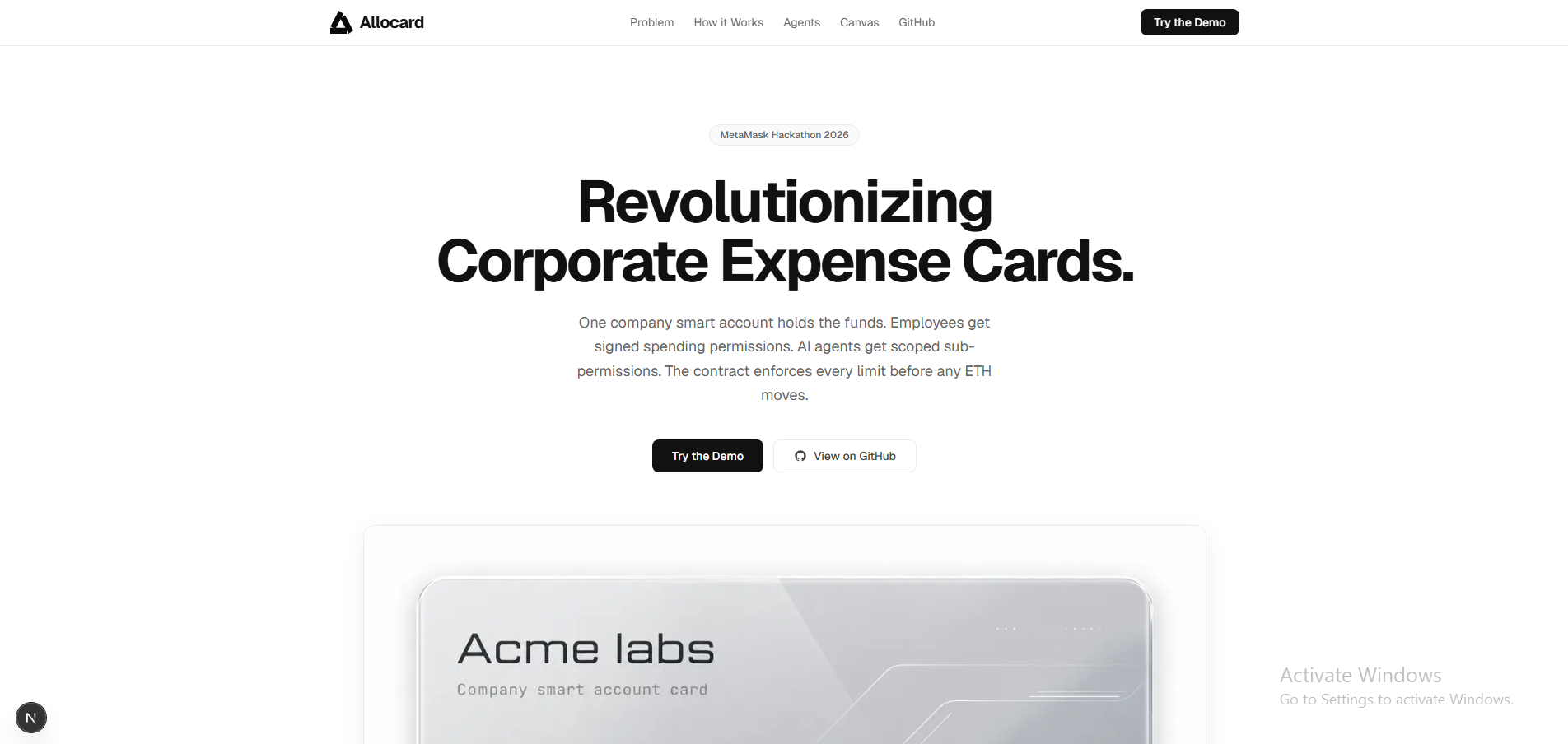
Corporate expense card providers like Brex and Ramp allow companies to issue their employees credit cards for business expenses with predefined rules and spending controls.
Allocard replicates this system with improvements. Using MetaMask's delegation features, we do not need to give employees direct access to funds. Instead, the company has a master smart account that holds all the expense funds. We then delegate funds to employees, who can only spend under certain rules (caveats).
Allocard takes it a step further with MetaMask's redelegation. We empower employees with AI agents, powered by Venice AI and smart accounts, built for specific expenses like travel and procurement. Employees can choose an agent that fits their expense need and redelegate the funds they received from the company to that agent to sort out the expense, for example the agent automatically books a flight.
Finally, Allocard has a fallback reimbursement agent that allows employees to get refunded if they paid for an expense out of their own pocket. The company delegates funds to the agent's smart account, and the employee uploads their receipt. Venice AI uses its image-capable models to extract information from the receipt, and if it matches the company's policy, the employee gets refunded.
Using MetaMask Smart Account ERC-7710 delegation, redelegation features, and Venice AI, Allocard replicates and improves on the current state of corporate expense card systems.
Corporate expense cards rely on preloaded funds or credit lines. Employees get access to more money than any single transaction needs. If an employee violates the company's spending policy, the money moves first, and audits find the violation after the transaction has occurred.
Centralized expense card providers enforce the spending rules. The provider controls the database. A company has no cryptographic proof that its spending policies were followed.
Allocard eliminates preloaded cards. The company keeps all funds in a master expense card smart account. The company signs cryptographic delegations that grant employees permission to spend. Every delegation contains specific caveats, like lifetime caps or merchant whitelists.
The smart contract checks every caveat before a transaction executes. A transaction that exceeds a limit reverts. No money moves until the contract verifies the math.
Allocard's corporate expense card system covers three fundamental spending modes: employees spending directly on business needs, agents spending on an employee's behalf, and employees getting reimbursed for out-of-pocket purchases. Allocard handles all three using ERC-7710 delegation and redelegation. Each mode maps to a distinct delegation pattern.
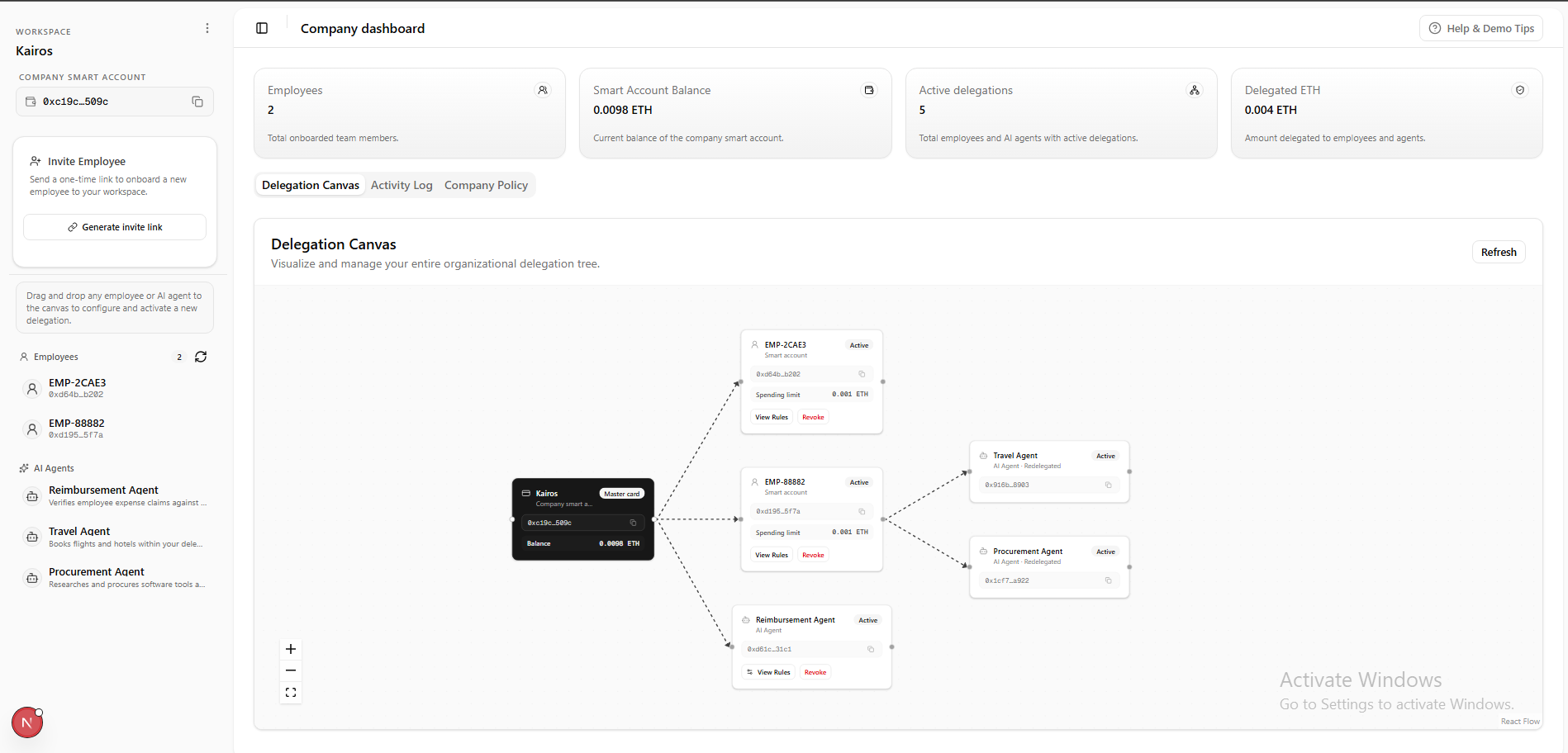
The employer creates a delegation from the company smart account to an employee's smart account. The employee then redelegates a subset of that authority to an AI agent's smart account. The agent receives an independent, scoped delegation and executes transactions on its own. The employee never needs to approve each individual spend. The agent only has access to what the employee chose to redelegate. The company's full budget is never exposed.
This covers planned business spending such as travel bookings and software procurement.
The employer creates a delegation directly from the company smart account to the reimbursement agent's smart account. The employee does not hold a delegation in this pattern. Instead, they submit a claim to the agent. The agent evaluates the claim, and if it passes, the agent redeems the company delegation and transfers ETH to the employee's wallet.
This covers reimbursements where employees paid out of pocket and need to be paid back.
The employer creates a delegation from the company smart account to the employee's smart account. The employee redeems that delegation themselves, specifying a merchant address as the recipient. No new delegation is created, and no agent holds the authority. The employee is the delegatee and the one executing the transaction.
This covers ad hoc business purchases such as a one-off software license, a business lunch, or a conference ticket. Before the transaction executes, Venice AI checks the stated purpose against the company's expense policy. If Venice flags a violation, the employee sees the reason and decides whether to proceed.
Revoking a parent delegation revokes every delegation in its subtree. An employer can revoke an employee's delegation in one action, and every agent that employee delegated to loses access simultaneously.
Allocard's agents are not chat assistants. Each agent holds a smart account, receives a scoped delegation, and executes on-chain transactions. Together they cover the core workflows of a corporate expense card.
Every transaction in Allocard is evaluated by Venice AI before it executes, though for direct spends the check is advisory rather than blocking. Venice is privacy-first: it does not retain data between requests, and no expense decisions or receipt images are stored or used for model training.
Before Venice evaluates any request, the app assembles three layers of context:
Layer 1, on-chain caveats, which are hard numeric limits from the delegation.
Layer 2, company expense policy, which are natural language rules the employer sets.
Layer 3, per-delegation rules, which are agent-specific additions.
Venice reads all three together and returns a pass or reject decision with written reasoning. If Venice approves a request but the amount exceeds an on-chain caveat, the contract reverts the transaction. Venice enforces policy while the contract enforces math.
Not every business expense can be paid in advance. Sometimes an employee pays out of pocket first and claims it back later. Traditional systems handle this manually.
Allocard automates this. The company creates a delegation to the reimbursement agent. When an employee submits a claim, the agent evaluates it.
The employee submits a claim with a description, amount, and optional receipt. If a receipt is uploaded, it is scanned and the data is extracted. The claim is evaluated against policy and caveats. If approved, the agent executes payment to the employee, and the full audit record is stored.
The company sets the budget ceiling. Venice decides policy compliance. The contract ensures correct value transfer.
Employees can transfer ETH directly for uncategorized expenses. Before execution, a policy check runs. The employee provides the recipient, amount, and purpose, and Venice evaluates and returns a verdict.
The check is advisory. The employee can still proceed, and if they do, the transaction is flagged for review.
Employees redelegate part of their budget to the travel agent and submit travel details. The agent evaluates options within policy and budget and proposes an itinerary. On approval, the agent executes the transaction. In production this would pay vendors directly; in the demo, funds go to the employee's account.
Employees redelegate a procurement budget and request tools. The agent checks for duplicates, then suggests vendors within budget. On approval, the agent executes the transaction. In production, funds go to vendors; in the demo, they go to the employee's account.
AGENT CONTRACT ADDRESSES
AGENT_REIMBURSEMENT_SMART_ACCOUNT=0xD61C510c51a1DD4a73C4Dfeca6893aeEE6A731c1
AGENT_TRAVEL_SMART_ACCOUNT=0x916BE00E5cCd1A3a7930f20dFDC55D21947B8903
AGENT_PROCUREMENT_SMART_ACCOUNT=0x1Cf7F91e72727AEfFb31603CBD3a7d5Ae03aa922
During the hackathon, we built the entire Allocard platform. Our technical accomplishments include:
Integrated the MetaMask Smart Accounts Kit to deploy ERC-4337 accounts for companies, employees, and AI agents on ETH Sepolia.
Built an ERC-7710 delegation engine that executes three specific spending patterns: direct employee spending, agent redelegation, and autonomous agent reimbursement.
Integrated Venice AI to enforce natural language expense policies and perform receipt OCR before execution.
Built a React Flow delegation canvas that maps the entire corporate spending tree and executes cascading revocations.
Developed a Next.js 15 frontend with a Neon Postgres database and Drizzle ORM to manage off-chain UI state.