
Keep your Treasury yield. Put borrowed USDC to work.

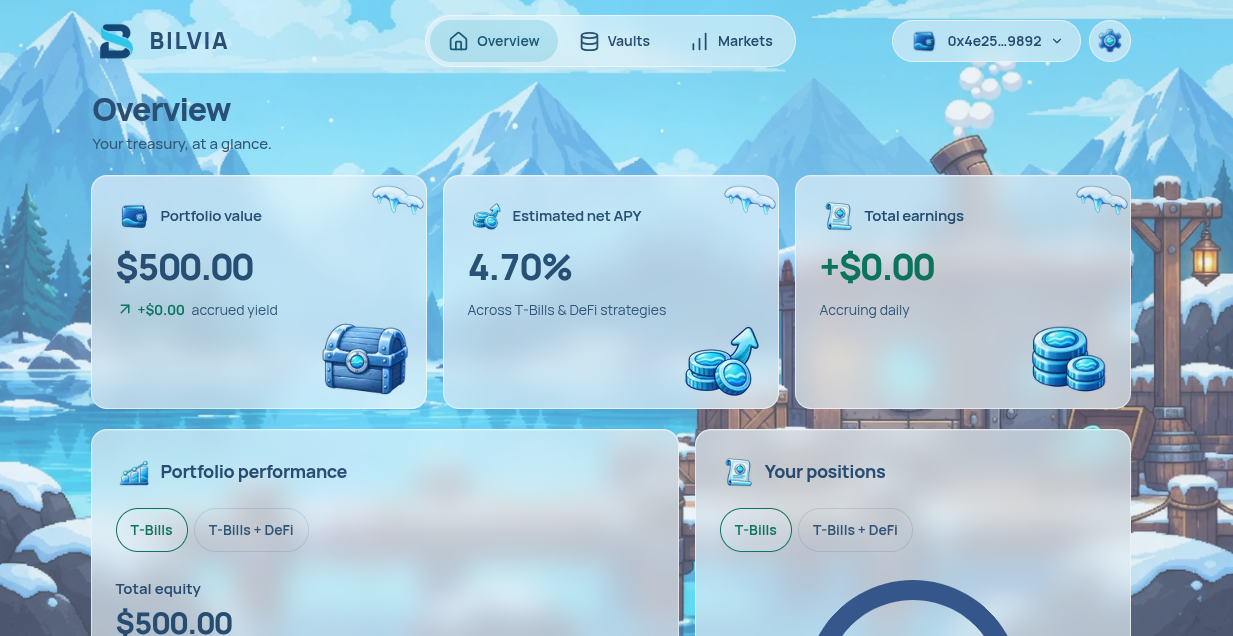
BILVIA connects Treasury holdings with a configurable USDC yield strategy. Users select Treasury collateral, choose a borrowing ratio, and distribute borrowed USDC across their own selection of yield pools. The collateral continues accruing its underlying yield while the allocated USDC earns a separate return, offset by borrowing costs and fees.
The core action is Deploy Strategy: collateral locking, borrowing, and allocation execute atomically through one router transaction. Positions are perpetual, with no fixed borrowing term. Users monitor their debt and Health Factor, then unwind when they choose, subject to available liquidity and repayment requirements.
The current application runs on Ethereum Sepolia (11155111). It uses BILVIA-issued test USDC, three Treasury-style ERC-4626 vaults, and ten funded USDC yield pools. These instruments demonstrate the complete transaction lifecycle; they do not represent real Treasury securities or deposits into external DeFi protocols.
Choose collateral, target LTV, and allocation weights in one workspace. Review the estimated yield and position health before execution. The router transfers collateral, borrows USDC, deposits it into the selected pools, and records a wallet-owned position in a single atomic operation.
One-click describes the combined strategy action. ERC-20 approvals may require separate transactions when allowances are insufficient. External wallets retain their own signing prompts.
Select one to four opportunities from up to ten live USDC protocol references, then assign percentages totaling 100%. The workspace shows original protocol logos, reported APY and TVL, composition, borrowing APR, estimated net APY, and opening Health Factor. Users choose the destinations themselves rather than selecting a predefined risk-tier package. Unavailable feed entries are never replaced with invented opportunities.
The activated V3 router (0xb9e0afffce288431b533e06cf2eefcb20c8ab382) supports 1–4 allocations. Existing positions on the immutable legacy V2 router (0x843c1f9c8d71ca96aacb1298376d48f94ed8bc20) remain fully readable, manageable, and exit-able through V2. See the router update plan.
Market weighted/net APY uses the live opportunity feed. Execution weighted/net APY uses deployed contract rates and appears separately in the rates panel and transaction review. A fixed protocol-reference mapping routes selections to ten BILVIA Sepolia pools; it does not deploy into external protocols. Overview retains the same reference logos while deriving balances, returns, and debt from actual contracts.
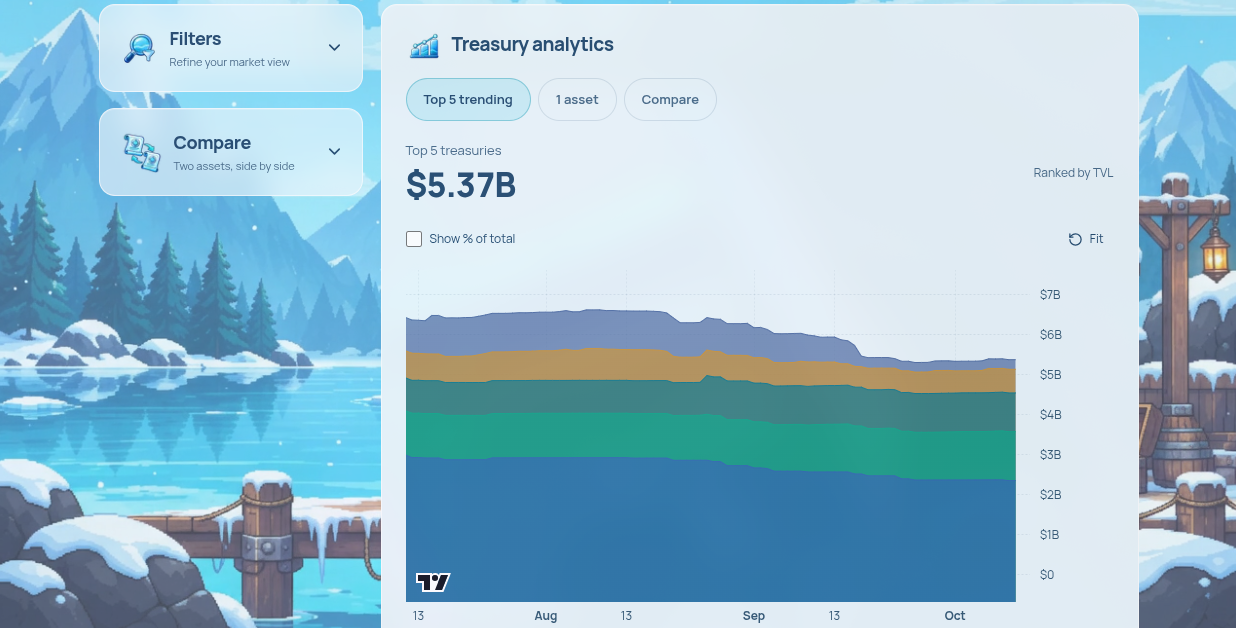
Research Treasury exposures using reported token prices, APY, TVL, comparison tools, and historical charts. Buy opens a review that explicitly identifies the supported BILVIA execution instrument and quotes its shares using the contract NAV. Public issuer research never silently changes into ownership of an external issuer's token. Purchased BILVIA shares can later be used as strategy collateral.
Overview brings together wallet holdings, portfolio value, earnings, position allocations, and Health Factor. Balances and active positions are read from contracts; the dashboard refreshes chain data every 20 seconds. Confirmed transaction history and sampled portfolio values are scoped to the wallet, chain, and deployment.
Close a strategy by redeeming its pool allocations, repaying accrued debt, and returning Treasury collateral plus any net USDC proceeds. A combined sell operation can also redeem the released collateral into USDC. Exit reviews account for a bounded USDC top-up when interest or rounding produces a repayment shortfall.
Sign in with Google through a Privy embedded wallet or connect an external Ethereum wallet. New wallets begin with zero balances. The testnet faucet provides 10,000 BILVIA USDC once per day. Eligible embedded wallets can receive limited Sepolia ETH funding for transaction fees.
Connect and fund. Sign in or connect a wallet, then claim test USDC.
Acquire collateral. Buy a supported BILVIA Treasury share in Markets.
Configure your strategy. Choose collateral shares, target LTV, one to four USDC pools, and allocation weights.
Review and deploy. Check the fresh preflight, grant any required allowance, and submit the atomic strategy transaction.
Monitor the position. Track collateral value, accrued debt, pool allocations, and Health Factor without a calendar expiry.
Unwind or sell. Redeem allocations, settle debt, and recover collateral and net proceeds, or redeem the collateral into USDC as part of the exit.
Progress During Hackathon
Architecture & Financial Modeling: Designed a capital efficiency model for tokenized T-Bills, transitioning from fixed tenors to a perpetual debt structure governed by real-time Health Factor monitoring.
Smart Contract & Execution Engine: Developed the 1-Click "Borrow & Deploy" multicall engine to lock T-Bill collateral, mint/borrow USDC, and auto-route funds directly into DeFi yield pools in a single transaction.
Data & Yield Pipeline: Integrated real-time yield indexing (via public DeFiLlama/protocol APIs) to dynamically track and sort floating lending rates across blue-chip protocols (Aave, Morpho, Fluid).
Frontend & UX Delivery: Implemented the "cozy winter harbor" UI, featuring collateral allocation breakdowns, live risk metrics, and a seamless 1-click unwind and exit flow.