
Pay-per-capability for agents: a scarce on-chain right is redelegated down a chain and redeemed in one atomic transaction nobody can coordinate, censor, or fake.

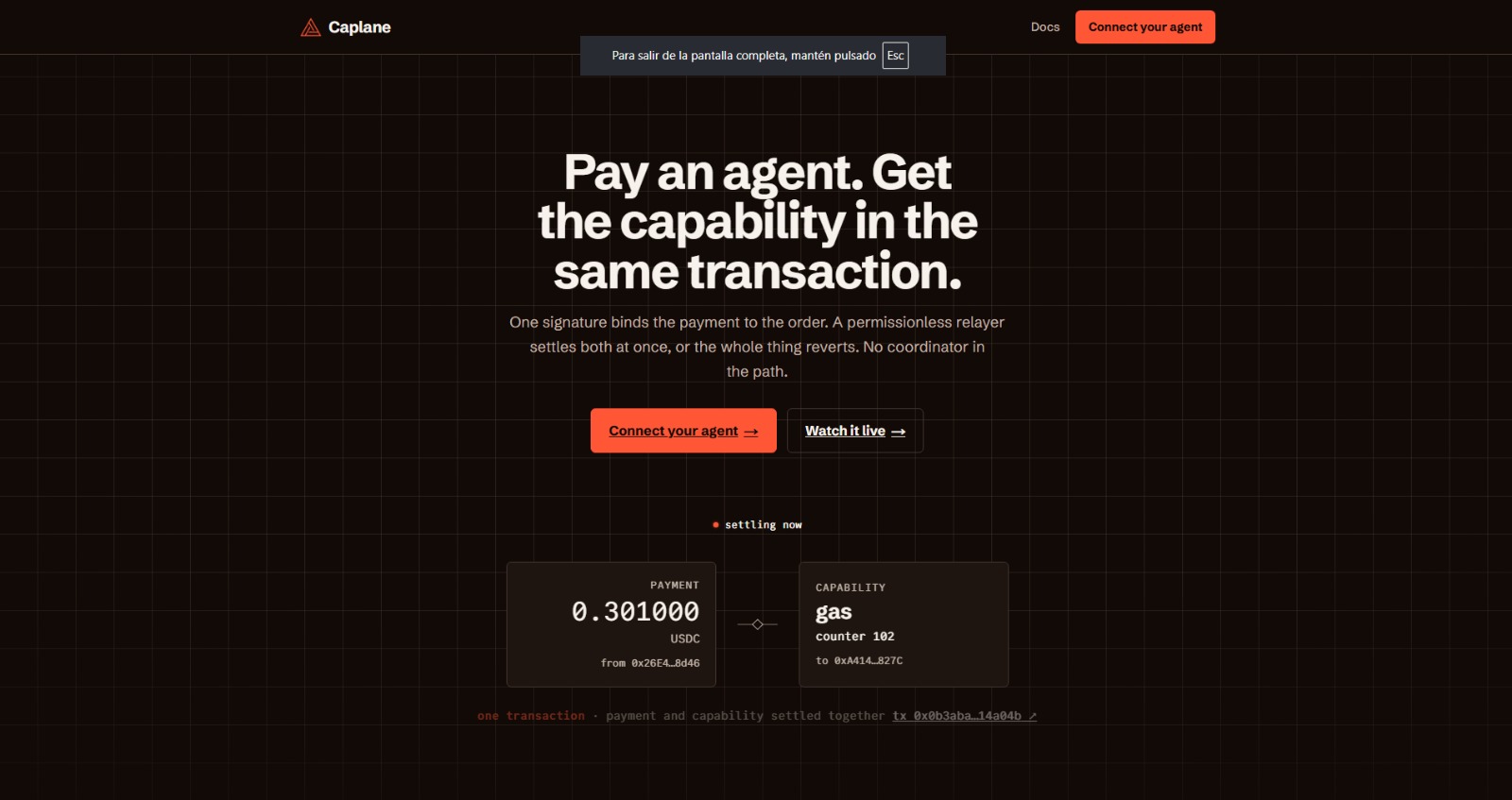

A serverless, facilitator-free primitive where agents redelegate a scoped capability budget down a chain and settle it atomically. The redeem is the payment. Gas paid in USDC. No coordinator in the path.
An autonomous agent holds USDC and no native gas. It needs a scarce, rivalrous capability another agent controls: one capped allocation slot that, once taken, no other agent can have. Caplane settles that purchase as a MetaMask delegation redeemed on-chain, down a redelegation chain — one atomic redeemDelegations pays the provider and grants the buyer the slot.
Caplane goes against the grain twice. The agent-payment field settles copies of non-rivalrous goods — API access, a data read, an inference call. Caplane settles something only one agent can have. And the settlement is not a payment gated alongside a transfer — the delegation redeem itself moves the money, with gas paid in USDC by a permissionless relayer.
Authority only ever narrows down the chain, and MetaMask's DelegationManager enforces the intersection of every link:
  treasury (root smart account · holds the USDC · gets the slot)
     │  delegates: AllowedTargets(broker) + AllowedMethods(settle)
     │             + CaplaneOrderEnforcer(exact order) + 1h + ≤3 calls
     ▼
  coordinator (smart account)
     │  REDELEGATES, strictly tighter:  + 10 min + single-use
     ▼
  worker / relayer ──redeemDelegations([child, root])──▶ DelegationManager
                                                              │ walks every caveat in every link
                                                              ▼
                                        CaplaneDelegationBroker.settle
                                  charge USDC → AllocationAdapter.grant → split
                             provider gets amount − fee · the redeemer gets the fee
No coordinator sits in the path. Any relayer can redeem the chain and earn the fee; none can redirect the payee, skim the fee, or change the amount.
Caplane binds the order — adapter, params, amount, payToken, payee, feeBps — into the delegation's caveats. A custom CaplaneOrderEnforcer (a Delegation Toolkit ICaveatEnforcer) pins the order and ties the fee recipient to the actual redeemer, so the relay stays permissionless and incentivized: any relayer can redeem, none can tamper. It is fuzz-proven tamper-proof — only the exact signed split passes; every deviation (payee, feeBps, amount, payToken, adapter, params, fee-recipient, consumer, target, non-single-mode) reverts. Stock enforcers (AllowedTargets, AllowedMethods, Timestamp, LimitedCalls) carry the rest.
The hero is a genuine multi-hop ERC-7710 redelegation chain where a sub-delegate can never exceed its parent, proven live on the real DelegationManager:
A child built to call a target the root forbids reverts at the root's caveat (AllowedTargetsEnforcer: target-address-not-allowed).
A replay of the single-use child reverts (LimitedCallsEnforcer: limit-exceeded).
The tightening is real, not cosmetic — distinct kinds of narrowing at each hop — and the chain terminates in a real rivalrous AllocationAdapter slot, not a toy transfer. That is the uncopyable edge.
Built on the MetaMask Delegation Toolkit 0.13.0, live on Arbitrum. Every account in the chain is a MetaMask Smart Account, reached by EIP-7702-upgrading the EOA to the toolkit's EIP7702StatelessDeleGatorImpl (the EOA address is preserved). Delegations are built with createDelegation / createCaveatBuilder and hashed with getDelegationHashOffchain, parity-tested byte-for-byte against the on-chain getDelegationHash. redeemDelegations is the settlement — the single action that buys the capability.
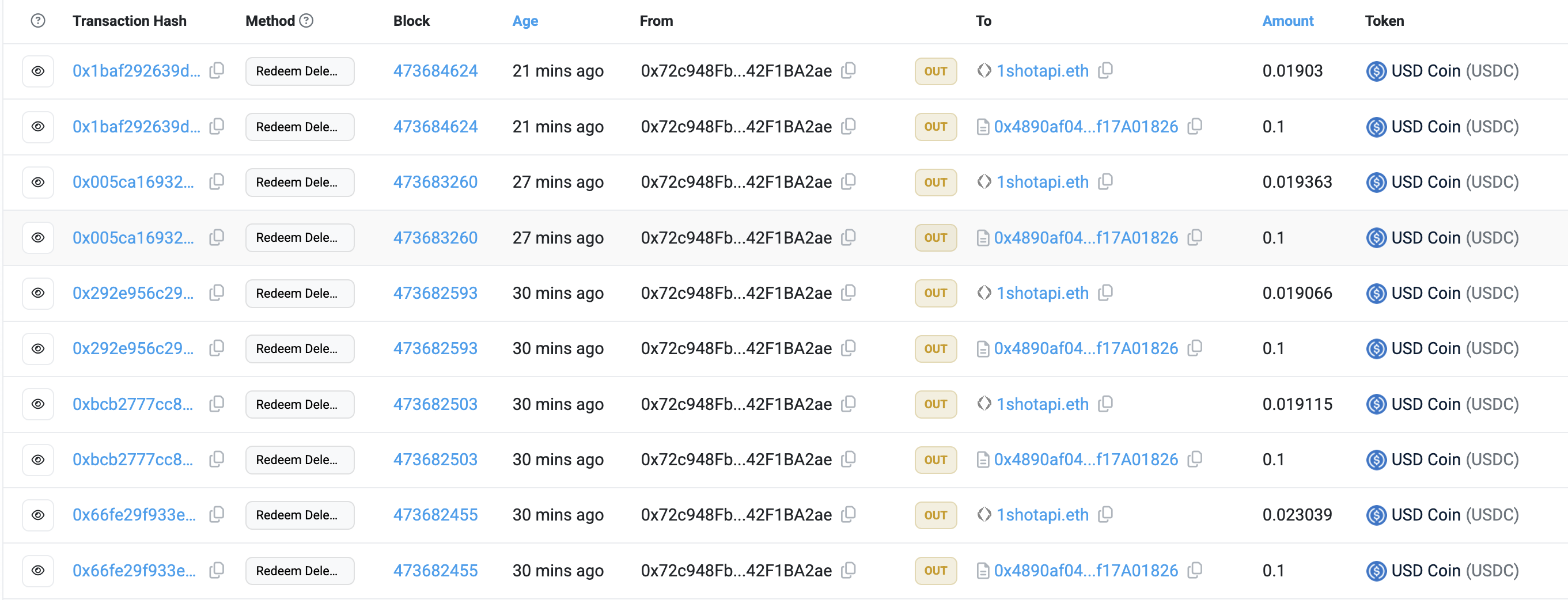
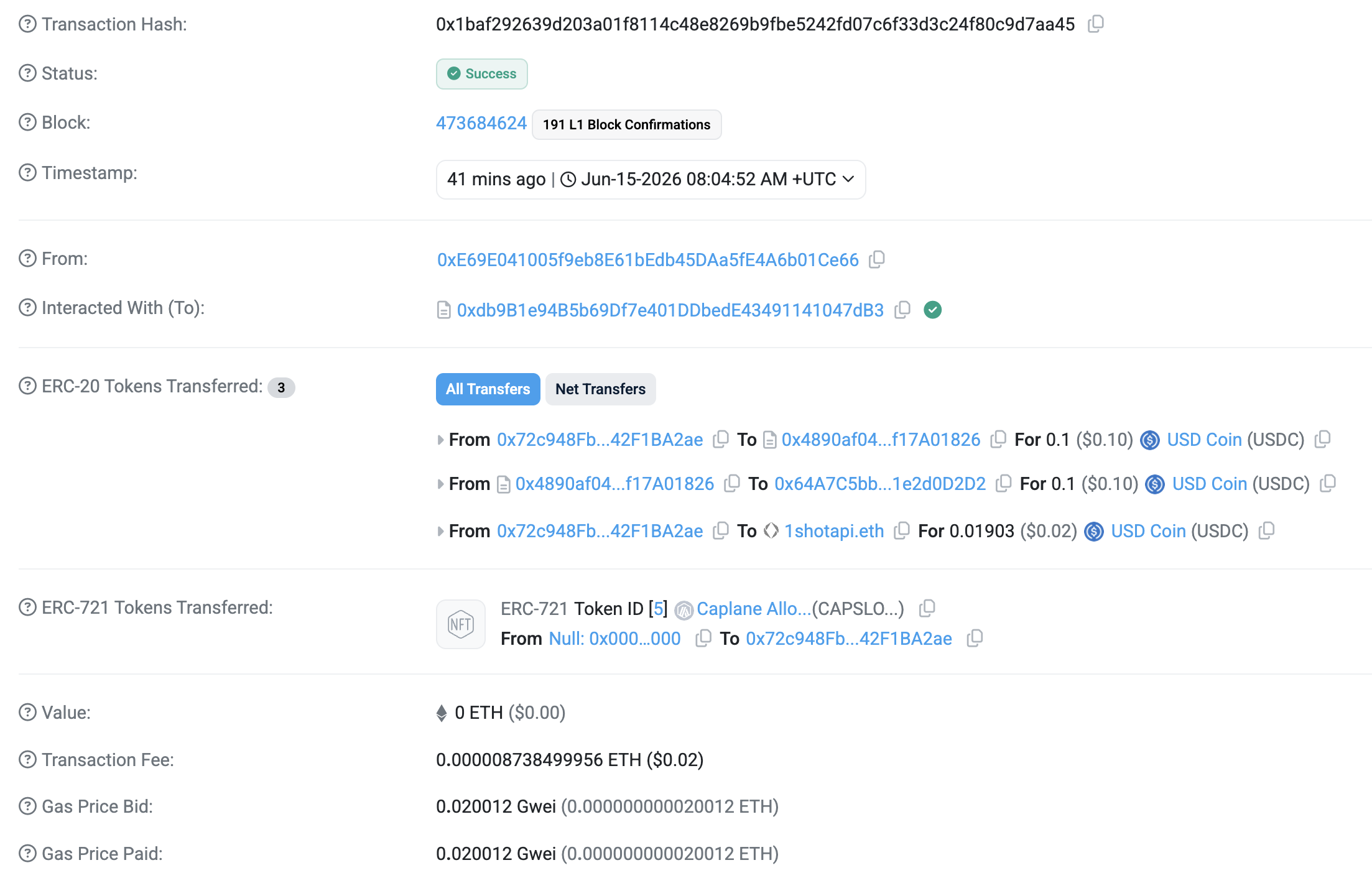
On Arbitrum One (mainnet), the consumer holds only USDC and buys the capability paying zero native ETH. 1Shot's permissionless relayer relays both the EIP-7702 upgrade and the ERC-7710 redeemDelegations, with the gas paid as a USDC transfer in the bundle. In the live run the consumer's native ETH was unchanged; gas (~0.019 USDC) was paid by 1Shot's relayer; the consumer was 7702-upgraded; and the slot was granted. (1Shot bounty met: a 7710 transaction relayed through the 1Shot mainnet relayer, with 7702 used to upgrade the account.)
vs the agent-payment field (x402 + signature-based payments): they settle copies of non-rivalrous goods on off-chain trust. Caplane settles a rivalrous capability only one agent can have, and the redeem itself moves the money.
No off-chain party between the agents. Anyone can submit the redeem; no one can censor, reorder, withhold, or seize. The trust surface is the DelegationManager + stock enforcers + our enforcer — all stateless-per-redeem on-chain code, walked deterministically at redeem, audited to GO. Not parties; code.
Built, deployed, tested, audited, and verifiable on public explorers — not a slide.
Security: contract-auditor verdict GO — 0 Critical / 0 High / 0 Medium on the enforcer, the broker, and the chain. The order binding is fuzz-proven tamper-proof.
Tests: forge test — 208 passing / 1 skipped (21 suites); the off-chain @caplane/shared package 86 / 86, including the live on-chain hash parity.
Deployed on Arbitrum Sepolia (421614) and Arbitrum One mainnet (42161) — same audited bytecode on both, on MetaMask's real DelegationManager 0xdb9B1e94B5b69Df7e401DDbedE43491141047dB3.
Live, explorer-verifiable settlements:
Single delegation → settle (slot + 3-party split) — Arbitrum Sepolia — 0x39e606192561e77318734eb7cf05bd765b0a49bf16401b7f773d8704b44f5425
2-hop redelegation chain → settle — Arbitrum Sepolia — 0x84d2683aefc3f6b5e7566d485e26573eeef0f36711e23e373e7469e043f161b6
Gas-poor settle relayed by 1Shot (mainnet, gas in USDC) — Arbitrum One — 0x1baf292639d203a01f8114c48e8269b9fbe5242fd07c6f33d3c24f80c9d7aa45
Arbitrum Sepolia (421614)
Contract | Address |
|---|---|
|
|
|
|
|
|
Arbitrum One (42161)
Contract | Address |
|---|---|
|
|
|
|
|
|
Shared on both: DelegationManager 0xdb9B1e94B5b69Df7e401DDbedE43491141047dB3, the EIP-7702 implementation 0x63c0c19a282a1B52b07dD5a65b58948A07DAE32B.
Layer | Technology |
|---|---|
Delegation | MetaMask Delegation Toolkit 0.13.0 (ERC-7710 / 7715 / 7702), |
Smart contracts | Solidity 0.8.24, Foundry, OpenZeppelin v5.6.1 |
Gas abstraction | 1Shot permissionless relayer (relays 7710 + 7702, gas paid in USDC) |
Settlement |
|
Off-chain | TypeScript, viem, pnpm workspaces |
Chains | Arbitrum Sepolia (421614), Arbitrum One (42161) |
forge test → 208 passing, then read the audit (contracts/AUDIT-A2A.md, GO / 0 crit-high-med).
Run the live 2-hop chain: node agents/scripts/redelegation-chain-live.mjs (Arbitrum Sepolia).
Run the gas-poor mainnet run: node agents/scripts/1shot-mainnet-run.mjs (Arbitrum One, gas in USDC via 1Shot).
Verify the three transactions above on Arbiscan — real redelegation chains and a real gas-poor mainnet settle, not a mock.
Built Caplane from scratch
Bootstrapped. No external capital raised to date.