
Defektr 2.0
Defektr is a Bittensor subnet that produces a single commodity: production-grade, edge-deployable AI models for manufacturing visual quality control.
Videos


Tech Stack
Description
Defektr is a Bittensor subnet that produces a single commodity: production-grade, edge-deployable AI models for manufacturing visual quality control.
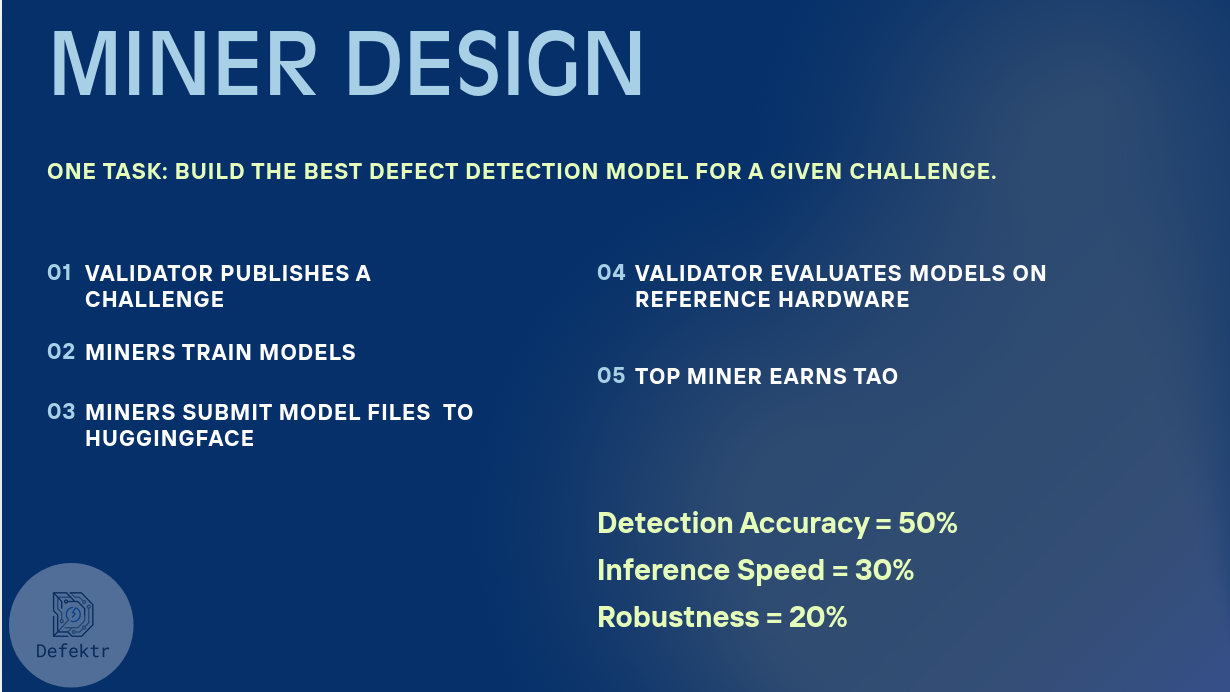
Miners compete to build the best defect detection models, scored on accuracy, speed, and robustness. Validators maintain curated benchmark datasets and objectively evaluate miner submissions through Yuma Consensus. Factory customers purchase top-ranked models and deploy them locally on edge hardware (Jetson, Coral TPU, industrial PCs) at production-line speed.
The result is a decentralized R&D engine for industrial computer vision, where global competition between miners continuously produces improving models, and market demand from real factories steers development toward what industry actually needs.
Progress During Hackathon
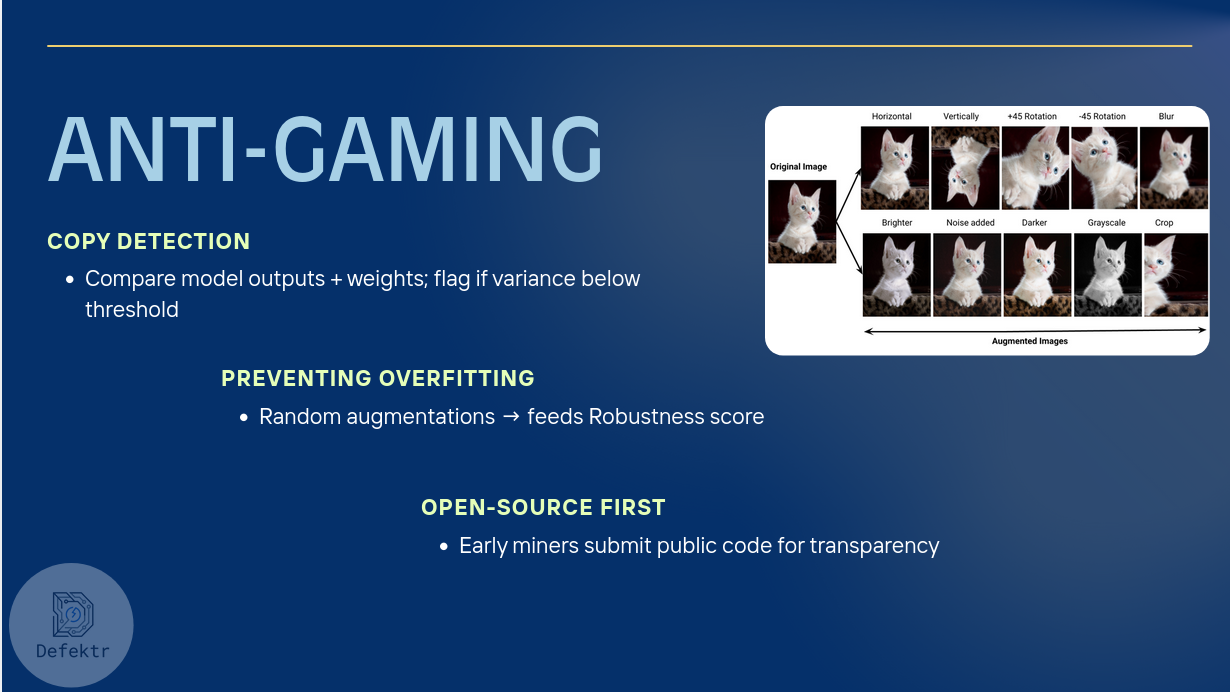
During the first phase of the hackathon, our team designed a high-potential subnet within the Bittensor ecosystem focused on delivering a genuine “proof of intelligence” through a robust incentive and mechanism design. We developed a comprehensive subnet proposal outlining emission and reward logic, clear miner and validator roles, and safeguards against low-quality or adversarial behavior. The design included a high-level algorithm covering task assignment, submission, validation, scoring, and reward distribution. We defined miner responsibilities (input/output formats, performance metrics such as quality, speed, and accuracy) and validator evaluation methodology with aligned incentives and recurring scoring cadence. Beyond the technical architecture, we articulated the business logic, competitive landscape, and long-term market rationale, demonstrating why the use case is uniquely suited for a Bittensor subnet. Finally, we prepared all required deliverables: a formal subnet design document (PDF/Notion/GitHub), an explanation video, a public introduction post, and a business pitch deck outlining go-to-market strategy, early adoption incentives, and sustainable growth pathways.
During the second phase of the hackathon, our team moved from design to full implementation and validation of the Bittensor subnet. We built the core protocol (Synapse) and implemented miner and validator modules, enabling end-to-end task assignment, model inference, evaluation, scoring, and reward distribution. Miners included baseline, enhanced, and adversarial versions to test robustness, while validators executed forward passes and reward calculations aligned with the incentive mechanism. We integrated the MVTec AD dataset for realistic anomaly detection tasks and developed a validation framework with automated tests, structured logs, and reproducible outputs. The repository was cleaned and documented with setup instructions and contribution guidelines. Design refinements included formalizing the incentive mechanism, detailing miner/validator workflows (e.g., model sharing via Pinata), and updating the business model to target manufacturing SMEs with fine-tuning services and revenue sharing.
DOCS: https://www.notion.so/Defektr-docs-321289de875980c78023d13fbba8c6b9
Fundraising Status
Pre-seed