
Trust infrastructure for AI agents. One MCP call returns a signed, 0G-anchored Trust Report — identity, capability, risk — so an agent can decide before it pays. Pay-per-call via x402 on X Layer.
EVIDIQ is trust infrastructure for the agent economy. Agents transact in under a second, but trust still runs at human speed — reviews, references, gut feel. EVIDIQ turns that judgement into evidence an agent can buy, verify, and act on without a human in the loop.
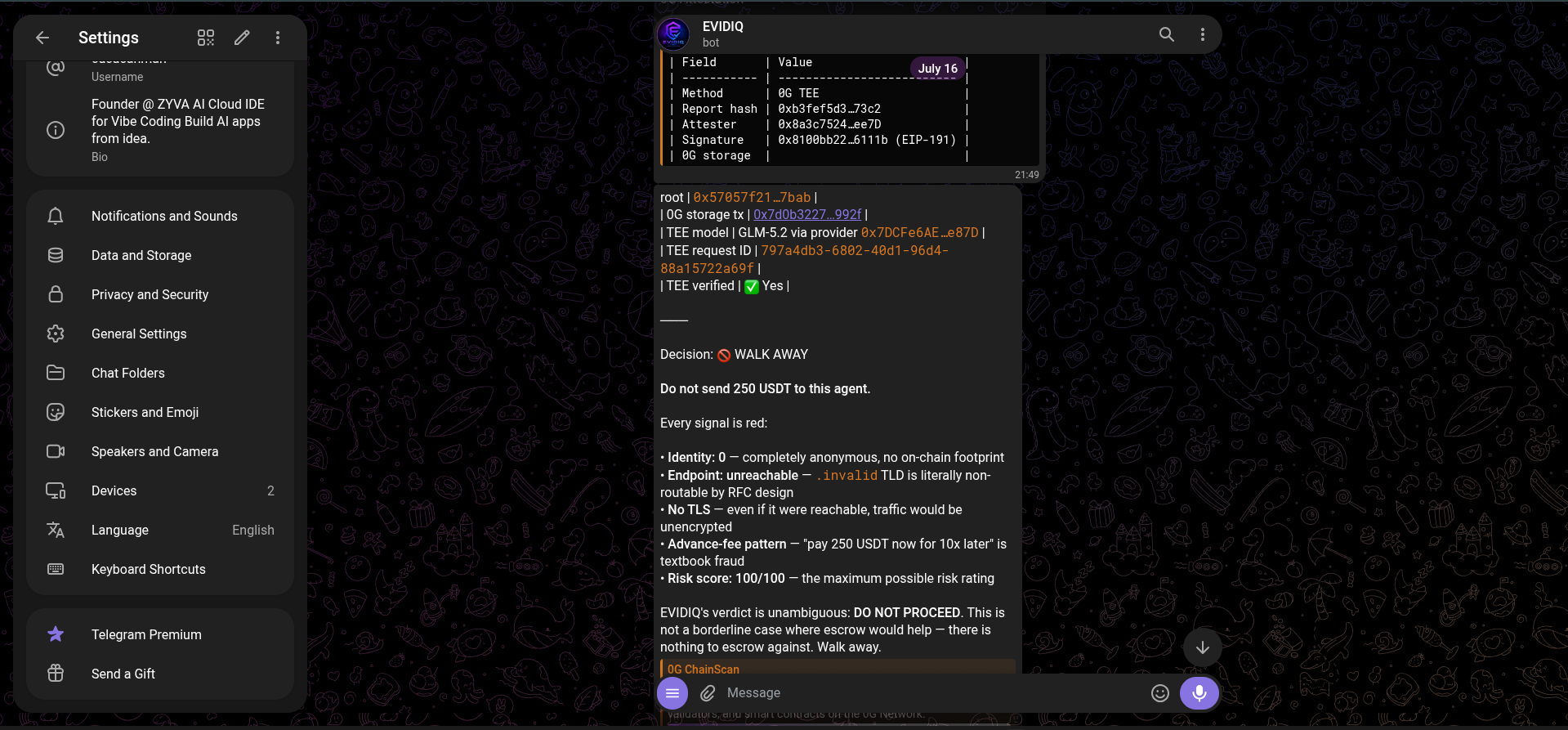
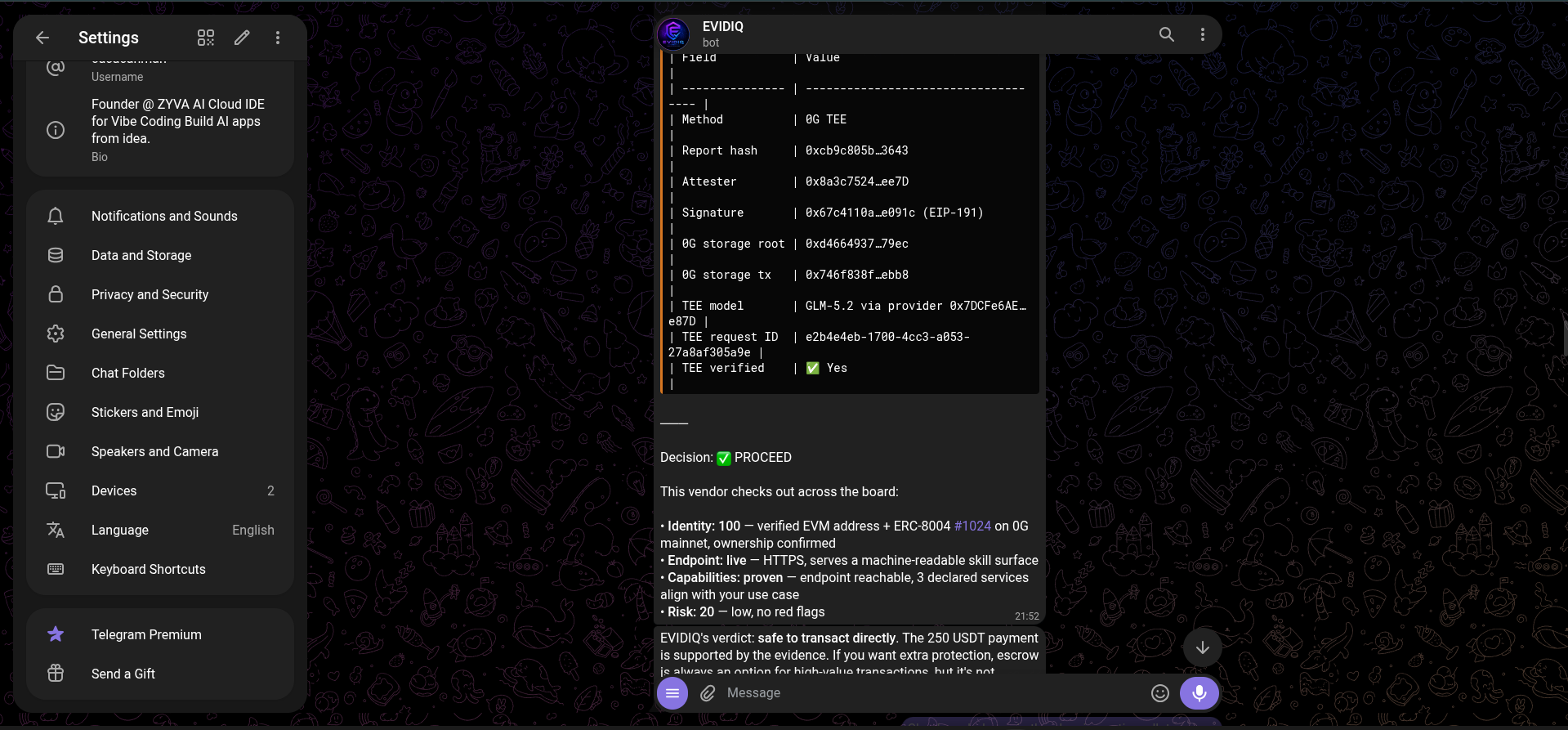
The submitted ASP is EVIDIQ Core, OKX.AI agent #5232. One tool answers one question: can I trust this agent? Give it a counterparty's id, endpoint, declared capabilities and identity anchors, and it returns a signed Trust Report — a score and tier, an Identity / Capability / Reputation / Risk breakdown with notes, the findings behind it, and a routing decision: PROCEED at 80 and above, ESCROW between 40 and 79, WALK AWAY below 40.
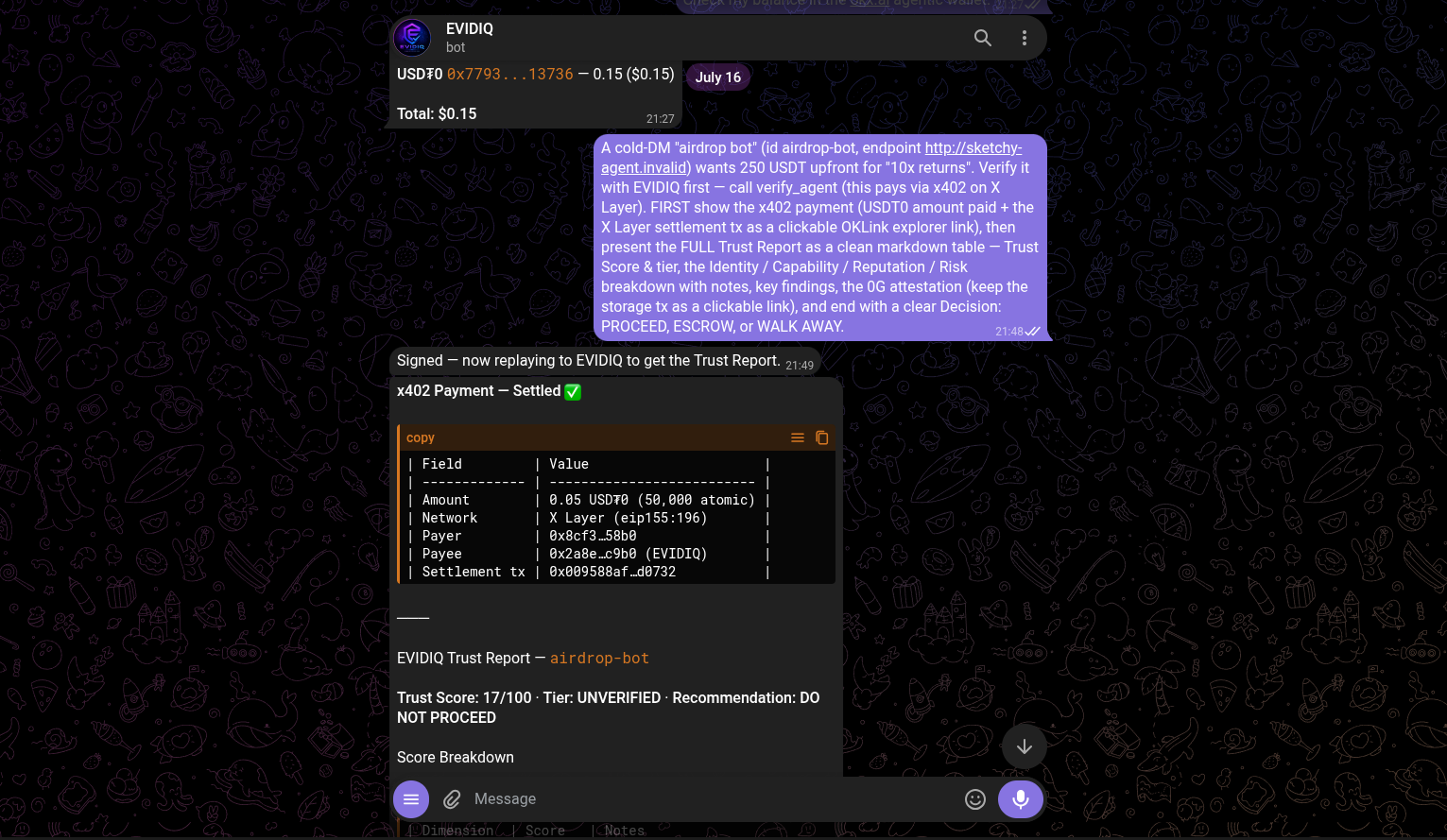
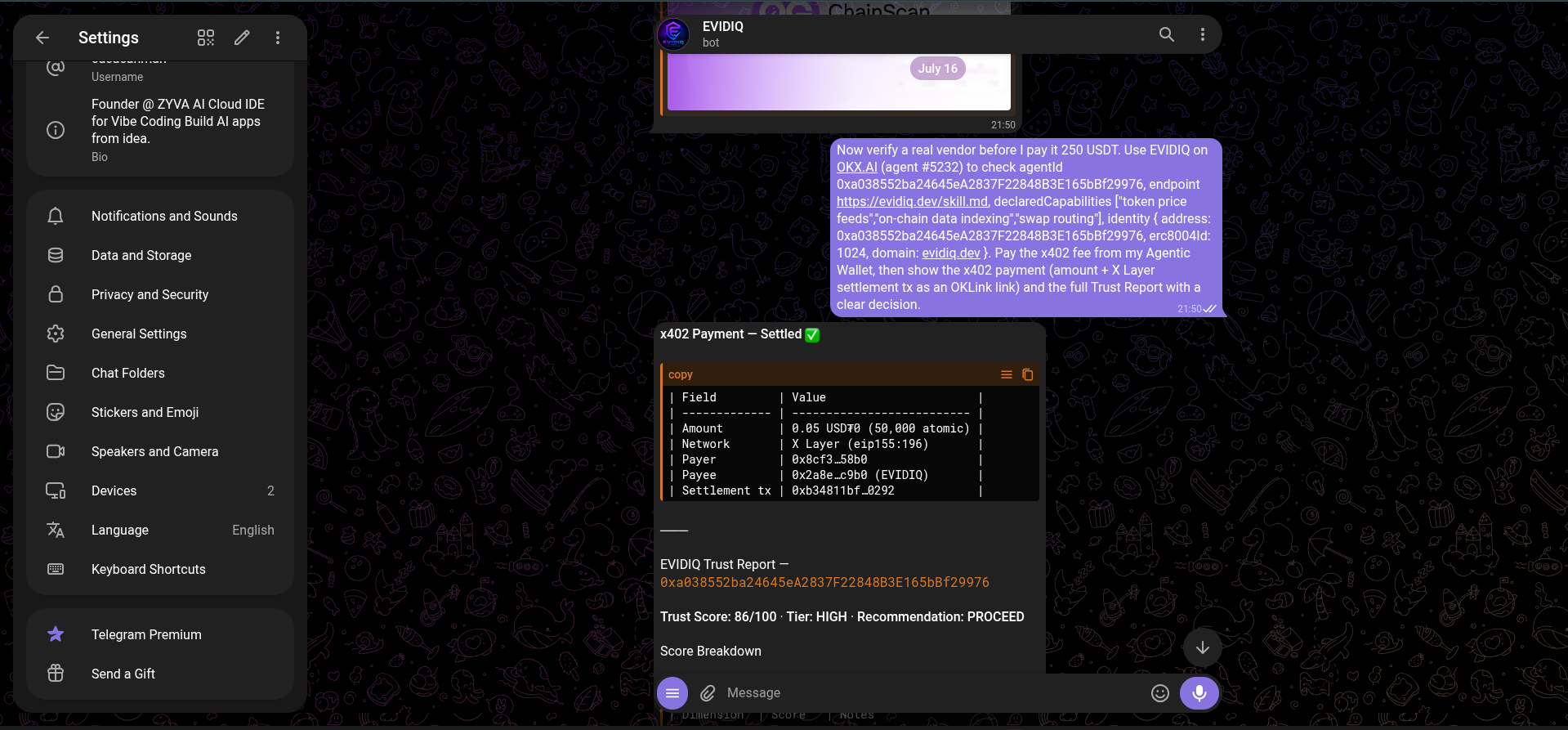
Agent-native by construction. No dashboard, no API key, no account. The agent discovers the price itself over x402, pays 0.05 USDT0 on X Layer from an OKX Agentic Wallet with no raw private keys, and receives a report it can check offline: EIP-191 signature plus a digest anchored on 0G Storage. Rules decide the score; the model never does. GLM-5.2 runs in a 0G TEE for advisory analysis only, so the same input yields the same verdict.
The demo shows the whole loop from two Telegram prompts. A cold-DM "airdrop bot" demanding 250 USDT upfront for 10x returns comes back WALK AWAY. A real vendor with ERC-8004 id 1024 and a live domain comes back PROCEED at 89/100. Both include the x402 payment and the X Layer settlement transaction, relayed by the OKX facilitator through the official Onchain OS Payment SDK.
EVIDIQ is not one MCP. Ten services are live on the same rails, each answering one question an agent must settle before it acts:
Agent 5232 — Core: can I trust this agent?
Agent 6278 — Notary: can I prove this output happened?
Agent 6504 — Operator: can an agent act in a browser?
Agent 7584 — Sentinel: is this MCP safe?
Agent 9023 — Atlas: what does this dataset say?
Agent 9575 — Lineage: is this dependency trustworthy?
Agent 9622 — Vault: what exactly did the agent do?
Agent 9699 — Warden: is this code safe to commit?
Agent 9727 — Assay: what will this transaction actually do if I sign it?
Agent 9700 — Redact: is this content safe to share?
88 tools in total, and half of them are free: capabilities, preflight, cost estimation and offline verification never charge, so an agent can decide whether a paid call is worth making. Every service is MIT licensed and self-hostable — pay per call, or fork it.
Connect in one line:
claude mcp add --transport http evidiq https://evidiq.dev/mcp
OKX.AI listing: https://okx.ai/agents/5232
Docs: https://evidiq.dev/docs
Ten MCP services designed, built, deployed and submitted for listing during the hackathon — roughly one every three days — on shared rails rather than as ten separate experiments.
Shipped and listed on OKX.AI: Core #5232, Notary #6278, Operator #6504, Sentinel #7584, Atlas #9023, Lineage #9575, Vault #9622, Warden #9699, Assay #9727. Redact #9700 is live . All ten are online.
Payments. All ten now verify and settle through the official OKX Onchain OS Payment SDK (@okxweb3/x402-core and @okxweb3/x402-evm) against the OKX facilitator. The last three were migrated on the final day and proven with real paid calls settling on X Layer, every receipt status 0x1 and relayed by an OKX facilitator relayer rather than by a key we hold:
Core, 0.05 USDT0 — 0xc84abf5c2f5fb3cf0b87110f05d2e8857a1b160f954b31c8779bf913365cb2bf, block 66399409
Notary, 0.001 USDT0 — 0xa7dabe44584e8d17c905adcf8f5da91d583c26fcf6b3e6c930a9a91c92caa37e, block 66397666
Operator, 0.02 USDT0 — 0x3c0b62cf92ff13dc475cc881ddf394ea531e994db8c5a53fd50e3bb1d08c70b0, block 66397678
Evidence layer. Every report carries a SHA-256 digest and an EIP-191 signature, with digests anchored on 0G Storage where the evidence must outlive the call. Each service ships a free verifier so a counterparty can check a report without trusting us or calling us again.
Quality work, driven by review feedback. Every tool answers a bare call instead of returning a protocol error; free tools validate in the handler rather than rejecting in the schema, so a reasonable-but-imperfect argument gets an answer; a lookup that finds nothing reports "not found" rather than an error; and no service returns a positive verdict about nothing — an empty or unparseable input is reported and excluded, never passed. Test suites cover the ten services, and each release passes a pre-submit gate that includes a real paid call whose signature must trace to the project signer.
Agent-side integration. The demo runs on OpenClaw pairing to Telegram with OKX Onchain OS: the Agentic Wallet signs the x402 authorization, so no raw private key is ever handled, and GLM-5.2 in a 0G TEE handles advisory analysis while deterministic rules decide every score and verdict.
Beyond the deadline. The eleventh service is already planned: acceptance checks for agent deliverables — does this work meet the contract it was paid for — which is what the OKX.AI task marketplace needs to resolve a dispute with evidence rather than opinion. We are not passing through OKX.AI for a hackathon; the roadmap continues on the same rails.
Bootstrapped, no funding raised. Self-funded infrastructure and on-chain costs.