
LP Doctor diagnoses Uniswap LP positions, simulates safer V4 hook migrations, and anchors verifiable reports across 0G Storage, Chain, iNFT memory, and ENS.
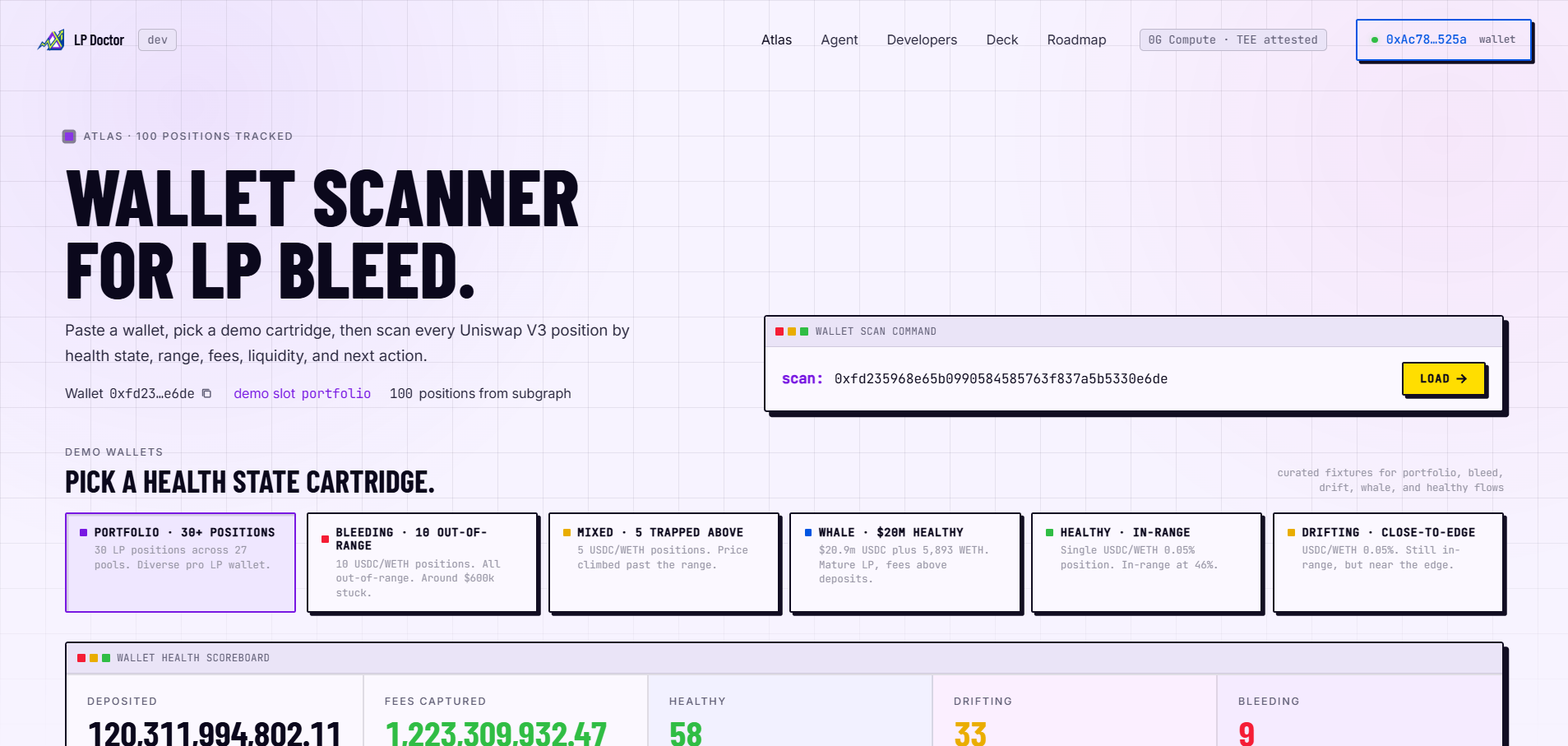
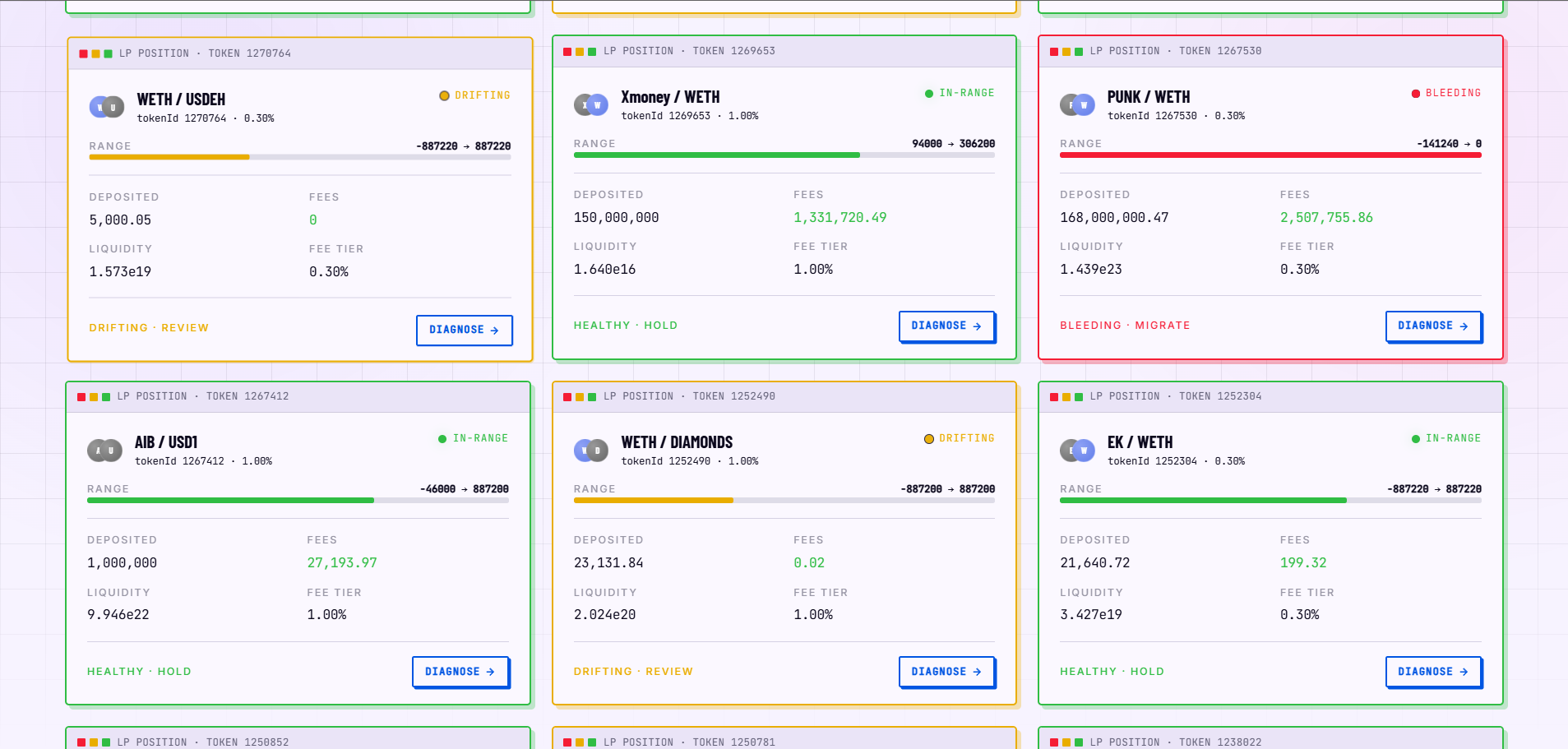
LP Doctor is an AI-native diagnostic and migration copilot for Uniswap liquidity providers.
Problem
Liquidity providers still operate with fragmented and mostly passive tooling. Existing dashboards can show positions, fees, and price ranges, but they do not answer the higher-order questions that actually matter for decision-making:
Why is this LP position underperforming?
Is the position exposed to an unhealthy market regime?
Is there a better V4 hook-based strategy available?
How can a user trust that an AI-generated recommendation is real, persistent, and verifiable?
This creates a major gap in verifiable finance: users can see data, but they cannot easily turn that data into structured, auditable action
Solution
LP Doctor transforms LP management from passive dashboard reading into an agentic financial workflow.
The product analyzes a live Uniswap LP position, reconstructs impermanent loss, classifies market regime, discovers and scores relevant Uniswap V4 hook opportunities, and then generates a verifiable diagnostic report with migration guidance.
Instead of returning a disposable chat-style answer, LP Doctor produces a result that is:
data-backed,
AI-synthesized,
persistent,
onchain-anchorable,
and tied to agent memory for future reasoning.
How The App Works
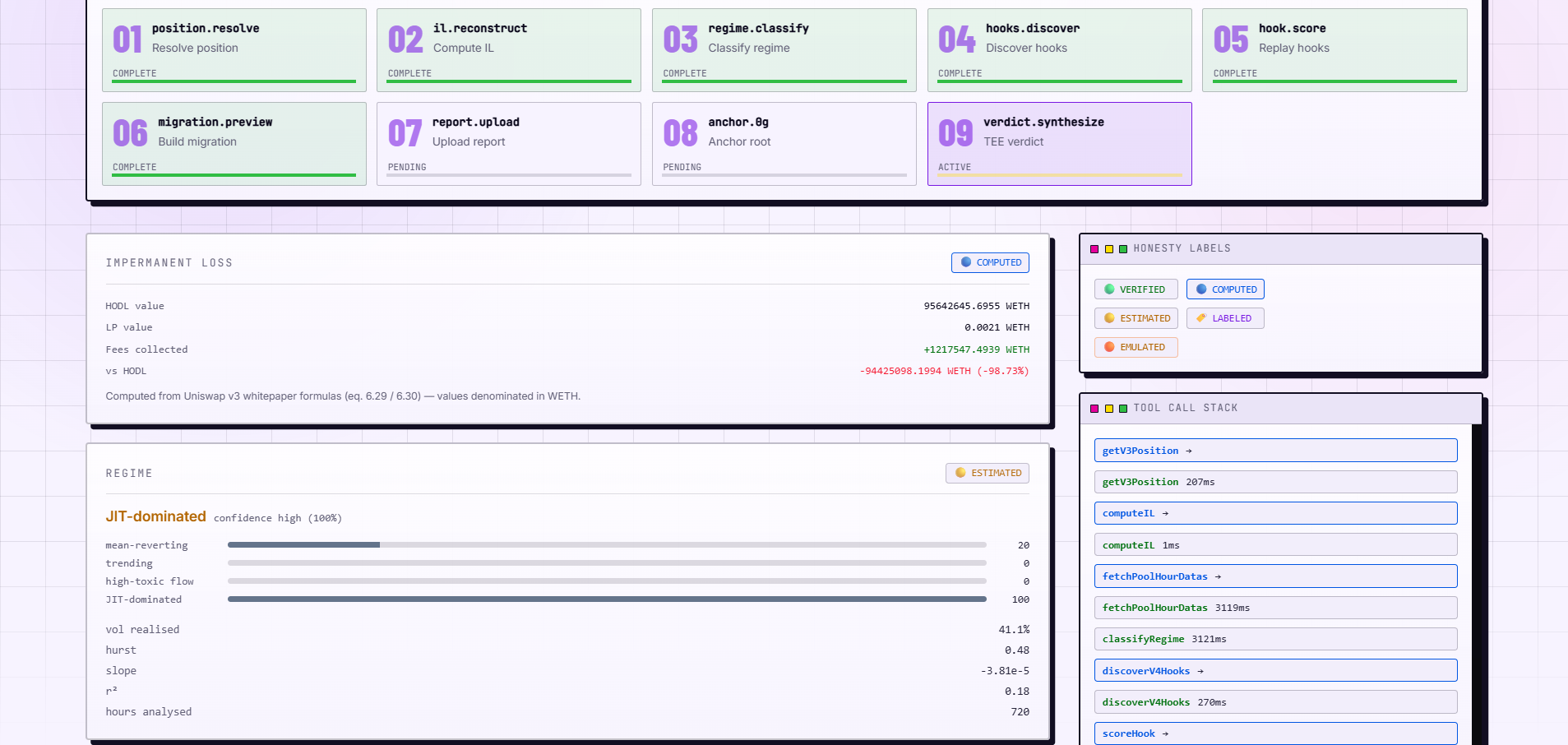
LP Doctor starts by resolving a live Uniswap V3 LP position and reconstructing its core state, including the liquidity range, token pair, and surrounding market context. From there, it computes impermanent loss against a HODL baseline so the user can see how the position has actually performed, not just how it looks on a dashboard. It then analyzes pool behavior to classify the current market regime, helping frame whether the position is operating in a relatively healthy or adverse environment.
Once that diagnostic layer is established, LP Doctor looks outward for strategy alternatives. It discovers relevant Uniswap V4 hook-enabled pools, evaluates candidate hooks, and scores them based on their strategic fit to the position’s observed behavior. Using that analysis, the app generates a migration preview that explains how a user could move from the current V3 setup into a more suitable V4 hook-based strategy. Finally, LP Doctor synthesizes the findings into a structured AI-generated verdict and persists the output through 0G infrastructure, so the diagnosis becomes a durable, verifiable financial artifact rather than a temporary interface response.
What Problem It Solves For Users
LP Doctor solves three business-critical problems for LPs:
Decision clarity. Users no longer need to manually interpret scattered metrics across dashboards and analytics tools.
Migration intelligence. Users get actionable guidance on whether moving into a V4 hook-based strategy may improve their setup.
Trust and verifiability. The diagnosis is not just “AI output.” It is persisted and anchored through 0G infrastructure, making the reasoning more credible and inspectable.
This is important because sophisticated LP management is increasingly becoming an execution and infrastructure problem, not just a UI problem.
0G Technologies Used
LP Doctor uses multiple core 0G components as part of the product itself, not as superficial add-ons.
0G Compute
Used to synthesize the final AI verdict for the diagnosis workflow.
This is the reasoning layer that turns structured LP analytics into an interpretable recommendation.
0G Storage
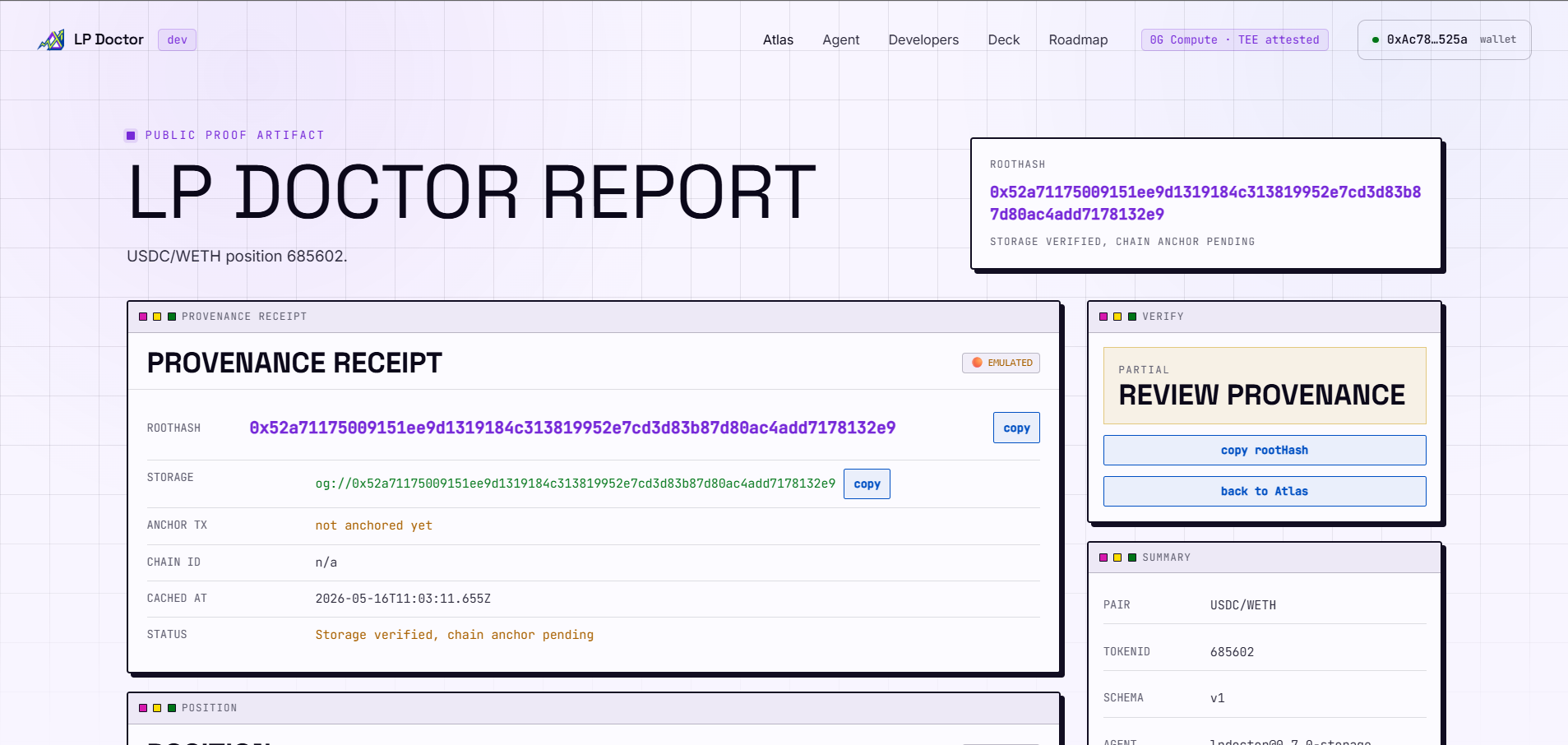
Used to persist generated reports.
Each diagnosis is stored as a durable artifact so the result can be revisited and referenced later.
0G Chain
Used to anchor report commitments onchain.
This provides verifiable provenance for the report lifecycle.
Agent Memory / Agent Identity
The LPDoctorAgent contract is used as persistent agent state.
Report roots and diagnosis outcomes are reflected in agent memory so the system can maintain continuity over time.
Why This Matters In The 0G Ecosystem
LP Doctor is a strong fit for Track 2: Agentic Trading Arena (Verifiable Finance) because it applies autonomous AI reasoning to a real financial decision-making workflow: LP risk diagnosis and migration strategy.
The project demonstrates that 0G infrastructure can support more than generic AI demos. It can power a full-stack financial agent workflow where:
AI reasoning is generated through 0G Compute,
outputs are persisted with 0G Storage,
commitments are anchored on 0G Chain,
and long-lived agent state is maintained across diagnoses.
This creates a stronger model for AI x Web3 financial applications: not just smarter interfaces, but verifiable, persistent, agent-driven financial systems.
Business Value
LP Doctor is designed as a foundation for a broader category of AI-powered LP infrastructure products.
Potential long-term business directions include:
premium LP diagnostics,
strategy migration tooling,
agent-assisted treasury and vault management,
portfolio-level LP risk monitoring,
and agent-native execution or subscription workflows.
In short, LP Doctor is not just a dashboard. It is a verifiable financial intelligence layer for liquidity management.
During the hackathon, we built LP Doctor as an AI-native copilot for Uniswap liquidity providers, focused on helping users understand LP underperformance and identify better strategy paths instead of relying on passive dashboards alone. The goal was to turn LP analysis into aproduct that feels actionable, inspectable, and verifiable.
We spent the hackathon shaping the product flow end to end: designing the frontend experience, implementing the backend diagnostic pipeline, and connecting both sides into a live working system. The application now resolves real LP positions, reconstructs impermanent loss, classifies market regime, surfaces relevant Uniswap V4 hook opportunities, and produces a migration-oriented diagnostic report.
A major part of the build was integrating 0G infrastructure directly into the product workflow. We used 0G Compute for AI-assisted verdict generation, 0G Storage for report persistence, and 0G Chain for anchoring diagnostic outputs onchain. We also deployed the supporting contracts and connected agent memory updates so each diagnosis becomes part of a longer-lived stateful system rather than a disposable response.
Beyond the core product logic, we also handled the deployment and operations work required to make the project real. This included deploying contracts, setting up the production backend server, configuring the database and cache layer, connecting live environment variables, and validating end-to-end API behavior from the public deployment. On the product side, we iterated on the UI and integrated it with the live backend so the experience works as a coherent application rather than a collection of separate modules.
By the end of the hackathon, LP Doctor was running as a live full-stack product with real onchain integration, live backend infrastructure, and a complete user-facing diagnostic flow built around 0G.