
Laminaa is an autonomous AI orchestrator for tokenized securities — the agent that runs a tokenized asset's entire regulated life after issuance on robinhood and arbitrum chain.
Laminaa is an autonomous AI orchestrator for tokenized securities — the agent that runs a tokenized asset's entire regulated life after issuance. A fund manager issues one natural-language instruction; Laminaa deploys a compliance-enforced token and then runs the whole lifecycle — KYC/OFAC screening, on-chain transfer enforcement, USDC coupon and dividend payouts, NAV updates, audit-ready regulatory reports, and maturity redemption — predominantly on Arbitrum and Robinhood Chain, with every action written to an immutable on-chain audit trail.
Tokenizing an asset is easy. Managing it after issuance is the bottleneck.
A tokenized bond still needs coupons paid on schedule, a KYC/sanctions check on every transfer, NAV updates from market data, regulatory reports each quarter, and principal redemption at maturity. Today that work is done manually by fund administrators, compliance officers, and lawyers — costing 20–50 basis points on assets under management plus legal fees. As issuance scales, this lifecycle overhead, not tokenization itself, is what breaks.
Laminaa turns that lifecycle into software. The fund manager issues one command — "Tokenize a $10M 5-year US Treasury bond, US accredited investors only, on Arbitrum" — and the agent:
Maps the asset to its regulatory framework (e.g. SEC Reg D / Reg S, MiFID II) and deploys an ERC-3643-style compliance token plus a dedicated audit topic in a single transaction.
Onboards investors: runs OFAC SDN sanctions screening (names and crypto addresses) and grants on-chain KYC; sanctioned parties are blocked automatically.
Enforces compliance on every transfer on-chain — KYC status, jurisdiction eligibility, lock-up periods, and holder caps — before settlement.
Distributes coupons/dividends to all holders proportionally in USDC, on schedule or on command.
Updates NAV from a yield/price oracle.
Settles maturity: claws back tokens, returns principal in USDC, and burns the supply.
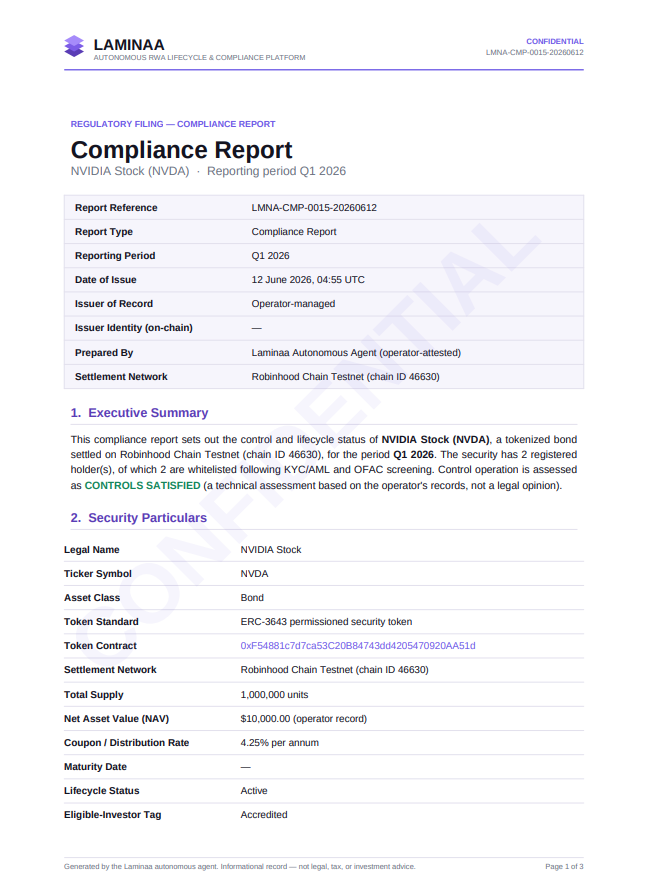
Generates production-grade regulatory PDF reports — compliance filings, investor statements, and audit summaries — each with on-chain verification links, an authorised-signature block, and a SHA-256 integrity fingerprint, backed by a tamper-proof on-chain audit trail.
What makes Laminaa different is that it is agent-native and multi-chain.
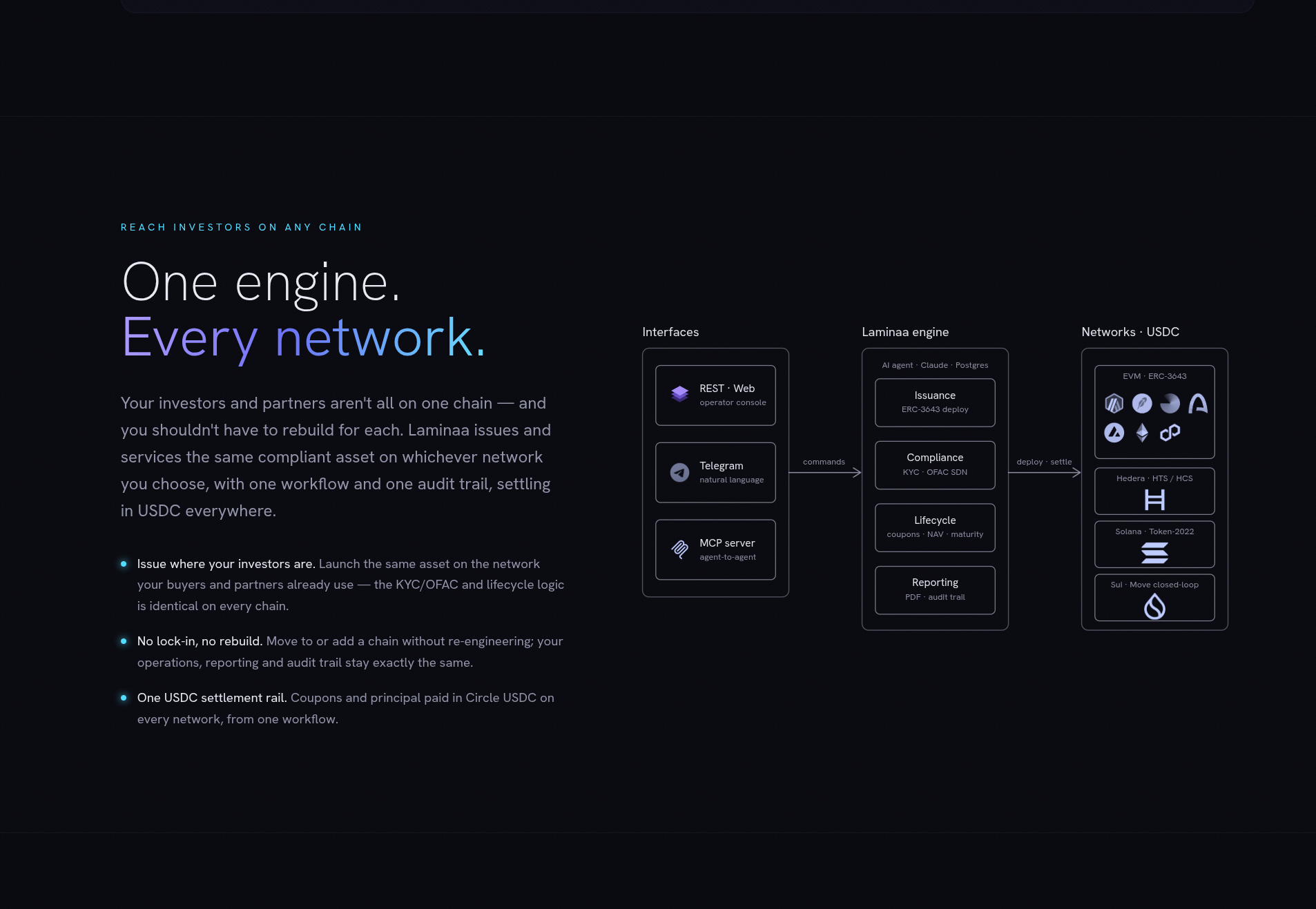
The same agent and the same compliance/lifecycle engine run across 8 chains through one codebase — led by Robinhood Chain and Arbitrum Sepolia, plus 5 more EVM testnets and even non-EVM Hedera — so an issuer chooses the chain and Laminaa handles the rest; adding a new EVM chain is a config change, not a code change.
And Laminaa is controllable by both humans and machines:
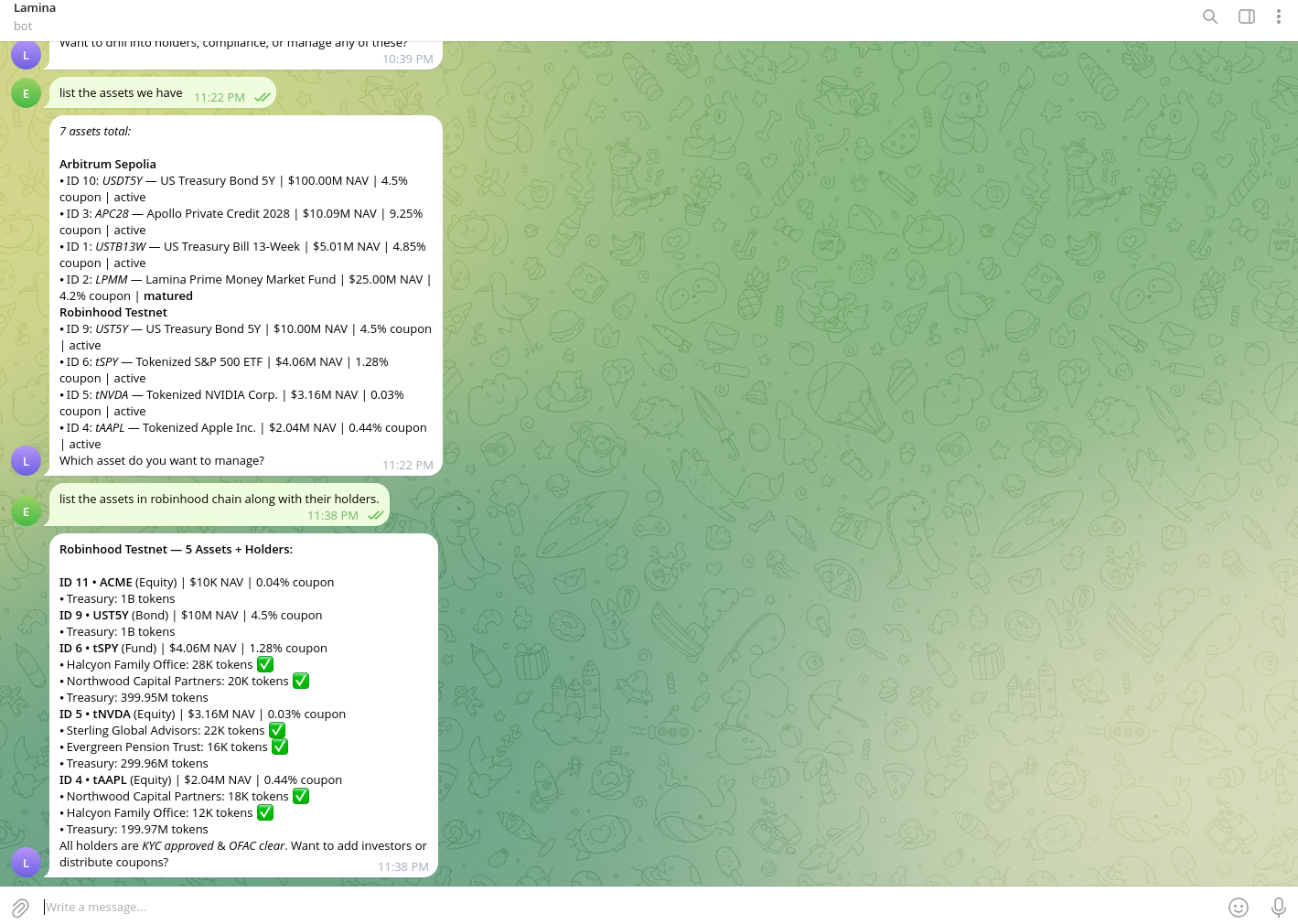
A fund manager can run the full lifecycle from a Telegram chat in natural language (with a confirmation step before any value moves).
Other agents and back-office systems can drive Laminaa programmatically over an authenticated MCP server.
Three front doors — REST API, MCP, and Telegram — all sit on one shared tool layer, so any new capability appears in all three at once.
Why Robinhood Chain and Arbitrum
Robinhood Chain is a regulated brokerage's own programmable rail for tokenized equities — the one place where the asset, a compliance-forward posture, and a path to distribution sit together — and it is built on the Arbitrum stack (Arbitrum Orbit).
So Arbitrum is the proven, low-cost, EVM base layer our compliance contracts run on unchanged, and Robinhood Chain is the equities-and-distribution rail on top of it. Predominantly Arbitrum and Robinhood is one coherent technical story, not two bets.
For this buildathon, Laminaa shows what comes after RWA issuance: an autonomous compliance and lifecycle agent that institutions can actually operate — live, deployed, and verified end-to-end on Arbitrum and Robinhood Chain.
Web app + AI agent
(also)
https://lamina-agent.vercel.app/
The full issue → comply → pay → report → redeem flow has been run end-to-end on Arbitrum Sepolia and Robinhood Chain testnet, driven through all three interfaces (web AI agent, MCP, and Telegram).
Deployer / Agent Operator
0xFa3e5d58ea338A274B7d739117AFfAe80168A429
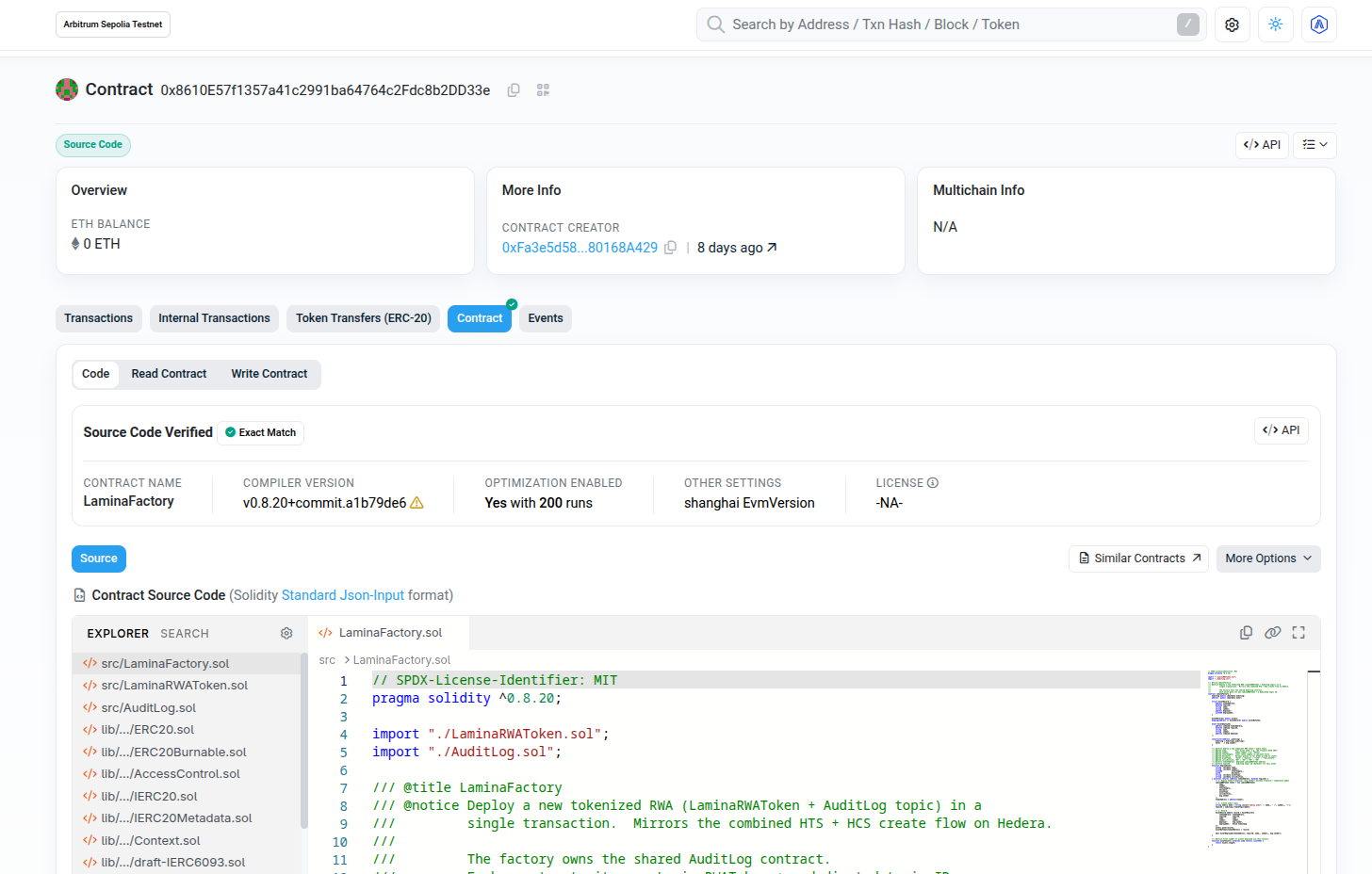
Source verified on Arbiscan
LaminaFactory
0x8610E57f1357a41c2991ba64764c2Fdc8b2DD33e
https://sepolia.arbiscan.io/address/0x8610E57f1357a41c2991ba64764c2Fdc8b2DD33e#code
AuditLog
0x2721b95C0fF4756D71Ab6357A38C35e458627595
https://sepolia.arbiscan.io/address/0x2721b95C0fF4756D71Ab6357A38C35e458627595#code
USDC (Circle)
0x75faf114eafb1BDbe2F0316DF893fd58CE46AA4d
LaminaFactory
0xd556c46758B2C4B62f929256dc3FA53fbd375A3A
https://explorer.testnet.chain.robinhood.com/address/0xd556c46758B2C4B62f929256dc3FA53fbd375A3A
AuditLog
0x153786D589c1d3bddEa68f232269d47Cb110D6Cd
https://explorer.testnet.chain.robinhood.com/address/0x153786D589c1d3bddEa68f232269d47Cb110D6Cd
USDC (Mock)
0x5B6C7cAF7F99f99154fD8375ec935Fcf03F326f5
Also deployed on: Base Sepolia, Avalanche Fuji, Ethereum Sepolia, Arc Testnet, and Polygon Amoy.
Arbitrum Sepolia + Robinhood Chain (Arbitrum Orbit), plus 5 more EVM testnets and Hedera
Solidity (ERC-3643-style compliance token, access-controlled AuditLog, Factory), Foundry, OpenZeppelin
Chain-agnostic adapter layer (web3.py for EVM, hiero-sdk for Hedera) behind one interface
FastAPI + SQLAlchemy 2.0 (async) + PostgreSQL backend, deployed live
Anthropic Claude agent with tool-use; OFAC SDN screening; treasury-yield oracle
Production PDF reporting engine (compliance / investor / audit reports, on-chain verification, integrity hash)
MCP server (authenticated, scoped, audited) for agent-to-agent access
Telegram bot for natural-language control with write-confirmation
USDC for coupons, dividends, and principal
Won 3rd place ($8,000) in the DeFi & Tokenization track at the Hedera "Hello Future" Apex Hackathon (2026), recognized specifically as "an autonomous AI agent that manages the full lifecycle of tokenized real-world assets."
Source:
https://hedera.com/blog/these-are-the-winners-of-the-hello-future-apex-hackathon/
Rebuilt from the ground up as a chain-agnostic, agent-native platform and deployed live; full lifecycle verified end-to-end on Arbitrum and Robinhood Chain across three interfaces.
On-chain tokenized RWAs grew from ~$5.5B in early 2025 to ~$24B (≈+308% in 3 years).
BCG projects ~10% of global GDP (~$16T) could be tokenized by 2030; Standard Chartered sees up to ~$30T by 2034.
https://www.nextmsc.com/report/tokenized-real-world-assets-rwas-market-bf3345
BlackRock's BUIDL tokenized treasury fund reached ~$2.9B AUM and pays multi-million-dollar monthly dividends — i.e. real, recurring coupon/dividend distribution that someone has to operate. Management fees run 20–50 bps.
Every tokenized asset needs this lifecycle managed. The work scales linearly with the number of assets and holders — exactly the kind of repetitive, rules-based, auditable process an autonomous agent should own.
Tokenization platforms & transfer agents — Securitize (powers BUIDL), Tokeny (authors of ERC-3643), Archax, Zoniqx, ADDX — who need lifecycle automation under their issuances.
Asset issuers / fund managers launching tokenized treasuries, bonds, and private credit who want to cut the 20–50 bps + legal/admin cost of running compliance and payouts by hand.
Banks and asset managers piloting tokenization who need an auditable, compliance-first operations layer rather than bespoke scripts.
RWA-focused chains (e.g. Robinhood Chain and Arbitrum Orbit RWA chains) that want turnkey lifecycle tooling to attract issuers to their ecosystem.
2–5 bps on AUM under agent management (vs the 20–50 bps charged today for manual administration).
On $1B of managed AUM that is approximately $200K–$500K/year recurring revenue, while the agent's marginal cost per additional asset is near zero.