
Exit markets for gated private credit funds. Built on Arbitrum and Robinhood chain.
Exit markets for gated private credit funds. Sell your accepted redemption to a professional buyer.
Live on testnet: founder-house.lockgate.finance · Arbitrum Sepolia + Robinhood Chain testnet
Tokenized credit backed by T-bills or crypto loans is already liquid. Holders swap it on DEXs.
Real private credit funds are not liquid:
Gated. Redemptions are paid quarterly, capped at about 5% of the fund per quarter.
Whitelisted. Only approved holders can own the fund, so no open pool can buy it.
No secondary. There is almost no market for the units, and cash offers come at a deep discount.
So an investor whose redemption the fund has already accepted, for a fixed amount and a known payment date, still waits weeks or months for the cash.
Lockgate turns that accepted redemption into something you can sell whole.
The holder sells the claim (this one payout, no fund units, no NAV exposure) to a whitelisted professional buyer. The holder gets cash now. The buyer gets paid by the fund on the payment date.
Four parties: the holder, the fund's paying agent, a professional buyer and a licensed operator who admits the parties.
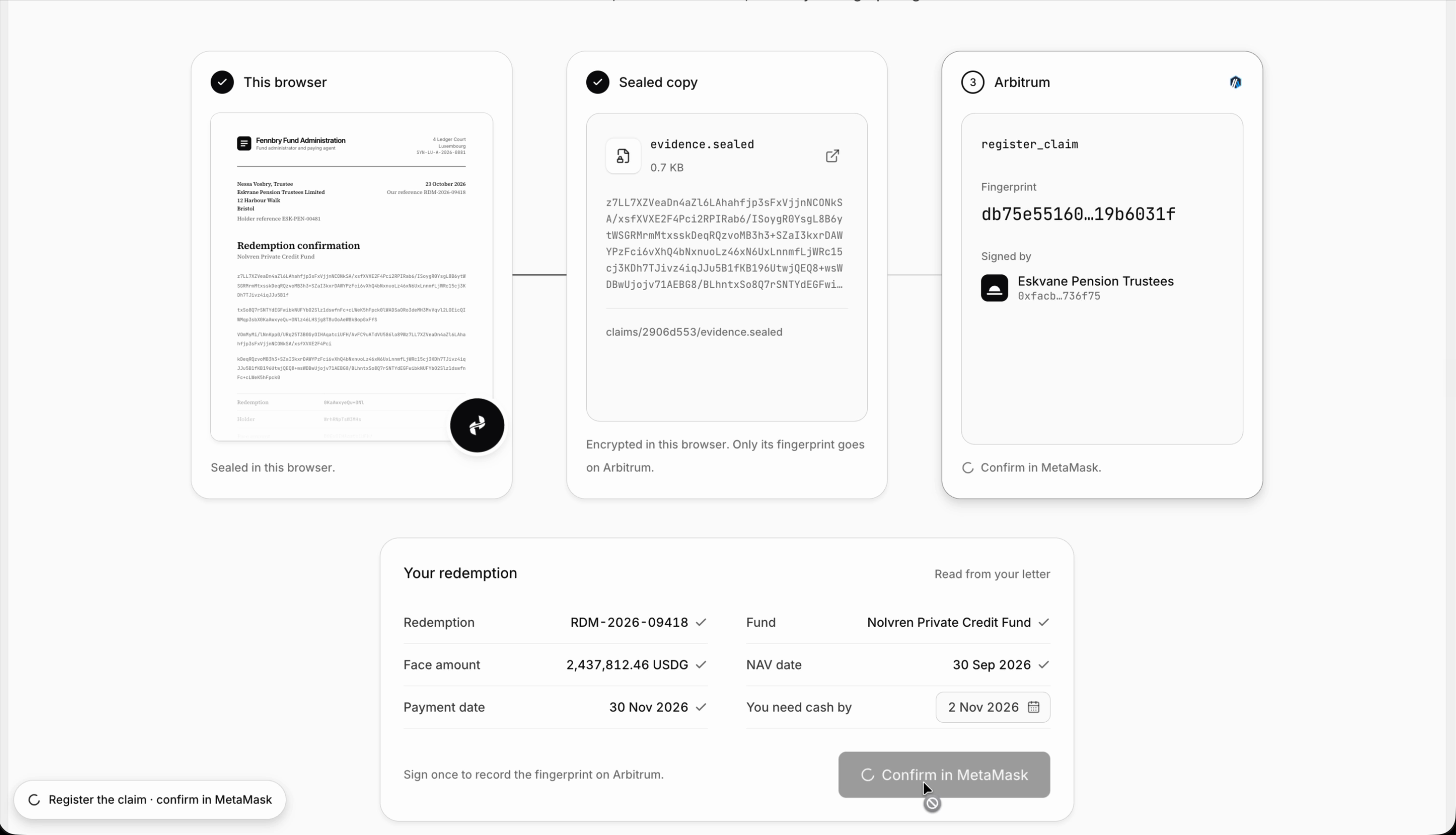
Register the claim. The holder adds the fund's confirmation letter: amount, NAV date, payment date. It is sealed in the browser, and only its fingerprint goes on-chain.
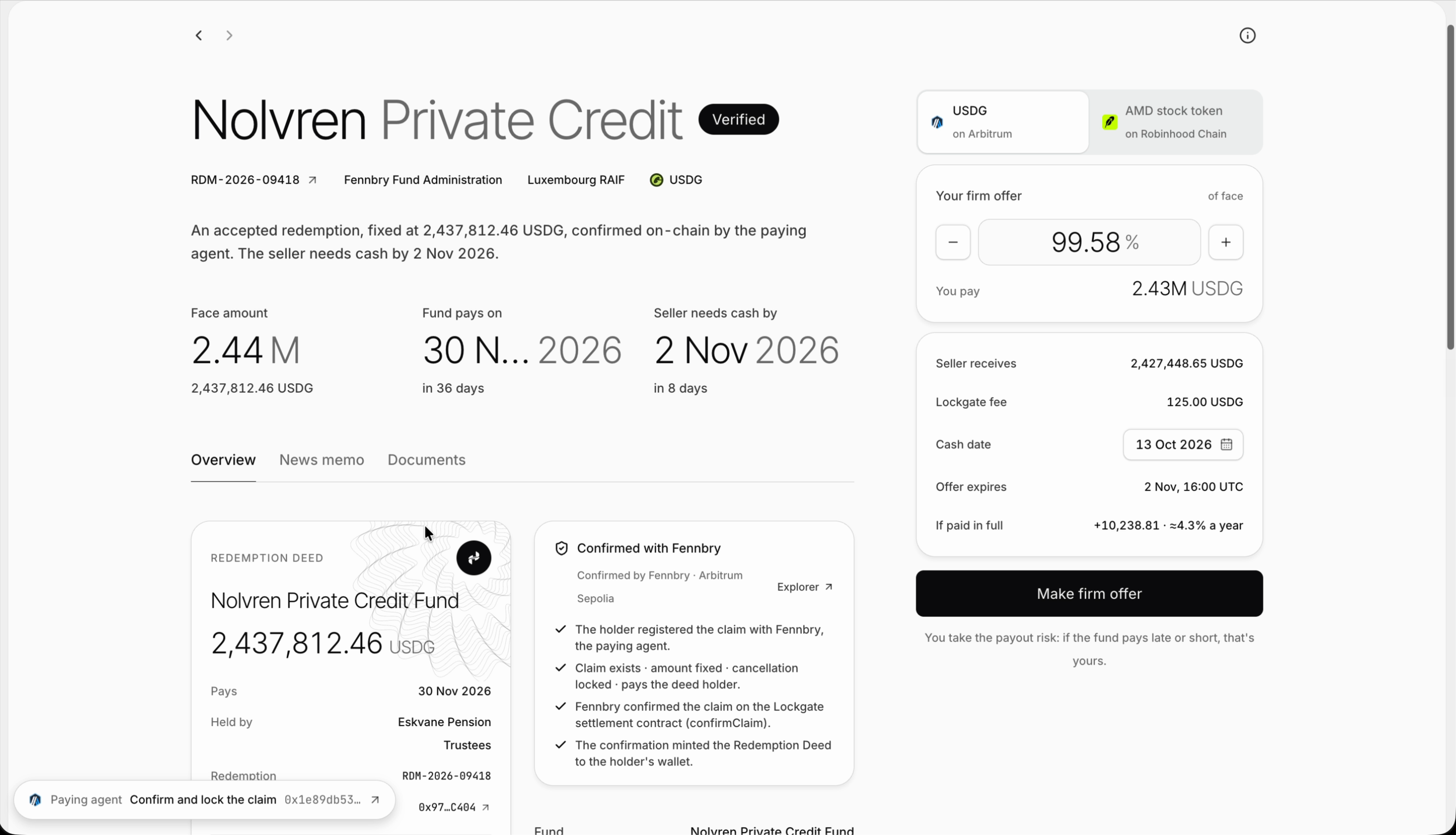
The fund locks it. The paying agent confirms the claim on Arbitrum and locks it: no cancellation, and the payout goes to the claim's payout route, which pays whoever holds the deed. Only then is a Redemption Deed issued to the holder. No lock, no deed. The deed is frozen and only moves inside a Lockgate settlement.
A buyer makes a firm offer. Approved buyers see the verified claim and a research memo on payment delays, loan defaults, flows and liquidity. They set a price, a cash date and an expiry.
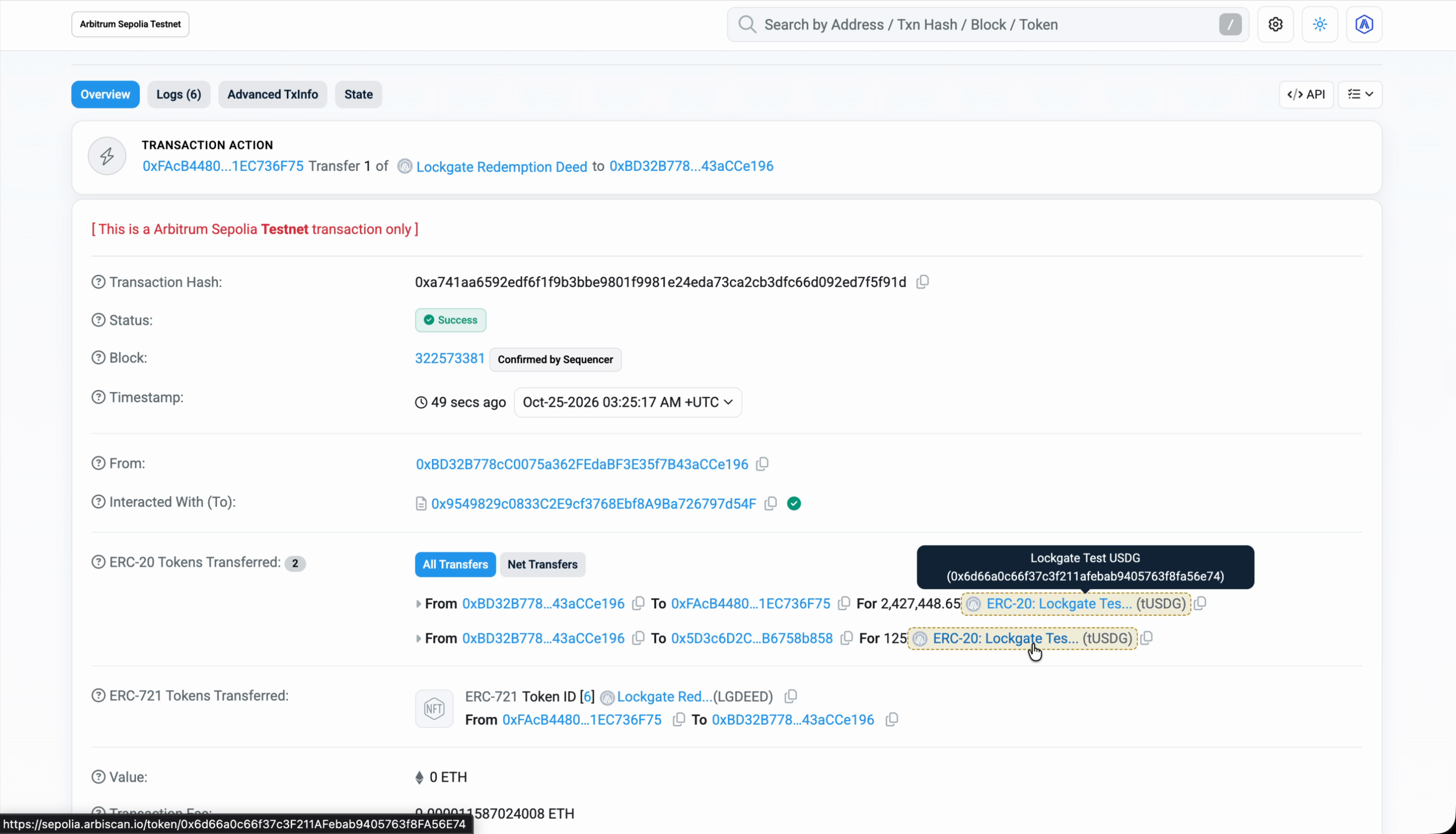
Three signatures, one transaction. Holder, buyer and operator each sign the same fingerprint of the terms and the standard assignment agreement. At settlement the contract checks that the buyer is still eligible (Chainlink ACE), the terms are unchanged, all three signed, and the holder still holds the deed. Then cash goes to the holder and the deed goes to the buyer in one Arbitrum transaction. Either everything moves or nothing does.
Payout. On the payment date the paying agent pays once. The contract pays whoever holds the deed, now the buyer, and retires the deed.
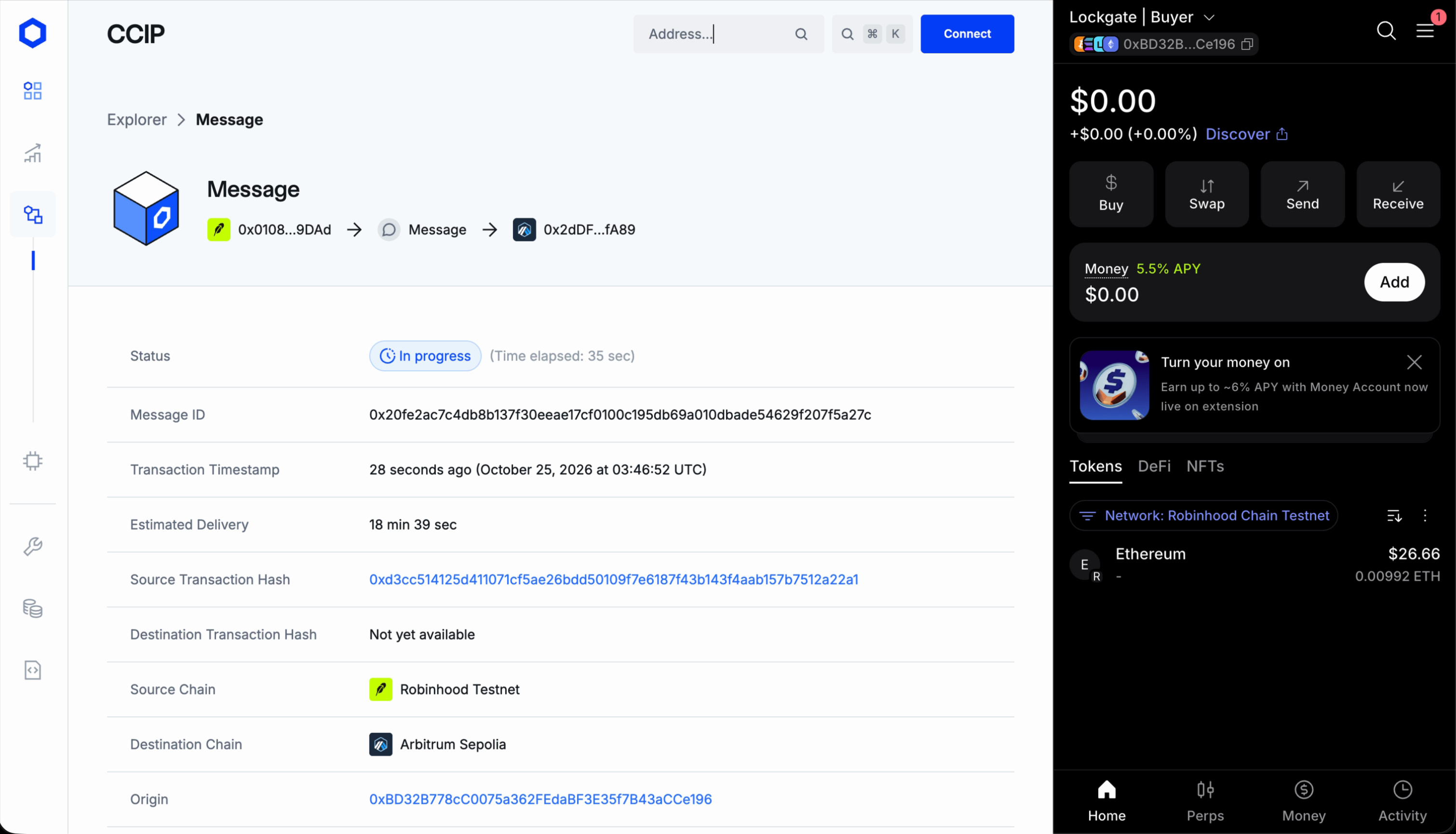
The buyer can pay in USDG on Arbitrum or in stock tokens on Robinhood Chain. Stock tokens sit in escrow on Robinhood Chain and are released over Chainlink CCIP once the deed moves on Arbitrum.
The fund's paying agent is in the loop: it confirms and locks the claim, and pays on the payment date as it always would.
Nothing about the fund changes. No new units, no NAV impact, and no liquidity is drained from the fund.
Only admitted, whitelisted parties can hold a deed, so the fund's investor rules hold.
Fund identifiers (ISIN, custodian, transfer agent) travel with the claim.
Piece | Where |
|---|---|
Deed, settlement, consents, payout route | Arbitrum Sepolia |
Buyer eligibility enforced inside settle | Chainlink ACE policies |
Deed records + stock-token escrow | Robinhood Chain testnet, over Chainlink CCIP |
Paying-agent portal: claim book, lock, pay | founder-house.lockgate.finance |
Holder, buyer and operator apps, testnet run page | founder-house.lockgate.finance |
Tests + browser end-to-end journey | CI on every push |
A fee on every settlement, shared with the distributor who brought the deal. Every fund we onboard makes the next deal cheaper: buyers learn the claim type, and later deals price faster.
Start with funds, scale through distributors.
Funds first. Small and mid-size private credit funds. Their paying agent signs on once, and every holder in the redemption queue gets an exit without draining fund liquidity.
Buyers lined up early. Credit funds buying claims, because every fund asks about liquidity first.
Then distributors. One wealth platform or distributor brings many funds' holders.
The RWA capital and the tokenized-fund issuers are here. Arbitrum is the clearing layer, Robinhood Chain brings stock-token buyers, and at scale we plan a permissioned Orbit chain with Stylus running the settlement logic.
A licensed operator and a design-partner fund whose paying agent signs off on transfers.
The first real settlement.
20 conversations in the next 2 weeks across holders, credit-fund buyers and fund administrators.
Atomic settle on Arbitrum Sepolia (deed to buyer, USDG to holder, one transaction): 0xa741aa65…f5f91d
Chainlink CCIP, Arbitrum Sepolia → Robinhood Chain testnet (deed record): 0x62686170…4ea01
Chainlink CCIP, Robinhood Chain testnet → Arbitrum Sepolia (AMD stock-token lock for the $2k deal): 0x20fe2ac7…5a27c
Chainlink CRE checks run as the official CLI simulation (cre workflow simulate): the paying agent's lock, and all three consents before settle.
Contract | Address |
|---|---|
LockgateSettlement: claims, paying-agent lock, offers, three consents, atomic settle, payout |
|
LockgateDeed: the Redemption Deed, frozen except inside a settlement |
|
Test USDG: the cash leg |
|
Chainlink ACE PolicyEngine: runs the compliance policies inside settle |
|
Chainlink ACE IdentityRegistry: participant identities |
|
Chainlink ACE CredentialRegistry: eligible-buyer credentials |
|
LockgateSettlementExtractor: hands settle parameters to the ACE policies |
|
ACE policy: buyer must hold a valid credential |
|
ACE policy: only an admitted operator issues credentials |
|
ACE policy: per-deal ticket cap |
|
ACE policy: emergency pause |
|
ACE policy: explicit reject list |
|
LockgateDeedPublisher: sends the deed record to Robinhood Chain over Chainlink CCIP |
|
LockgateForeignDesk: receives stock-token locks over CCIP, settles with stock, triggers the release |
|
Contract | Address |
|---|---|
LockgateSettlement: claims, paying-agent lock, offers, three consents, atomic settle, payout |
|
LockgateDeed: the Redemption Deed, frozen except inside a settlement |
|
Test USDG: the cash leg |
|
Chainlink ACE PolicyEngine: runs the compliance policies inside settle |
|
Chainlink ACE IdentityRegistry: participant identities |
|
Chainlink ACE CredentialRegistry: eligible-buyer credentials |
|
LockgateSettlementExtractor: hands settle parameters to the ACE policies |
|
ACE policy: buyer must hold a valid credential |
|
ACE policy: only an admitted operator issues credentials |
|
ACE policy: per-deal ticket cap |
|
ACE policy: emergency pause |
|
ACE policy: explicit reject list |
|
LockgateDeedRegistry: deed records received over CCIP |
|
LockgateStockEscrow: holds the buyer's stock tokens, releases them over CCIP when the deed moves |
|
Sample stock token: the stock-token payment leg |
|
Founder House was a growth sprint for Lockgate, not just a build. What changed in 3 days (23-25 Oct):
Product + APAC partnerships mentors (Offchain Labs) named a direct competitor and the buyer-side chicken-and-egg. We rewrote our difference: they buy a fund token from one pool; Lockgate sells an accepted redemption to many buyers.
Partnerships, product marketing and GMX mentors showed that T-bill and crypto-backed credit tokens already exit on DEXs. We narrowed the wedge to gated, permissioned private credit funds: 5% quarterly gates, whitelisted buyers only, no secondary.
From the distribution panel (Paxos, Pendle, SBI Digital Markets) and the GTM sessions: start with funds, scale through distributors. One fund's paying agent signs on once; one distributor brings many funds' holders. Product and GTM canvases rewritten around this.
Buyer outreach during the event (early): asked credit lenders and market makers how they would price an accepted claim. One market maker booked a call for 27 Oct; another replied "let's do a call"; an RWA accelerator offered a call on buyer and investor intros.
Arbitrum Foundation offered ongoing support on BD, marketing and fundraising; first call booked for 26 Oct.
A tokenized ABS issuer replied in writing: "yes it is interesting for early exit, I need to understand your terms and needs and we can plug it".
An ecosystem operator asked how the fund stays in the loop and about ISIN, custodian and transfer-agent data. We shipped those fields and a standard assignment agreement behind the terms fingerprint.
Whole repo written at the event: ported the app to EVM, Chainlink ACE eligibility inside settle, live on Arbitrum Sepolia and Robinhood Chain testnet, CCIP deed records and stock-token escrow on Robinhood Chain, an in-app testnet run page, CI with browser end-to-end tests.
New one-liner: "Exit markets for gated private credit funds." Deck rebuilt to a 9-slide demo-day format; new pitch and demo films.
20 conversations across holders and wealth platforms, credit funds as buyers, and fund admins. The goal is written yeses on both sides before the first real deal.