
Intent Inheritance Protocol
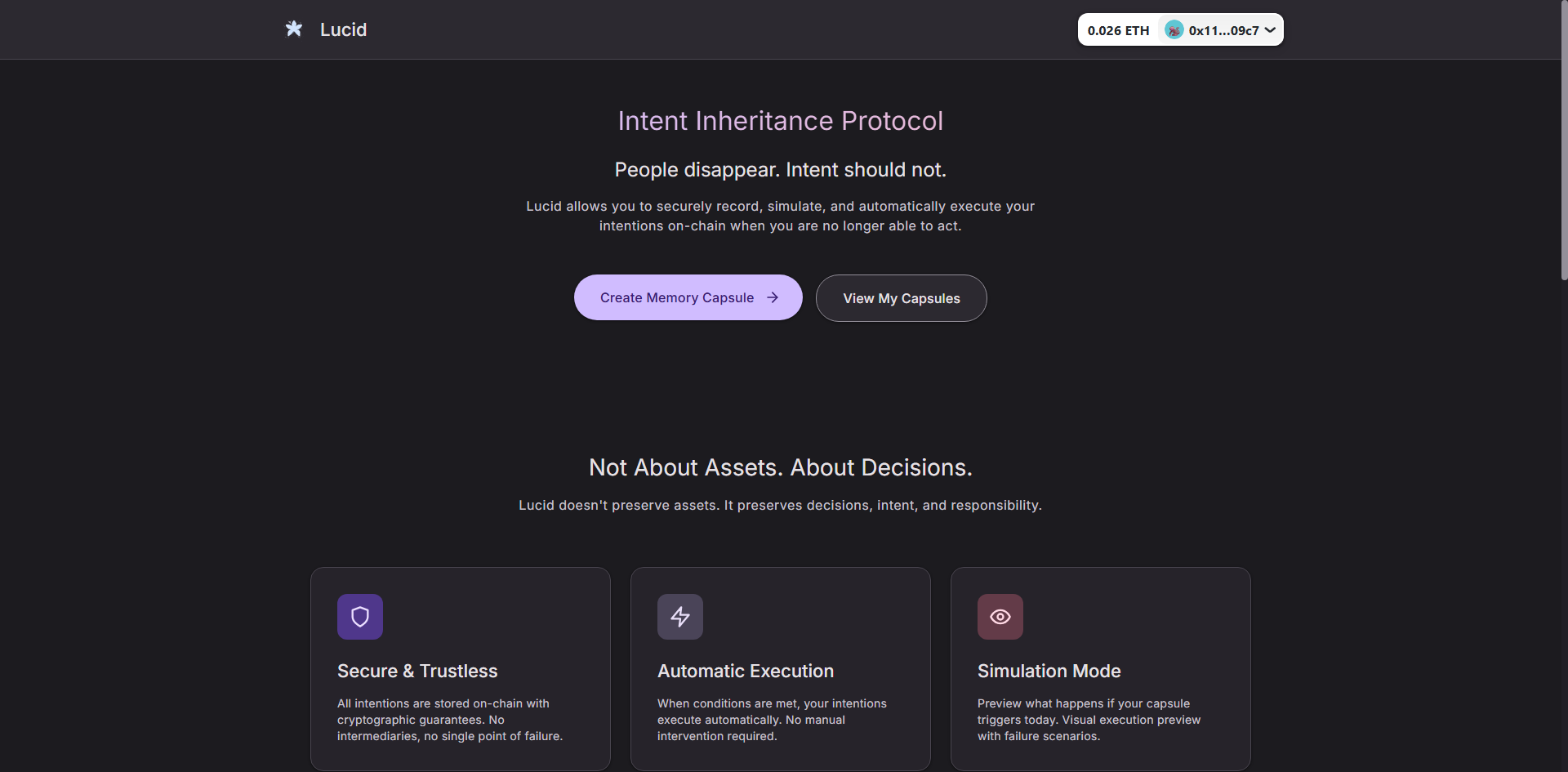
Lucid is an on-chain intent inheritance protocol that preserves and executes a user’s decisions when they can no longer act.
In Web3, wallets represent identity, assets, roles, and autonomous agents. But the moment a wallet goes silent due to inactivity, lost keys, or unexpected absence, everything stops. Assets freeze, DAO permissions remain assigned to no one, and agents continue without guidance.
Lucid ensures that a user’s intent does not disappear with their presence.
Crypto has learned how to automate assets and agents, but it has never learned how to preserve intent.
Existing solutions focus on custody, recovery, or legal inheritance. They assume off-chain processes, trusted intermediaries, or static documents. None of these work well for autonomous, on-chain systems that are meant to run continuously.
Lucid introduces a missing primitive:
programmable intent that activates only in silence.
Instead of asking “who controls the wallet?”, Lucid asks:
“What should happen when I can’t act anymore?”
Lucid allows users to define conditional intentions that remain dormant while they are active and execute automatically once predefined conditions are met.
With Lucid, users can:
Define how assets should be distributed after inactivity
Assign successor wallets or beneficiaries
Transfer or revoke DAO roles and permissions (extensible)
Pause, delegate, or terminate autonomous agents (extensible)
Intent is stored as living on-chain logic, not as a static document.
It can be updated anytime before activation and executes trustlessly once triggered.
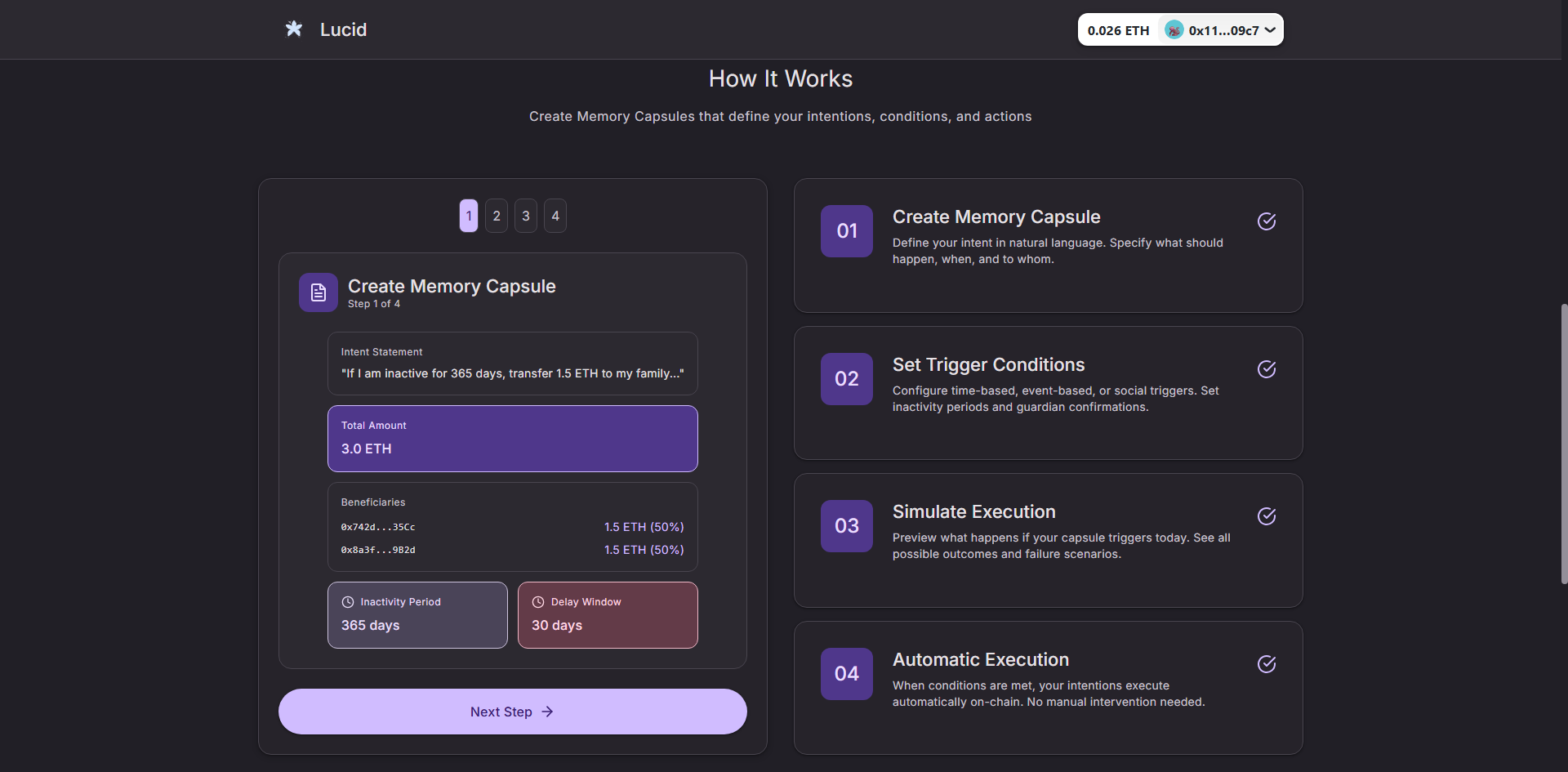
The user connects their wallet and defines an intent
The intent specifies:
An inactivity period (trigger condition)
One or more actions to execute
The intent is deployed as an on-chain contract on Arbitrum
While the user remains active, nothing happens
If the inactivity condition is met, Lucid executes the intent automatically
Lucid acts only when the user cannot.
Lucid is built on Arbitrum Sepolia to support long-lived, low-cost, and secure execution.
Low gas costs enable intent contracts to remain idle for long periods
Fast finality ensures predictable execution
Ethereum-level security guarantees trustless outcomes
Arbitrum makes silent execution feasible.
The Lucid MVP is deployed on Arbitrum Sepolia.
Connect your wallet to the Lucid interface
Define an inactivity period and execution rules
Deploy your intent
Simulate and verify the execution outcome
Wait; Lucid only acts when silence begins
Lucid does not act when users are present.
It acts when they are absent.
By turning intent into on-chain logic, Lucid enables continuity across assets, roles, and agents without custodians, assumptions, or off-chain enforcement.
Lucid is not about death.
It is about ensuring that even in silence, intent remains clear.