
A competitive social GameFi ecosystem built on skill, rivalry, and community.
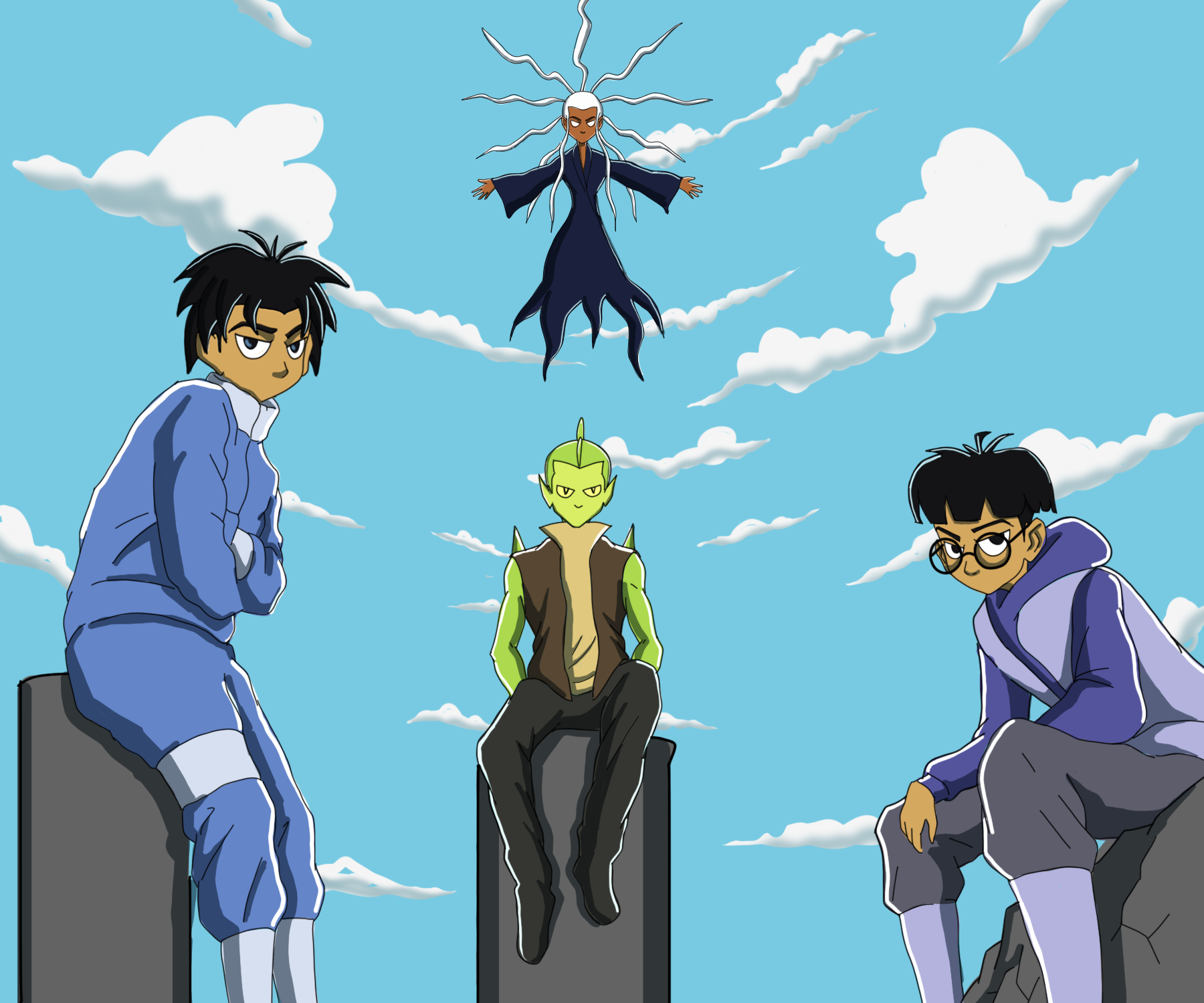
StakeWars is a competitive social game where value is created by player rivalry, reputation, and time — not token emissions.
StakeWars is built around strategic PvP battles where players compete using skill, timing, and decision-making.
Players build their identity through characters, villages, ranks, and public performance, rather than relying on passive rewards.
The Core Problem We're Solving:
Every blockchain game in the past three years has followed the same broken playbook: print tokens to reward players, attract mercenaries who extract value, watch the economy collapse under selling pressure, and see 95% of players leave within months. The $2.5 billion GameFi graveyard exists because projects prioritize speculation over genuine engagement.
Our Approach:
StakeWars is built on a simple insight: people don't play competitive games for money—they play for status, rivalry, and social recognition. League of Legends, Fortnite, and Valorant have hundreds of millions of players who pay to play, not because they earn tokens, but because competitive games with social layers create lasting engagement through reputation and rivalry.
We've applied this principle to blockchain gaming by building an economy that generates value from competition itself, not from printing tokens.
StakeWars features deep tactical gameplay inspired by competitive card games and turn-based RPGs:
20 unique characters across 4 rival villages (Hidden Leaf, Sand, Mist, Cloud)
Stamina-based combat system - manage 100 stamina across offensive and defensive abilities
Progressive cooldowns - prevents ability spam, rewards strategic planning
Defense inventory limits - maximum 2 defenses, no duplicates, forcing timing decisions
Damage variance with critical hits - adds tactical depth while maintaining skill primacy
Every match is a battle of resource management, prediction, and tactical execution. Better players win consistently—not those who spend more.
StakeWars isn't just a game—it's a competitive social network where your identity and reputation matter:
1. Rank System with Decay
Advance through ninja ranks (Academy Student → Kage Candidate → Legendary)
Ranks decay with inactivity - your status must be constantly defended
Public rankings tied to your social identity (Google/X/Email via Privy)
Progression unlocks strategic options, not raw power (maintains skill-based balance)
2. Village Faction Warfare
Four villages compete as teams in ongoing territorial rivalry
Village-specific events, strategic tools, and collective achievements
Inter-village tournaments create tribal loyalty and long-term engagement
3. Guild System
Form or join guilds (clans) with shared identity and goals
Guild leaderboards showcase collective dominance
Team-based tournaments and collaborative competition
Guild vs. guild rivalries generate organic content and retention
4. Spectator Economy & Viral Loops
Watch matches live or view replays
Share clutch moments directly to X/Twitter
Top players build followings and legendary reputations
Social proof drives organic growth and community engagement
This social infrastructure creates what traditional GameFi lacks: network effects. Once players join guilds, build rivalries, and establish reputations, they can't leave without losing their social capital.
Unlike traditional GameFi projects that rely on inflationary token emissions, StakeWars generates protocol-owned revenue from competitive gameplay itself and redistributes real yield to skilled, loyal players.
How Value Enters the System:
Free Entry Path:
First character is FREE (zero barrier to entry)
400 CHAKRA starter allocation (can compete immediately)
Casual PvP earns XP and CHAKRA through performance
Community tournaments for pure social clout (no fees required)
Competitive Revenue Generation:
Optional tournament entry fees (players who want higher stakes)
Winner takes 95% of prize pool, platform takes 5%
Character unlocks cost 1,000 CHAKRA (60% burned, 40% to treasury)
Platform fees fund development, prizes, and yield distributions
STAKEWARS ECONOMIC ENGINE
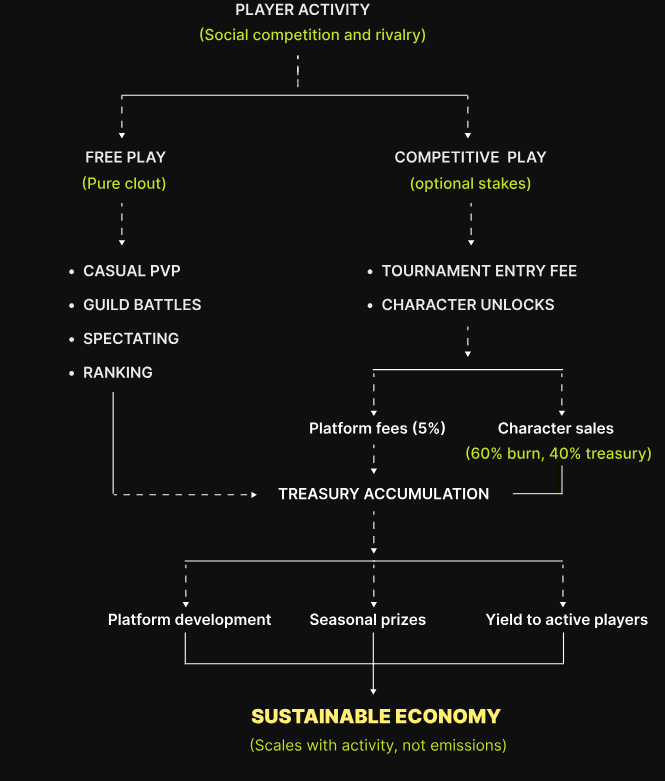
Figure 1. Business Model Flow Chart
Critical Innovation: The Economy Scales Safely
StakeWars' economy scales down safely under low activity, with rewards naturally adjusting to gameplay volume instead of relying on fixed emissions or speculative demand.
Low activity → Lower tournament pools → Lower rewards → Economy remains stable
High activity → More fees → Larger treasury → More sustainable yield → Economy thrives
Burns from character unlocks create deflationary pressure that scales with adoption
This is the opposite of traditional GameFi:
Old model: Activity drops → Fixed emissions continue → Death spiral
StakeWars: Activity drops → Rewards adjust organically → Economy survives
All yield in StakeWars comes from actual protocol revenue—never from token printing.
Character Commitment Yield (Planned):
Temporarily commit characters to competitive seasons
Earn share of platform fees based on:
Match participation and completion rate
Competitive performance (wins, ranking)
Season contribution and consistency
High-skill, high-activity players earn more
Idle characters earn nothing (no passive farming)
Treasury Participation (Planned):
Portion of treasury (40% from character sales) distributed to ecosystem contributors
Activity-based allocation (not passive staking)
Rewards skilled players who drive platform value
Capped distributions ensure long-term sustainability
Key Principle: Yield rewards contribution, not capital. You can't buy your way to earnings—you must compete and win.
Blockchain Infrastructure:
Network: Mantle (low gas fees, EVM compatibility)
Smart Contracts:
ERC-1155 for character NFTs (owned, tradeable, progression-linked)
ERC-20 for CHAKRA token (deflationary, utility-focused)
On-chain win/loss tracking (verifiable competitive history)
Reward distribution contracts (transparent, auditable)
Frontend & UX:
Platform: Next.js/React web application
Authentication: Privy (Google/X/Email social login—no wallet friction)
Styling: Tailwind CSS (modern, responsive design)
Backend: Firebase (Firestore for game state, Functions for serverless logic)
Web3 Integration: Viem + Wagmi (type-safe blockchain interactions)
Current Build Status:
✅ Full PvP combat system (playable)
✅ Character minting and ownership (ERC-1155)
✅ CHAKRA token contract (ERC-20)
✅ Reward claiming mechanism
✅ On-chain win/loss tracking
✅ Complete UI/UX for all gameplay modes
🚧 Tournament smart contracts (in development)
🚧 Guild system contracts (in development)
🚧 Yield distribution contracts (designed, not yet deployed)
StakeWars proves three critical points:
Blockchain games don't need to pay players to retain them - Social rivalry and competitive status are more powerful than token incentives
Sustainable tokenomics are possible - Revenue from competition, deflationary burns, and activity-scaled rewards create stable economies
Web2 UX is achievable on Web3 - Free entry, social login, and zero wallet friction eliminate adoption barriers
We're not building "Axie 2.0" or another play-to-earn ponzi. We're building the first blockchain game where players compete because they want to—not because they're paid to.
Product Testing:
Closed beta with 50-200 testers
Bug fixes and balance adjustments
Community feedback integration
Stress testing for tournaments and matchmaking
Social Infrastructure:
Launch guild system and village rivalries
Deploy rank decay mechanics
Enable spectator mode and match sharing to X/Twitter
Organize community tournaments (pure clout, no fees)
Target: 1,000 DAU, 4 active guilds, stable beta performance
Mainnet Deployment:
Deploy all smart contracts to Mantle Mainnet
Migration from testnet to production
Security audits and final testing
Public launch announcement
Competitive Features:
Deploy tournament smart contracts (wager system)
Launch ranked seasons with leaderboards
Character unlock marketplace integration
First sponsored tournament ($1K+ prize pool)
Target: 3,000 DAU, break-even revenue, successful mainnet launch
Community & Partnerships:
Ecosystem partnerships and integrations
Gaming guild collaborations
Influencer partnerships and content creators
Cross-promotion with Mantle ecosystem projects
Sustainable Economics:
Activate character commitment yield (fee-backed)
Revenue-sharing seasons for top guilds
Mobile optimization for broader reach
Advanced tournament formats and prize structures
Target: 5,000+ DAU, profitable operations, established competitive scene
StakeWars represents a fundamental rethinking of what blockchain gaming can be. Instead of asking "how do we pay players to play," we ask "how do we make players care about winning?"
The answer lies in what traditional gaming has known for decades: competitive games with social layers create engagement that transcends financial incentives. Ranks, guilds, rivalries, and reputation keep players engaged for years—not months.
By combining this social competitive layer with sustainable, fee-backed economics, StakeWars offers a path forward for the entire GameFi industry: build real games with real retention, and use blockchain to ensure fairness, ownership, and transparent value distribution.
Short-term: A thriving competitive community of 5,000+ daily players who compete for status, reputation, and real rewards
Medium-term: A self-sustaining ecosystem where top players earn meaningful income from skill-based competition, not speculation
Long-term: The proof that blockchain gaming works when you prioritize engagement over extraction, and social status over token price
[Live Demo Link]
[GitHub Repository]
[Twitter/X]
StakeWars is more than a game—it's a competitive social network where every match matters, every rivalry tells a story, and every player has the chance to build a legendary reputation.
No upfront investment. No wallet required. Just skill, strategy, and the will to dominate.
Welcome to the battlefield.