
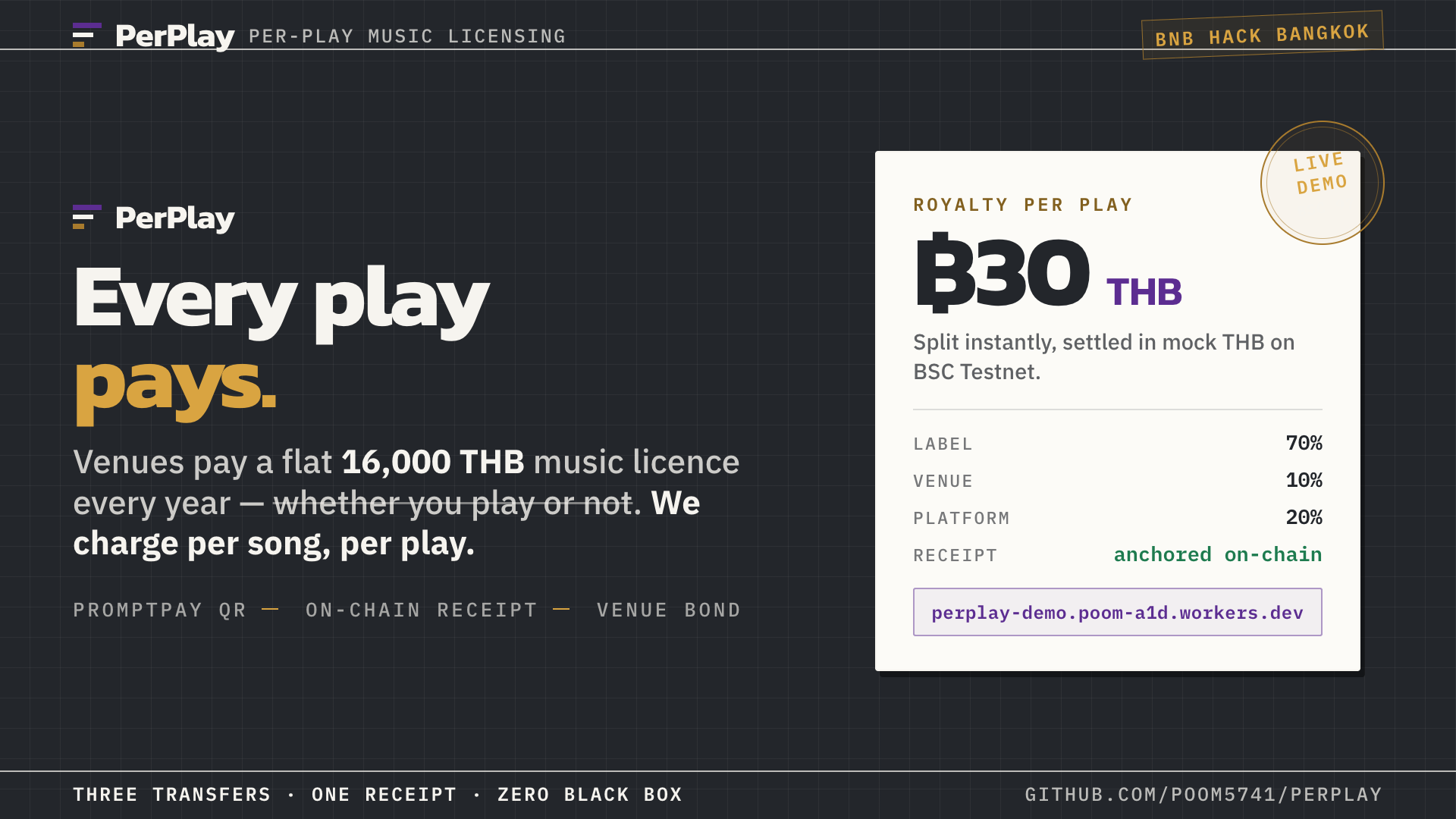
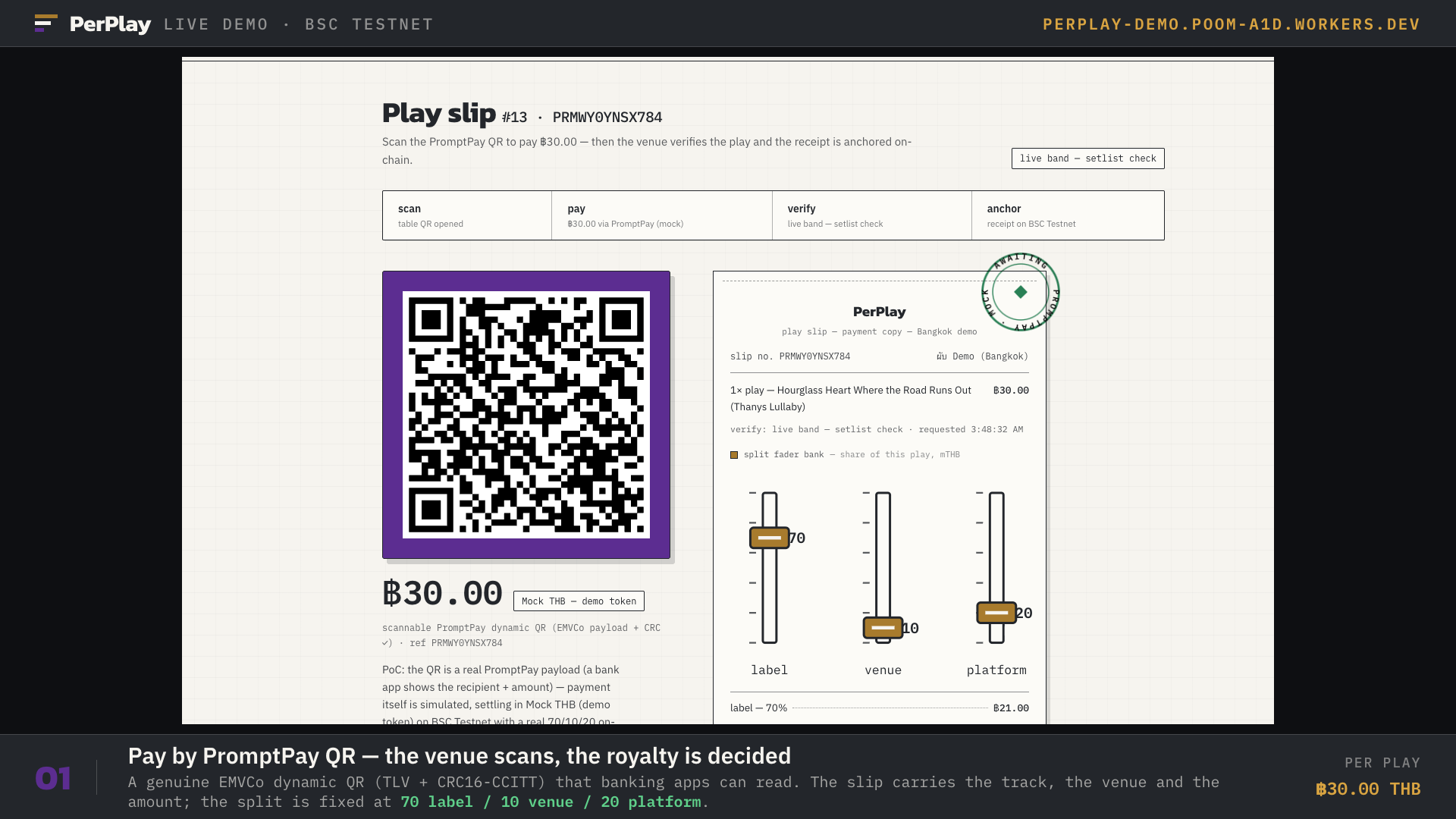
PerPlay turns music licensing into a per-play transaction: a fan scans a QR at the venue table, pays ฿30 via real PromptPay, the play is verified against tonight's setlist, and the 70/10/20 split sett
Pain Point:
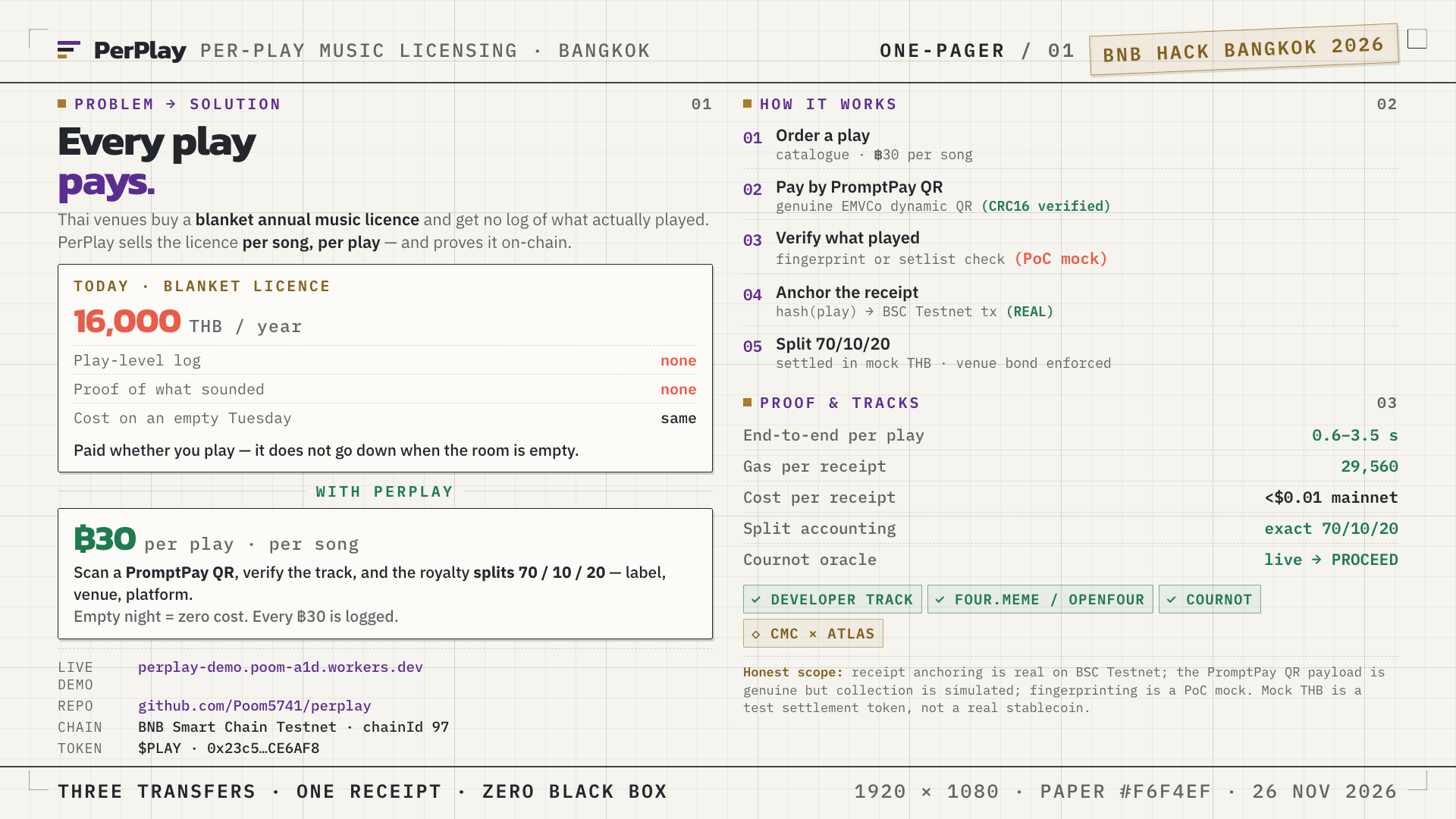
A small Bangkok bar pays a flat 16,000 THB/year blanket fee for music licensing – the same bill on a sold-oout Saturday as on an empty Tuesday, and no log of which song actually played, so the venue earns nothing from it and the artist gets nothing per play. Across the industry the same model holds: labels cannot see what played. The country's biggest label (GMM Grammy) asked for per-play licensing years ago; the project bird because pre-COVID tech could not settle a 20-50 THB micro-payment per play or prove which song actually sounded.
How the integration works:
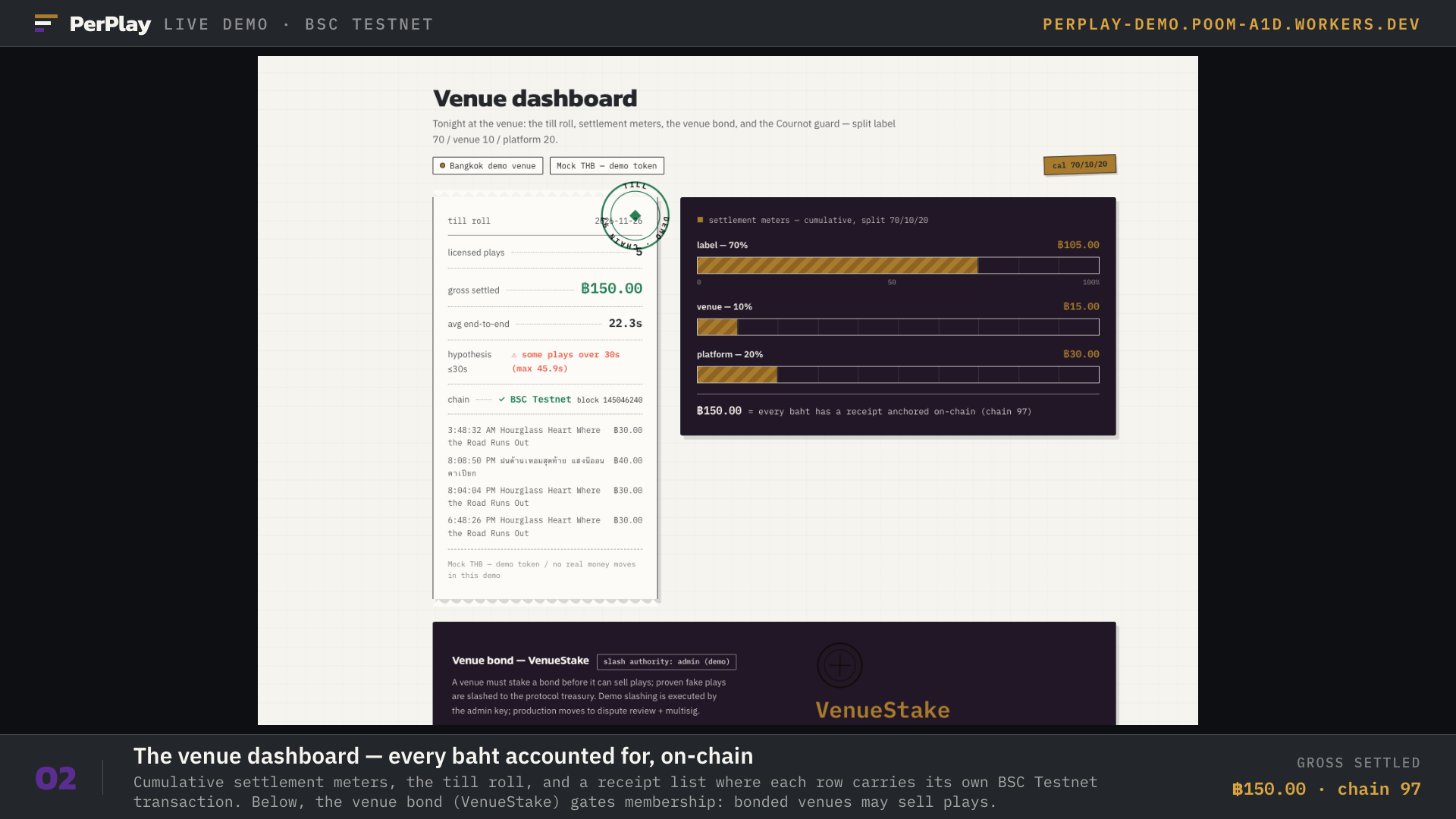
BNB Smart Chain is the settlement layer. The API writes a real data transaction on BSC Testnet 97 containing the canonical play event (song id, amount, split amount, verification result); its hash becomes the receipt id that the venue screen, the artist dashboard and the explorer all resolve to.
Usability:
No app, no account, no wallet. A customer at the table scans one QR and pays ฿30 in their own banking app. The venue screen flips to "licensed, paid, anchoring on-chain" before the chorus, so proof of license is visible to the room — not buried in a dashboard. A judge can hold verifiable on-chain evidence on their own phone within 30 seconds. The owner's economics are shown as a before/after: 16,000 THB/year fixed, versus 2,640 THB/month to the venue at 40 requests a night, on top of what it already earns.
Open source:
The whole repo is public, and it was built with two AI brains: a repo-resident agent committing every product decision (visible in the agent-authored decisions log in the git history) and a cloud memory brain that recalls why each choice was made, with sources. The demo video itself was produced by a reproducible Node + ffmpeg pipeline that lives in the repo.
Sustainable business:
15,000+ licensed entertainment venues in Thailand, starting from the country's biggest label. 50 venues ≈ 250K THB/month at 96% per-play margin. The venue's blanket fee becomes a revenue share (10% of every play), turning a cost centre into income.
What we build as MVP for this pain point and submitting on this hackathon is a working per-play licensing flow on BNB Smart Chain:
- Real EMVCo PromptPay QR payload – scannable by Thai banking apps
- Setlist-based verification for live bands, audio-fingerprint corroboration for DJ mode works for song request from bar guests (and paid by bar guests)
- 70/10/20 split (label / venue / platform) settled as three real MockTHB transfers
- Each play receipt hash-anchored as a data transaction on BSC Testnet
- VenueStake contract: a venue must post 1,200 mTHB collateral before it can sell a play: a faked play slashes the stake (HTTP 402 to sell without a bond, HTTP 409 for an unregistered song)
- $PLAY launched through our own OpenFour fork, where staked liquidity is pledged to settlement rather than only traded
We will present this to GMM Grammy (The Thai music label) and they might provide some funding for us to develop and launch this project. Hopefully 🥹