
Regen Bazaar
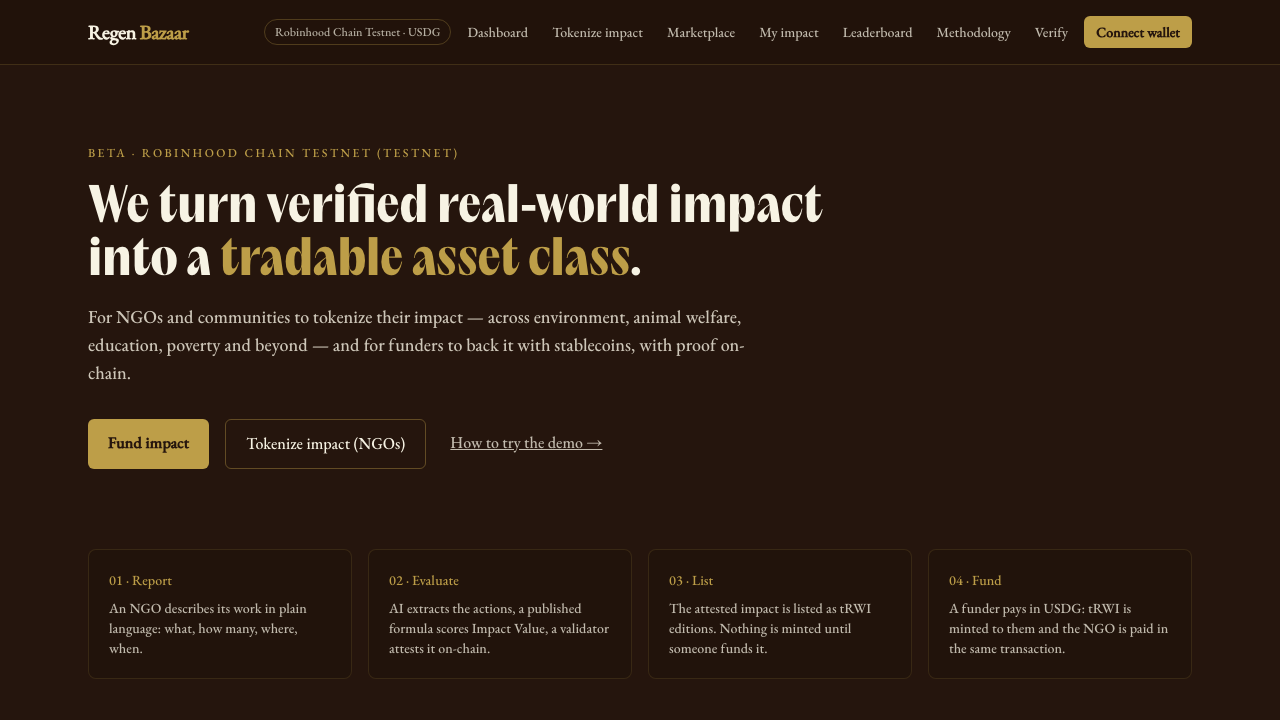
NGOs turn verified real-world impact into tRWI tokens that anyone can fund in Paxos USDG. AI extracts, a transparent formula scores, EAS attests on-chain, and the NGO is paid in the same transaction.
Videos
Tech Stack
Description
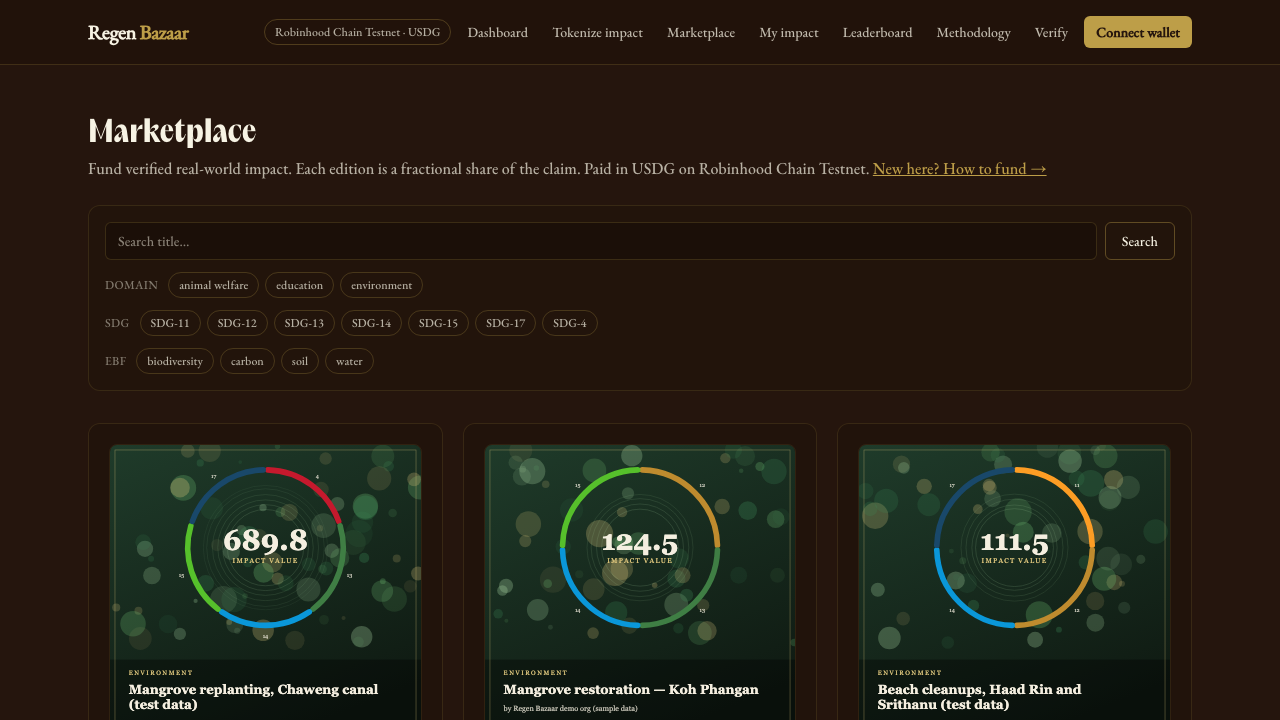
Regen Bazaar is a marketplace for tokenized real-world impact (tRWI). Small NGOs and community groups do measurable good (reforestation, cleanups, animal rescue, education) but cannot turn that work into something a funder can buy, hold and verify. Regen Bazaar closes that gap on Arbitrum.
Demo video (5 min): https://www.loom.com/share/a69dc479cec34ad3a5499168db8b7d77
How it works: an NGO describes its work in plain language. An LLM extracts the actions (the report is treated strictly as data and the output is validated). A deterministic, versioned formula (methodology v0.2) computes the Impact Value; the LLM never scores. A validator checks the public proof, sets a proof level (P0 to P4) and approves; the platform pins metadata and a generated artwork to IPFS and attests the claim on-chain with EAS. Funders buy fractional editions as tRWI (ERC-1155) and pay in Paxos USDG. The token is lazily minted at purchase from a platform-signed EIP-712 voucher, and the NGO is paid in the same transaction.
One live app, one network switcher: https://app.regenbazaar.com runs on Arbitrum Sepolia and Robinhood Chain testnet (plus Celo Sepolia, the original network); the wallet switches to the chosen network. Real Paxos USDG purchase on Robinhood Chain testnet, 97.5% paid straight to the NGO: https://explorer.testnet.chain.robinhood.com/tx/0xea4a18d20c2fc3c4ed2a46ef7681129a99b905118745ff2de9ad95609ca2ba77
No double counting: one impact report is listed on one network only, the one the organisation chose. The listing step refuses a report that is already listed anywhere, and validators see hints when a new report looks like an earlier one.
Who pays: individual funders who want proof of what they funded, companies with CSR budgets that need auditable impact purchases in a regulated-issuer stablecoin, and AI agents (public machine-readable catalogue at /api/impact). Revenue: 2.5% platform fee signed into each voucher, plus a capped royalty back to the NGO on resales.
USDG: Paxos USDG is allowlisted on both Arbitrum chains. The Paxos testnet faucet stopped dispensing on Arbitrum Sepolia from 2026-09-22 to 2026-09-26, so the Arbitrum Sepolia demo sells in tUSDG, a clearly labelled stand-in with the same interface; the contract already accepts USDG and switching is one config value.
Methodology v0.2, live since 2026-09-28: https://app.regenbazaar.com/methodology
Impact Value is Regen Bazaar's own relative index, not a certification. Each impact area (environment, animal welfare, education, poverty, social, health) gets its own score in physical units: for example mangroves go from hectares to tCO2e per year (IPCC 2019, Bernal et al. 2018), waste is counted in kg. One overall IV (sum of area scores × k) is kept for price, EAS attestation and staking. Every one of the 34 weights has a public card marked sourced, derived or assumption, with its sensitivity: https://app.regenbazaar.com/methodology/cards/mangroves_planted
Community layer: the 22 actions volunteers can deliver are scored; 12 that need capital, a licence or professionals score 0 for now.
Proof levels P0 to P4 are set only by a validator, and a report below P1 is not listed. The server fetches public proof links (https only, SSRF-protected), stores a hash snapshot and raises flags on dates, numbers and place; page text cannot change the flags, the level or the IV (covered by a prompt-injection test).
Price in USD = Impact Value × rate × proof factor × cost coefficient (1.0 to 1.5 from the costs a group declares), paid in stablecoin at that price. The rate is $1 per IV point for now.
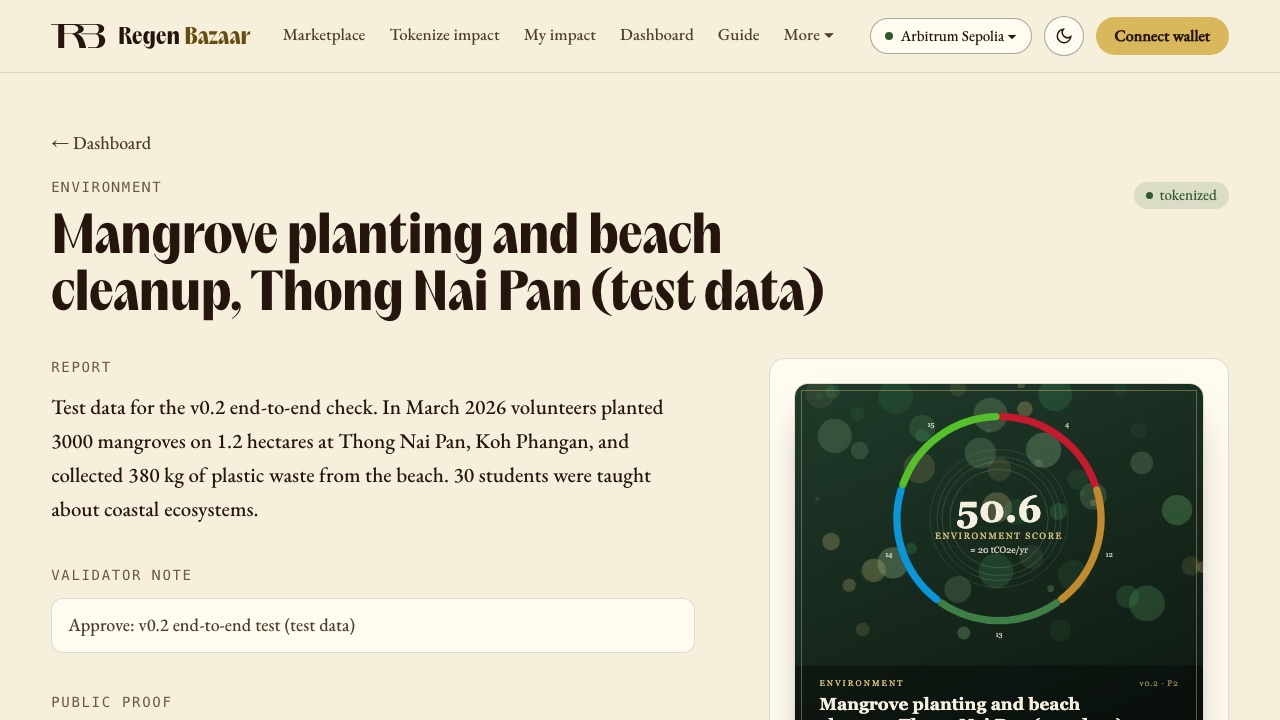
End-to-end check on Arbitrum Sepolia, 2026-09-28 (test data): v0.2 report, proof-link check, approval at P2, EAS attestation (https://arbitrum-sepolia.blockscout.com/tx/0x27b4b46eba1346a6bb76785c8d23f4046d4850e38203e07ab4811213be620b23), tRWI #10, purchase of 2 editions in tUSDG (https://arbitrum-sepolia.blockscout.com/tx/0xb49beb3138eb3e786a992cbe37476cb51f120b469e5bf2de7ef6dd58d98df488). The price, $0.5075 per edition, matched the price formula in use that day, and the IV in the token matched the database: https://app.regenbazaar.com/submission/12d4ed94-0293-44ff-93a2-aaa8b53280bf
Before Regen Bazaar we ran two single-organisation pilots of this model: Clean Phangan (community beach cleanups, Optimism) and EcoThailand Foundation (mangroves, Celo). Status: beta on testnets, no production users or revenue yet.
Contracts are source-verified (Blockscout on both chains, Arbiscan); 61 Foundry tests; OpenZeppelin 5.1. Guide: https://app.regenbazaar.com/guide
Progress During Hackathon
Built during the buildathon (https://github.com/Regen-Bazaar/regenbazaar-beta, PR #26 and follow-ups #27-#49):
Deployed and source-verified the full contract set on Arbitrum Sepolia (Blockscout + Arbiscan) and Robinhood Chain testnet (Blockscout).
USDG checkout: Paxos USDG allowlisted on both chains; real USDG purchases on Robinhood Chain testnet; labelled tUSDG stand-in on Arbitrum Sepolia, added while the Paxos faucet was not dispensing there.
One app with a network switcher (Arbitrum Sepolia, Robinhood Chain testnet, Celo Sepolia); the wallet switches to the chosen network or adds it; WalletConnect for phone wallets. The old robinhood.regenbazaar.com address redirects to it.
Multichain indexer: one network registry, per-chain listings, config-driven Ponder indexer, fix for an indexer crash loop.
Double-counting guard: one report is listed on one network only; listing refuses a report already listed anywhere; validators see duplicate hints and the evidence on the verification page.
Generative tRWI artwork: a deterministic SVG impact card drawn from the impact data, pinned to IPFS as the token image.
Buyer 'My impact' page (live holdings, Impact Value funded, retire), step-by-step /guide with test tokens for every network, public /roadmap, prices on cards, on-chain proof links.
New interface: light and dark theme, readable type, phone layout.
LLM extraction via OpenRouter, model chosen by an eval of 8 low-cost models (no invented numbers, resists prompt injection).
Public-beta safety: LLM content moderation, input validation, rate limits, validator-only approvals, link-only evidence.
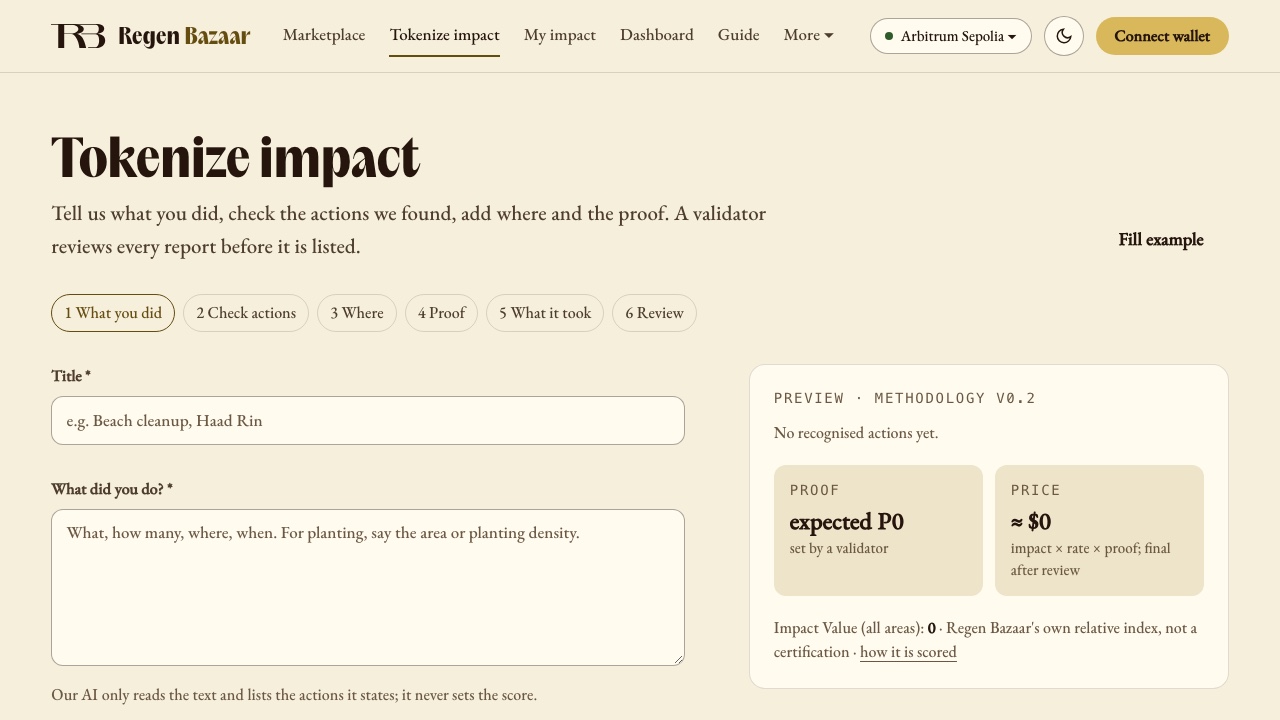
Methodology v0.2 "Community layer", live 2026-09-28 (PR #42): scores per impact area in physical units, 34 weight cards (sourced / derived / assumption), proof levels P0 to P4 set by a validator, server-side proof-link checks with hash snapshots, USD price = Impact Value × rate × proof factor × cost coefficient (1.0 to 1.5 from declared costs) (PR #49), step-by-step submission form, validator panel, per-area leaderboard. Tests: engine 62, pipeline 33, db 2.
End-to-end v0.2 check on Arbitrum Sepolia (test data): report, proof check, P2 approval, EAS attestation, tRWI #10, purchase of 2 editions in tUSDG; price and IV matched the formula in use that day.
Before the buildathon (not claimed): the Impact Value engine, the contract set and its June 2026 self-audit, a Celo Sepolia deployment.
Fundraising Status
Bootstrapped, not raised.