
DeFi tokenized the asset side of finance but has no repo - the backbone of institutional funding. Repo Protocol brings title transfer and rehypothecation on-chain. The missing funding primitive.
Repo Protocol is the first on-chain implementation of repurchase agreement (repo) mechanics — the $4.6T/day funding infrastructure that powers institutional finance, now built as smart contracts on Arbitrum.
DeFi has successfully tokenized $9B+ in real-world assets (BlackRock BUIDL, Franklin FOBXX, Hashnote USYC). But these assets sit idle — there is no on-chain structure for institutions to generate yield from them the way they do in traditional finance.
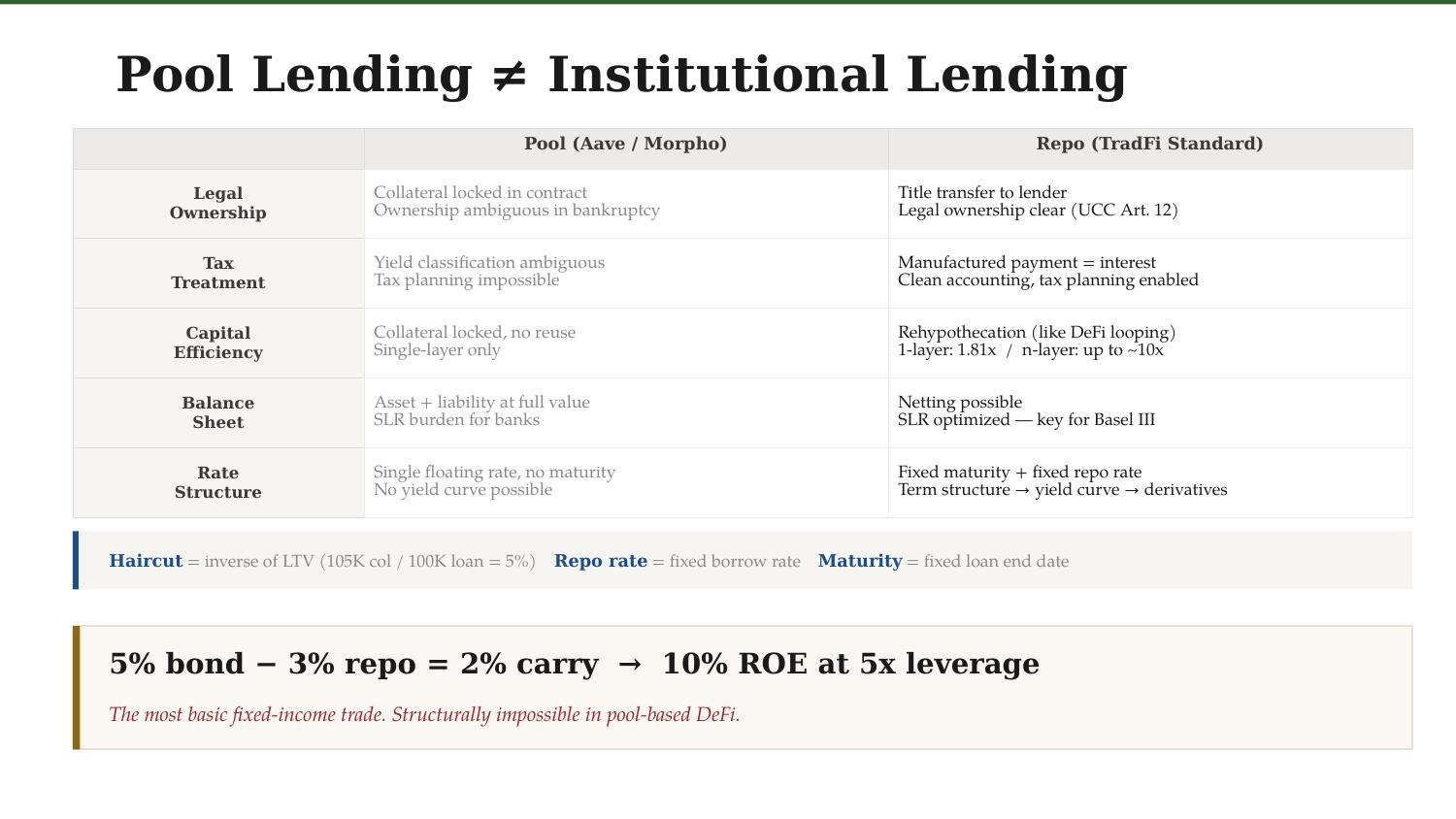
Current DeFi lending (Aave, Morpho) is pool-based. For institutions, this model fails on five critical dimensions: legal ownership is ambiguous (collateral locked in contracts), tax treatment is unclear (no manufactured payment logic), capital efficiency is limited (no rehypothecation), balance sheet treatment is unfavorable (no netting for Basel III/SLR), and there is no term structure (floating rates only, no yield curve).
In TradFi, all five problems are solved by one instrument: repo. On-chain, repo does not exist. Until now.
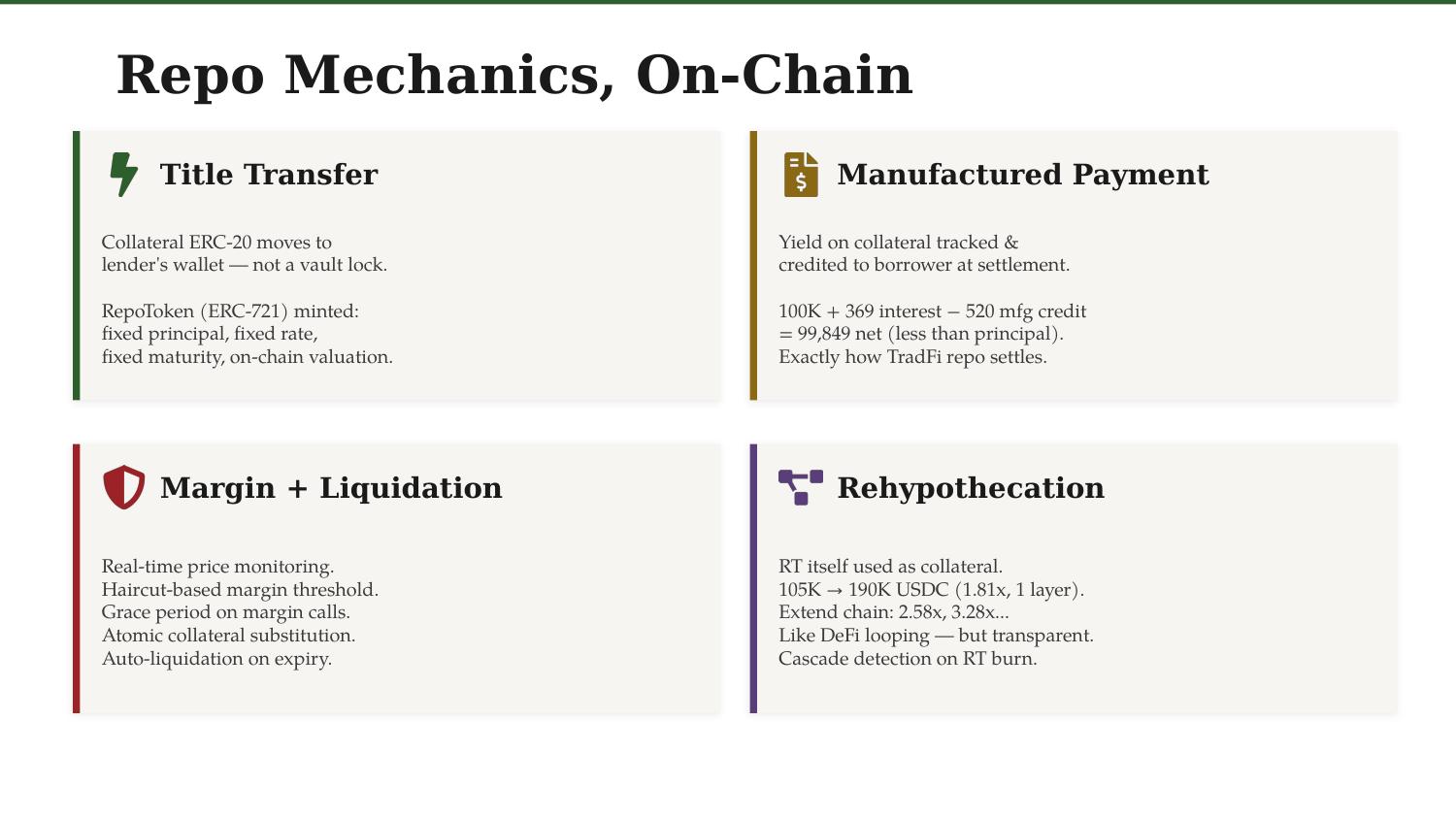
Repo Protocol implements core repo mechanics as Solidity smart contracts:
Title Transfer — Collateral ERC-20 tokens physically move to the lender's wallet (not vault-locked). A RepoToken (ERC-721) is minted representing the lender's claim with fixed principal, fixed rate, and fixed maturity.
Manufactured Payments — Yield accruing on collateral during the repo term is tracked and credited to the borrower at settlement, exactly mirroring TradFi repo economics.
Margin & Liquidation — Real-time price monitoring with haircut-based thresholds, grace periods, atomic collateral substitution, and auto-liquidation.
Rehypothecation — RepoToken itself can be posted as collateral for new repos. One layer achieves 1.81x capital efficiency (105K USYC → 190K USDC). Chain extends like DeFi looping — but fully transparent on-chain.
Cascade Detection — When a base repo settles and the RT burns, downstream repos receive automatic margin calls. The entire rehypothecation chain is auditable and programmable.
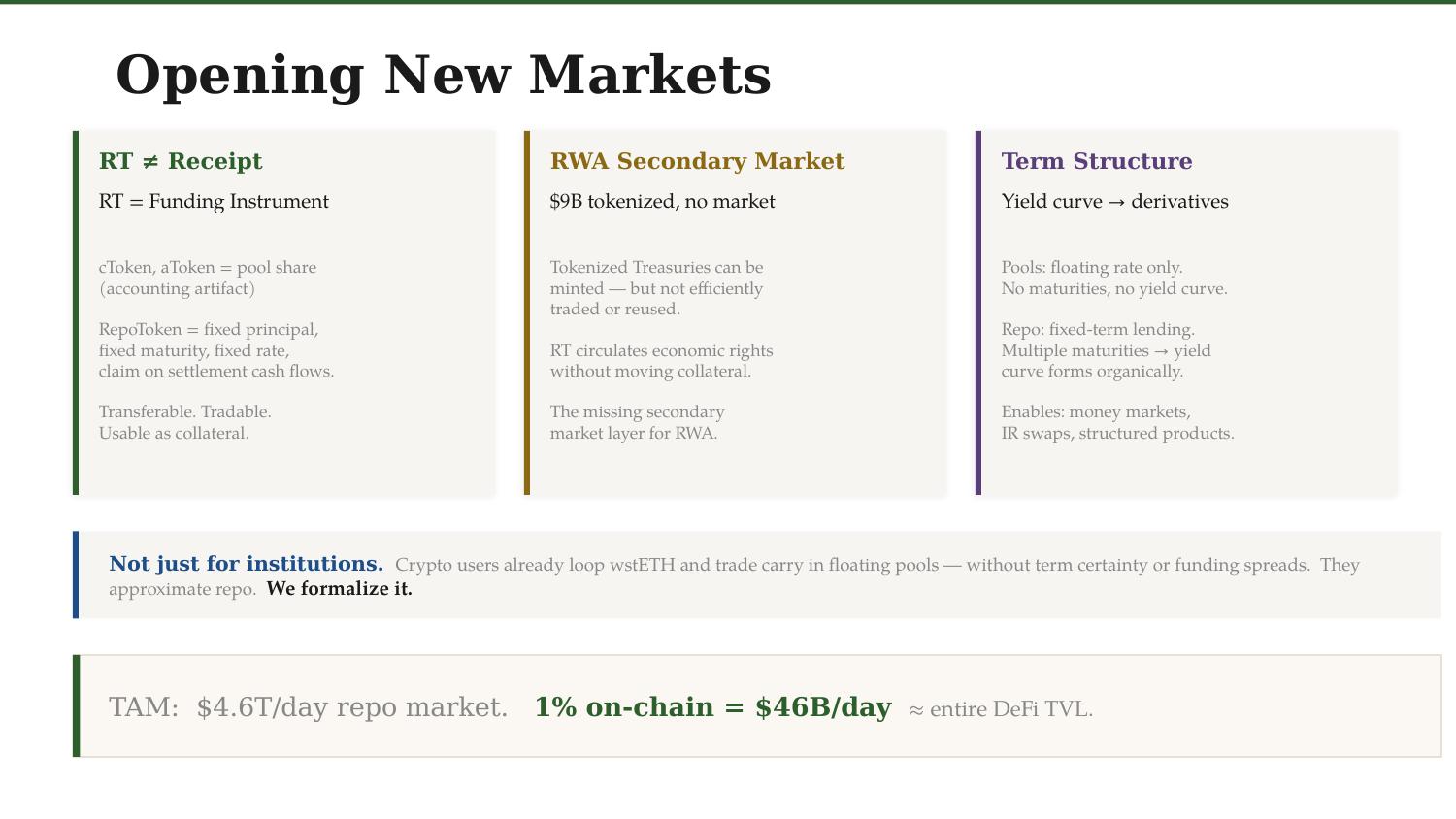
This is not a better lending protocol. It is the missing funding primitive that enables:
RWA Secondary Markets — RT circulates economic rights without moving collateral, creating liquidity for $9B in tokenized assets that currently have no secondary market.
Term Structure — Fixed-maturity repos form yield curves organically, enabling money markets, interest rate swaps, and structured products that DeFi has never had.
Solidity 0.8.24 · Foundry · Arbitrum Sepolia · OpenZeppelin ERC-721 · ethers.js v6 · MetaMask
6 contracts deployed on Arbitrum Sepolia: RepoServicer, RepoToken, MockUSDC, MockUSYC, MockUSTB, PriceFeed
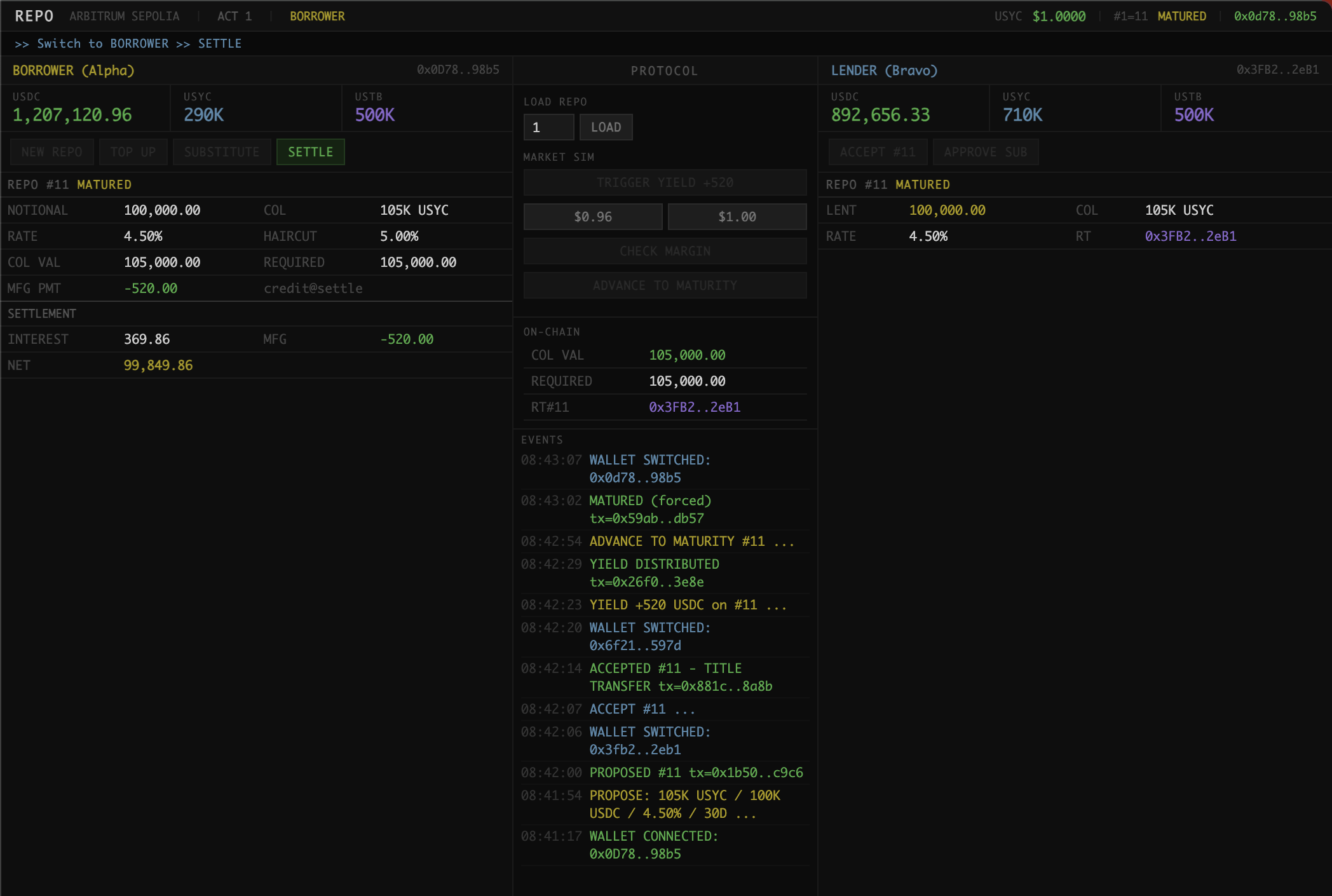
Full repo lifecycle: propose → accept → margin call → top up → collateral substitution → mature → settle
Rehypothecation with cascade detection and force liquidation
Manufactured payment calculation and settlement netting
Single-page Bloomberg Terminal-style UI
3-wallet demo flow (Borrower / Lender / Charlie)
Act 1: Core repo lifecycle (11 steps) — title transfer, yield distribution, margin call, collateral substitution, settlement
Act 2: Rehypothecation with scenario selection
Scenario A: Normal unwind (settle rehypo first → clean exit)
Scenario B: Cascade risk (settle base first → RT burned → downstream liquidation)
18 total demo steps, all functional on testnet
All contracts verified on Arbitrum Sepolia
Live interactive demo connected to deployed contracts via MetaMask
Multi-maturity repos for yield curve formation
Orderbook or matching engine for repo market discovery
Integration with existing RWA tokens (BUIDL, USYC)
Mainnet deployment
Self funded. Looking for a grant.