
RNA therapeutics will define the next decade of medicine, turning RNA inverse-folding into a continuously contested public market.

Ribosome Network: A Synthetic Ribosome for the Decentralized RNA Era
Every modern mRNA vaccine, every therapeutic aptamer, every engineered ribozyme begins with the same hard problem. Someone has to design an RNA sequence that folds into a precise three-dimensional shape inside a living cell. Get the fold wrong and the molecule degrades before it reaches its target. Get it right and you have a candidate worth a clinical trial. For decades that design work has lived inside a handful of pharma labs and a smaller handful of academic groups, gated by compute, by expertise, and by access to folding oracles. Ribosome Network takes that bottleneck and turns it into an open, verifiable, continuously contested market. The result is not just faster drug discovery. It is a measurable, public curve of how good humanity actually is at designing RNA, updated every 15 minutes, comparable across labs and across years.
The Stakes: Why RNA Folding Is the Real Bottleneck
The mRNA vaccines that reshaped the pandemic response worked because their sequences were tuned for stability, not just for translating the spike protein. Degradation rates track structural stability. A single misplaced base pair can turn a working therapeutic into a molecule that falls apart in the lipid nanoparticle before it ever reaches a cell. The same is true for riboswitches that sense metabolites in living bacteria, for aptamers that bind thrombin in clotting disorders, for CRISPR guide RNAs that must hold their shape long enough to direct a cut. In every case the design space is astronomical, four raised to the power of the sequence length, and the only way to know if a candidate folds is to fold it. Folding is expensive. Verification, once an oracle exists, is cheap. That asymmetry is exactly what a Bittensor subnet is built to enforce, and it is exactly what no single lab can sustain alone.
What We Built
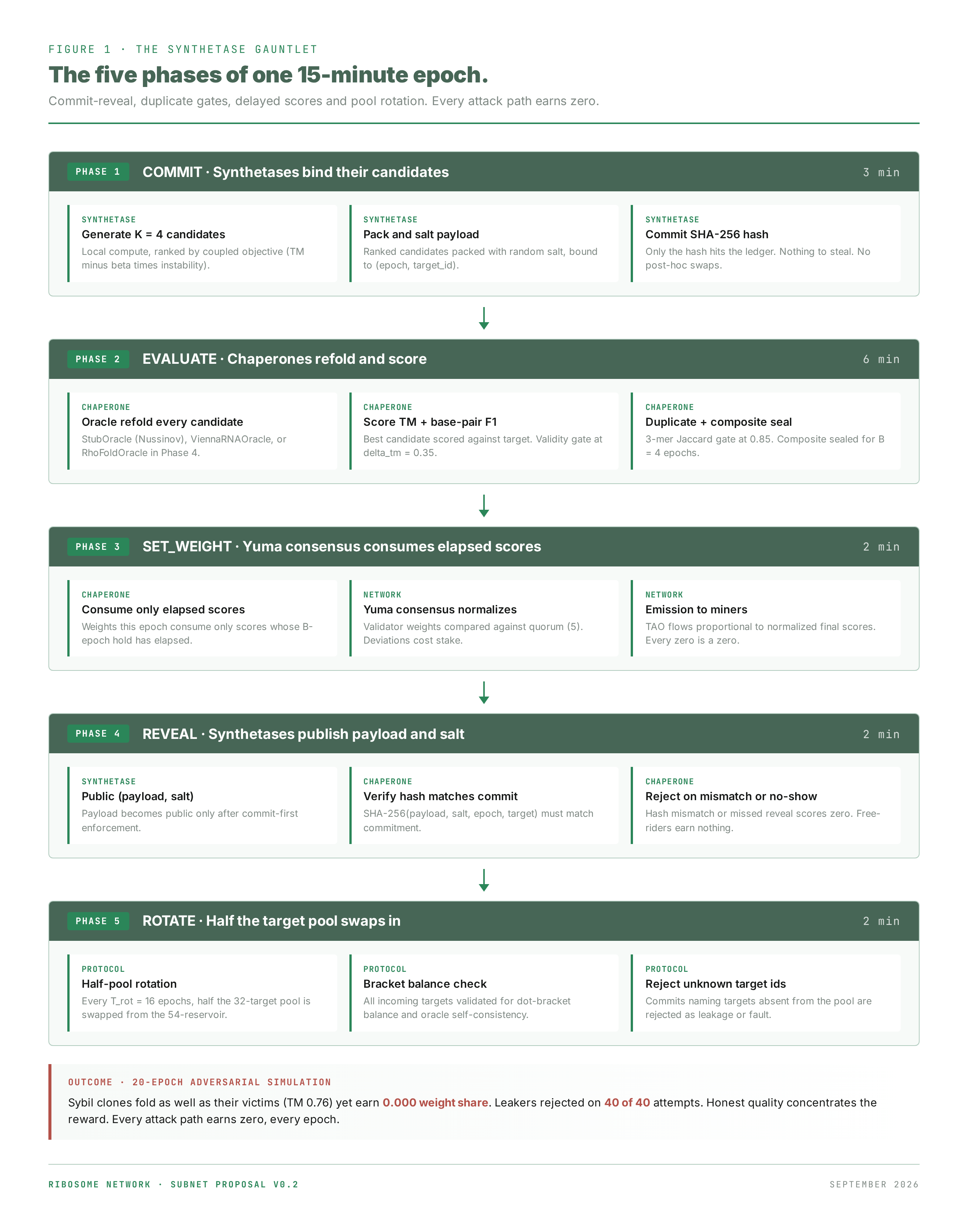
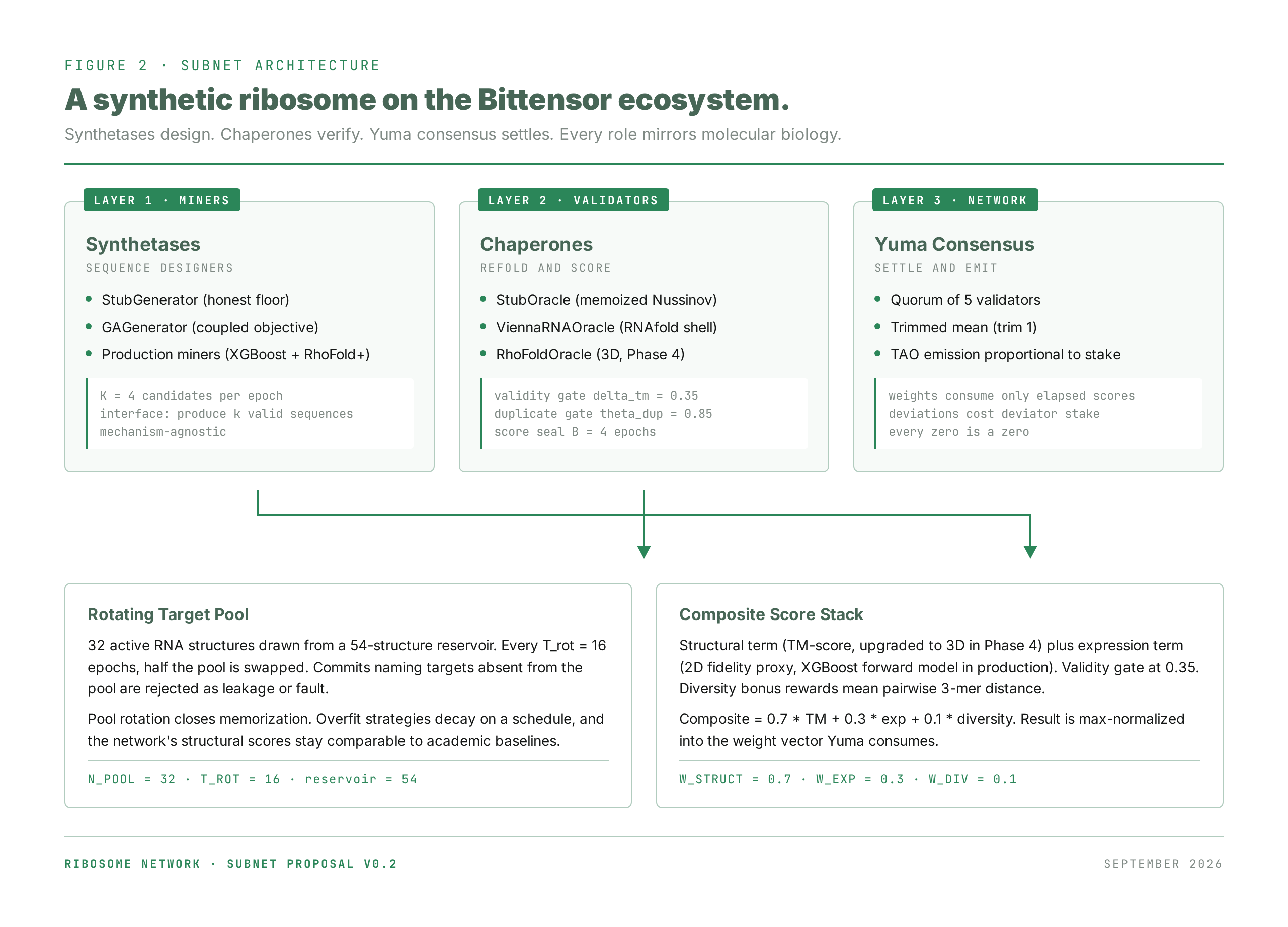
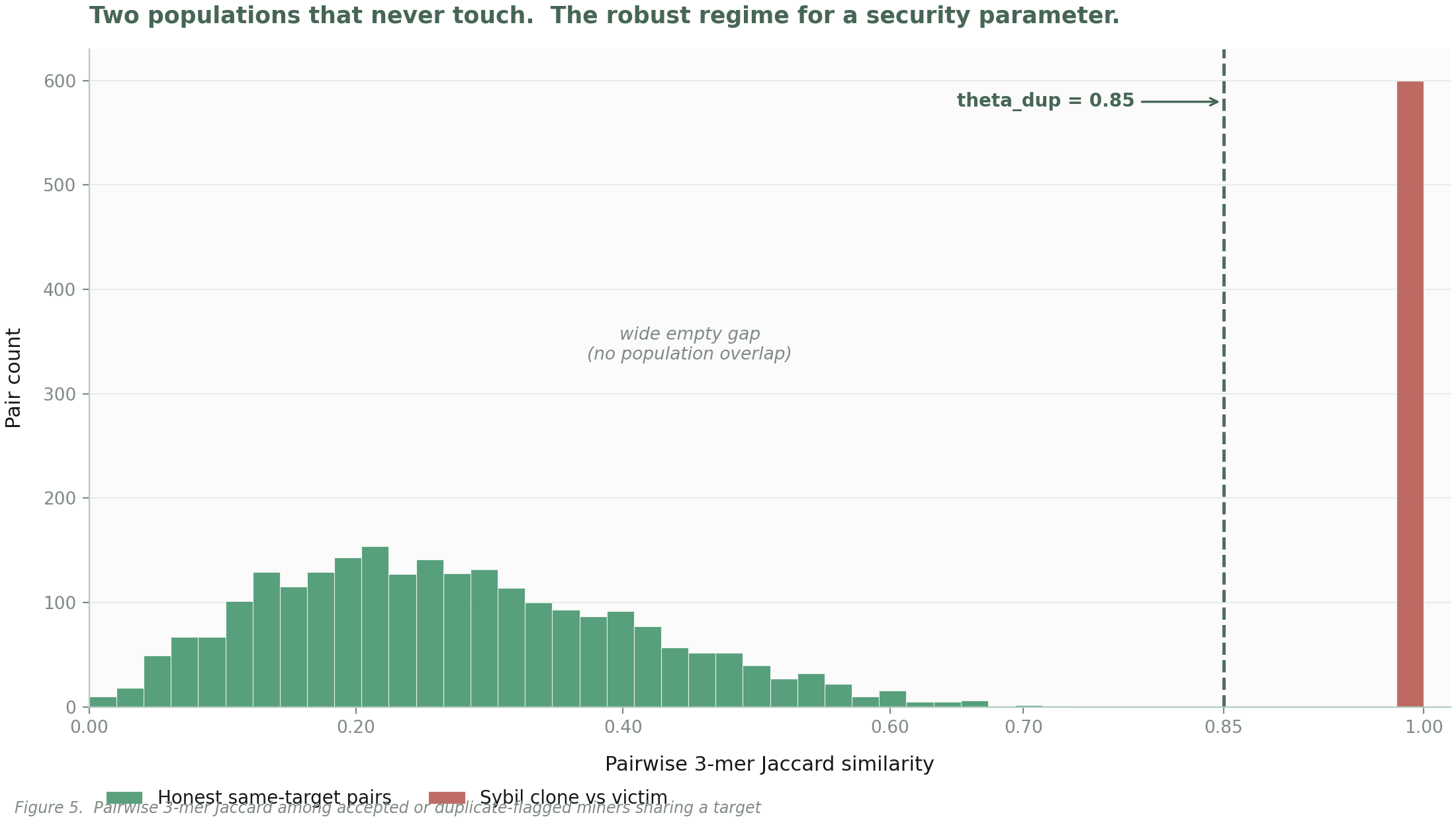
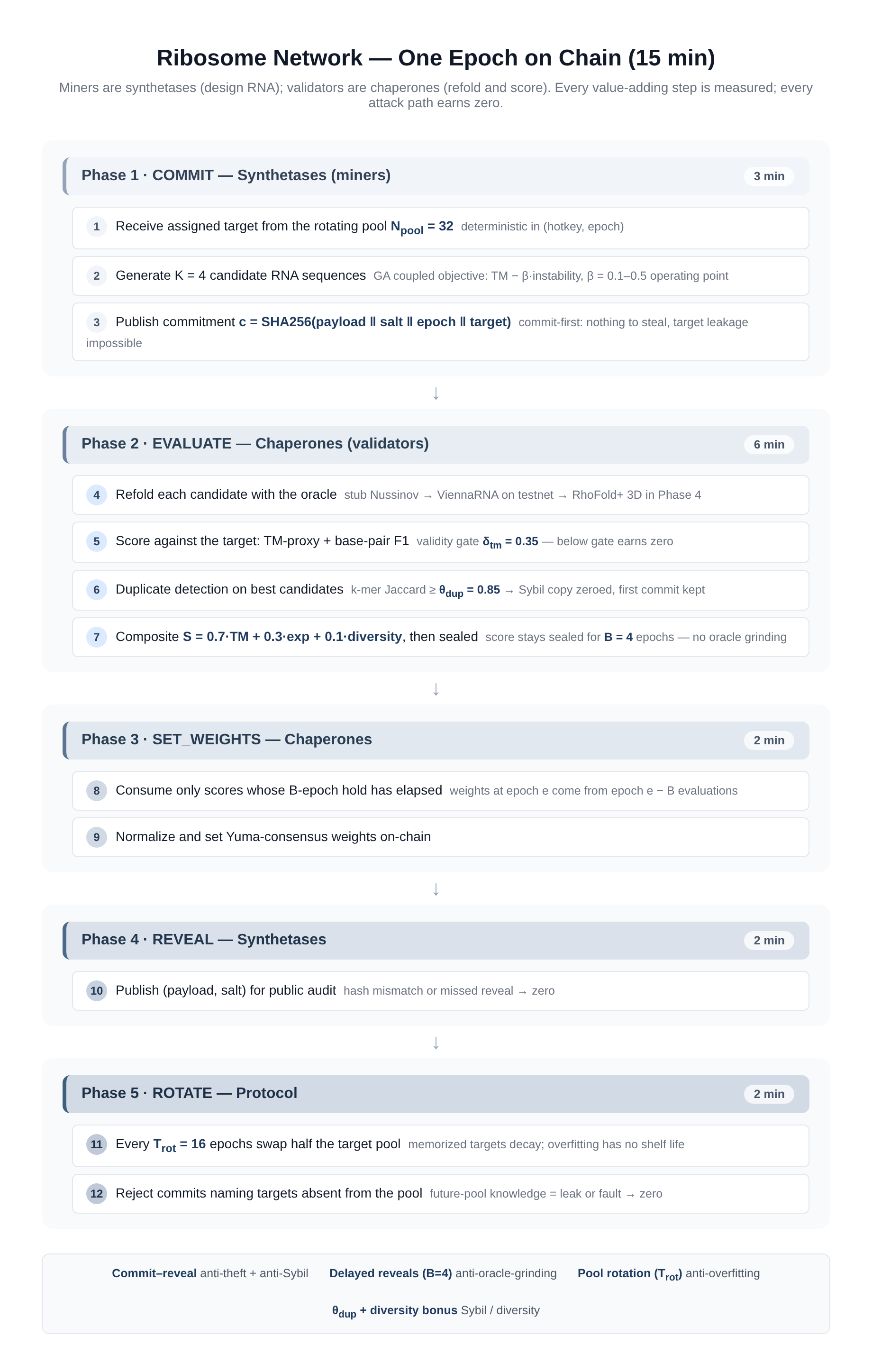
Ribosome Network is a working subnet layer where miners called synthetases design sequences for a rotating pool of 32 target RNA structures, and validators called chaperones refold every candidate with a deterministic oracle and score its structural fidelity. The mechanism is not a sketch. It ships as a pure-Python package with 58 passing tests, a five-phase commit-reveal round, a duplicate gate, a diversity bonus, delayed score reveals, and deterministic target-pool rotation. We ran an adversarial simulation for 20 epochs with 32 miners, six of them Sybil clones built the way a real attacker would build them. Sybil clones fold as well as their victims. They earn exactly zero weight. Leakers are rejected on all 40 attempts. Honest quality concentrates the reward where it should. The defense holds.
Why It Matters Beyond the Hackathon
The OpenVaccine benchmark this subnet's forward model is trained on exists because the field already agrees that the binding constraint in mRNA medicine is the pair of properties we are scoring, correct fold plus stable fold. By rotating targets from published benchmarks, the network produces a structural score curve that is directly comparable against academic baselines. A lab in Boston can compare its in-house generator against the network's frontier without submitting anything proprietary. A PhD student in Singapore can plug a state-of-the-art neural inverse folder into the same interface that a Kaggle model uses, and the mechanism treats them identically. The generator interface admits everything from a stub Nussinov folder to RhoFold+ checkpoints in production. The subnet cannot quietly regress, because the benchmarks are public and the rotation never stops. This is the piece that turns RNA design from a craft practiced behind closed doors into a measurable, contestable, continuously improving public good. Cures for genetic diseases, vaccines for the next pandemic, synthetic biology tools we have not invented yet, all of them wait on better RNA design. Ribosome Network is the layer that makes better RNA design somebody's job to deliver, every epoch, forever.
Website: https://ribosome.network/
My Research Paper: https://doi.org/10.5281/zenodo.22420044
Proposal: https://drive.google.com/file/d/1-hJeh8E2sLuQiTHytKoOpT8YZNv3kUie/view?usp=sharing
Contact Me: aqila@aqila.site
Built & tested the subnet.
We are looking for fundraising!