
An AI agent that verifies supply chain compliance against satellite data and public registries, issuing self-revoking onchain attestations on Base when new evidence contradicts exporter claims.
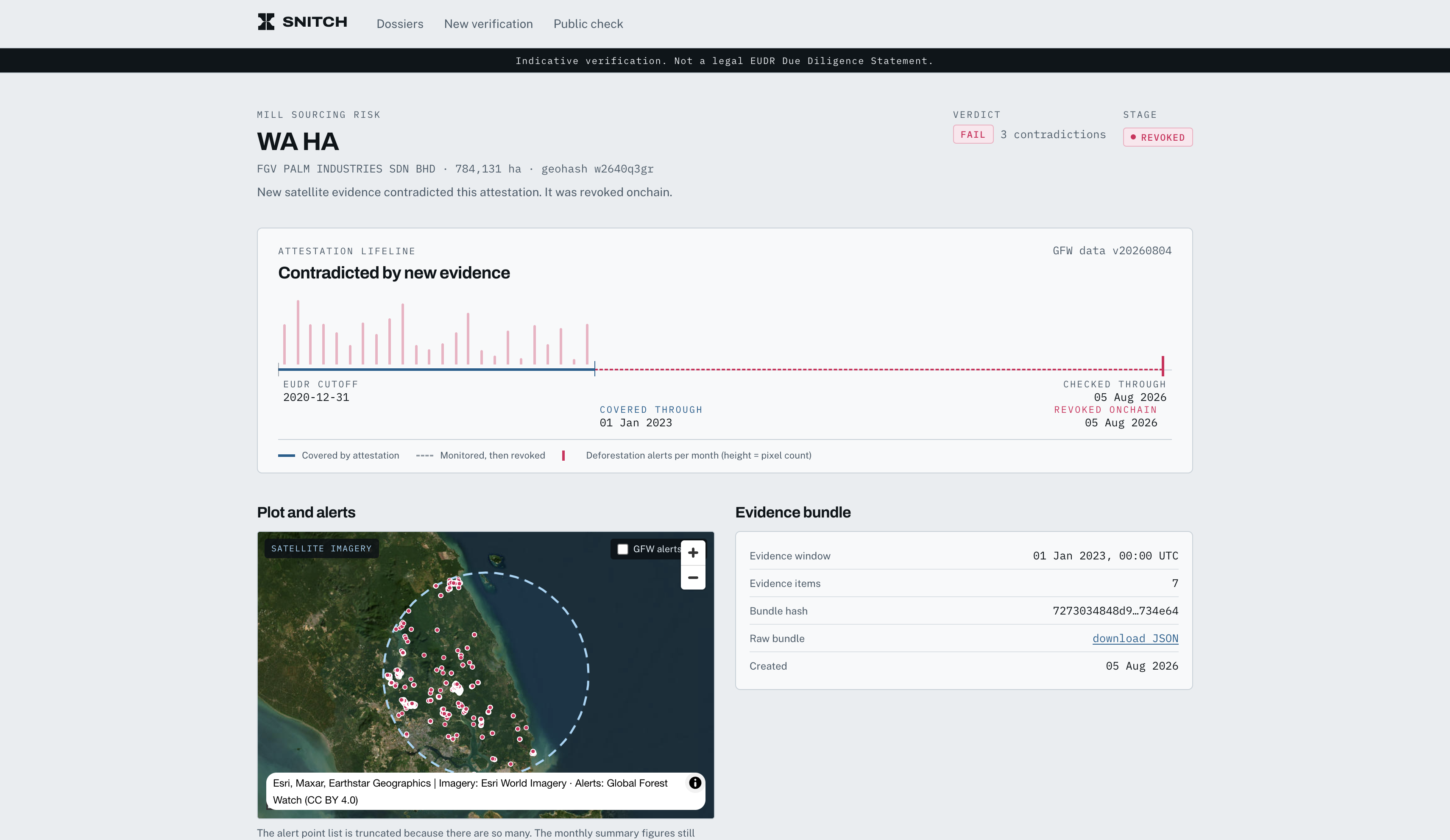
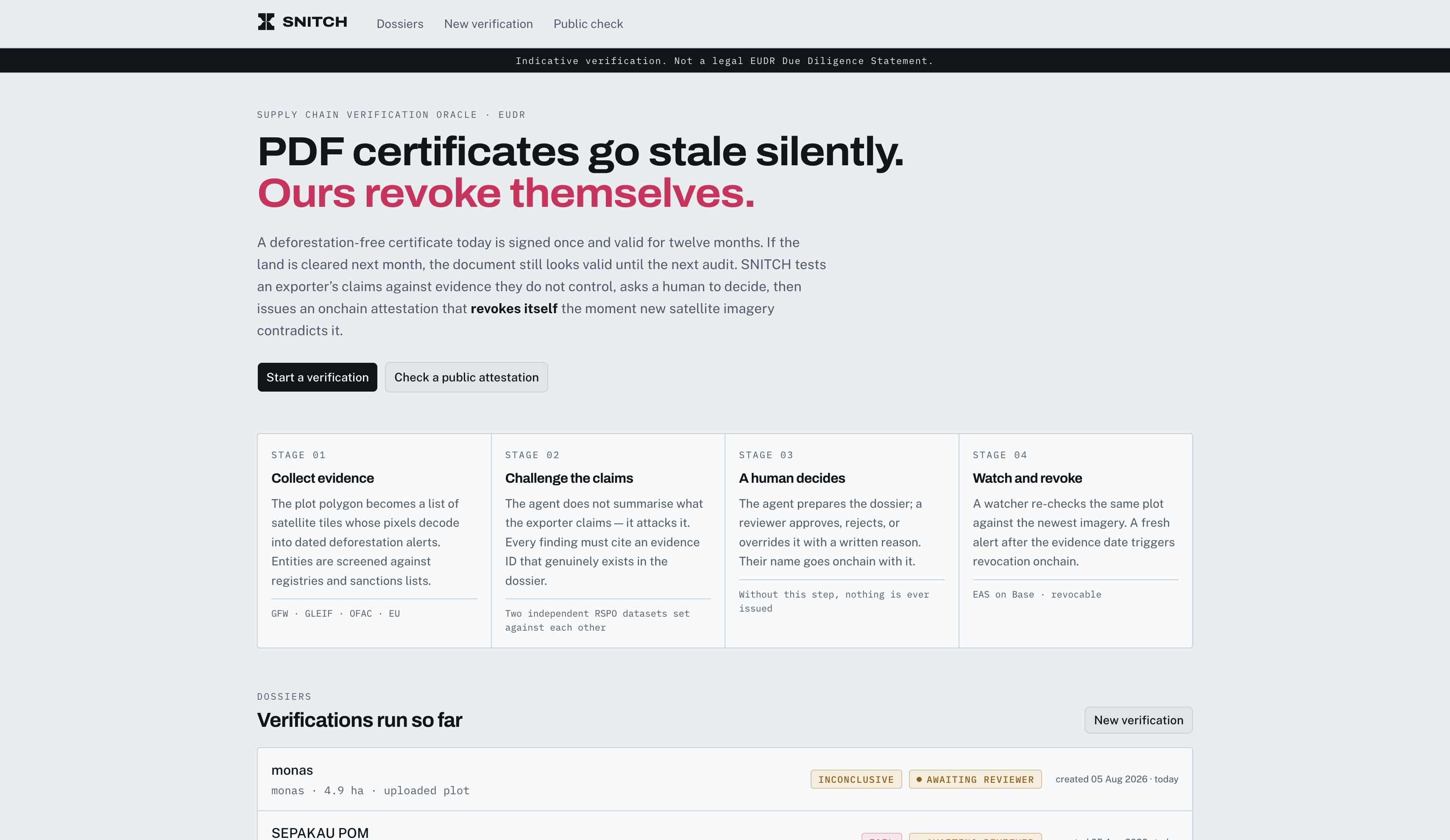
The Problem: Static Compliance in a Dynamic World Upcoming regulations like the EU Deforestation Regulation (EUDR) and Carbon Border Adjustment Mechanism (CBAM) put immense pressure on global supply chains, particularly in Southeast Asia. Currently, compliance is proven through static PDF certificates. These documents are signed once and remain valid for a year. If a protected forest is cleared a month after certification, the PDF still looks valid. Certificates go stale silently, and the high cost of manual audits excludes smallholders from the market.
The Solution: Snitch Snitch is a supply chain compliance verification oracle. It acts as a trust layer that does not blindly accept supplier claims. Instead, it uses an AI agent to adversarially verify those claims against independent, public evidence before issuing living, self-revoking onchain attestations on the Base network.
How It Works
1. Adversarial Verification Our AI agent challenges every claim made by an exporter. If an exporter claims a plot of land is deforestation-free, the AI cross-references this against raw satellite alerts from Global Forest Watch. If they claim a clean corporate record, the AI checks the Global LEI Index and international sanction lists. The AI does not generate narratives; it outputs structured non-conformance reports backed by verifiable data.
2. Human in the Loop (Industrial 5.0) The AI does not publish the final decision. It prepares a comprehensive evidence bundle for a human compliance officer. The officer reviews, approves, or rejects the findings. This ensures accountability and perfectly aligns with the human-centric principles of Industrial 5.0.
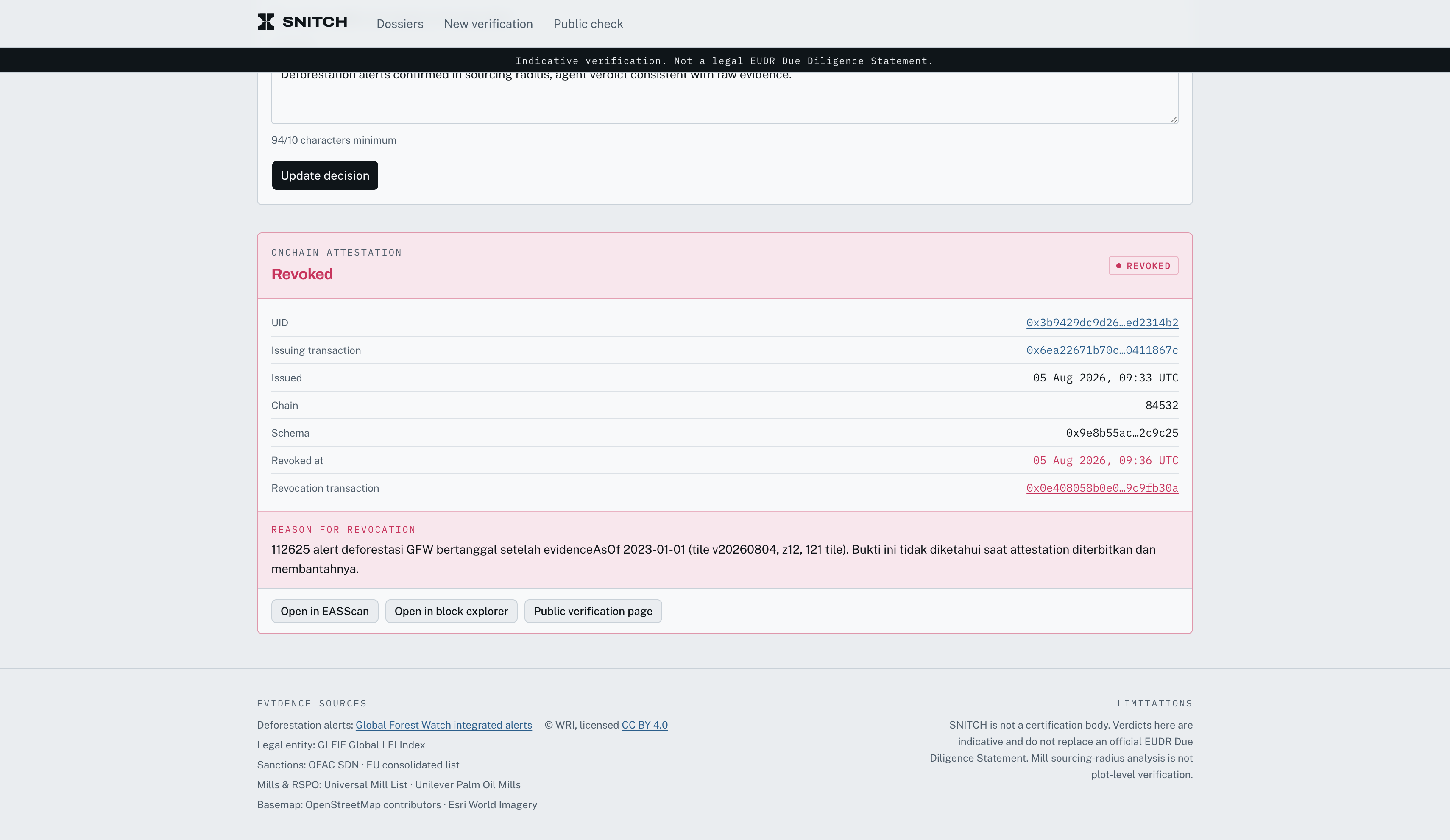
3. Self-Revoking Onchain Attestations Once approved, the attestation is published onchain using the Ethereum Attestation Service (EAS) on Base. This is where the blockchain becomes essential. A continuous watcher monitors the registered land plots. If a new satellite alert indicates deforestation after the attestation date, the system automatically triggers an onchain revocation.
The Impact Supply chain partners instantly see the revoked status directly from the blockchain. No waiting for the next annual audit, no emails, and no relying on hidden databases. Snitch transforms compliance from a static, expensive paper trail into a transparent, living oracle that heals itself.
Everything in this project was built from scratch during the hackathon period. We focused on building a fully functional, end to end prototype with real data integrations rather than using mock data.
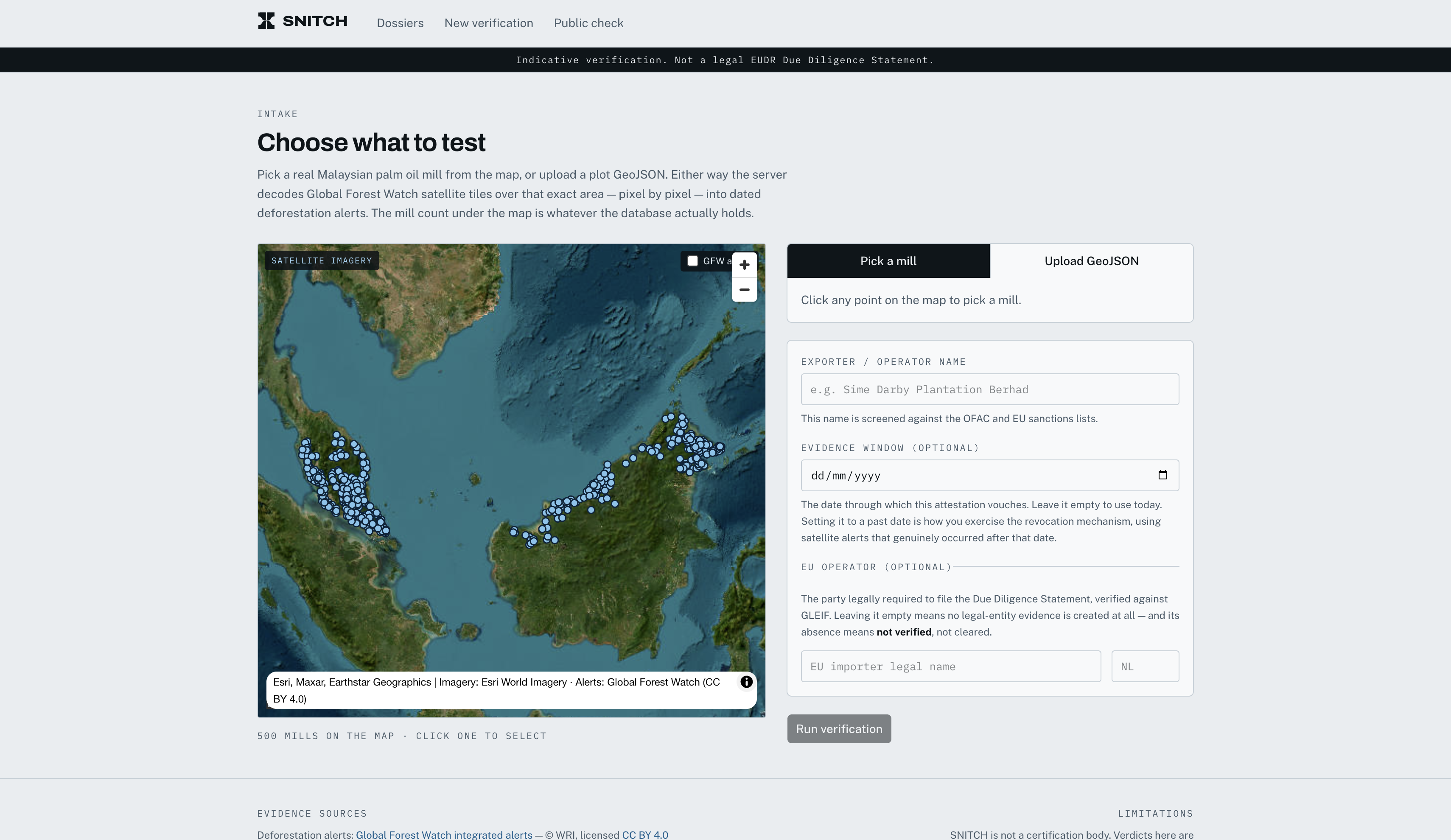
1. Data Infrastructure and Evidence Collection We integrated multiple real world data sources. This includes the Global Forest Watch API, GLEIF LEI API, OFAC SDN list, and EU consolidated sanctions. We intentionally designed the architecture to work without commercial API keys, relying entirely on open public data to ensure true independence.
2. Custom Satellite Data Decoder We built a custom deterministic decoder for Global Forest Watch satellite tiles. It processes raw map tiles, decodes the pixel data, and identifies specific deforestation alerts within a given land polygon.
3. AI Contradiction Agent We integrated LLM via the Vercel AI SDK. The agent is strictly constrained to reason only over the provided evidence bundle. It successfully cross references exporter claims against the decoded satellite data and public registries to generate structured non conformance reports.
4. Base Smart Contracts and EAS Integration We designed and deployed our custom attestation schema on Base Sepolia using the Ethereum Attestation Service (EAS). We successfully implemented the full onchain lifecycle: issuing attestations and, most importantly, the self revoking mechanism.
5. Continuous Watcher and Revocation Engine We built the watcher cron job that continuously monitors previously certified land plots. If a new satellite alert is detected after the attestation date, it automatically triggers a smart contract call to revoke the attestation on Base.
6. Frontend and Human Review Dashboard We developed the complete user interface using Next.js 16 App Router and MapLibre GL for interactive map visualization. The dashboard includes the human review interface, allowing compliance officers to approve or override the AI findings before pushing them onchain.
Currently, Snitch is completely bootstrapped. The project was conceived and built entirely during this hackathon by an independent team. We have not taken any outside funding or venture capital to date.