
Steamlink
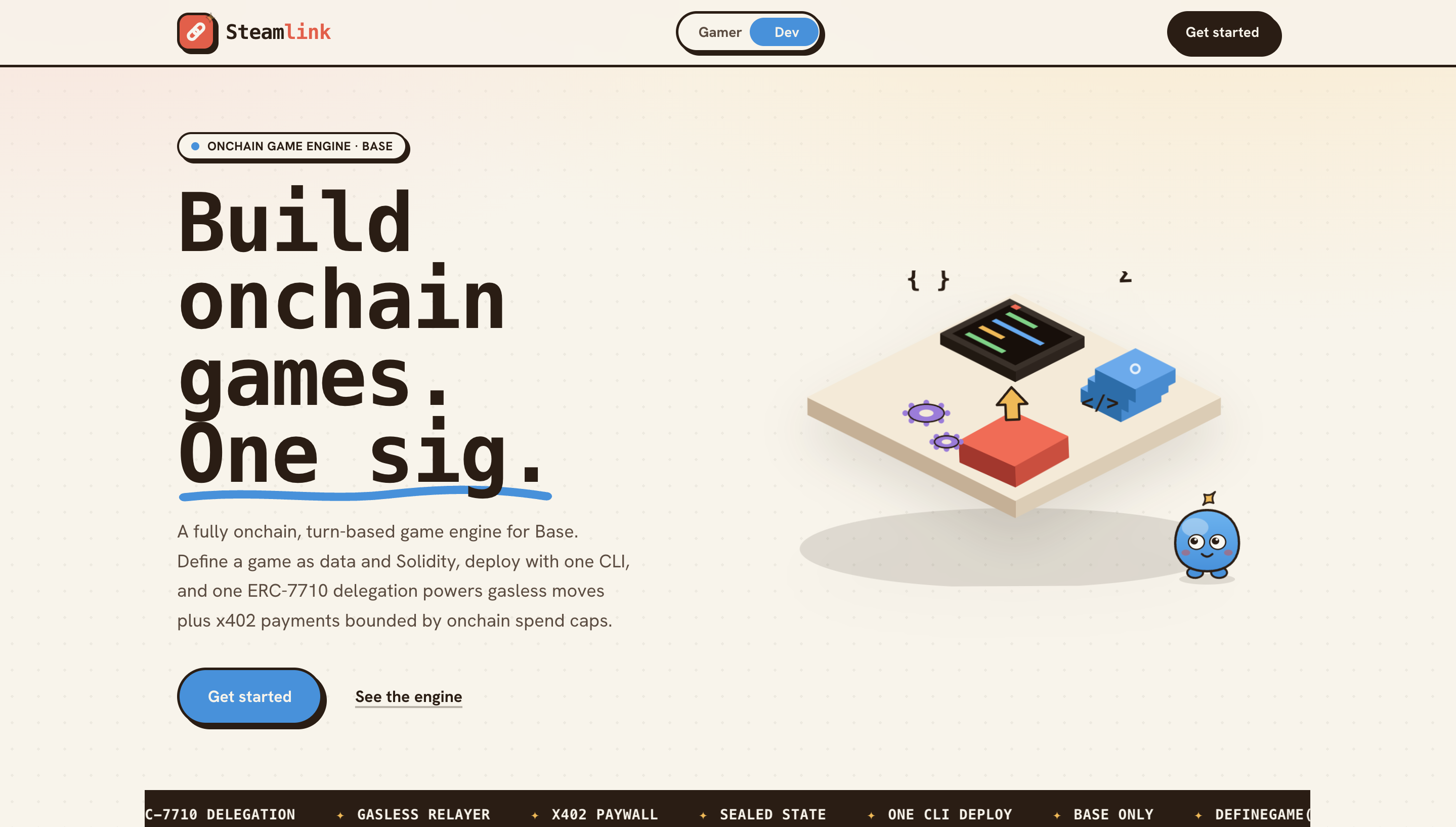
SteamLink is a fully onchain game engine built on Base that makes blockchain games feel like traditional games. with steamlink Developers define their games using simple data structures and plug tools
Videos
Tech Stack
Description
SteamLink
One Signature. A Whole Game. Fully Onchain.
SteamLink ships fully onchain games on Base, powered by its game engine Nexus — a player signs once and plays forever: every move gasless, every payment bounded onchain, every outcome provably fair.
The Problem
Today's onchain games are fundamentally broken from a user-experience perspective.
Players face:
Endless wallet popups
Gas fees on every move
Leaking hidden information
Manipulable randomness
Fragmented payment systems
For developers, the situation is even worse.
Every game team repeatedly rebuilds:
Delegation infrastructure
Transaction relaying
Payment settlement
Randomness systems
Hidden-state mechanics
As a result, very few projects ever ship games that are truly fully onchain.
The Solution
SteamLink reduces the entire problem to a single primitive:
One Delegation.
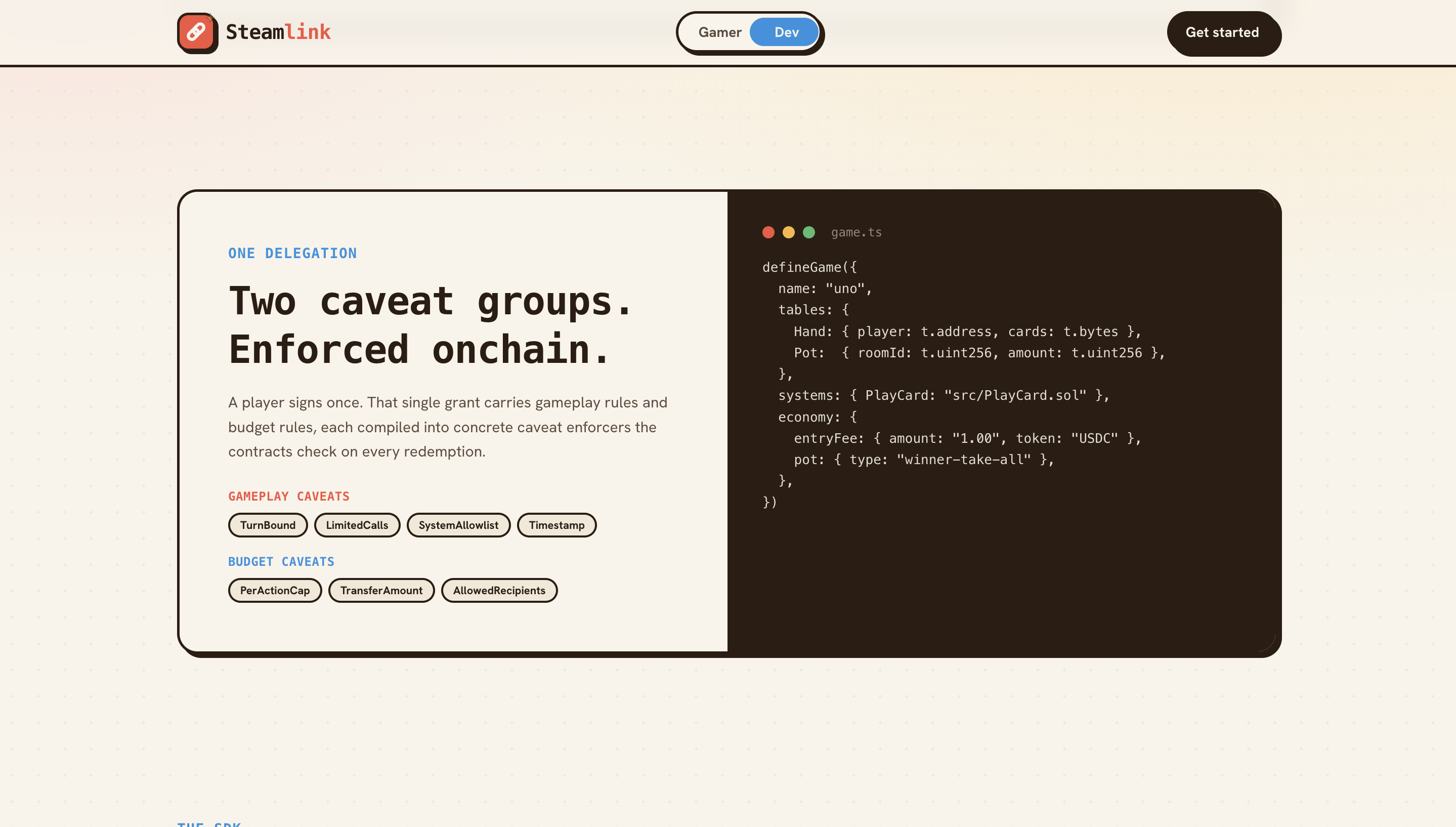
When a player joins a game room, they sign a single ERC-7710 delegation containing two permission groups:
Gameplay Permissions
Authorizes future game actions.
Budget Permissions
Defines strict onchain spending limits.
After this single signature:
Every move becomes gasless
No additional wallet confirmations appear
Payments execute automatically within predefined limits
The player never signs again during gameplay
Developers simply define:
Data (tables)
Logic (systems)
SteamLink handles everything else:
Delegation execution
Transaction relaying
Secret state management
Randomness
Settlement
How It Works
Infinite Moves From One Signature
A player signs once.
The relayer continuously redeems the delegation through redeemDelegations() and pays transaction gas using stablecoins.
The player:
Pays no gas
Signs nothing else
Experiences gameplay similar to Web2
Money With Guardrails
SteamLink integrates x402 payments directly into gameplay.
Entry fees, purchases, and in-game transactions are executed through delegation redemption while remaining bounded by onchain budget caveats.
This means:
Spending limits are enforced onchain
Relayers cannot overspend user funds
Payments remain fully automated
Secret State
Games require hidden information.
SteamLink uses Lit Protocol to seal private state such as:
Card hands
Fog-of-war information
Private inventories
Hidden strategies
Data can only be revealed to the authorized player through onchain access conditions.
Provable Fairness
Random events settle directly onchain.
Examples include:
Card shuffles
Dice rolls
Loot generation
Match outcomes
Every random result is publicly verifiable.
Optimistic UX, Onchain Truth
Moves execute instantly in the interface.
The system later reconciles against Base transactions and relayer confirmations.
If a move fails, developers receive typed errors such as:
NOT_YOUR_TURNBUDGET_EXCEEDEDINVALID_MOVE
What We Built
SteamLink SDK
Published as:
npm i @steamlink/core @steamlink/react
Packages include:
Package | Purpose |
|---|---|
core | Game definitions, delegation handling, randomness |
react | Live state hooks |
server | x402 payment endpoints |
relayer | Delegation redemption infrastructure |
secrets | Hidden-state management |
cli | Deployment tooling |
types | Shared type system |
Benefits:
Type-safe game definitions
Compile-time validation
Provider abstraction
Minimal blockchain complexity
Two Complete Games Live On Base
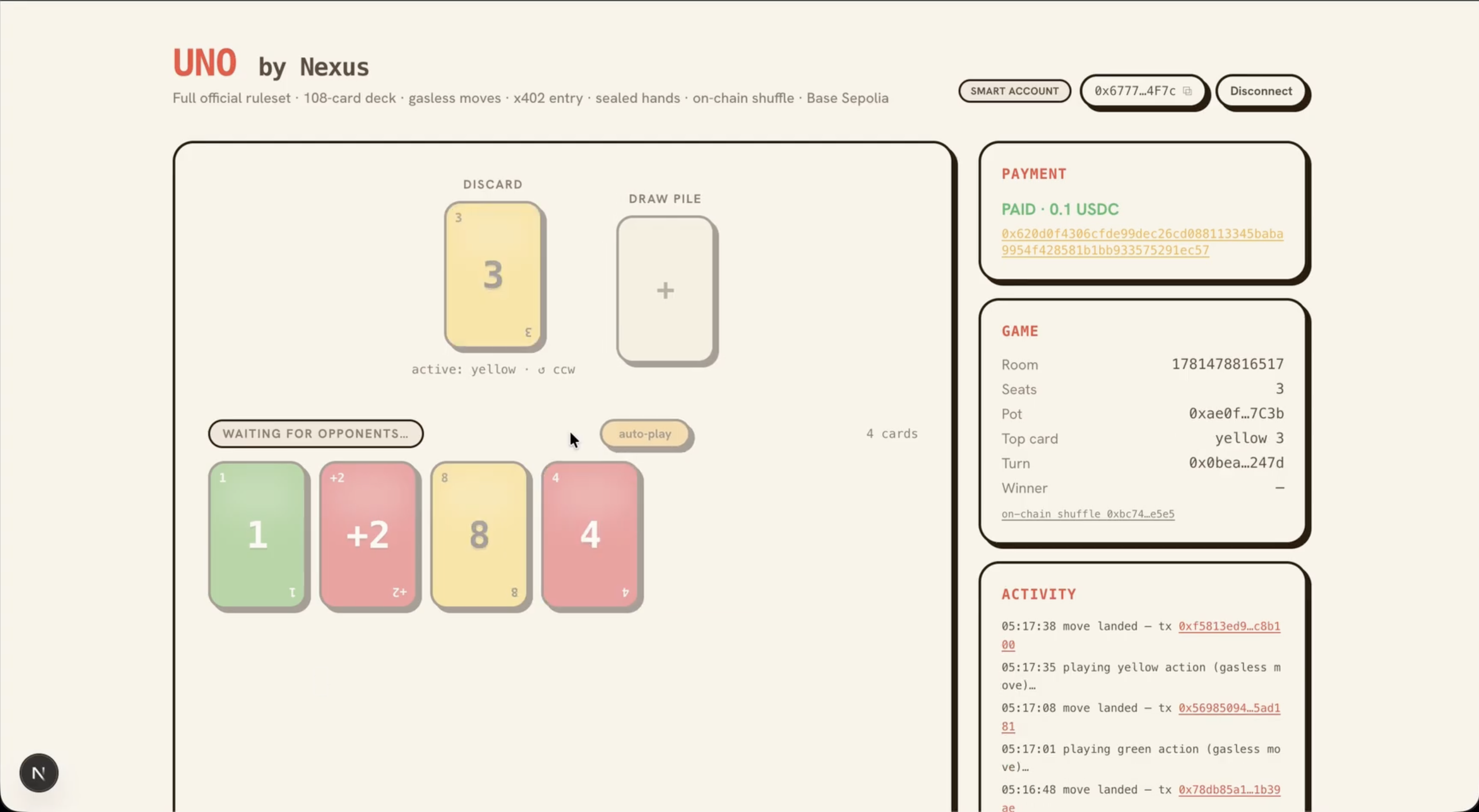
UNO
A full 108-card implementation featuring:
Buy-ins
Hidden hands
Gasless gameplay
Onchain winner settlement
Monopoly
A complete 40-space implementation featuring:
Property ownership
Rent payments
Buy-ins
Pot settlement
Onchain payouts
Both games have been played end-to-end:
First move → Last move → Onchain payout
Autonomous AI opponents also participate using their own delegations and play entirely gaslessly.
Technology Stack
MetaMask Smart Accounts Kit
ERC-7710 Delegations
1Shot Permissionless Relayer
Stablecoin gas payments
EIP-7702 EOA upgrades
Delegation redemption
Lit Protocol
Sealed state
Private game information
Onchain Randomness
Verifiable fairness
Public settlement
x402
Automated payment rails
Budget-constrained spending
Base
Settlement layer
Transaction execution
Why It Matters
SteamLink transforms fully onchain game development from a months-long cryptography project into an afternoon of game design.
Instead of:
Wallet popup after wallet popup
Custom relayer infrastructure
Trust assumptions around payments
Developers get:
One signature
Gasless gameplay
Bounded spending
Verifiable settlement
Production-ready infrastructure
Most importantly:
Two finished games prove the entire stack works today.
Not simulations.
Not mockups.
Not slides.
Real players.
Real transactions.
Real payouts.
Why Not Existing Onchain Engines?
Most existing engines focus on storing game state onchain.
SteamLink focuses on something more important:
The Player.
Nexus provides:
Gasless interaction flows
Delegated execution
Bounded payment rails
Secret-state infrastructure
Settlement guarantees
It is not another storage framework.
It is the experience layer required for real onchain applications.
Beyond Board Games
The SteamLink primitive extends far beyond games.
The combination of:
Single Delegation + Bounded x402 Payments
enables any application where users repeatedly act and pay without re-signing.
Examples include:
Trading card games
Strategy games
Prediction markets
Multiplayer economies
AI agent competitions
Paid social experiences
Turn-based marketplaces
Anywhere users repeatedly interact with smart contracts, SteamLink removes wallet friction.
Verification
SDK
npm i @steamlink/core @steamlink/react
Onchain Activity
Every action is a real transaction on Base:
Entry fees
Delegation redemptions
Gameplay actions
Winner payouts
The player remains the delegator.
The relayer pays gas.
The protocol enforces spending limits.
Proof
SteamLink includes:
Full UNO implementation
Full Monopoly implementation
Complete gameplay recordings
Onchain settlement transactions
From first move to final payout.
SteamLink
Powered by the Nexus Engine
Live on Base.
SDK available on npm.
One signature → an entire game.
Progress During Hackathon
All development, integrations, testing, and deployment were completed entirely during the hackathon period. No pre-built product or functionality existed before the event.
Fundraising Status
Bootstrapped — built during the hackathon period. No external funding raised.
We are actively looking for Grants and fund raising to make it the game builder for EVM ecosystem