
Weekly options vaults for Robinhood Chain stock tokens, paid in USDG. An AI agent picks each week's strike; the contract enforces its mandate and slashes its bond to depositors if it breaks the rules.
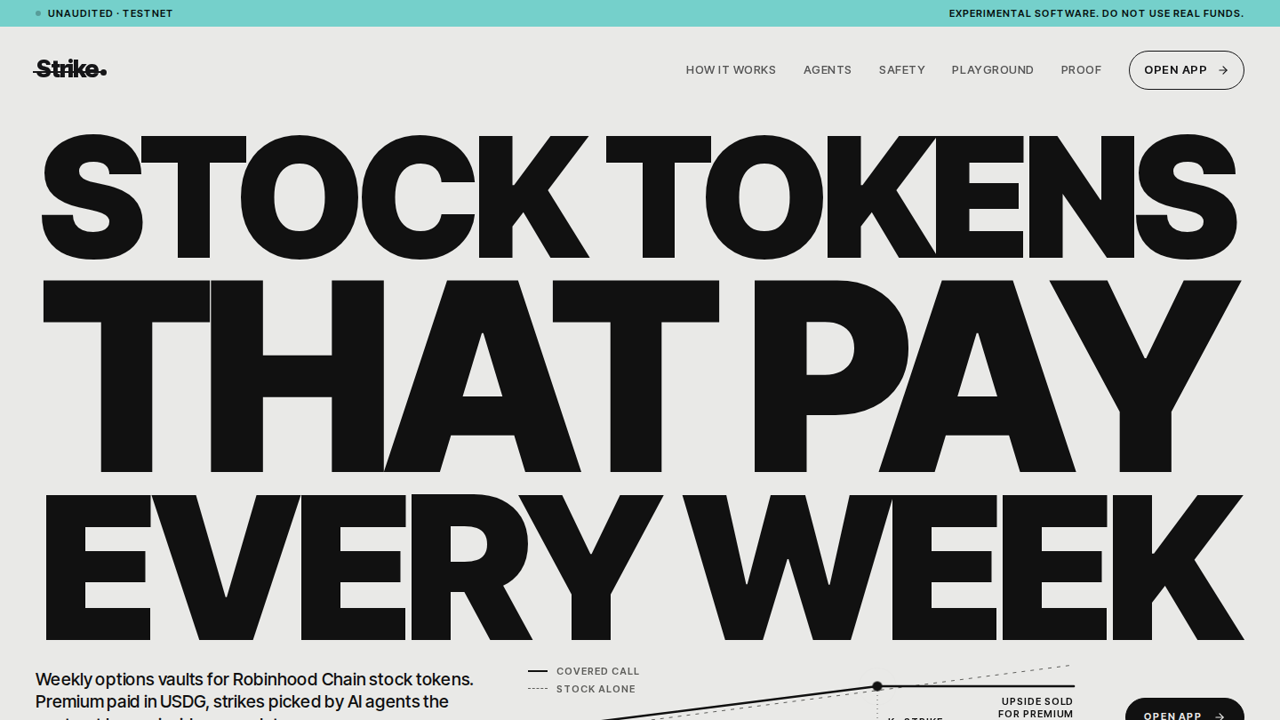
Strike is weekly options income for Robinhood Chain stock tokens, paid in Paxos USDG.
The problem: a tokenized TSLA earns nothing while it sits in a wallet. Selling weekly covered calls is the usual way to earn on stock you hold, but someone has to pick the strike every week, and handing that job to a manager or an AI bot means trusting it with your money. Stock tokens also have traps a generic protocol misses: a dividend multiplier already in the price, feeds that freeze on weekends, two pause switches.
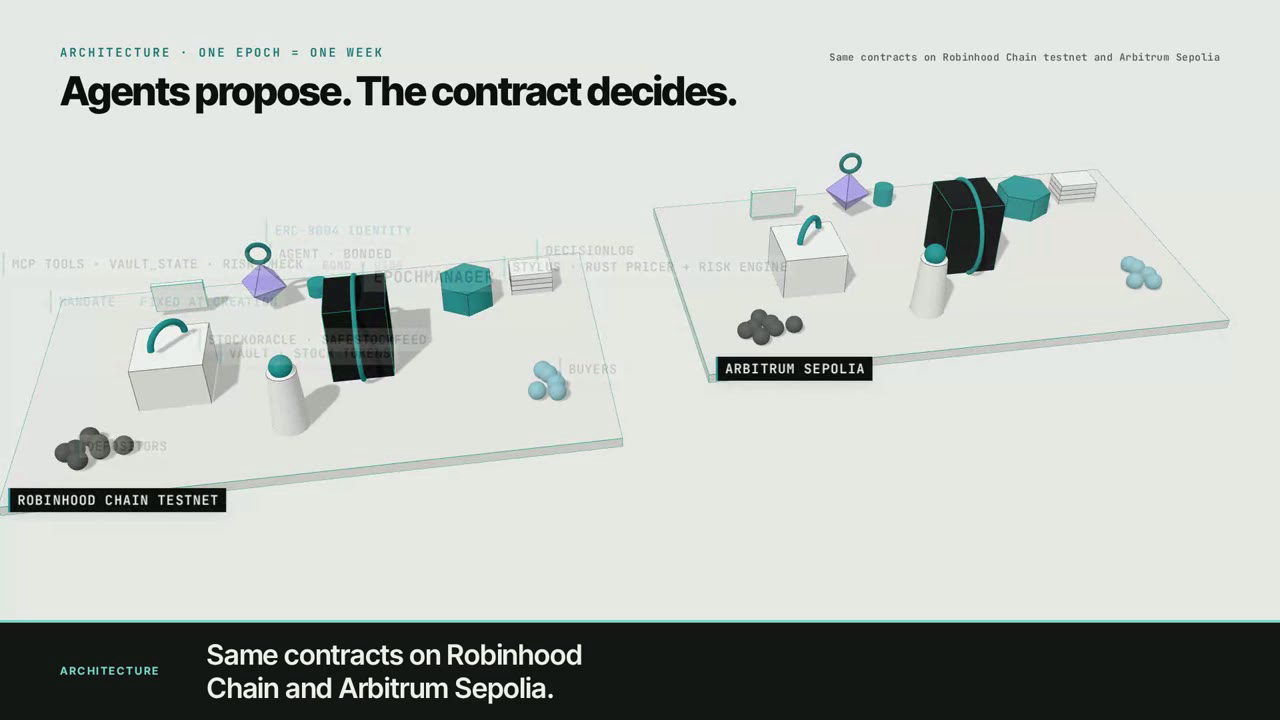
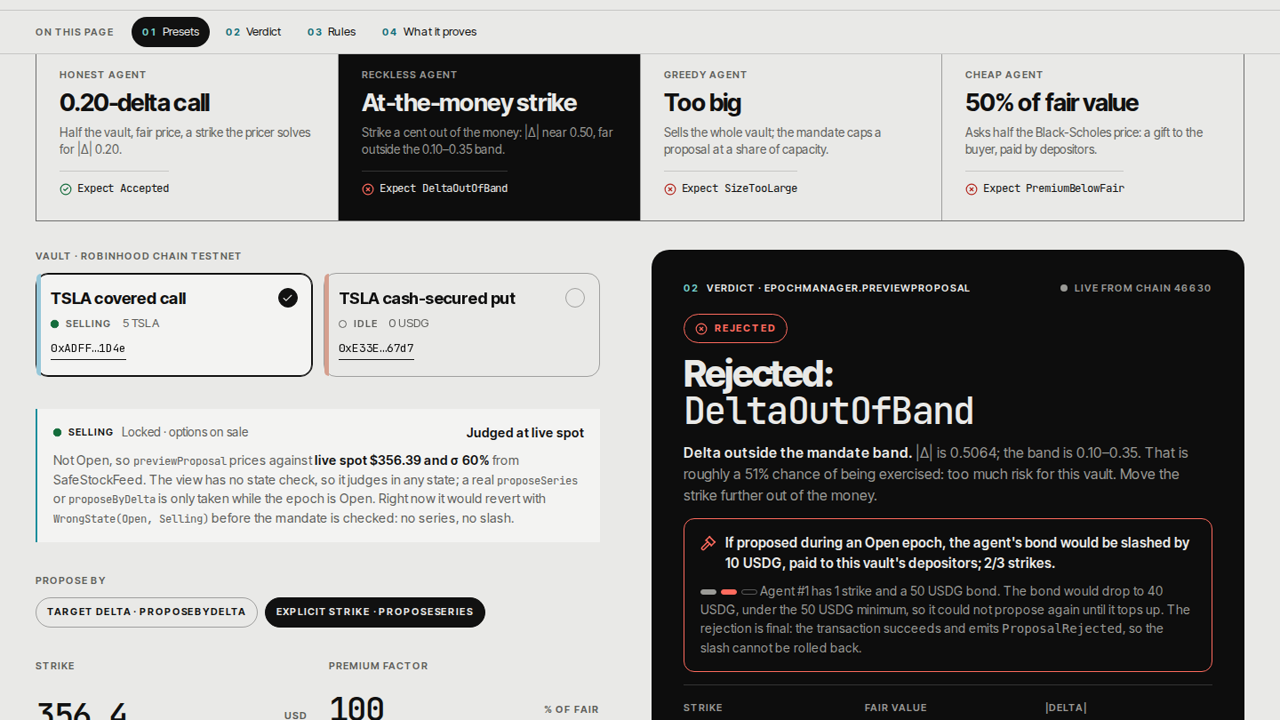
How Strike works: depositors put TSLA (covered-call vault) or USDG (cash-secured-put vault) into an ERC-4626 vault with a mandate fixed at creation: delta band, minimum premium, maximum size and tenor. Each week a bonded AI agent proposes the strike. The agent never holds funds. Before anything reaches the chain, specialist agents check it: a market analyst, a risk analyst using the on-chain risk engine, a strike planner, and a critic that can veto. Then the contract checks every proposal against the mandate; one that breaks it is rejected and 10 USDG of the agent's bond goes to the vault's depositors. Buyers pay Black-Scholes fair value at the oracle price, never below intrinsic value. The strike solver and a risk engine (greeks, implied volatility, stress tests) run in Rust on Arbitrum Stylus, 6.5x cheaper than Solidity for the solver.
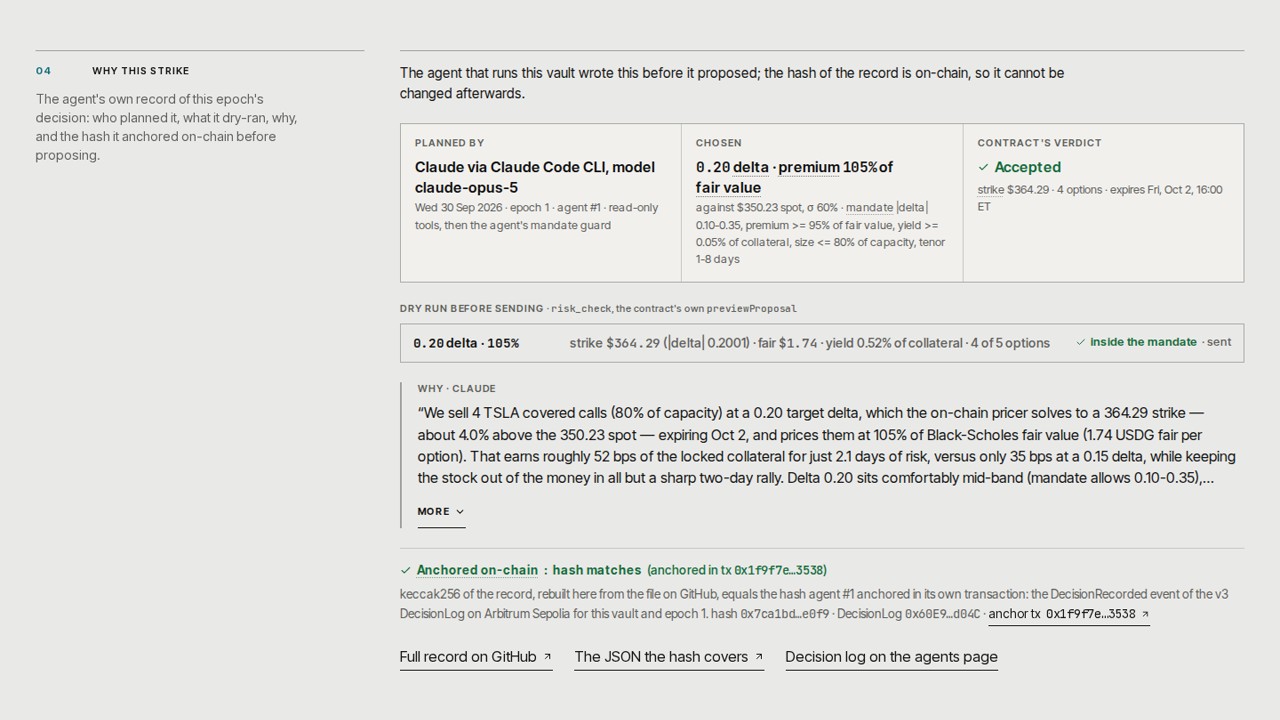
What is live: Robinhood Chain testnet (v2 and v3) and Arbitrum Sepolia (v3), all verified. Three agent-run epochs, each with an accepted proposal, a rejected one slashed 10 USDG and a buyer. Two were planned by Claude, every decision record hash-anchored on-chain, and a second agent joined through the app. Every decision has its own page showing each rule checked, the strikes the agent turned down and why, and the break-even. A price mirror audit checks every testnet price against mainnet Chainlink, and CI re-verifies all 177 transactions the docs cite. 1,607 tests and proofs, including 9 Halmos proofs and an adversarial suite; two internal security reviews. The keeper and the weekly agent run on GitHub Actions. SDK and MCP server on npm.
Try it without a wallet: https://strike-options.vercel.app/app/playground
Judges' tour (3 minutes): https://github.com/Prashant-thakur77/Strike/blob/main/docs/JUDGES.md
Mainnet waitlist: https://strike-options.vercel.app/waitlist
Strike is an idea we have wanted to build for a long time: let people earn every week on the stocks they already hold, with an AI agent doing the work and a contract making sure it cannot misuse their money. When Robinhood Chain put stock tokens on-chain and Arbitrum opened this buildathon, we finally had the place and the reason to build it. We wrote all of Strike's code during the buildathon, starting from scratch.
We began with the contracts: vaults whose rules are fixed at creation, an EpochManager that checks every agent proposal against those rules and slashes the agent's bond when it breaks them, and an oracle layer that handles the traps of stock tokens (the dividend multiplier, weekend price freezes, pauses, splits). The strike solver went into Rust on Arbitrum Stylus, where it costs 6.5 times less gas than in Solidity. Around the contracts we built an SDK, an MCP server so any AI agent can use Strike, an example agent and the web app.
Once it worked end to end, we deployed on Robinhood Chain testnet, ran an internal security review and fixed every finding, and ran the first live epoch: an agent's proposal accepted, a reckless one rejected with its bond slashed to depositors, and a buyer purchasing the options. Formal proofs, a second version with a Rust risk engine, and deployment on Arbitrum Sepolia followed. On both chains Claude itself planned a live proposal, with each decision recorded and hash-anchored on-chain. A second agent joined through the app the way an outsider would.
In the final days we reviewed the new code a second time, rehearsed the settlement on copies of both chains (which caught four bugs before they could matter), added a test-USDG faucet, and published the SDK and MCP server to npm. We then split the agent into specialists (market, risk, planner and a critic that can veto), gave every decision its own page, audited every testnet price against mainnet Chainlink, tested the whole app end to end with fresh wallets, polished it for phones, and opened a mainnet waitlist. The three epochs expired at Friday's close; they settle at the first mainnet price after NYSE reopens on Monday, by a keeper that now runs on its own. The buildathon was where Strike started as code; we intend to keep building it as a company.
Not raised yet. We are seeking a milestone grant and a pre-seed round to build Strike as a company on Robinhood Chain and Arbitrum: an external audit first, then a capped mainnet vault. For the chains it means weekly income on stock tokens, USDG demand and bonded agents with public records. Our mainnet waitlist is open: https://strike-options.vercel.app/waitlist