
The Onchain Identity & Reputation on Arbitrum.
Vitrum is an on-chain reputation and social credibility system designed for the Crypto, Web3, and Blockchain ecosystem. It addresses the challenge of assessing influencer and community credibility in an environment often distorted by social hype, bots, and Sybil attacks.

By leveraging Soulbound Identity NFTs as non-transferable reputation identities, Vitrum transforms reputation into an earned, verifiable, and non-tradable social asset. The system combines automated reputation scoring with reputation-gated bullish/bearish voting, ensuring that credibility signals are objective, transparent, and resistant to manipulation, while remaining composable and usable across a wide range of Web3 applications.
There is no widely adopted on-chain standard for measuring and verifying the credibility of influencers and community participants. Most trust signals are informal, subjective, and cannot be independently verified on-chain.
Influence in Web3 is often driven by social hype, follower counts, and narratives that can be artificially amplified through bots, Sybil accounts, or coordinated manipulation.
Wallets and social accounts can be created or abandoned with minimal cost, allowing bad actors to reset their identity and reputation without long-term consequences.
Existing reputation data lives across multiple off-chain platforms and centralized databases, making it non-interoperable and unusable across different decentralized applications.
Without on-chain enforcement, there is no consistent way to penalize malicious behavior or enforce consequences for manipulation, misinformation, or abuse.
New users and applications lack reliable signals to distinguish credible actors from malicious or low-quality ones, increasing risk and reducing overall trust in the ecosystem.
Voting, signaling, and community decisions are vulnerable to Sybil attacks due to the absence of identity-bound and reputation-gated participation.
Vitrum introduces reputation as a first-class on-chain primitive, enabling credibility to be transparent, verifiable, and enforceable directly at the smart contract level.
Each user is represented by a non-transferable Soulbound NFT that permanently binds reputation to a single identity, preventing reputation trading and identity resets.
Reputation scores are stored as dynamic on-chain properties rather than static metadata, allowing continuous updates without re-minting NFTs or breaking composability.
Reputation is calculated through automated scoring mechanisms based on on-chain activity and behavioral signals, reducing reliance on subjective or centralized judgment.
Voting and other social interactions are gated by reputation thresholds, ensuring that only credible participants can influence outcomes.
Vitrum provides a structured on-chain voting mechanism to generate clear, community-driven credibility signals for influencers and public figures.
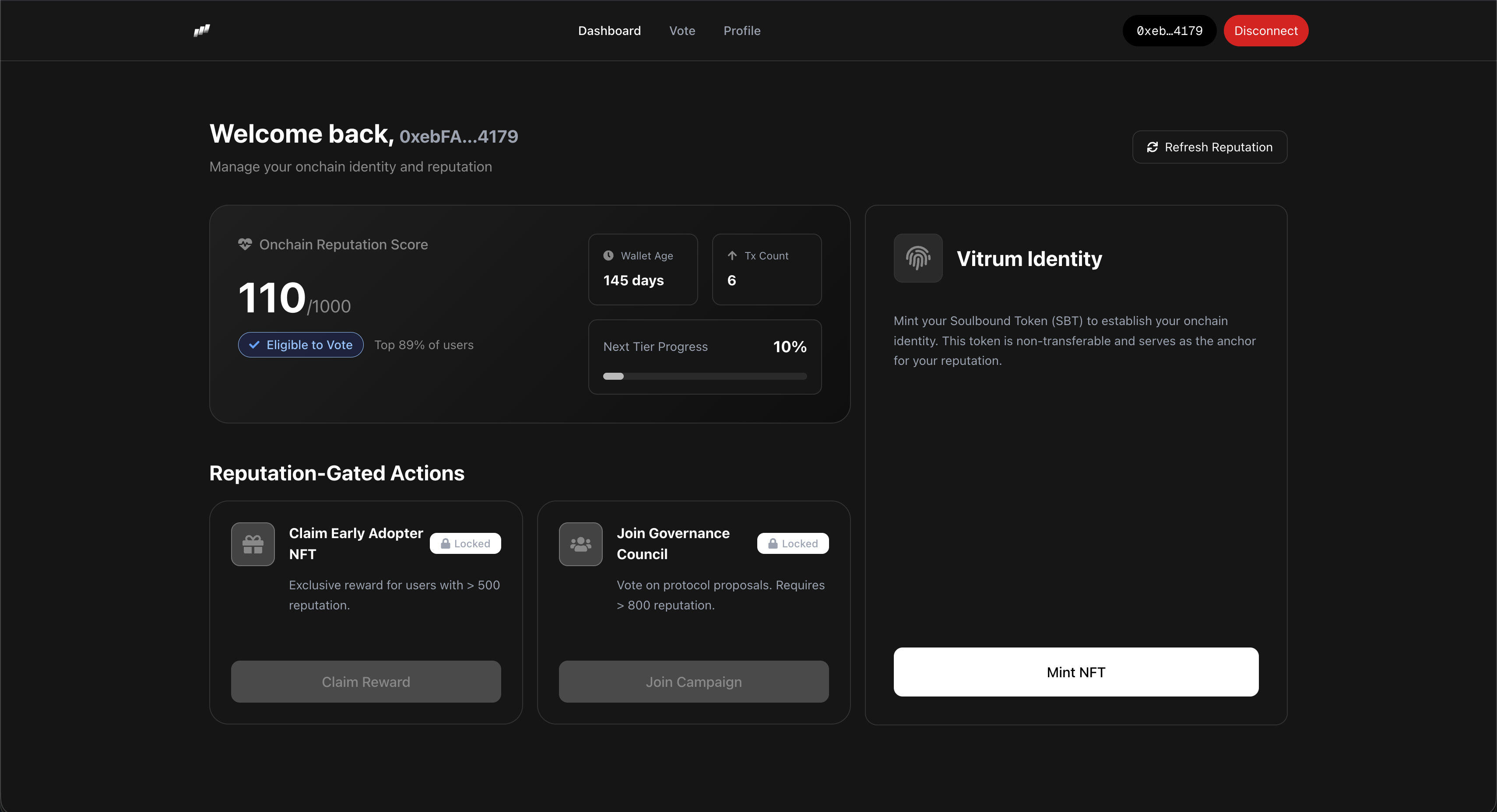
Vitrum introduces reputation as a first-class on-chain primitive, allowing credibility to be transparently measured, verified, and enforced directly at the smart contract level. Reputation is no longer an informal social signal, but a protocol-native asset that can be programmatically consumed by decentralized applications.
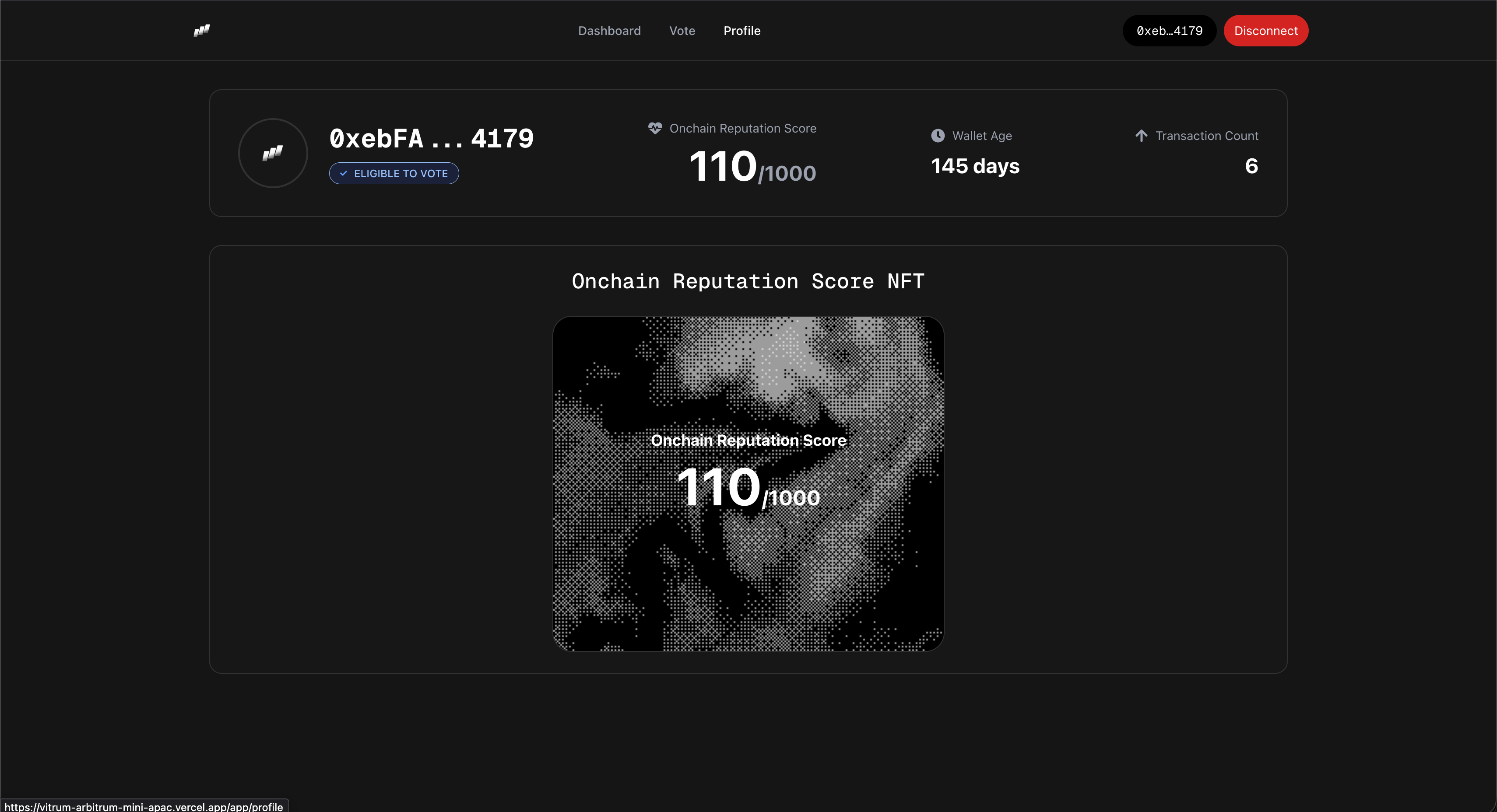
Each user is represented by a non-transferable Soulbound Identity NFT that permanently binds reputation to a single on-chain identity. This design prevents:
Reputation trading
Identity resale
Low-cost identity resets
By anchoring reputation to a soulbound identity, Vitrum ensures that credibility must be earned over time and cannot be transferred or discarded.
Reputation scores are stored as dynamic on-chain properties, not static NFT metadata. This enables:
Continuous reputation updates without re-minting NFTs
Gas-efficient score changes
Native composability with other smart contracts
Other protocols can read and enforce reputation scores directly on-chain without relying on off-chain indexing.
Vitrum combines automated reputation scoring with cryptographic on-chain verification. Reputation is derived from behavioral and activity-based signals analyzed off-chain, then verified on-chain through signature-based validation.
This approach:
Reduces subjective or manual judgment
Preserves scalability
Ensures that all reputation updates are verifiable and tamper-resistant
Vitrum enables reputation-gated interactions, where only identities that meet predefined credibility thresholds can participate in sensitive actions such as voting, signaling, or access control.
This mechanism:
Raises the cost of Sybil attacks
Filters low-quality or malicious participation
Ensures that influence is earned, not fabricated

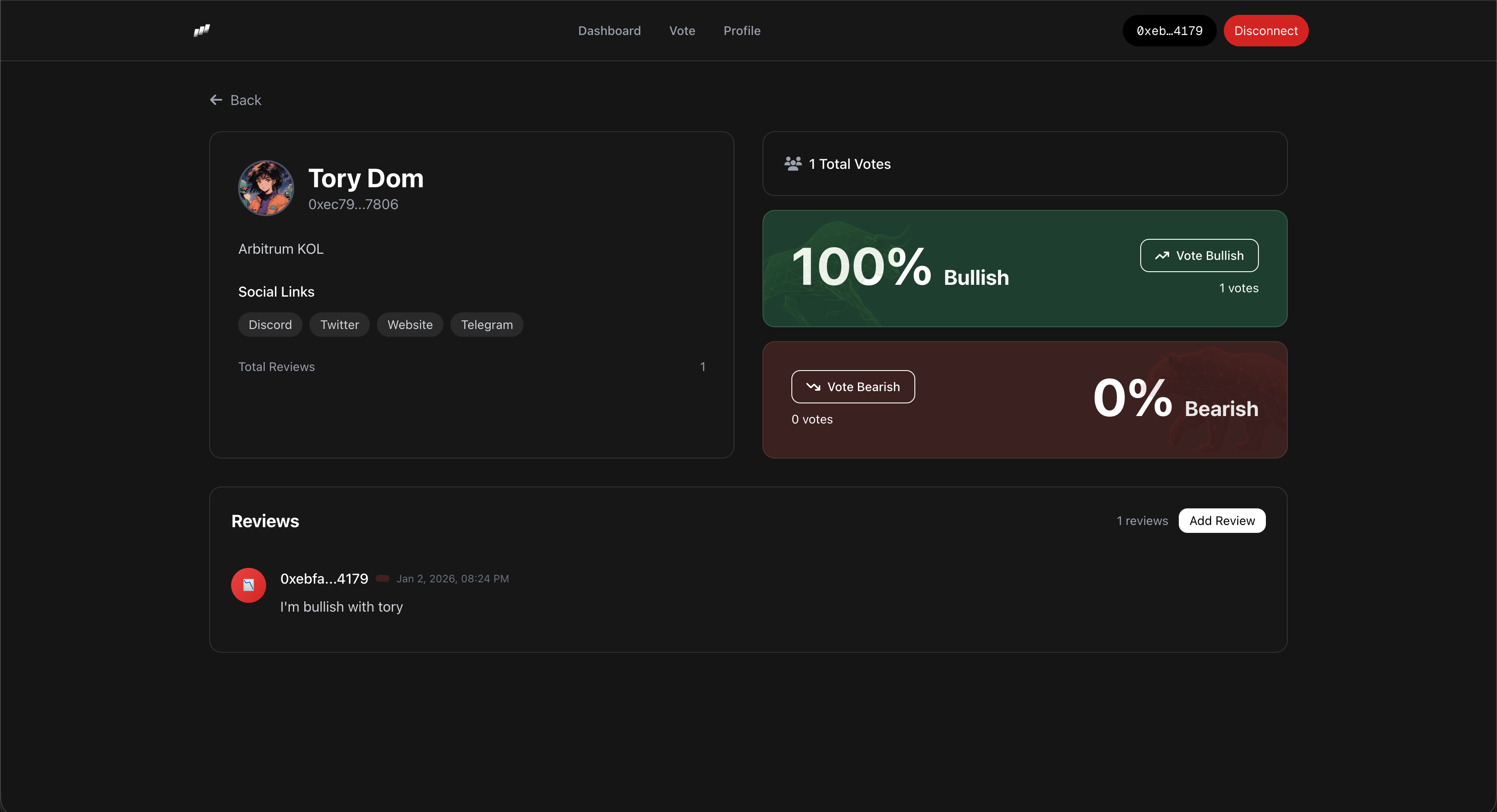
Vitrum provides a structured on-chain bullish and bearish voting mechanism to generate clear, community-driven credibility signals for influencers, public figures, or initiatives.
Votes are:
Reputation-gated
Identity-bound
Immutable once cast
This ensures that social signals reflect credible conviction, not short-term hype or manipulation.

This identity NFT is non transferable and permanently bound to a single wallet address. Each wallet can mint only one identity, enforcing a one to one relationship between wallet and identity.
By anchoring identity on chain, Vitrum prevents identity resale, reputation trading, and low cost identity resets.

At this stage, reputation scoring is based on on-chain activity from the following networks:
• Arbitrum Mainnet • Arbitrum Sepolia
The analyzed activity includes wallet age, transaction history, and interactions with smart contracts deployed on these networks.
By clearly defining supported networks, Vitrum ensures that reputation scores are consistent, auditable, and resistant to cross network manipulation.

On-chain data is retrieved through Alchemy, which provides reliable access to blockchain state, transaction history, and contract interaction data without relying on custom indexers.
This analysis focuses on measurable signals that reflect long term participation within the Arbitrum ecosystem rather than off chain or social metrics.

The resulting reputation score is verified on chain using cryptographic signature based validation. This ensures that reputation updates are authorized and cannot be spoofed or arbitrarily modified.
Verified reputation scores are stored as dynamic on-chain properties associated with the user’s Soulbound Identity NFT rather than static metadata.
This design allows reputation to evolve over time without re minting NFTs while preserving composability with other smart contracts.

Applications and smart contracts can define minimum reputation thresholds before allowing users to participate in sensitive actions such as voting, signaling, or access restricted interactions.
In Vitrum’s initial implementation, only identities with an on-chain reputation score of 100 or higher are eligible to participate in bullish or bearish voting on crypto influencers.
Wallets with reputation scores below this threshold are restricted from influence related actions.

Votes are identity bound, reputation gated, and immutable once submitted. Each eligible wallet carries equal voting weight, ensuring fairness and preventing dominance by capital or automation.
This voting process generates clear, community driven credibility signals grounded in verified on-chain behavior.

The protocol includes an on-chain slashing mechanism that allows reputation to be penalized or reset in cases of proven abuse, manipulation, or rule violations.
Reputation can increase through continued on-chain participation on supported networks, but it can also be reduced or lost, creating long term accountability.
Contract Address (Deployed on Arbitrum Testnet) :
VitrumIdentity: 0xB25c93f98e05a3db58fae281c9226281D2C1078D
VitrumVote: 0x310869f0312a0A0c607e2D5BdF57F4a1aaBed1A2
Gitbook : https://zoe-2.gitbook.io/vitrum
Github Organization : https://github.com/Vitrum-Labs
Website : https://vitrum-arbitrum-mini-apac.vercel.app