
KURA brings ROSCAs on-chain on Arbitrum. Communities save, coordinate capital, bid for liquidity, build reputation, and govern transparently while sensitive financial data remains confidential through
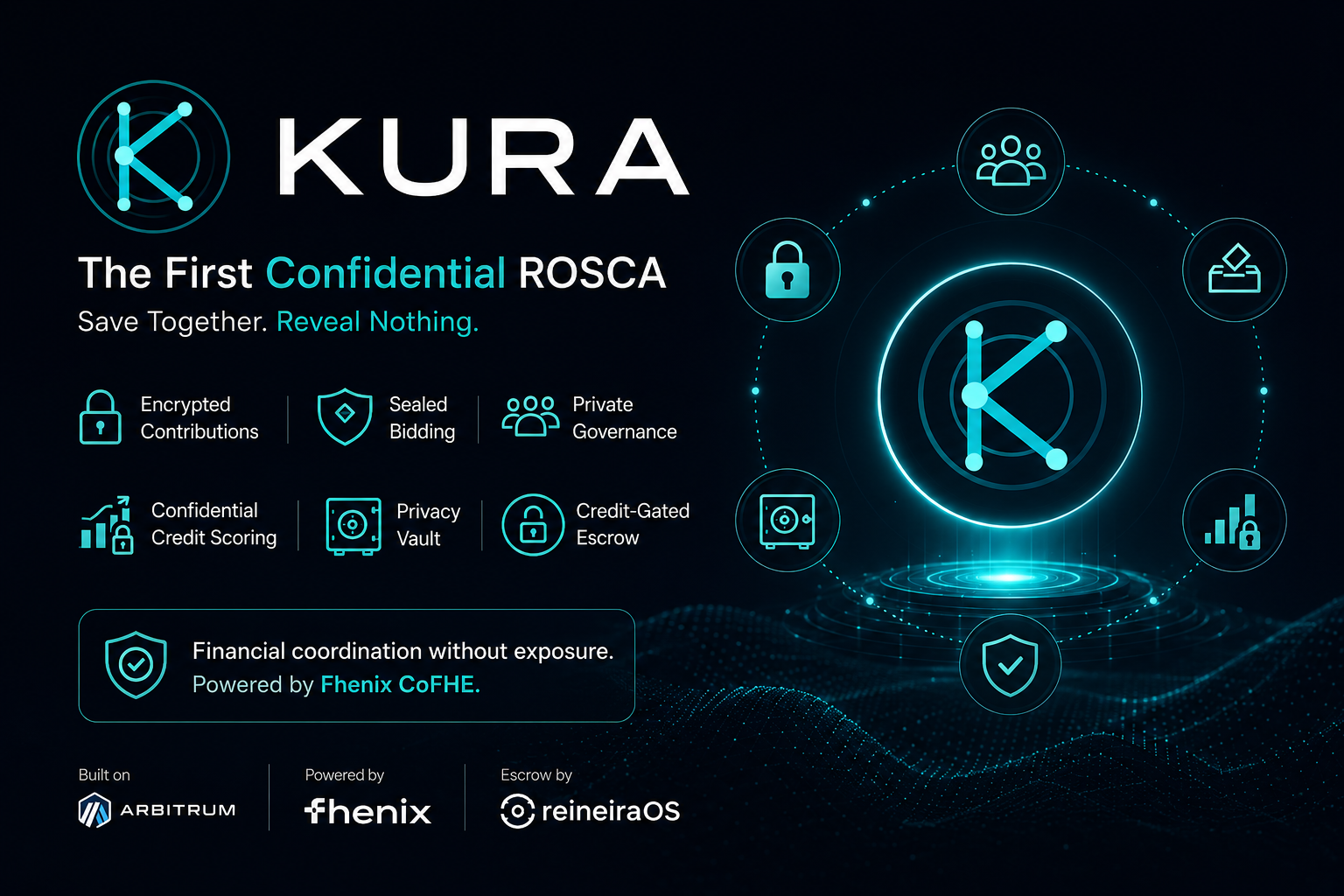
For billions of people worldwide, Rotating Savings and Credit Associations (ROSCAs) have long served as one of the most trusted methods of collective saving, liquidity access, and financial coordination.
Yet traditional ROSCAs suffer from limited transparency, manual coordination, geographical constraints, and significant trust assumptions.
KURA transforms this centuries-old financial model into a decentralized, privacy-preserving protocol built on Arbitrum.
By combining Arbitrum's scalability with Fhenix's CoFHE technology, KURA enables communities to coordinate savings, access liquidity, participate in confidential bidding rounds, build reputation, and govern collectively without exposing sensitive financial information on-chain.
Traditional blockchain applications force users to choose between:
Everyone can verify activity, but sensitive financial information becomes publicly visible.
Data remains hidden, but trust and verifiability become difficult.
For community finance systems such as ROSCAs, this tradeoff becomes particularly problematic.
Members should not have to publicly reveal:
Their bids
Their contribution history
Their financial behavior
Their voting preferences
Their creditworthiness
Yet the protocol must still guarantee fairness and correctness.
KURA introduces Confidential Community Finance.
Using Fhenix CoFHE, KURA processes encrypted financial data directly on-chain without requiring users to reveal their private information.
This enables:
Members submit encrypted bids for liquidity access while preserving privacy.
Winning participants are determined through confidential computation before verified publication.
Voting can occur without exposing voter preferences.
Creditworthiness can be calculated without exposing individual financial histories.
Members coordinate capital collectively while protecting sensitive data.
KURA is built on Arbitrum because community finance requires:
Low transaction costs
High throughput
Fast confirmations
Strong Ethereum security
Scalable infrastructure
Arbitrum allows recurring contributions, settlement operations, and governance participation to remain affordable and accessible for real-world communities.
Without low-cost execution, on-chain ROSCAs cannot scale.
Arbitrum provides the foundation necessary for mass adoption.
Users create and join community savings circles directly on-chain.
Participants submit encrypted bids using Fhenix CoFHE.
Automated settlement mechanisms distribute funds according to protocol rules.
Members build reputation through participation and successful contributions.
Private voting enables better decision-making without social pressure.
Encrypted participation history can power future lending and financial coordination.
All critical protocol operations are executed on-chain while preserving privacy.
Most blockchain privacy solutions focus on hiding data.
KURA goes further.
We needed a system capable of computing directly on encrypted values.
Fhenix CoFHE enables:
Encrypted contributions
Encrypted bids
Encrypted votes
Encrypted credit scoring
Confidential financial coordination
without exposing sensitive user information.
This allows KURA to preserve both privacy and verifiability.
Not private storage.
Private computation.
That distinction is what makes KURA possible.
KURA aims to become the foundational privacy-preserving financial coordination layer for communities worldwide.
From local savings groups and DAOs to cooperative investment circles and decentralized credit systems, KURA enables people to coordinate capital without sacrificing privacy.
The future of community finance should be:
Global
Accessible
Transparent where necessary
Private where it matters
KURA is building that future.
During the buildathon, we focused on transforming KURA from an initial prototype into a more robust confidential finance protocol.
Our work concentrated on strengthening protocol architecture, expanding test coverage, improving Fhenix integrations, and refining documentation for long-term scalability.
Implemented direct synchronization between KURA circles and the member registry system.
This ensures participant records remain consistent across protocol components and establishes the foundation for future reputation and credit-scoring mechanisms.
Members are now automatically registered during:
Circle creation
Circle participation
Membership onboarding
This reduces operational complexity and improves protocol reliability.
Expanded documentation and validation around:
Confidential bidding
Reputation storage
Privacy-preserving governance
Metadata protection
Improved privacy guarantees by documenting and testing edge cases related to encrypted data access and member permissions.
One of the primary goals of the buildathon was increasing protocol reliability.
Achievements include:
Increased protocol test coverage
Added multiple privacy-focused test scenarios
Added registry synchronization tests
Added escrow-related integration tests
Added encrypted metadata validation tests
✅ 99 Passing Tests
✅ Confidential Logic Verified
✅ Registry Synchronization Verified
✅ Settlement Logic Verified
✅ Escrow Adapter Testing Added
Significantly expanded project documentation to improve clarity for:
Judges
Developers
Contributors
Future ecosystem partners
Documentation updates included:
Detailed explanation of:
Confidential bidding flows
Settlement lifecycle
Circle management
Reputation infrastructure
Clarified how Fhenix CoFHE is used across the protocol.
Added deployment and integration references for protocol components.
Built additional tooling for:
Deployment workflows
Registry integration
Testing environments
Future protocol upgrades
These improvements make the protocol easier to maintain and extend.
By the end of the buildathon, KURA evolved into a significantly more mature protocol with:
Stronger privacy guarantees
Improved architecture
Expanded testing coverage
Better developer tooling
Clearer documentation
Enhanced ecosystem readiness
The protocol is now positioned for continued development and future deployment across privacy-focused financial applications.
KURA is currently in the early development phase and has not yet raised institutional funding.
The project's current focus is on:
Product development
Protocol validation
User feedback
Ecosystem integrations
Community growth
Future fundraising efforts will be directed toward:
Accelerating protocol development and feature expansion.
Conducting comprehensive smart contract audits before large-scale deployment.
Expanding integrations across the Arbitrum ecosystem and privacy-preserving infrastructure providers.
Supporting adoption among real-world savings communities and decentralized organizations.
KURA is actively exploring opportunities with:
Ecosystem grant programs
Accelerator programs
Strategic infrastructure partners
Privacy-focused blockchain initiatives
Community finance organizations
Our long-term vision is to become the leading privacy-preserving community finance protocol, enabling millions of users worldwide to coordinate savings, liquidity, and reputation through confidential on-chain systems.