
Governance-first AI runtime. The LLM is only the reasoning engine — sovereign memory, telemetry & validation live outside it. Local-first, POPIA-compliant. Built to cut the 32.8% unemployment gap.
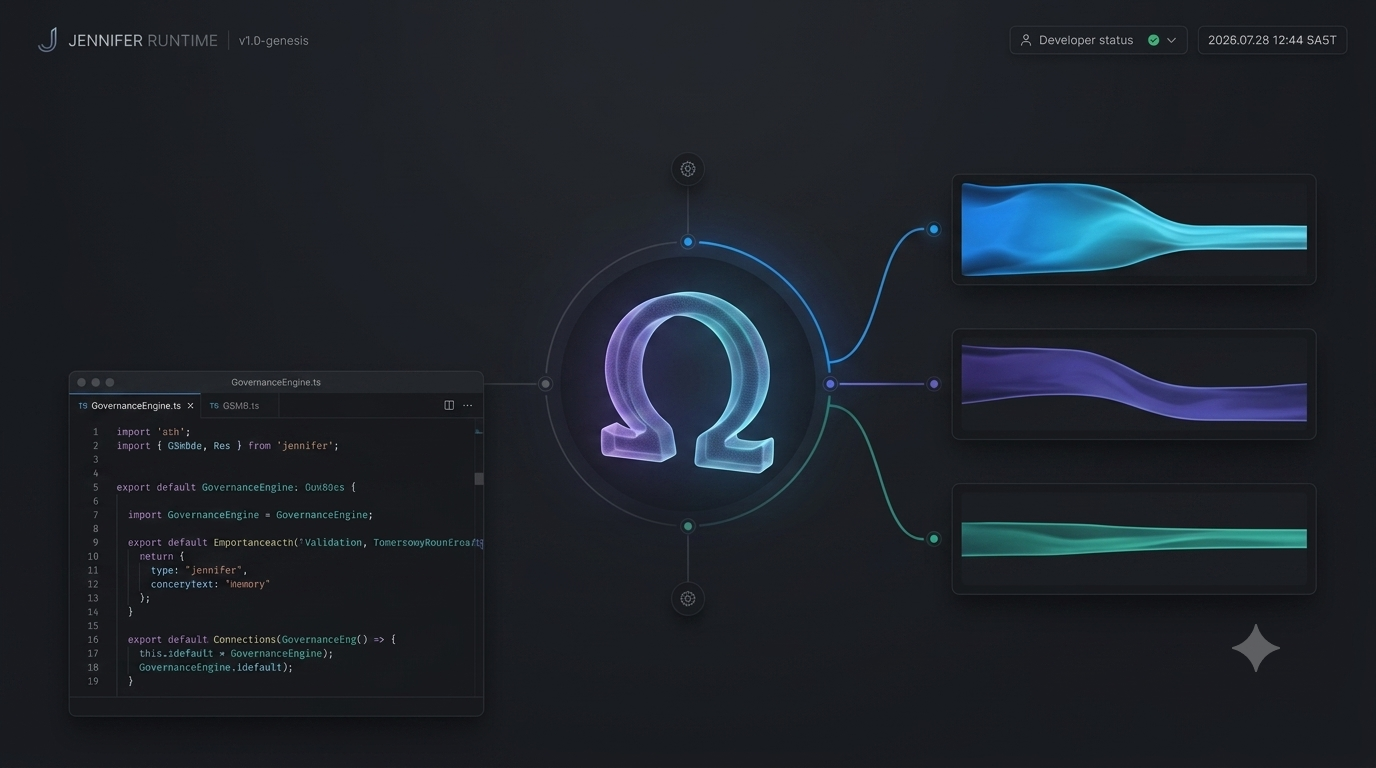


Project Jennifer (the Kopano-Phu Governance System / KPGS) is a sovereign, governance-first AI runtime. It moves artificial intelligence beyond stateless chatbots into a persistent, living system where every decision is governed, measured, and validated against reality — not just against a benchmark.
The core idea. The large language model is only the reasoning engine. Governance, memory, telemetry, validation, and human-state understanding exist outside the transformer, as first-class modules. This inverts the usual stack: the model reasons inside a constitution, instead of the constitution being a prompt bolted onto the model.
Core systems. Governance Engine (runtime policies, permissions, semantic contracts, decision validation) · GSMB — Grounded State Memory Buffer (persistent, governed memory — curated, not hoarded) · Telemetry Engine (governed event capture) · Validation Engine (confidence scoring + reality verification, with hard FAIL gates) · HUE — Human Understanding Engine (emotional & context weighting) · Collective Ingress + the Collective Perception Protocol (CCPP) · Crisis Connect (communities, public service, employment, accessibility).
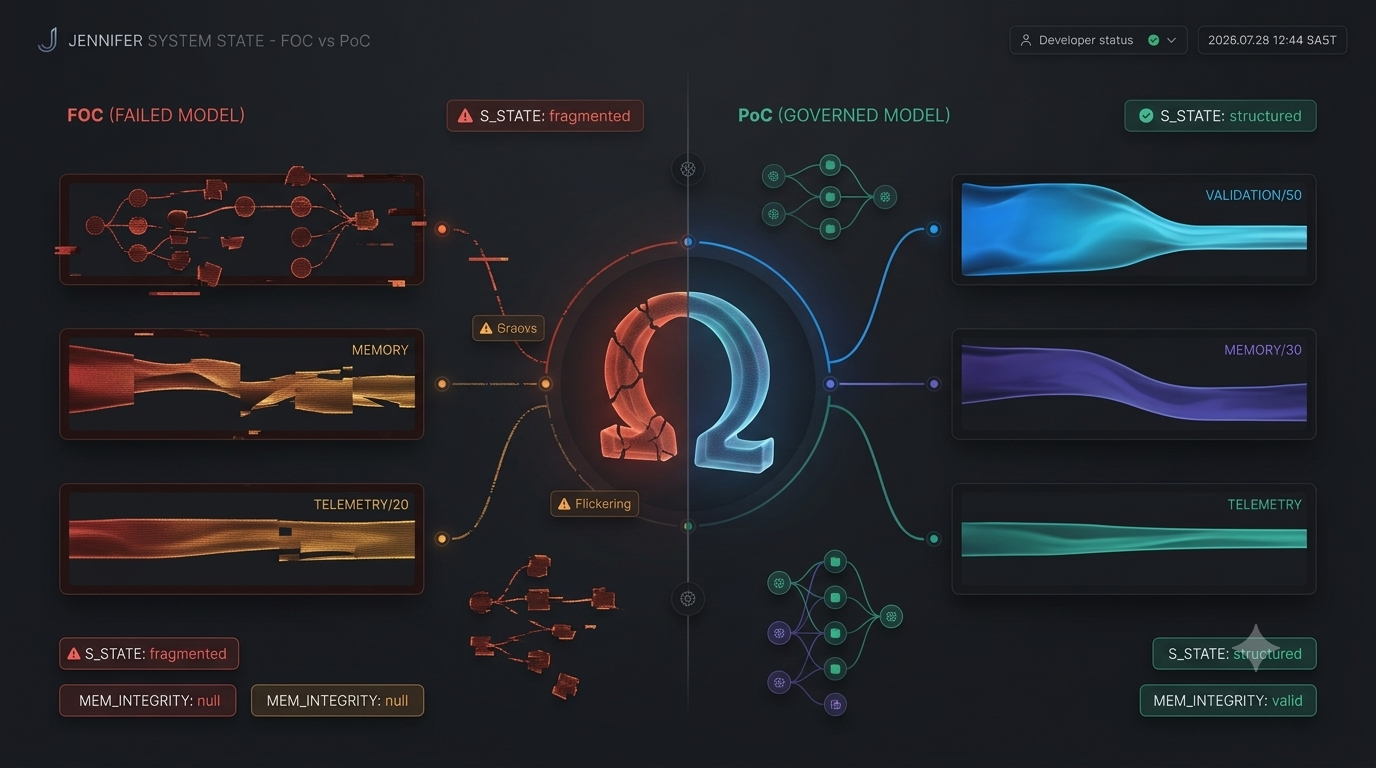
Why it exists. Public-sector failure fragments people: siloed databases, unindexed marginalized communities, foreign data leakage, vendor lock-in, quadratic cloud cost — and at the bottom of that column, unemployment and tender-cycle dependency. KPGS is the green column: unified low-bandwidth ingress, equitable indexing, linear cost, offline-first resilience, and total data sovereignty — data stays local, controlled, POPIA-compliant.
The differentiator. Governed memory instead of a memory hoard; validation that can say NO before the system ever speaks; and a sovereign substrate where the engine is a tenant, never the landlord.
(honest sprint log — matches the repo we just audited, no vaporware)
Shipped: monorepo scaffolded (Turborepo + pnpm workspaces, TypeScript `strict`), all core packages defined as modules — `governance`, `telemetry`, `memory` (GSMB), `validation`, `runtime`, `npc`, `hue`, `collective-ingress`, `crisis-connect`, `shared` — plus `apps/api` and `apps/web`. Architecture, research, and protocol docs started. Governance-first philosophy locked: the persona (Jennifer) is a package *inside* the system, not the operating system. Initial commit authored and signed under the founder.
Next: implement the governing engines first (validation + governance as the "brake" before any persona logic), the GSMB serialized write-queue for SQLite single-writer safety, governed telemetry, the persistence "resurrection" test (state must reload byte-identical after restart), and a CI gate that runs the validation suite on every merge.
(governed, no over-promise)
Bootstrapped / pre-seed.
Open to mission-aligned grants and partners in public-good infrastructure, sovereign data, and unemployment reduction. Not pursuing token-launch or hype capital — the roadmap is governed by real-world outcomes, not by a raise.