
Mainnet-first verifiable yield optimizer on 0G that turns idle crypto balances into proof-backed strategies.
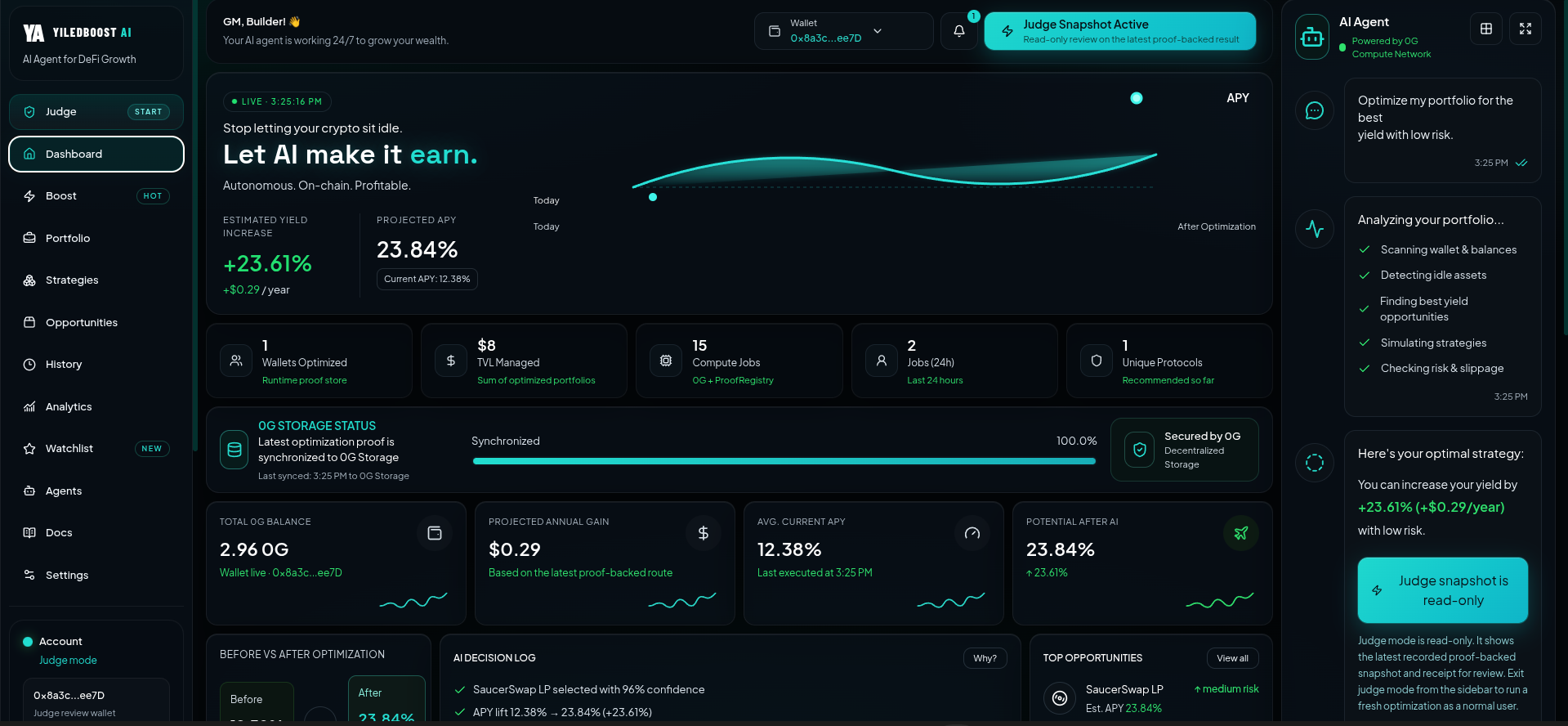
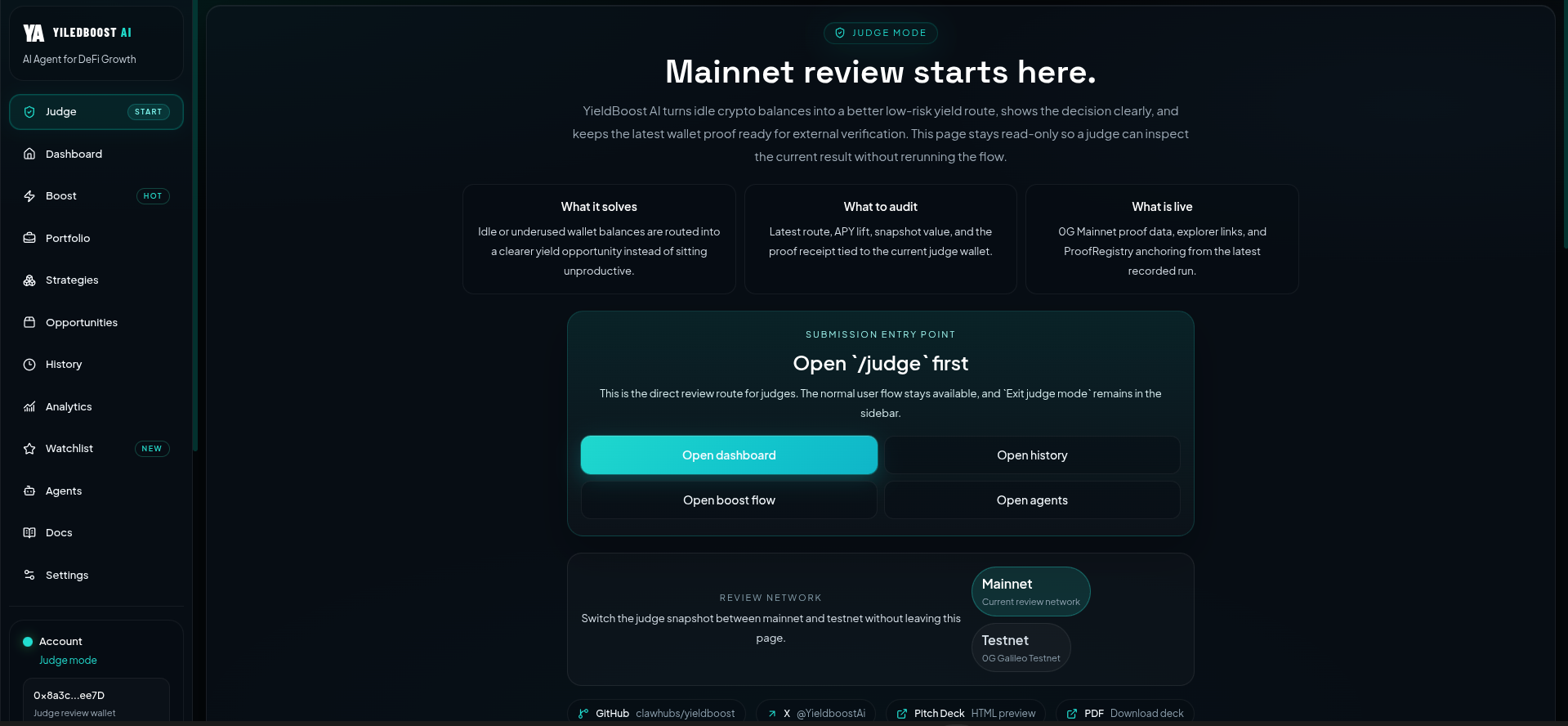
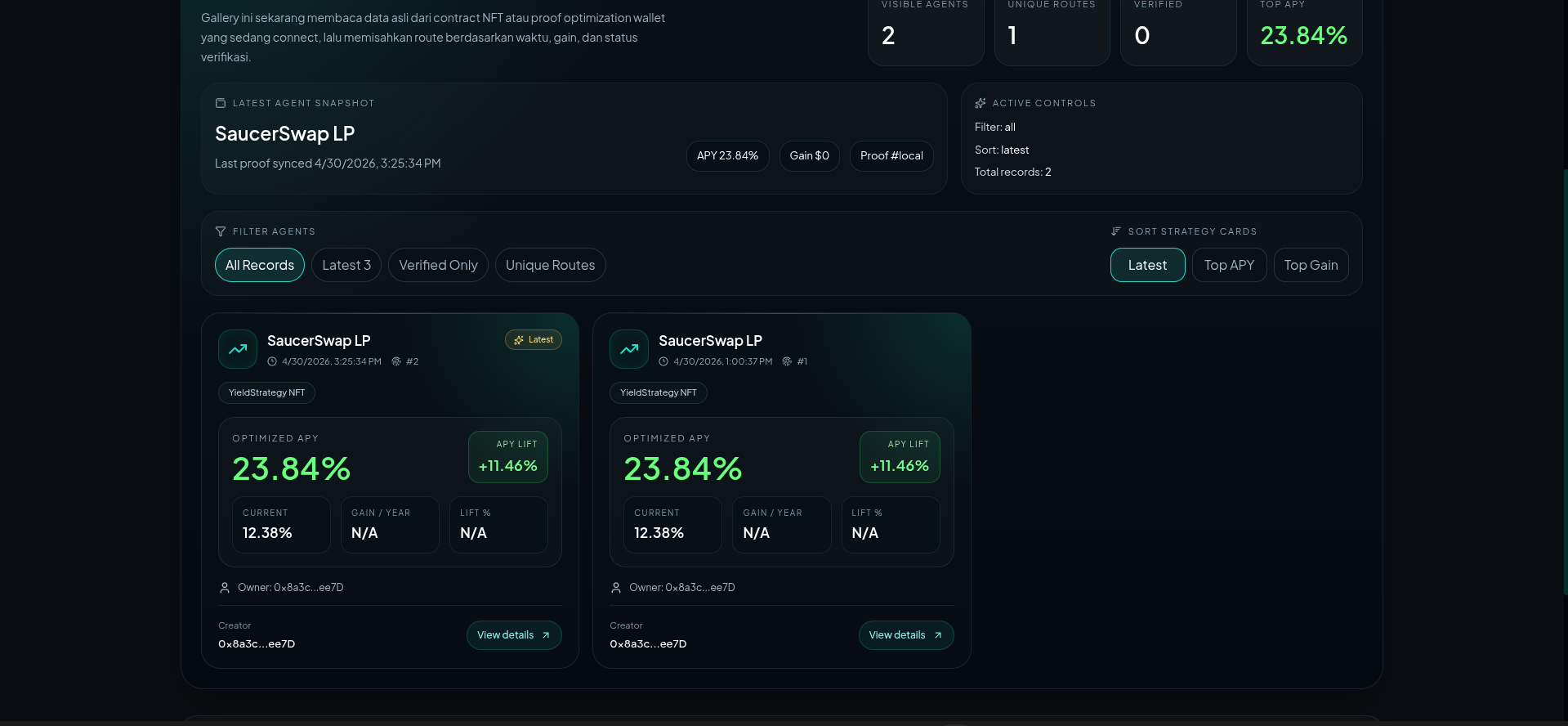
YieldBoost AI is a mainnet-first verifiable yield optimizer built on 0G.
The product helps Web3 users turn idle crypto balances into proof-backed yield strategies. Instead of leaving underused wallet capital unproductive, YieldBoost analyzes a wallet, recommends a better low-risk yield route, stores the optimization result through 0G Storage, and anchors the proof on-chain through ProofRegistry.
Because AI + finance is highly sensitive to hallucination, YieldBoost does not treat AI output as final truth by default. Every optimizer output is checked through an Integrity Auditor guardrail that compares the recommendation against the real portfolio snapshot, stored proof context, and deterministic financial constraints before it can be written as a proof, shown as verified, or minted as an Agent NFT.
YieldBoost now also includes three additional 0G-native integrity layers:
1. Sovereign Memory
Agent state snapshots and long-term optimization context are persisted on 0G Storage. This gives the strategy agent a decentralized memory layer that can be rehydrated later instead of depending on a centralized database.
2. Hallucination Blacklist
Rejected or unsafe AI outputs are indexed as blacklist artifacts on 0G Storage and backed by a deployed mainnet GlobalBlacklistRegistry. Before future inference, the system can check known-bad patterns and block repeated hallucination risks earlier.
3. Multiverse Stress Test
Historical replay and backtesting results are stored as 0G-backed Integrity Report Cards. A deployed mainnet ValidationRegistry anchors the stress-test layer so historical validation becomes part of the verifiable audit surface.
The runtime also uses prompt compression, semantic caching, and embedding-based reuse to keep recommendations more consistent, efficient, and less noisy. The app includes a dedicated Judge Mode so reviewers can inspect the latest proof-backed snapshot without connecting a wallet, requesting faucet funds, or rerunning the optimizer.
YieldBoost supports one-click optimization, 0G Storage proof persistence, ProofRegistry verification, mainnet/testnet review switching, Strategy Agent NFT minting, on-chain attestation oracle verification, Sovereign Memory, Hallucination Blacklist defense, Multiverse Stress Test reports, and a Strategy NFT Marketplace / adoption flow.
Live demo:
https://yieldboost-ai.vercel.app/judge
GitHub:
https://github.com/clawhubs/yieldboost
Pitch Deck:
https://yieldboost-ai.vercel.app/pitchdeck/yieldboost-pitchdeck.html
During the hackathon, YieldBoost AI evolved from a yield dashboard prototype into a mainnet-first verifiable finance product on 0G.
Completed progress includes:
- Built the Next.js dashboard, wallet-aware portfolio view, and one-click optimization flow.
- Integrated 0G Storage to store optimization proof payloads, verification metadata, portfolio snapshots, reasoning outputs, Sovereign Memory snapshots, blacklist artifacts, and stress-test report cards.
- Deployed and connected ProofRegistry for on-chain proof anchoring, so each optimization result can be traced through a public transaction.
- Added Judge Mode for frictionless review without requiring wallet connection, faucet setup, or rerunning the optimizer.
- Added mainnet and testnet snapshot switching for audit comparison.
- Added runtime efficiency signals including semantic cache, embedding reuse, and prompt compression to reduce repeated inference cost and keep optimization requests more consistent.
- Added Integrity Auditor guardrails to reduce AI hallucination risk. Instead of trusting the optimizer output blindly, the system compares the AI recommendation against the real portfolio/proof context and rejects unrealistic results before they are written as proofs or minted as Agent NFTs.
- Added Sovereign Memory on 0G Storage, allowing the strategy agent to persist context snapshots and long-term state across sessions.
- Added Hallucination Blacklist defense, where rejected AI outputs can be indexed as known-bad artifacts and checked before future inference.
- Deployed GlobalBlacklistRegistry on 0G Mainnet to expose the blacklist layer as a verifiable on-chain deployment artifact.
- Added Multiverse Stress Test, a historical replay system that compares standard AI decisions against auditor-verified decisions and stores Integrity Report Cards on 0G Storage.
- Deployed ValidationRegistry on 0G Mainnet to support stress-test report anchoring and historical validation evidence.
- Added deterministic verification for finance-sensitive outputs. If an AI response suggests an APY, route, or strategy that does not match available snapshot data, the guardrail can flag the result instead of allowing an unverifiable claim into the product flow.
- Added Strategy Agent NFT minting so a proof-backed optimization can become an on-chain strategy artifact.
- Added an on-chain attestation oracle for Agent NFT verification.
- Added a Strategy NFT Marketplace / adoption flow for listed proof-backed strategy NFTs.
- Surfaced mainnet deployment artifacts directly in Judge Mode, including the latest proof CID, 0G Storage transaction, ProofRegistry anchor, Agent NFT mint transaction, marketplace contract, attestation oracle, YieldStrategyINFT contract, GlobalBlacklistRegistry, ValidationRegistry, and ChainScan links.
- Published the live app, GitHub repository, pitch deck, PDF deck, and video demo for judging.
Anti-hallucination approach:
YieldBoost AI treats AI output as a proposal, not as final truth. The optimizer may generate a strategy recommendation, but the system adds verification steps around it before the result becomes part of the audit trail.
The project uses several layers to reduce hallucination risk:
1. Prompt compression keeps the input concise and structured, reducing noisy or ambiguous instructions before inference.
2. Semantic cache and embedding reuse help avoid repeatedly generating different answers for similar wallet and portfolio conditions.
3. Integrity Auditor checks the AI recommendation against the real portfolio snapshot and stored proof context.
4. Hallucination Blacklist stores rejected outputs and known-bad patterns so similar future inputs can be blocked earlier.
5. Proof writing only happens after the recommendation passes the deterministic guardrail.
6. Sovereign Memory persists verified agent context so the system can maintain continuity without relying only on short-lived session state.
7. Multiverse Stress Test replays historical market slices to compare standard AI output against auditor-verified decisions.
8. Agent NFT minting depends on the verified proof-backed result, so an unrealistic or rejected optimization should not become an on-chain strategy artifact.
This design makes YieldBoost AI closer to deterministic AI for DeFi: the AI can reason and recommend, but the product flow requires proof, context, memory, blacklist defense, and historical validation before the output is treated as trustworthy.
YieldBoost AI is currently bootstrapped and built independently for the 0G Labs Global Hackathon.
No external fundraising has been completed yet. The current focus is product validation, mainnet proof reliability, hackathon judging, and expanding the verifiable yield optimization layer on top of 0G.