
0G APAC Hackathon
Build the next generation of AI x Web3 applications on 0G’s modular infrastructure.
Hackathon State
Prepare with AI


Use this prompt in your AI IDE to quickly get started with this hackathon.
Recommended prompt
I am preparing for 0G APAC Hackathon. Help me understand the rules, required developer resources, project ideas, and a 7-day preparation plan based on my HackQuest builder journey.
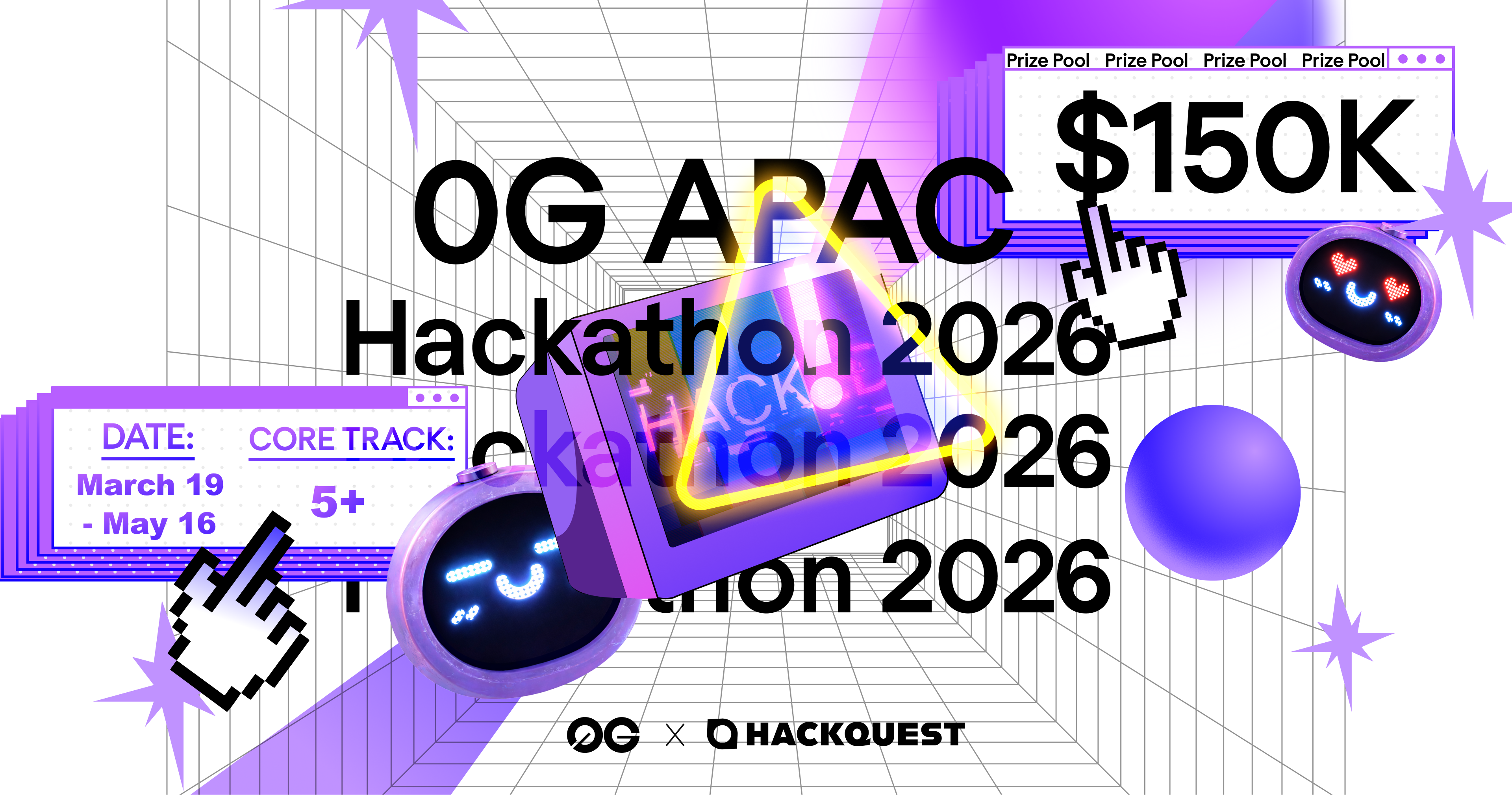
150,000 USD
Available in Prizes
Description
The 0G APAC Hackathon is a builder program for developers creating the next generation of AI x Web3 applications on 0G.
Running from March to May 2026, the hackathon invites developers, founders, and early-stage teams to build with 0G’s modular infrastructure across areas such as autonomous agents, verifiable finance, AI-native applications, privacy, and high-performance consumer products.
This program is designed to help promising teams move from idea to deployment, with technical support, ecosystem exposure, and follow-up opportunities inside the 0G ecosystem.
Key Dates
Registration Opens: March 19, 2026
Online Checkpoint: Early April 2026
Teams submit a progress update covering project direction, technical architecture, and current development status for early feedback.Mini Demo Day at Hong Kong Web3 Festival: April 22, 2026
Selected teams will have the opportunity to present an early showcase of their project on-site as part of the ecosystem spotlight.Submission Deadline: May 16, 2026, 23:59 UTC+8
All teams must complete and submit their final project materials through the HackQuest platform before the deadline.Preliminary Review: 1–2 weeks after submission closes
The judging panel will review all valid submissions and shortlist the strongest projects for the final round.Final Demo & Award Ceremony: Early May 2026
Finalists will present their projects online, followed by the official winner announcement and award ceremony.
Prize Pool & Incentives
Total Prize Pool: $150,000
Reward Structure: USDT + 0G Ecosystem Credits
Credits may be used for 0G storage, compute, AI inference, and other ecosystem services
Grand Prizes
1st Place: $45,000
2nd Place: $35,000
3rd Place: $20,000
Additional Awards
10 Excellence Awards: $3,700 each
10 Community Awards: $1,300 each
Tracks
Track 1: Agentic Infrastructure & OpenClaw Lab
Core Focus: Developing the cognitive backbone and orchestration layers for autonomous intelligence.
Technical Scope: Building agent frameworks, specialized Skills, and data-processing pipelines.
Priority Requirements: We encourage the integration of OpenClaw for orchestration and 0G Compute for model fine-tuning or inference. Projects should demonstrate the use of 0G Storage for state persistence and long-context memory.Track 2: Agentic Trading Arena (Verifiable Finance)
Core Focus: Transitioning from manual DeFi to fully autonomous, verifiable financial logic.
Technical Scope: Intelligent yield optimizers, risk-management bots, and AI-driven perpetual strategy agents.
Key Innovation: We specifically support the use of Sealed Inference and TEE-based execution to ensure execution privacy and mitigate front-running, creating a more secure environment for proprietary trading strategies.Track 3: Agentic Economy & Autonomous Applications
Core Focus: Building the financial and service layer for the AI era. We welcome everything from foundational economic protocols to creative AI-driven consumer dApps.
Key Directions:
-Financial Rails: Micropayments, automated billing, and revenue-sharing
-AI Commerce & Social: AI-driven marketplaces, SocialFi agents, and Agent-as-a-Service platforms
-Operational Tools: Self-custodial agent wallets and AI-governed DAO infrastructureTrack 4: Web 4.0 Open Innovation (The Wildcard)
Core Focus: High-performance scaling for SocialFi, Gaming, and DePIN.
Technical Scope: This track is designed for high-quality application teams that require 0G’s decentralized storage for real-world scaling.Track 5: Privacy & Sovereign Infrastructure
Core Focus: Building the confidentiality rails and abstraction layers for a secure Web 4.0.
Technical Scope: Developing privacy-preserving protocols, cross-chain fragmentation solutions, and MEV-resistant infrastructure.
Eligibility
Open to global developers, with a focus on APAC builders
Open to solo builders and teams of 1–6 members
Best suited for developers, startup teams, and AI x Web3 builders with strong product or technical ideas
Teams may submit a brand-new project, an early MVP, or an existing prototype that is further developed and deployed on 0G during the hackathon
One participant may join only one team
Submission Requirements
All submissions must be completed through HackQuest and must include the following materials.
(Please note that the information provided here is the most up-to-date. Content on other platforms may not be updated yet.)
1. Basic Project Information
Each team must provide:
Project name
One-sentence project description in no more than 30 words
A short summary clearly explaining:
what the project does
which problem it solves
which 0G component(s) are used
2. Code Repository
Each team must submit:
A GitHub repository link
Repository must be public or shared with judges for review
The repo should show substantial development progress during the hackathon period
Empty repos, placeholder repos, or repos without meaningful commits may be disqualified
3. 0G Integration Proof
This is the core requirement of the hackathon. Each submission must include:
A 0G mainnet contract address
A 0G Explorer link showing verifiable on-chain activity
Clear proof that at least one 0G core component has been integrated into the project
Accepted 0G components include, but are not limited to:
0G Storage
0G Compute
0G Chain
Agent ID
Privacy or secure execution features within the 0G stack
Projects without actual 0G integration will be considered invalid.
4. Demo Video
Each submission must provide:
A demo video of no more than 3 minutes
The video must clearly show:
the product’s core functionality
the user flow or use case
how the 0G component is actually used in the project
Slide-only or concept-only videos will not be accepted
Video must be uploaded through a publicly accessible link such as YouTube or Loom
5. README / Documentation
Each team must submit a project README in English or Chinese that includes:
Project overview
System architecture diagram or technical description
Explanation of which 0G modules are used
Description of how those modules support the product
Local deployment or reproduction steps for judges
Test account details, faucet instructions, or other reviewer notes if needed
Strong documentation will be an important part of judging.
6. Public X Post
Each team must publish at least one public project post on X and submit the post link through HackQuest.
The post must include:
Project name
Demo screenshot or short demo clip
Hashtags: #0GHackathon and #BuildOn0G
Tags: @0G_labs @0g_CN @0g_Eco @HackQuest_
This requirement is mandatory and will be checked during review.
7. Optional Bonus Materials
The following are not mandatory, but may strengthen a submission:
Pitch deck or slides
Frontend demo link
User feedback screenshots
User testing notes
Backend API documentation
Tutorial or technical write-up showing how the 0G integration works
Judging Criteria
Projects will be evaluated based on:
0G Technical Integration Depth & Innovation
Technical Implementation & Completeness
Product Value & Market Potential
User Experience & Demo Quality
Team Capability & Documentation
At least one 0G component must be integrated into every valid submission. Projects that fail to meet this requirement may be disqualified or receive major score deductions.
About 0G
0G is a modular infrastructure stack for AI x Web3 applications, including decentralized storage, scalable data availability, decentralized compute, persistent memory, agent identity, and privacy-preserving execution.
It is designed for builders creating applications that require scale, speed, data persistence, verifiable compute, and secure execution across AI-native and on-chain use cases.
Grand Prizes
100,000 USD
Grand Prizes
1st Place — $45,000
2nd Place — $35,000
3rd Place — $20,000
Reward Structure: USDT + 0G Ecosystem Credits
Grand Prizes
Judging Criteria
0G Technical Integration Depth & Innovation
Extent of adoption of 0G components, and innovative solutions to AI / on-chain pain points.Technical Implementation & Completeness
Functional integrity, code quality, and mandatory on-chain deployment (Explorer link / contract address must be provided for verification).Product Value & Market Potential
Market fit, problem-solving capability, user value, and growth roadmap.User Experience & Demo Quality
Intuitiveness and user-friendliness of UI/UX; clarity and persuasiveness of pitch and demo (live performance at the Hong Kong Web3 Festival Mini Demo Day will be a key reference).Team Capability & Documentation
Team background, quality of open‑source code and README.Additional Rule:
At least one 0G component must be used; failure to comply will result in point deductions.
Excellence Awards
37,000 USD
Excellence Awards
10 awards × $3,700
Reward Structure: USDT + 0G Ecosystem Credits
Excellence Awards
Judging Criteria
Awarded to the most creative and promising projects that did not place in the top three.
Community Awards
13,000 USD
Community Awards
10 awards × $1,300
Reward Structure: USDT + 0G Ecosystem Credits
Community Awards
Judging Criteria
Selected through community voting mechanisms such as Discord or X platform voting, recognizing the most popular and community-impactful projects.
Schedule
Resource
You may freely select and flexibly combine 0G’s core technical modules based on your project needs:
0G Storage: An ultra-low-cost decentralized storage solution optimized for AI. Featuring a dual-layer architecture (Log permanent archival layer + KV millisecond-level query layer), it supports petabyte-scale structured and unstructured data. The architecture ensures high availability and is optimized for rapid access and persistence of massive datasets.
Compute Network: A decentralized GPU compute marketplace where providers supply inference, fine-tuning, and training services on demand. The network supports multi-chain integration and ZK-verifiable settlement with pay-as-you-go pricing.
Persistent Memory: Coming soon. A persistent memory system purpose-built for AI Agents and long-context LLMs, enabling cross-session “permanent memory” and ultra-large context windows to empower continuous, long-term intelligence.
Agent ID: Based on the Agent ID standard, an Agent ID standard designed specifically for AI Agents. It tokenizes the intelligence, memory, and behavior of AI Agents, supporting encrypted metadata, interactive evolution, tradable ownership, and composability.
Privacy & Security: Utilizes TEE secure execution environments for hardware-enforced data privacy during AI inference, combined with AI Alignment Nodes to monitor model drift, bias, and anomalies in real time. Integrated with end-to-end privacy via Agent ID encrypted metadata and ownership proofs for AI agents, delivering encrypted protection and verifiable computation.