
Multi-agent Web3 due diligence with on-chain verifiable receipts. 8 agents analyze, a Critic challenges, scores adjust mathematically, every report is signed (EIP-712) and recorded on 0G Chain mainnet
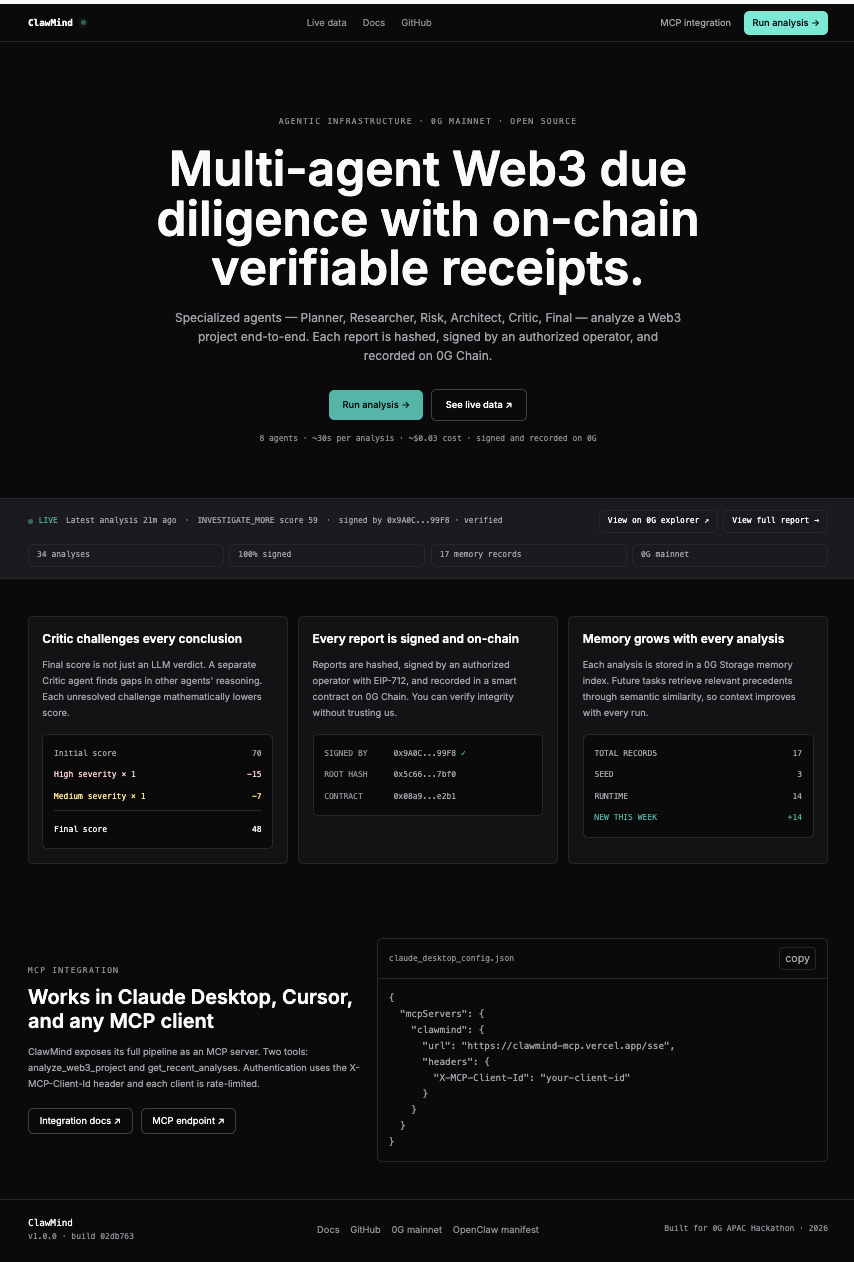
ClawMind runs multi-agent due diligence on Web3 projects and anchors every report on 0G Chain, so audit results can be verified later instead of silently rewritten.
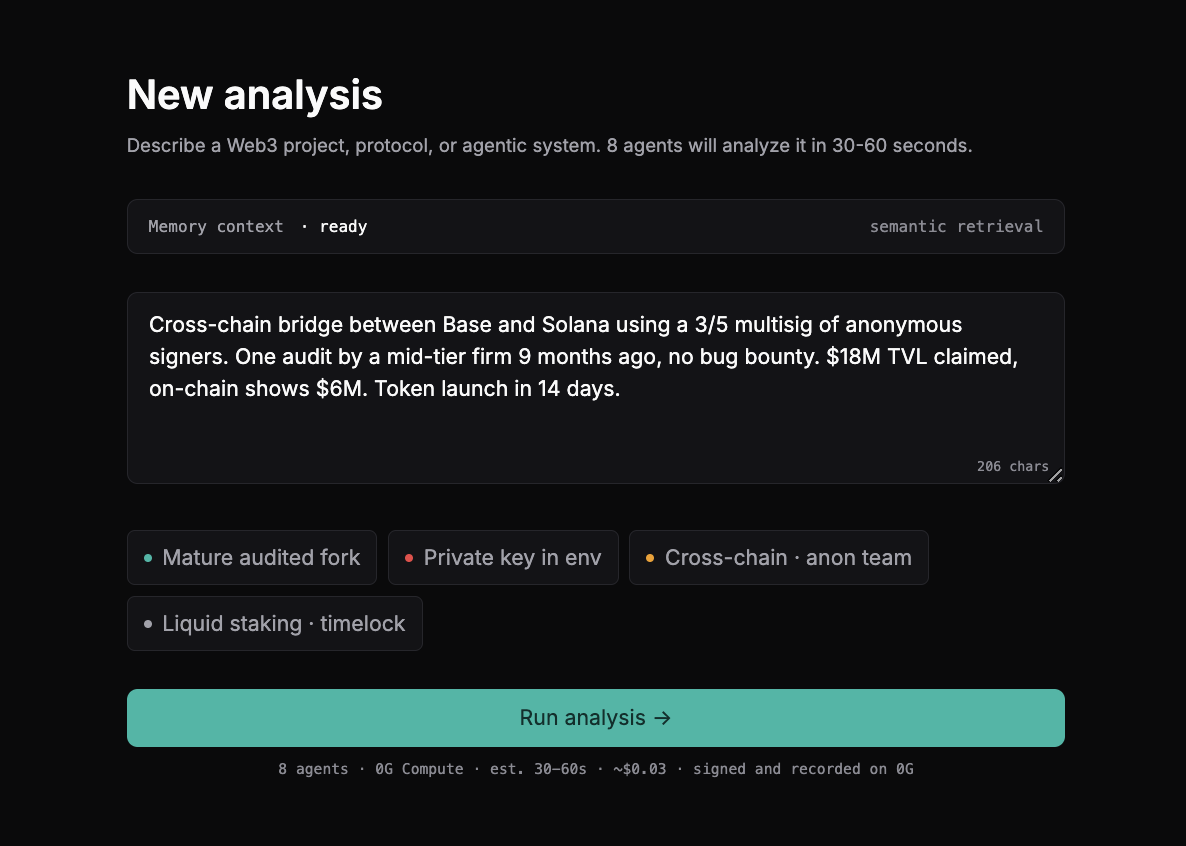
A user submits a project description. Eight specialized agents analyze it end-to-end. An adversarial Critic challenges the other agents' assumptions. The final report is hashed, signed by an authorized operator via EIP-712, and recorded in the AnalysisRegistry smart contract on 0G Chain mainnet.
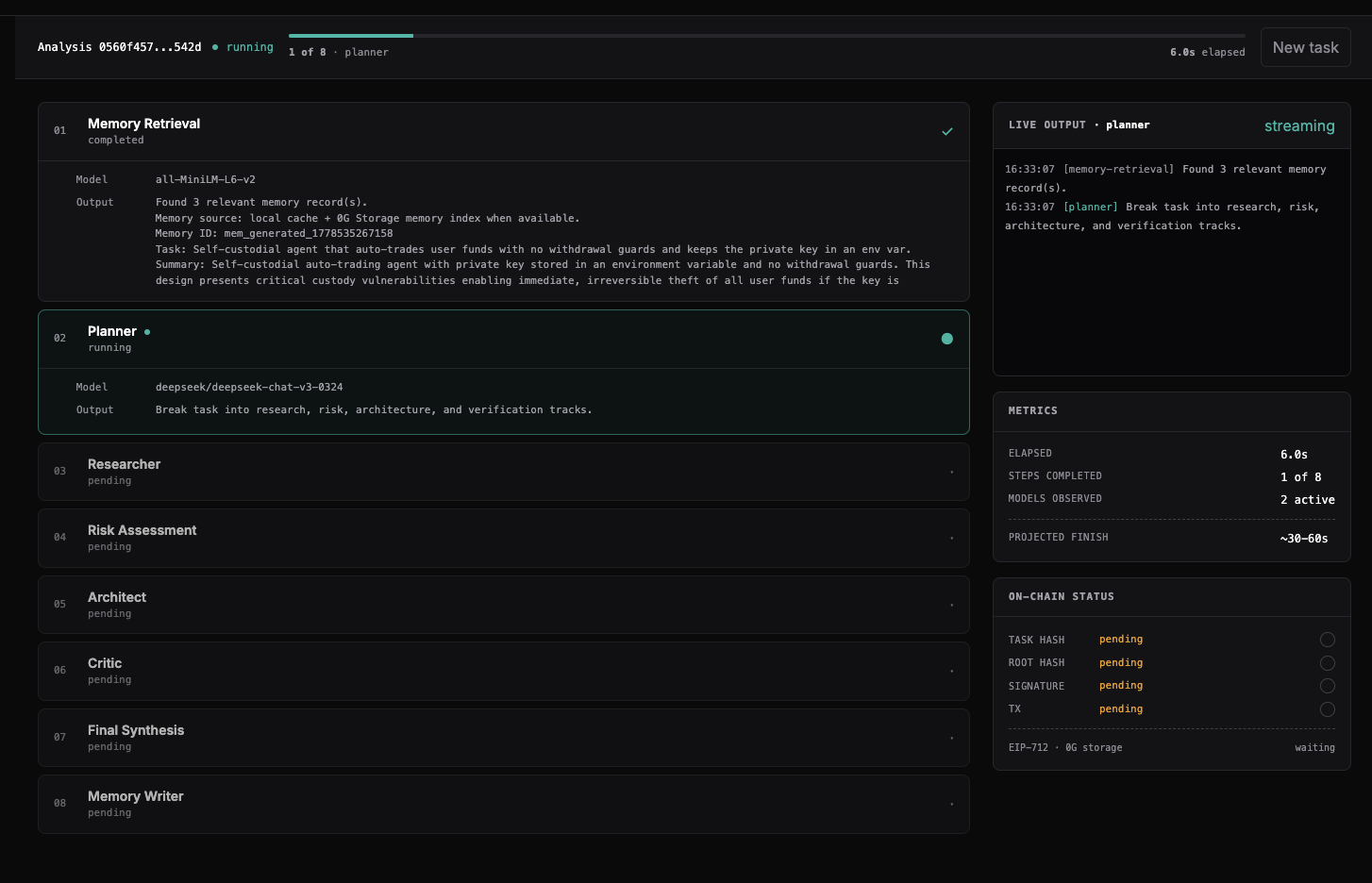
1. Memory Retrieval - semantic search over prior analyses stored through the 0G-backed memory index
2. Planner - decomposes the task into research, risk, architecture, and verification tracks
3. Researcher - extracts facts, assumptions, and external risk signals
4. Risk Agent - identifies custody, governance, operational, and economic risks
5. Architect - proposes mitigations and architecture-level improvements
6. Critic - adversarially challenges prior conclusions and flags unresolved issues
7. Final Synthesis - reconciles all outputs into a score, recommendation, and report
8. Memory Writer - appends the completed run to persistent semantic memory
Inference is routed through 0G Compute. Memory retrieval uses 384-dimensional embeddings with all-MiniLM-L6-v2.
Multi-agent reasoning pipeline. ClawMind separates planning, research, risk assessment, architecture review, adversarial critique, final synthesis, and memory writing into distinct pipeline stages.
Adversarial Critic with measurable impact. Each unresolved Critic challenge mathematically lowers the score: high -15, medium -7, low -3. The math is visible in the UI and reproducible.
EIP-712 signed receipts. Reports are signed by an authorized operator before being written on-chain. The smart contract verifies the signature on every write and rejects unauthorized submissions.
Persistent semantic memory. Each analysis is stored as a verifiable snapshot. Future runs retrieve relevant precedents through cosine similarity over 384-dimensional embeddings.
MCP integration. The full pipeline is exposed as a Model Context Protocol server. Any MCP-compatible client, including Claude Desktop and Cursor, can invoke ClawMind with two tools: analyze_web3_project and get_recent_analyses.
ClawMind covers the core requirements of Track 1: Agentic Infrastructure & OpenClaw Lab.
- OpenClaw orchestration - openclaw.yaml defines the full 8-step pipeline, skills, artifacts, and security policies. Served at /api/openclaw/manifest.
- 0G Compute - agent inference is routed through 0G Compute.
- 0G Storage - decision reports and memory records are persisted with verifiable 0g:// URIs.
- 0G Chain - AnalysisRegistry.sol records each analysis with root hash, score, recommendation, storage URI, and operator signature.
- Long-context memory — runtime-grown semantic memory with active retrieval and public stats.
ClawMind is built for DAO contributors evaluating external proposals, Web3 VCs needing reproducible due diligence, and protocol teams looking for an independent pre-screen with a verifiable audit trail.
ClawMind is a due-diligence aid, not a formal audit or exploit detector. It does not execute transactions, manage user funds, or replace human security review. On-chain integrity proves that a report hash was signed and recorded; it does not prove the report is correct.
Smart contract - AnalysisRegistry.sol
Deployed twice on 0G mainnet. The first iteration 0x01c9...4D2) was open-write; the second 0x08a9c275...e2b1) adds EIP-712 operator authentication. The contract verifies a typed-data signature on every recordAnalysis() call and rejects writes from unauthorized signers. Operator 0x9A0C8040...99F8 is currently authorized. Source: contracts/AnalysisRegistry.sol.
8-agent pipeline
Built from scratch: Memory Retrieval → Planner → Researcher → Risk → Architect → Critic → Final Synthesis → Memory Writer. Each agent has its own skill, prompt, and model assignment. Final Agent applies explicit score anchors plus Critic severity penalties (high −15, medium −7, low −3), so calibration is measurable, not vibes.
0G Compute integration
Agent inference is routed through 0G Compute. The production deployment currently uses deepseek/deepseek-chat-v3-0324 as the primary model route, with model routing/fallback logic in the codebase.
Persistent semantic memory
Memory index lives on 0G Storage with versioned, immutable snapshots. Each analysis appends a record. Retrieval uses cosine similarity over all-MiniLM-L6-v2 embeddings (384 dimensions).
MCP server
Deployed as a separate Vercel project apps/mcp-server). Two tools: analyze_web3_project and get_recent_analyses. Authentication via X-MCP-Client-Id header with 60-second rate limit per client. The MCP server is a thin wrapper that calls the existing /api/analyze endpoint, so MCP-initiated analyses get the same EIP-712 signing and on-chain recording as web-initiated ones.
Production UX
Core screens: landing, /analysis or /analyze, live pipeline/report view, /stats, and /judge. Live pipeline shows real-time agent output, model strings, on-chain status (task hash → root hash → signature → tx), and a Critic moment where unresolved challenges visibly lower the score.
Verifiable end-to-end loop
A user can submit a task, see it analyzed, retrieve the report by storage URI, and verify the on-chain hash matches the storage content. The "Retrieve Report" widget on the report page accepts any 0g:// URI or root hash and reconstructs the persisted report.
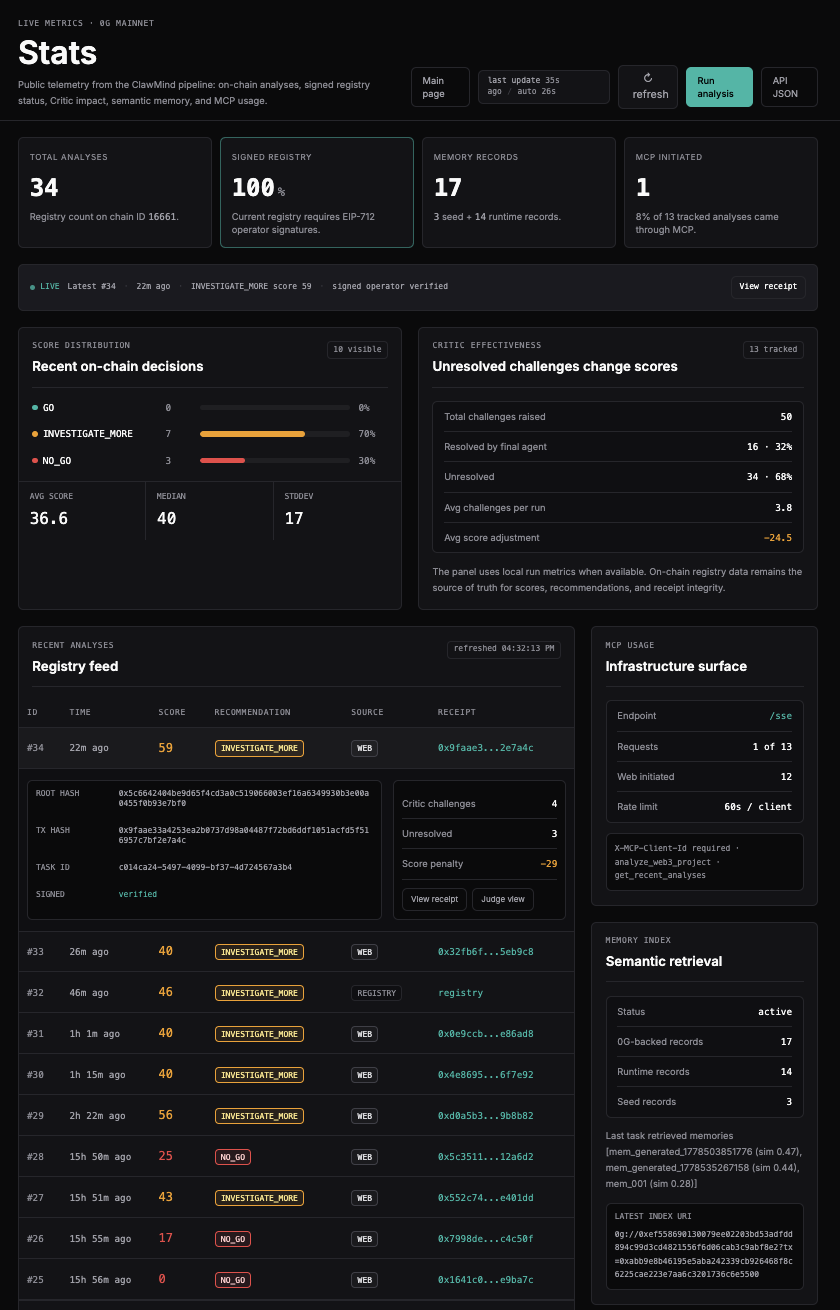
ClawMind is already running as a public live deployment with verifiable 0G mainnet activity.
37 analyses recorded on 0G Chain mainnet
18 semantic memory records stored through the 0G-backed memory index
15 runtime-generated memory records from live analyses
100% of current signed registry metrics use EIP-712 operator authentication
1 signed analysis initiated through the MCP surface
Score distribution includes GO, INVESTIGATE_MORE, and NO_GO across calibration and live runs
Critic raised 62 challenges across 16 tracked runs, with visible score adjustments in the UI
Judges can verify these numbers through the public /stats dashboard and /api/judge endpoint.
ClawMind is a due-diligence aid, not a formal audit or exploit detector.
It does not execute transactions, manage user funds, or replace human security review.
On-chain integrity proves that a report hash was signed and recorded; it does not prove the report is correct.
Memory growth is real but still early. More live runs will improve semantic retrieval quality over time.
Not raised. ClawMind is a hackathon project built for Track 1 of the 0G Hackathon, currently in closed beta. We're focused on validating the multi-agent due-diligence pipeline with real Web3 reviewers (DAO contributors, protocol teams, Web3 VCs) before any fundraising conversation.
Open to grants and ecosystem support from 0G or aligned partners. Not actively pitching to VCs at this stage.