
Domino is an on-chain survival game on Robinhood Chain. Pick the stronger of two tokens each round and be the last player standing. Free-entry beta now; paid pools with stablecoin prizes are planned.
Domino turns token price movements into a multiplayer survival game on Robinhood Chain.
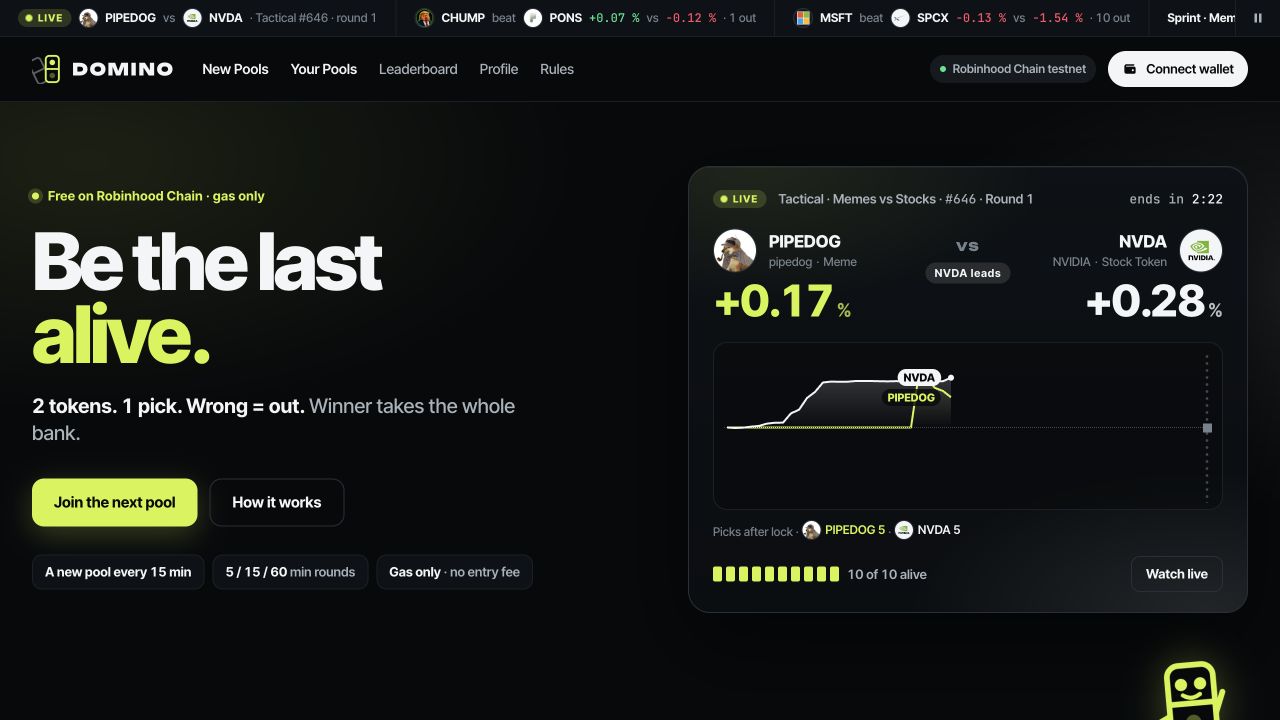
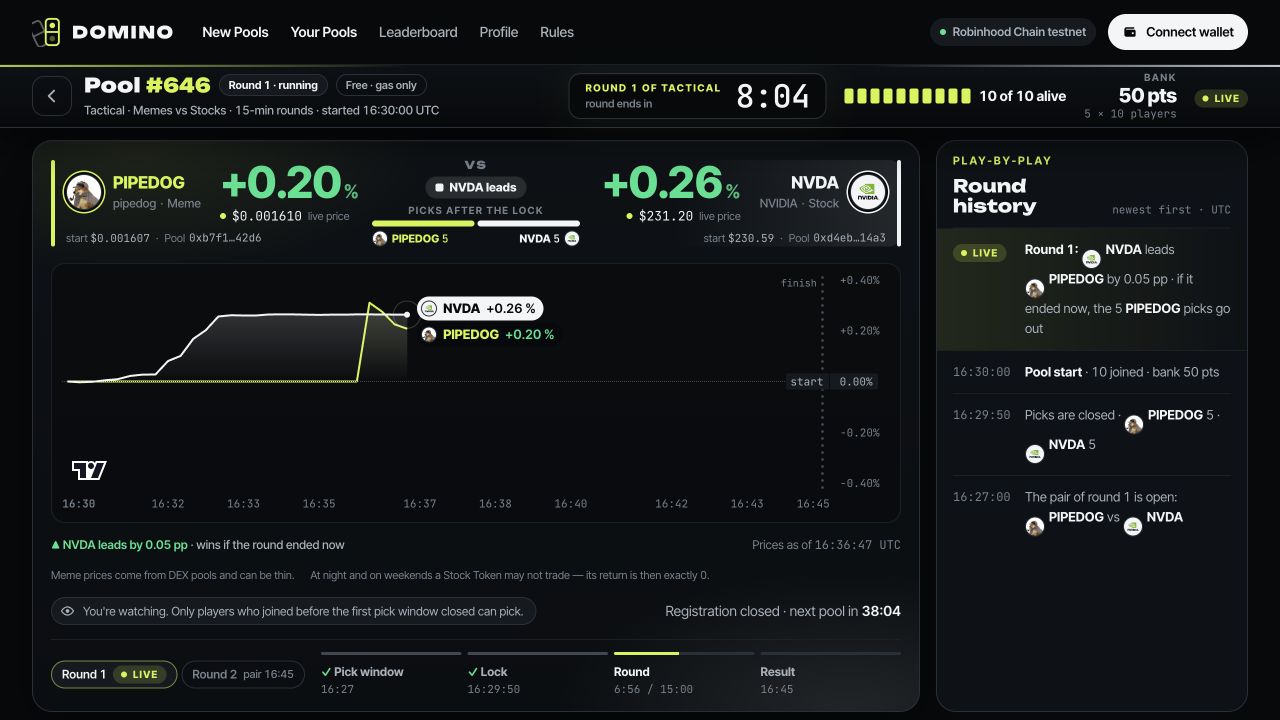
Each round, everyone in a pool gets the same pair of tokens and picks the one that will perform better. A correct pick keeps you in; a wrong or missed pick eliminates you. Players compete to be the last one standing.
Three formats offer different speeds:
• Sprint: memecoins, 5-minute rounds.
• Tactical: memecoins versus Stock Tokens, 15-minute rounds.
• Marathon: Stock Tokens, 60-minute rounds.
The live interface shows both tokens racing on one chart, player eliminations and round-by-round results. Players earn points, build streaks and compete on weekly leaderboards. Winners of pools with at least ten participants can claim a non-transferable title NFT.
Domino is designed for people who already follow memecoins and Stock Tokens and want to compete around their price movements.
Game contracts run on Robinhood Chain testnet, while prices come from real trades in liquidity pools on Robinhood Chain mainnet. Stock Token prices reflect those pools, rather than stock exchange quotes.
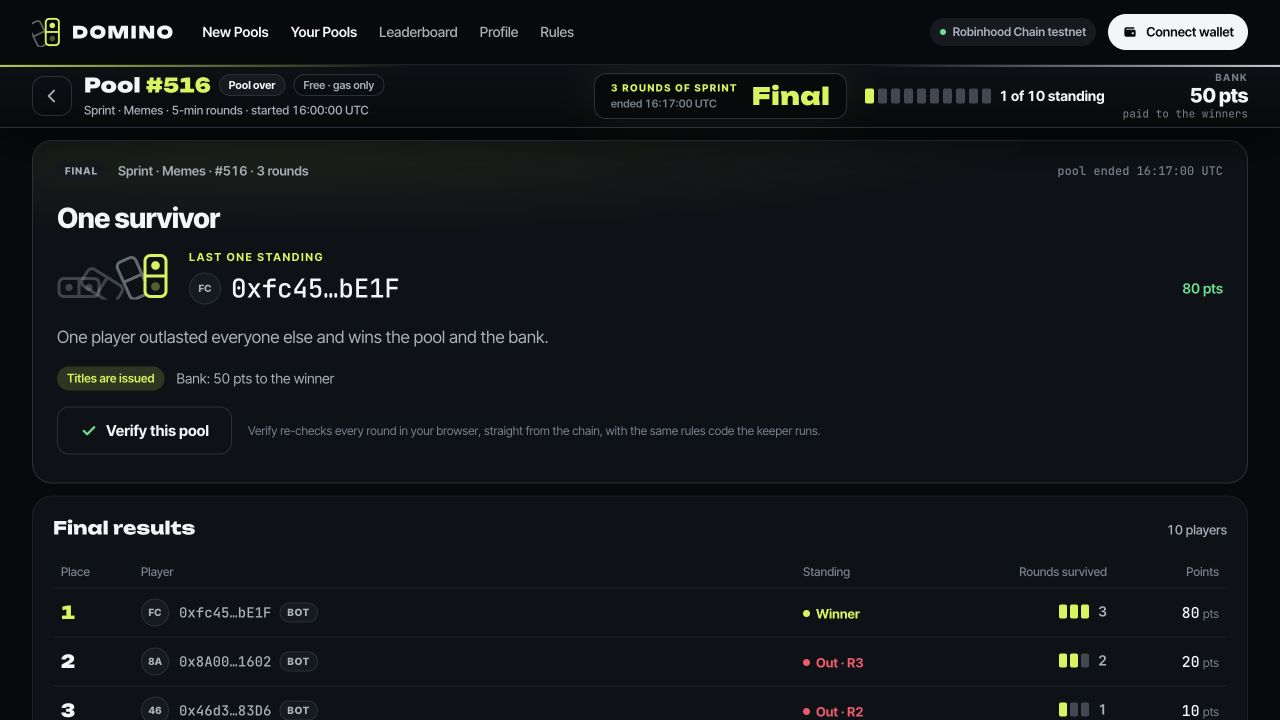
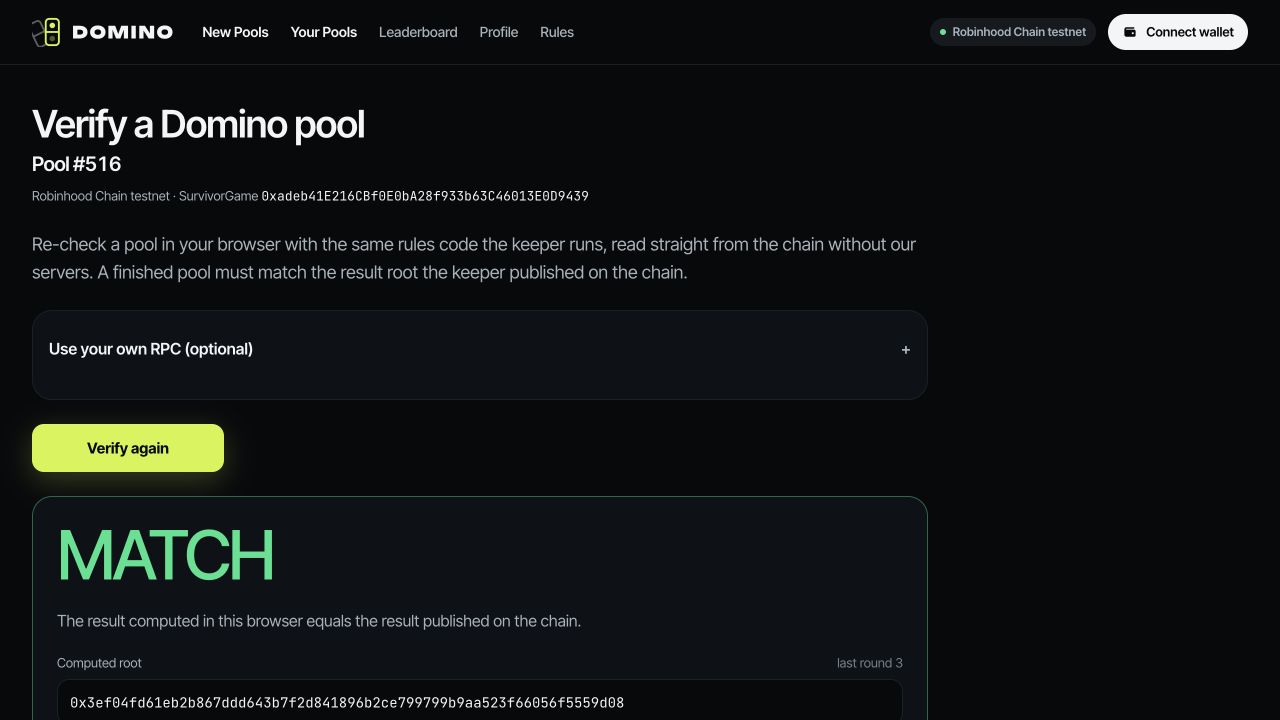
Contracts record joins and picks and enforce their deadlines. A keeper calculates the outcome and publishes a result commitment on-chain. Anyone can independently replay a finished pool in the browser and compare the result. The beta relies on the keeper for settlement; verification makes its work checkable.
The current beta has free entry and non-transferable points; players use test ETH for transaction fees. Paid pools with stablecoin entry and prize banks are planned for a later release.
Play: https://dominogame.xyz
During the buildathon, Domino progressed from documented game rules to a deployed, playable testnet MVP.
The repository records the first project documentation on September 17 and the first code commit on September 21, 2026.
Completed work includes:
• Solidity contracts for pool registration, timed picks, result commitments and winner title NFTs.
• A shared TypeScript game engine for pair selection, price returns, elimination, scoring and result verification.
• An automated keeper for pool creation, finalization and operational alerts.
• An API with live updates and a React frontend covering wallet connection, gameplay, interactive charts, results, profiles and leaderboards.
• Independent browser and command-line verifiers.
• Three game formats using real on-chain price data.
• Testnet bot tooling and automated contract and application tests.
On September 22, 50 test wallets completed a full Sprint pool, and an independent replay matched the result published on-chain. Pool #516 was later verified in both the browser and CLI. These were test participants, not user traction.
Final improvements included faster loading, mobile layout fixes, interactive chart inspection, versioned USD price calculations, more resilient finalization and automatic testnet gas funding.
The frontend is deployed on Vercel, with the API and keeper on Railway. The next milestone is testing activation and repeat participation with human players.
Bootstrapped and self-funded. No external investment, grants or prize funding received to date.