
Open-source contributions, verified by zkTLS & AVS, rewarded by Mantle USD.
zkPull is a trustless open-source bounty and contribution protocol that enables developers to earn rewards automatically once their pull requests are merged, without relying on manual approvals or trusted intermediaries.
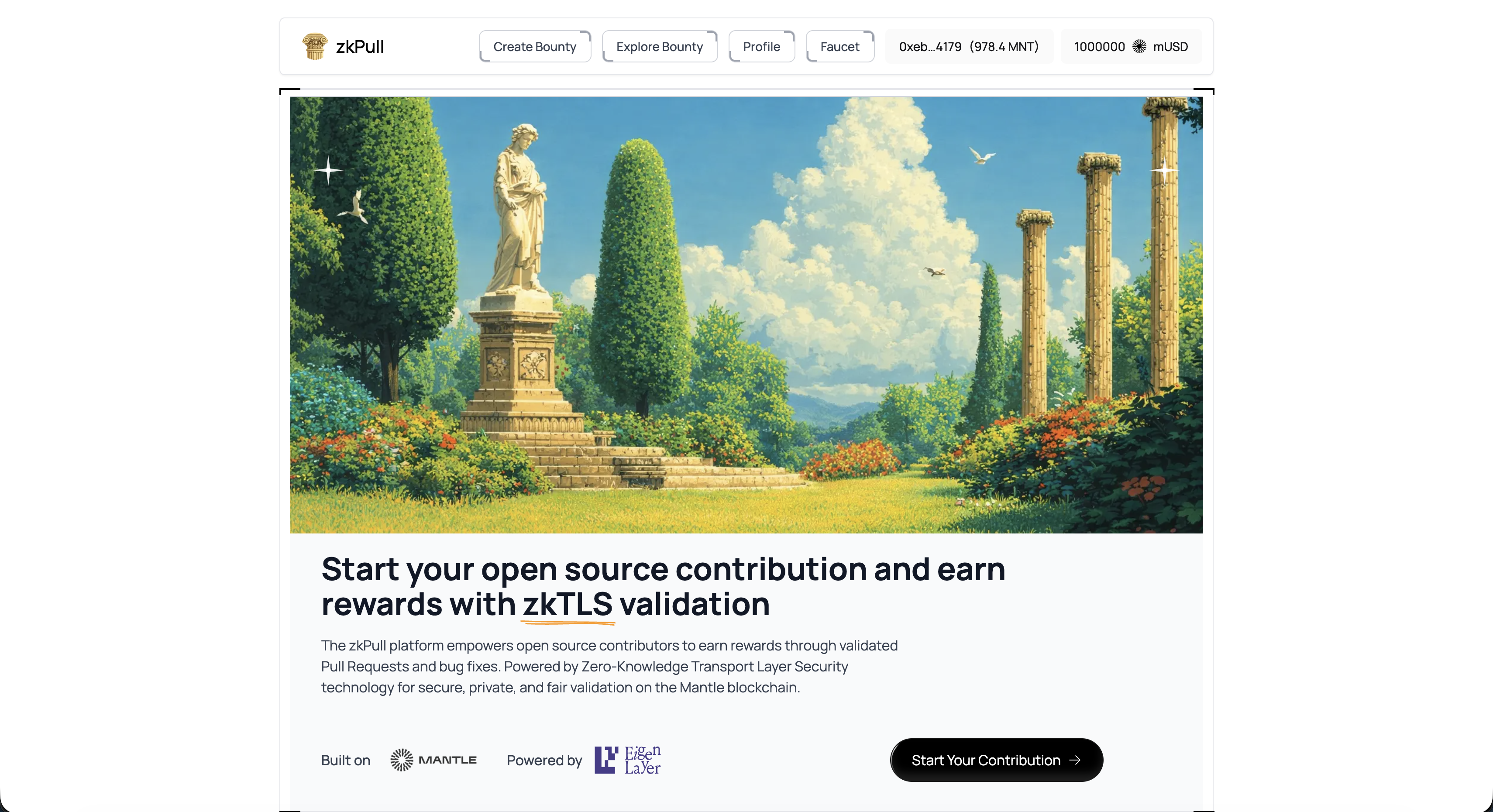
In today’s open-source and Web3 ecosystem, contributors often face delayed payments, manual verification, or complete uncertainty about whether their work will be rewarded. Bug bounties and contribution incentives typically require contributors to trust project owners or centralized platforms to release funds after work is completed.
zkPull removes this trust assumption by turning GitHub contributions into cryptographically verifiable, on-chain enforceable claims.
zkPull connects three worlds that traditionally do not trust each other:
Off-chain developer work (GitHub)
Cryptographic verification (zkTLS)
On-chain enforcement (EigenLayer AVS)
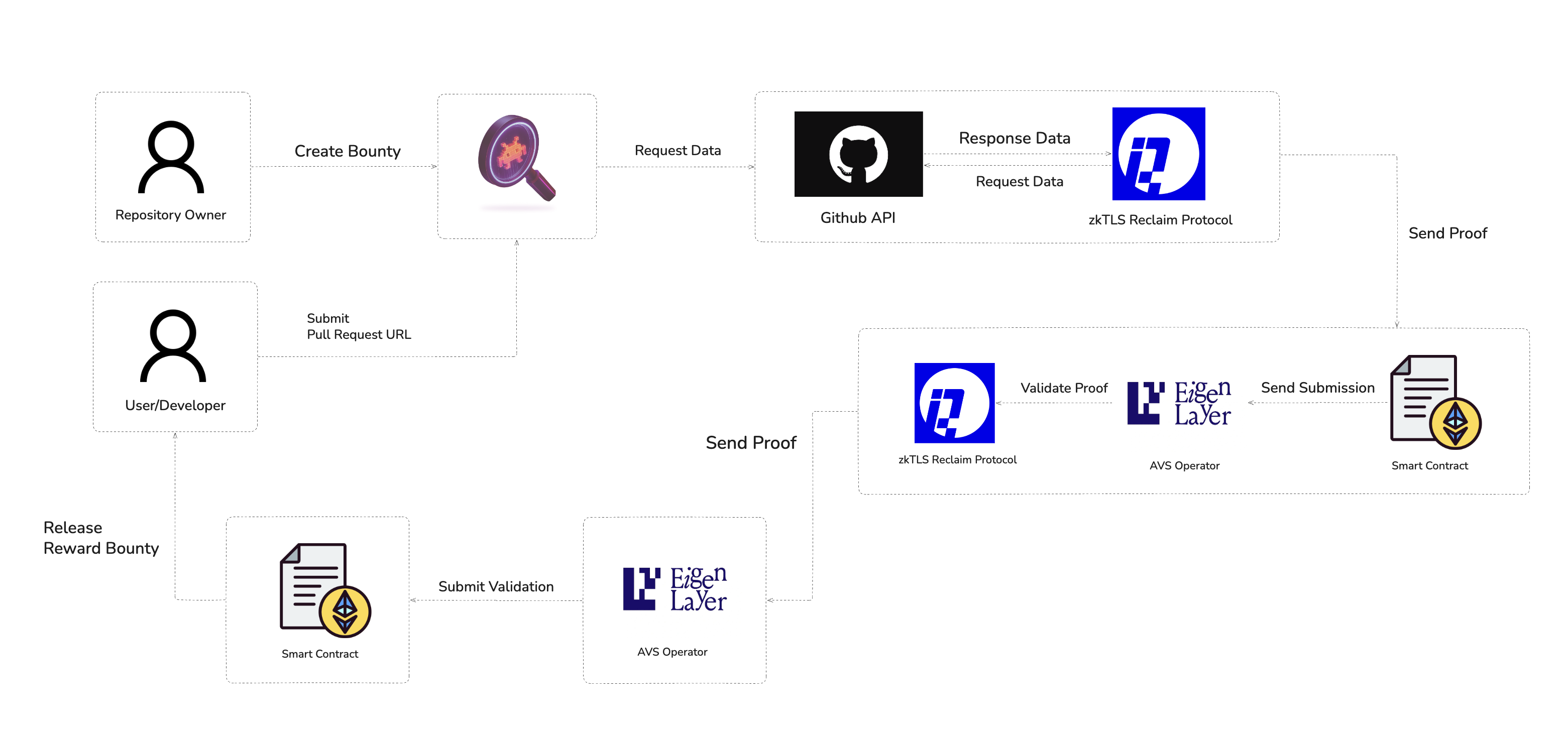
With zkPull:
Project owners create bounties linked to GitHub issues and lock rewards on-chain.
Developers contribute by submitting pull requests as usual.
Once a pull request is merged, the developer submits the PR URL.
zkTLS generates a zero-knowledge proof that verifies the PR status and contributor identity without exposing sensitive data.
An EigenLayer AVS (Actively Validated Service) validates the proof and enforces the result on-chain.
Rewards become instantly claimable by the contributor — no manual fund release required.
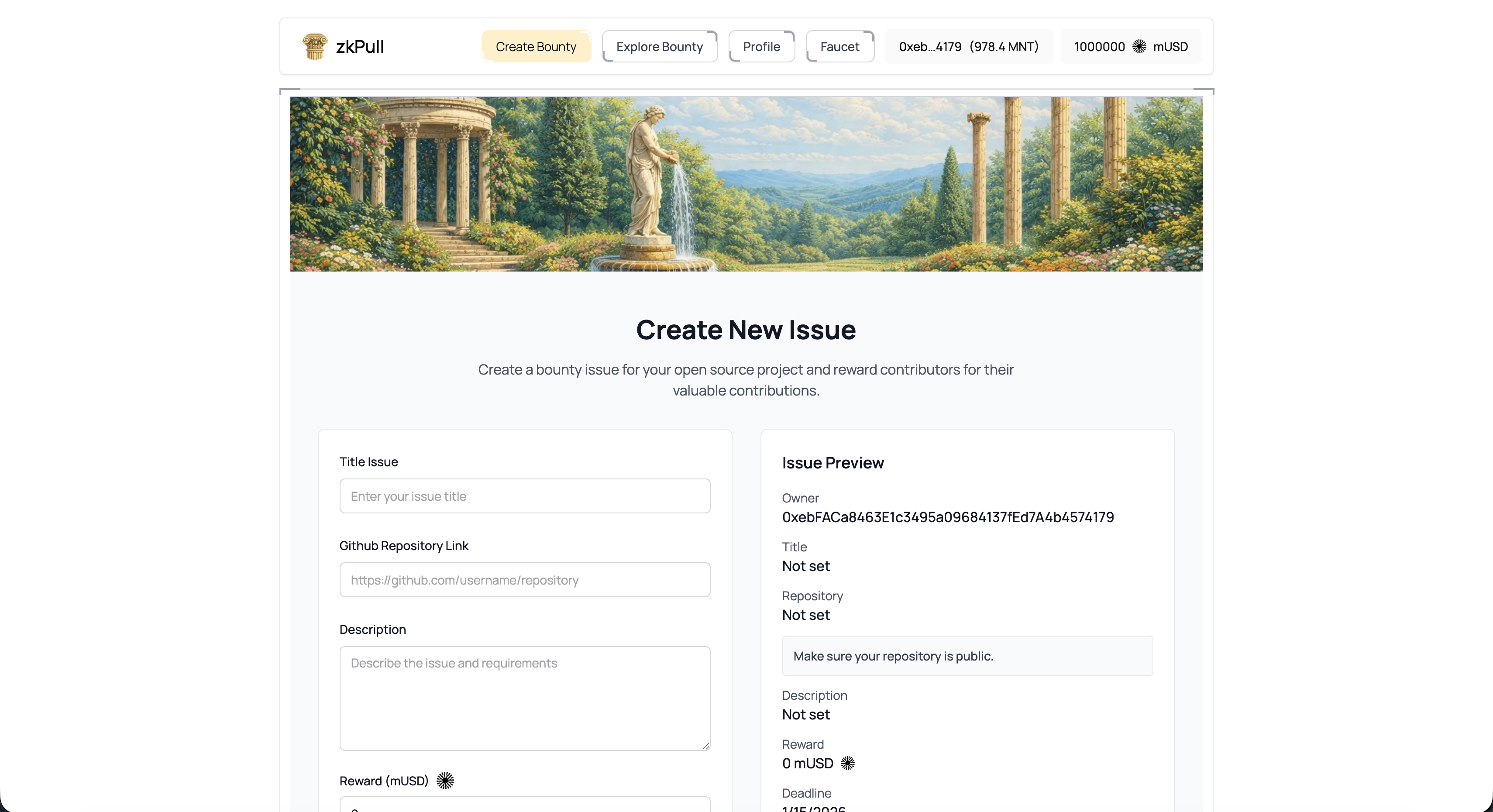
zkPull allows project owners to create bounties directly linked to GitHub issues, with rewards locked on-chain from the start.
Funds are escrowed at bounty creation
Rules are enforced by smart contracts
Contributors are protected from unpaid work
This removes the need to trust project owners or platforms to release funds manually.
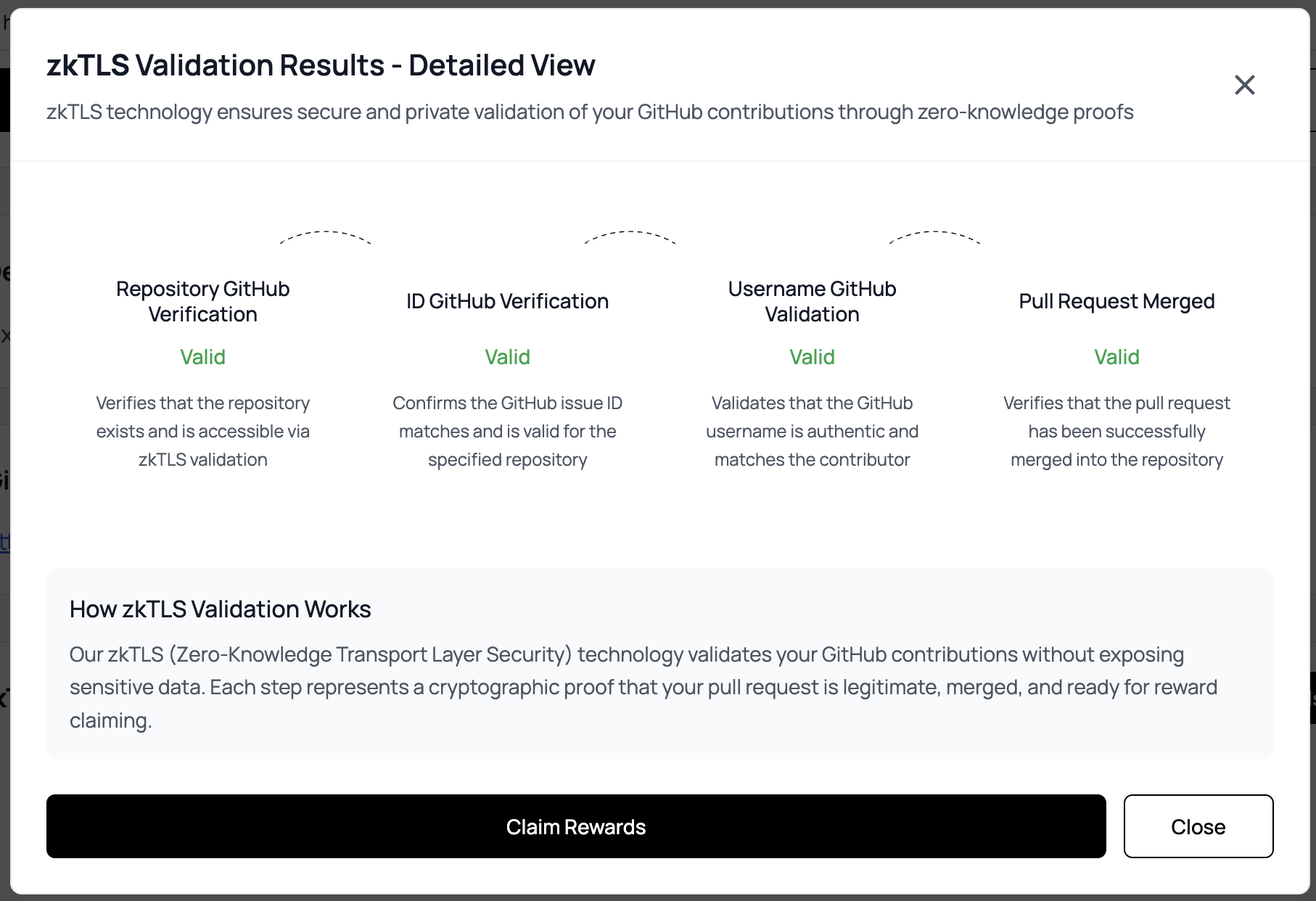
zkPull uses zkTLS (Zero-Knowledge Transport Layer Security) to verify off-chain GitHub data in a privacy-preserving way.
zkTLS proves:
that a pull request exists
that it is merged
that it belongs to the correct repository and issue
that the contributor identity matches
No GitHub access tokens or raw API responses are exposed.
Once a pull request is merged, contributors can independently initiate reward claiming.
No manual approval required
No platform intervention
No waiting for fund release
If verification succeeds, the protocol must pay.
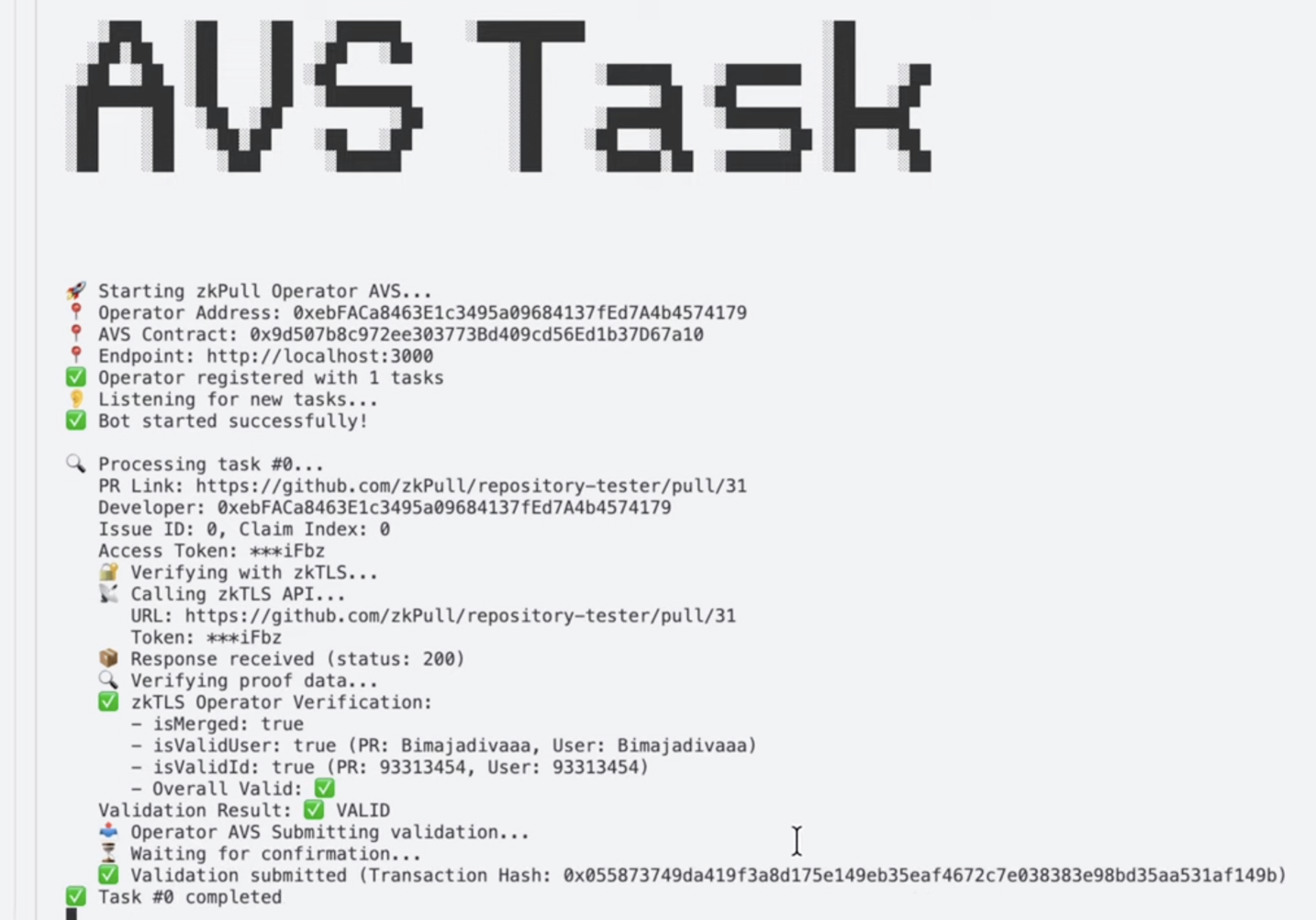
zkPull integrates with EigenLayer Actively Validated Services (AVS) to enforce verification results on-chain.
AVS operators validate zkTLS proof outputs
Validation is decentralized and economically incentivized
Payouts are censorship-resistant
This moves enforcement from a backend server to a decentralized operator network.
MantleUSD (mUSD): 0x5ab8ddE10e31d503C5db1D734ca64dD2e0066d72
IssuesClaimWithAVS: 0x836112Af92dCA17D5a45d3b4Fc7E490eC6b4B36e
ZKPullAVS: 0x9d507b8c972ee303773Bd409cd56Ed1b37D67a10
zkPull is designed as protocol-level infrastructure for open-source contributions and bug bounties.
The protocol automates verification and enforcement, not contributor labor.
Core principle:
zkPull only earns revenue when a contribution is successfully verified and paid out.
This aligns incentives across all stakeholders:
Contributors get guaranteed payouts for valid work
Project owners pay only for verified results
Validators (AVS operators) are rewarded for correct enforcement
The protocol sustains itself through usage-based fees
There are:
no subscriptions
no upfront listing fees
no custody of user funds
zkPull uses a success-based fee model applied only at payout time.
5% fee on each successfully claimed bounty
Example (1,000 mUSD bounty):
95% (950 mUSD) → Contributor
5% (50 mUSD) → zkPull protocol fee
From the 5% protocol fee:
60% → EigenLayer AVS operators (validation work)
40% → zkPull protocol treasury (maintenance & development)
Result:
Validators are economically incentivized
Protocol remains sustainable
Contributors receive the full advertised reward net of protocol fee
Priority validation for high-value bounties (+1–2%, opt-in, paid by project owners)
Enterprise / DAO integrations (custom deployments, off-protocol)
Core protocol usage remains permissionless and unchanged.
zkPull grows through a self-reinforcing incentive loop:
More Projects Create Bounties
Funds are escrowed on-chain, increasing trust and visibility.
More Contributors Participate
Trustless payouts reduce risk, increasing participation.
Assumption: +10% projects → +15–20% contributors.
More Successful Claims
Higher participation leads to faster issue resolution and more validated claims.
Protocol Revenue Increases
Each successful claim generates a 5% fee.
AVS Operator Incentives Improve
60% of fees reward operators, attracting more validators and increasing decentralization.
Higher Trust & Larger Bounties
Strong enforcement enables higher-value and security-critical bounties.
Flywheel Repeats at a Higher Baseline
+20% contributors → +25% successful claims
+25% claims → +25% protocol fees
Higher fees → stronger AVS participation → higher trust
Goal: Prove the core trustless contribution → reward flow.
What is already implemented:
GitHub-based bounty creation
zkTLS proof generation for merged pull requests
EigenLayer AVS operator for on-chain validation
Permissionless reward claiming
Smart contract–enforced payouts on Mantle
Goal: Make zkPull production-safe for real open-source usage.
Planned improvements:
zkTLS proof format standardization
Improved AVS task retry and fault handling
Gas and latency optimization for validation flows
Better error reporting for failed claims
Goal: Reflect real-world open-source collaboration patterns.
Planned features:
Multiple valid PRs per issue
Partial or split reward distribution
Configurable claim limits per bounty
Time-based or milestone-based rewards
Goal: Reduce reliance on a single operator and improve decentralization.
Planned features:
Multiple AVS operators per task
Slashing and incentive mechanisms
Operator reputation tracking
Permissionless operator onboarding
Resource | Description | Link |
|---|---|---|
GitHub (Main Repo) | Core zkPull repository containing smart contracts, frontend, and protocol logic | |
Website | Live demo website showcasing the full zkPull flow | |
zkTLS Repository | zkTLS integration for zero-knowledge verification of GitHub data | |
AVS Repository | EigenLayer AVS implementation for decentralized validation and enforcement | |
Demo Video | End-to-end walkthrough of zkPull features and flow | |
GitBook Documentation | Complete technical and product documentation | |
One Page Pitch | High-level product and protocol summary for judges and partners | |
One Page Pitch Video | Short pitch video summarizing zkPull in under 2 minutes |