
A Programmable Physical Security Layer | Bridging silicon-rooted trust into Web3 governance through the modular 0G stack
The evolution of Web3 architecture has reached a critical point: software-only security is increasingly insufficient against modern threats. As we move into 2026, risk shifts from private key theft to intent manipulation—users believe they are approving “Transaction A”, while the actual encoded payload executes “Transaction B”.
0GArgos proposes a new paradigm: a Programmable Physical Security Layer that brings a Hardware Root of Trust directly into on-chain authorization and governance flows. It leverages silicon uniqueness via SRAM PUF on ESP32-S3, and anchors physical interaction proofs into the modular 0G infrastructure (DA, Storage, and Sealed Inference).
For the 0G ecosystem, 0GArgos can be viewed as a DePIN security primitive: a distributed fleet of physical devices producing verifiable, high-frequency real-world interaction proofs. 0G DA and 0G Storage make this practical at scale by separating real-time proof propagation (DA) from permanent audit trails (Storage).
In the mid-2020s, the blockchain industry has seen a significant rise in attack sophistication. While adoption of Multi-Party Computation (MPC) and hardware wallets may reduce “raw” private-key compromise, adversaries adapt by exploiting user interfaces and execution logic.
Based on summaries from multiple 2025 security reports, total Web3 losses from hacks, phishing, and rug pulls are estimated around $3.35B–$3.375B.
2025 data suggests attacks are increasingly concentrated on high-value targets. Even if the number of major incidents trends downward in some quarters, loss per incident rises sharply. Attacks on centralized exchanges (CEXs) report an average loss of roughly $178M per attack.
Security metric | 2024 (actual) | 2025 (estimate/actual) | Change |
|---|---|---|---|
Total global losses | $2.515B | $3.375B | +34.2% |
Major security incidents | 410 | 313–318 | -23.6% |
Average loss per incident | $6.13M | $10.61M | +73.1% |
DeFi sector losses | $370M | $630M | +70.3% |
CEX sector losses | $850M | $1.78B | +109.4% |
Fund recovery rate | ~10% | 7.46% | -25.4% |
This pattern suggests attackers increasingly prefer well-coordinated, large-scale operations over high-volume random attacks. The Bybit incident (February 2025), with $1.44B in losses, is presented as an example of how third-party vulnerabilities and multi-signature approval process failures can lead to catastrophic outcomes.
The most dangerous threat in 2026 is not only key loss, but intent manipulation: the user “knowingly” signs, yet what they see on-screen differs from the raw transaction data. Modern malware (examples mentioned: OmniStealer and Marco Stealer) relies on UI overlay techniques.
Example scenario:
The user sees: “Approve swap $10”
The payload actually encodes: “Drain all assets to attacker address”
Because the display in a purely software environment can be manipulated by OS-level malware, the user’s eyes become the weakest link. The document also references findings in Android 10–13 where multiple critical system windows lack sufficient overlay protection, enabling attackers to hijack approval of sensitive actions.
The core Web3 security problem is an over-reliance on an untrusted software environment. This “trust gap” shows up in four areas:
“One-click” catastrophe at the personal level
Collusion/insider threats at the institutional level
Cost barriers for storing & verifying deep audit proofs on-chain
DAO governance & treasury control becoming an attack surface (“legit” actions with malicious outcomes)
For individual users, a single interaction mistake can wipe out an entire net worth instantly. The document cites malware targeting crypto wallet extensions on Chromium-based browsers (e.g., via local directory extraction and DLL injection).
The core issue: users generally lack an easy way to verify the “raw data” they are signing. They rely on the software’s visual representation. If the software is compromised, that representation becomes a deception tool.
Conclusion: a physically isolated device—with its own display and input, inaccessible to the host malware—is needed to break the UI manipulation cycle.
At the institutional level, insider threats are described as increasingly dominant compared to external attacks. The document cites an “Insider Threat 2025” summary:
Average annual cost of insider threats: $17.4M per organization
About 83% of organizations experienced at least one insider attack in the last year
Category | Avg frequency/year | Cost per incident | Key characteristics |
|---|---|---|---|
Malicious insiders | 6.3 incidents | $715,366 – $4.92M | Financial motives, sabotage |
Negligent insiders | 13.5 incidents | $480,000 | Misconfiguration, phishing |
Compromised insiders | variable | $779,000 | Credentials stolen by external actor |
The document also argues that digital-only MFA (e.g., authenticator/passkeys) is not enough to prevent high-level collusion, because credentials can be copied/shared/compromised (e.g., via supply chain attacks).
Storing physical interaction proofs on a traditional Layer 1 (e.g., Ethereum) is considered expensive. The document states that verifying a P-256 signature (common in HSMs) can cost 500,000–1,000,000 gas per transaction. As a result, organizations may reduce audit depth for cost efficiency.
Conclusion: a cheap, fast data availability (DA) layer is needed to make real-time physical-proof verification practical.
DAOs increasingly hold large treasuries and operational “god-mode” permissions (upgrade keys, admin roles, Safe multisigs). That makes the DAO’s own governance + execution layer a primary target. The most damaging incidents often don’t look like “classic hacks” — they look like valid approvals executed under compromised intent, compromised signers, or captured governance.
Common failure patterns (with real cases):
Governance capture via low turnout + token concentration
A small set of actors can assemble enough delegated voting power to pass self-serving proposals, especially when voter participation is low.
Compound DAO (Jul 2024): Proposal 289 passed to earmark ~$24M in COMP (≈5% of treasury) to a vault controlled by the “Golden Boys” / “Humpy,” widely characterized as a governance attack.
Sources: CoinDesk, The Defiant
Flash-loan / instantly acquired voting power
Token-weighted voting can be attacked if voting power can be acquired (or borrowed) cheaply for just long enough to pass and execute a malicious proposal.
Beanstalk (Apr 2022): attacker used a flash loan to pass a malicious governance proposal and seize $182M in reserves within a single block.
Source: a16z crypto — “DAO governance attacks, and how to avoid them”
Multisig signer compromise + UI deception (“everything looked normal”)
Even when teams use hardware wallets and multisigs, attackers increasingly target the signers’ endpoints and the transaction verification UI (Safe, simulators), so humans approve the wrong payload.
Radiant Capital (Oct 2024): loss of ~$50M after malware compromised multiple DAO contributors. Safe{Wallet} UI and Tenderly simulation looked legitimate while malicious transactions were signed/executed. The postmortem calls the compromise “completely undetectable” during normal review.
Source: Radiant Capital Post-Mortem
Social engineering → key compromise → treasury/contract control
A large share of “DAO losses” are ultimately people and process failures: targeted phishing/job-offer malware, poisoned repos, compromised devices.
Tapioca DAO (Oct 2024): estimated $4.4M stolen after a social-engineering-driven key compromise; attacker took over vesting/stablecoin contracts and drained liquidity.
Source: Halborn — Explained: The Tapioca DAO Hack (Oct 2024)
Structural asymmetry: one successful proposal can irreversibly move funds
Many DAO designs are economically attackable when the cost to reach quorum is lower than the value of assets controlled, and when there is no execution-layer veto/circuit breaker.
Gitcoin (Mar 2026): a security review flagged a structural governance vulnerability; Gitcoin coordinated a pre-emptive custody transfer of liquid treasury assets to a Safe multisig because there was “no execution-layer veto or circuit breaker.”
Source: Gitcoin governance forum — Treasury Protection & Governance Transition (Mar 2026)
Why this matters to 0GArgos: the DAO “approval moment” is a high-value choke point. If we can require a physically isolated, silicon-rooted proof for high-impact governance actions (treasury transfers, upgrades, role transfers, admin key changes), then:
UI/malware-based intent manipulation becomes dramatically harder (because the user verifies real details on an independent device).
Signer compromise becomes more costly (attacker needs both digital compromise and physical interaction).
Governance can be constrained by policy (via AA / ERC-4337) so that even “valid” governance outcomes must satisfy physical-proof requirements before execution.
0GArgos moves the Root of Trust away from compromise-prone software environments into a Hardware Isolated Environment (HIE). The core is a Physical Anchor of Trust (PAT) built on an ESP32-S3 microcontroller.
Every silicon chip has unique microscopic variations from manufacturing (e.g., threshold voltage differences and transistor gain factors). 0GArgos leverages this via an SRAM Physically Unclonable Function (PUF):
When the ESP32-S3 boots, SRAM cells stabilize into a device-specific 0/1 pattern.
This pattern becomes a unique “silicon fingerprint” per device.
SRAM PUF advantages (as described):
No permanently stored key: keys are reconstructed on demand and disappear when power is removed.
Anti-cloning: SRAM patterns come from physical fabrication variance, making identical clones impractical.
Environmental stability: claimed operation across -55°C to +150°C and ±20% voltage variation.
Each device goes through an enrollment phase to produce an Activation Code (AC) / helper data, used to correct SRAM readout noise and reconstruct a stable key (with an indicated failure rate < 10^-9).
0GArgos is not standalone; its strength comes from deep integration with 0G’s modular stack for AI-scale workloads and large data throughput.
The goal of 0G DA here: ensure the Physical Interaction Proof (PIP) can be verified before the transaction executes on-chain.
DA feature | Celestia (2026) | EigenDA (2026) | 0G DA (2026) |
|---|---|---|---|
Throughput | ~10 Mbps – 1,33 MB/s | Skalabilitas horisontal | 50 Gbps |
Verification speed | ~12s latency | Dependent on Ethereum | 50,000× faster than ETH DA |
Consensus mechanism | Tendermint / DAS | Restaking | Sharding / Verifiable Random Access |
AI optimization | Limited | Medium | Highly optimized (dAIOS) |
The document emphasizes that 50 Gbps throughput enables near-instant broadcasting of physical interaction proofs, achieving hot-wallet-like latency while preserving physical security guarantees.
Every physical interaction generates metadata for compliance and audit. The document positions 0G Storage as decentralized storage projected to be 95% cheaper than traditional cloud (e.g., Amazon S3), while providing a permanent audit trail.
Cost component | AWS S3 Standard (est. 2026) | 0G Storage (est. 2026) |
|---|---|---|
Storage (per GB/month) | $0.023 (first 50 TB) | Much lower (modular) |
Egress (per GB) | $0.08 – $0.09 | Integrated with Web3 ecosystem |
Request cost (per 1K) | $0.005 (PUT) / $0.0004 (GET) | Token-based incentives |
The document states 0G Storage uses Proof of Random Access (PoRA) to ensure audit data remains available and tamper-resistant.
To prevent verification logic from being manipulated by admins/node operators, verification runs inside a Sealed Inference environment (TEE), described as supported by Intel TDX and NVIDIA H100/H200 GPUs.
Claimed goals:
Node operators cannot inspect or modify data during verification.
Signing keys are generated inside the enclave and never leave it.
To stay consistent with the current codebase, the MVP is implemented as an ERC-4337 Account Abstraction flow on 0G Galileo:
ESP32 device displays the request details and signs a challenge → PIP (Physical Interaction Proof).
Next.js app (UI + API routes) coordinates requests, device polling, approvals, and audit views.
Smart contracts (ERC-4337): EntryPoint + Device2FAAccount + Factory. The account validates owner signature and conditionally requires a device signature based on policy (e.g., value threshold).
Bundler service submits eth_sendUserOperation and calls handleOps on EntryPoint.
0G Storage (MVP default) stores approval proofs + metadata for auditability.
0G DA (optional) can be added later as a low-latency “proof receipt bus”.
Primary (what the MVP directly mitigates):
Signer endpoint compromise + UI deception: even if the host UI is manipulated, high-impact actions cannot execute without the device’s independent review + signature.
Targeted social engineering that aims to harvest approvals from a subset of signers.
Secondary (helpful but not “solved” alone):
Insider collusion (physical approval raises cost + adds strong attribution/audit trails)
In the MVP, policy is enforced in the smart account:
Always require the owner signature.
Additionally require the device signature when the operation exceeds a threshold (e.g., value >= deviceValueThresholdWei).
Unknown/unsupported calls should be treated conservatively (require device approval).
This gives a simple demo-friendly “2FA” story while still being programmable.
The device produces a PIP tied to a specific ERC-4337 operation:
chainId
account (the smart account address)
userOpHash (the canonical UserOperation hash)
deviceAddress (the registered device signer address)
policyId (e.g., VALUE_THRESHOLD)
issuedAt, validUntil (expiry window to prevent replay)
deviceId (logical device identifier; in MVP can be provisioned)
Optional: geoHint (audit-only)
For the AA contracts, the minimum cryptographic requirement is: device ECDSA signature over userOpHash.
To keep the demo reliable and cheap:
MVP default: upload {requestId, userOpHash, deviceSignature, decision, ts, metadata} to 0G Storage (permanent audit log).
Optional: publish a compact receipt to 0G DA for low-latency “approval feed” semantics.
The concept describes SRAM PUF. For the current Arduino MVP, the device can start with a provisioned & stored device keypair (demo-friendly). A later hardening path is:
ESP-IDF + secure boot / flash encryption
PUF enrollment + helper data
Stronger device identity binding and tamper resistance
The key advantage (as described) is total isolation from software threats at the critical moment of authorization.
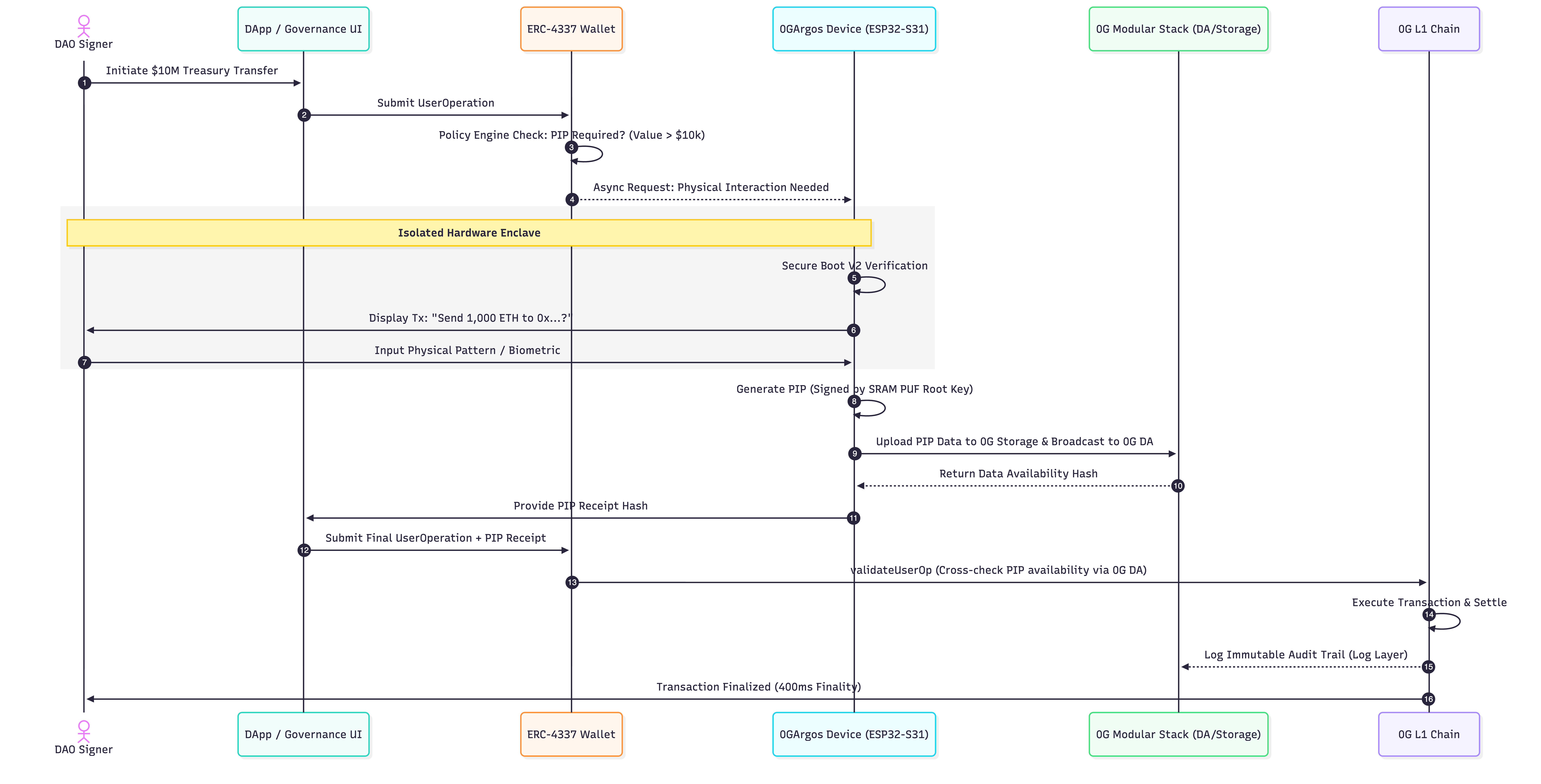
Initiation & policy detection
A user creates an action request in the web app (e.g., transfer value above threshold). The backend builds a UserOperation and computes the userOpHash. The account policy determines whether a device signature is required.
Challenge & visual isolation
The request is sent to the device via polling. The device displays the real intent (decoded destination/value/function summary) on an isolated screen, so overlay malware on the host cannot falsify what the signer sees.
Physical verification & proof production (PIP)
The user confirms via button/touch. The device signs the userOpHash → producing a PIP (device signature).
Anchoring into the 0G stack
The PIP + metadata are uploaded to 0G Storage (permanent audit record). Optionally, a compact receipt can be posted to 0G DA for low-latency propagation.
Final execution
The bundler submits the signed UserOperation to the EntryPoint. The smart account validates the owner signature and (if policy requires) the device signature; if valid, the operation executes.
Personal: the “ultimate kill-switch”
A physical button triggers a smart contract instruction to freeze assets / enable “deposit-only” mode. Because it’s signed by the silicon Root Key, remote attackers cannot undo it without physical access.
DAO governance: anti-collusion treasury
Large treasury moves require physical interaction proofs from a council, reducing single-point-of-failure risk from digital keys/cloud custody.
Institutions: cold-wallet security with hot-wallet speed
Private keys never exist digitally outside the silicon (cold-storage-like), while verification can be fast thanks to 0G DA (hot-wallet-like UX).
0GArgos is described as aligning incentives across hardware vendors, infrastructure builders, and end users:
Hardware sales: selling ESP32-S3 units pre-provisioned with secure 0GArgos firmware.
Tiered subscription (B2B): subscriptions for DAOs/institutions (advanced policies, risk dashboards, custom API integrations, priority support).
Audit-as-a-service (compliance): a small per-transaction fee to cover permanent audit log storage on 0G Storage.
The document highlights ESP32-S3 security features:
Secure Boot V2: only legitimately signed firmware can run.
Flash Encryption: protects code/static data from physical readout if the device is opened.
Digital Signature Peripheral: accelerates cryptographic operations for smart contract communication.
HMAC for secret key management: adds isolation for session keys and authentication to 0G infra.
Moving into Web 4.0—where autonomous AI agents may manage assets—identity and authorization rooted in physical reality becomes increasingly important. 0GArgos is positioned as a foundation for “Agentic ID”: verified agent identity combining AI with human physical oversight.
Highlighted comparison:
Traditional hardware wallets (Ledger/Trezor) are described as a “digital pen” that signs whatever is sent to them.
0GArgos is positioned as an “intelligent gatekeeper” via policy integration (AA) and 0G infrastructure for real-time verification.
0GArgos redefines the Web3 security boundary by combining:
Silicon-rooted physical uniqueness (SRAM PUF on ESP32-S3)
Flexible on-chain policy enforcement (Account Abstraction / ERC-4337)
0G modular scalability (DA, Storage, Sealed Inference)
Core message: as screens and software become easier to manipulate, digital-asset security must be re-anchored to real physical interaction—backed by proofs that can be verified quickly and economically on decentralized infrastructure.
We have transitioned from theoretical research to active execution:
Phase 1: Ideation & Attack Mapping
Completed an in-depth analysis of high-profile multisig exploits and deepfake-led financial fraud. We mapped these vulnerabilities to design the Physical Interaction Proof (PIP) protocol, ensuring it specifically mitigates "Blind Signing" and "Session Hijacking."
Phase 2: Hardware Prototyping (Current Status)
We are currently "getting our hands dirty" with the following:
Core Assembly: Building the prototype using the ESP32-S3 microcontroller to leverage its native hardware security features.
Display Logic: Successfully integrated the TFT display, enabling an isolated visual path for transaction data.
Mechanical Integration: Wiring and calibrating the tactile input sensors (buttons/joysticks) required for the Physical Captcha mechanism.
0G Integration: Developing the firmware logic to push interaction logs to 0G Storage, bridging the gap between physical touch and decentralized audit trails.
-