
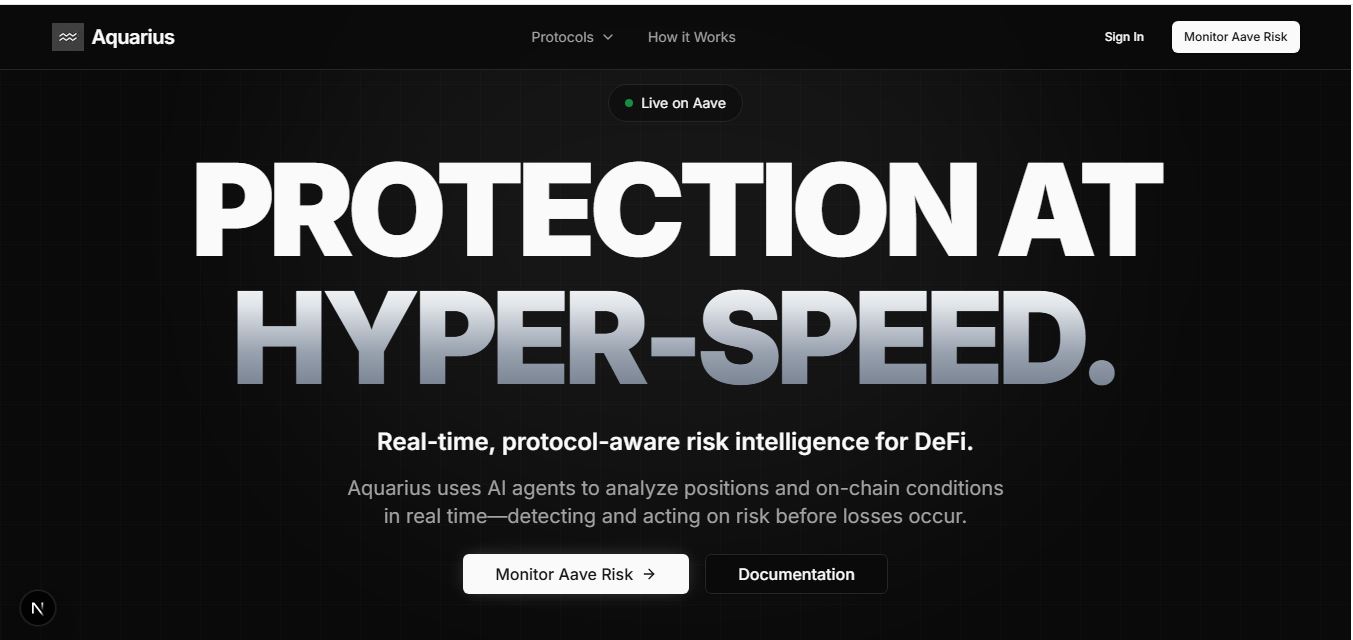
Aquarius is a DeFi risk intelligence protocol that uses AI agents and CRE orchestration to detect and mitigate lending risk on Arbitrum Sepolia before liquidation — with on-chain policy bounds.
What It Is ?
Aquarius is a protocol-aware risk intelligence and mitigation system for DeFi lending positions. For the Arbitrum Open House buildathon, we focus on Arbitrum as the EVM execution layer: agentic risk orchestration plus on-chain policy enforcement for autonomous protection.
What It Does (Arbitrum track)
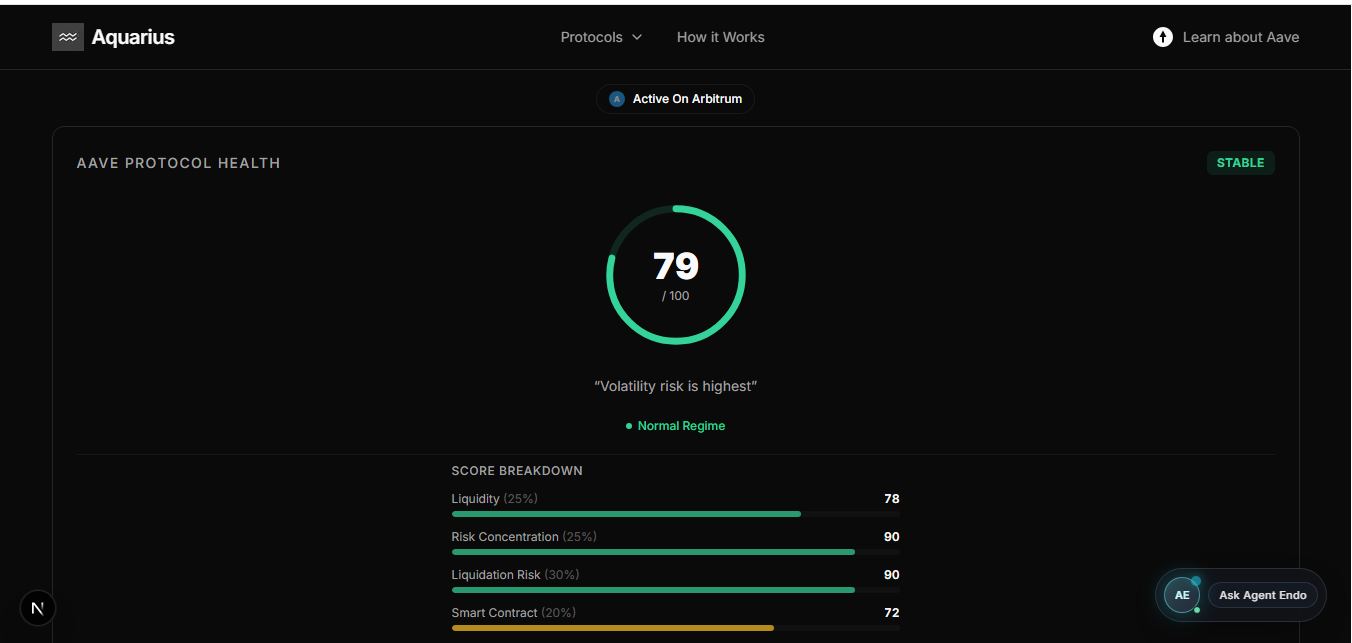
• Monitors Aave-style position health (Arbitrum logical chain in our API; demo uses mock/local reads; live on-chain reads planned post-audit).
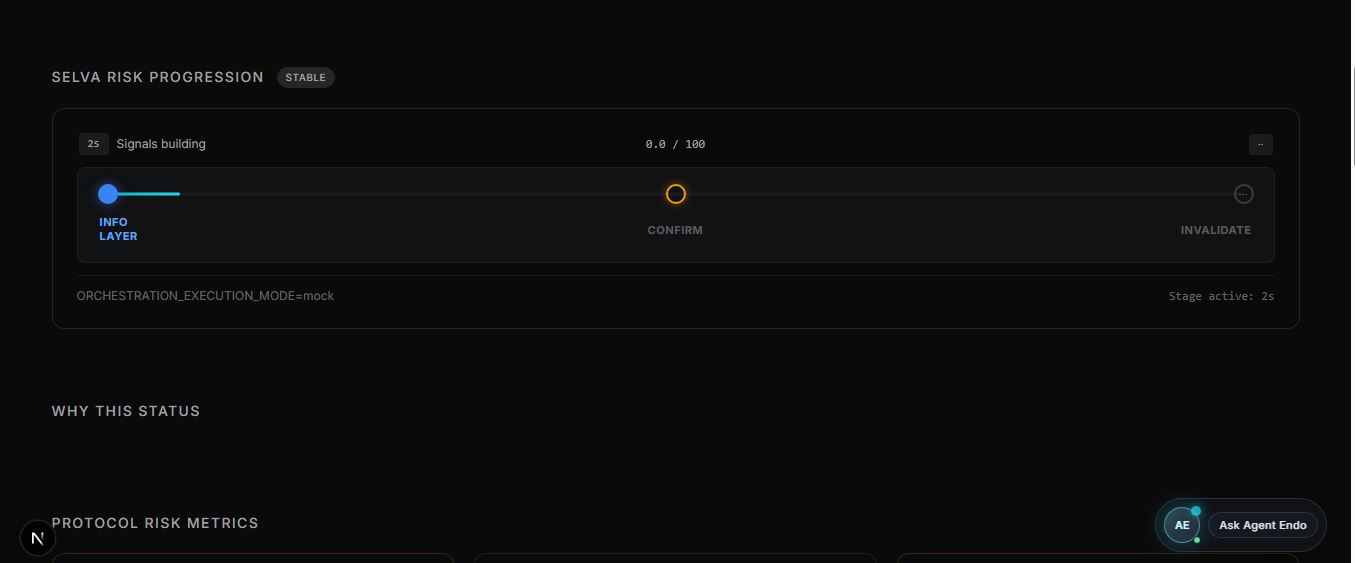
• Computes deterministic risk signals and escalates through a defined state machine.
• Orchestrates via Chainlink CRE–compatible workflows (GET /api/cre/run?chain=arbitrum) — agent decisions, optional LLM advisory.
• Enforces bounds on-chain with AquaAgentPolicyGuard deployed on Arbitrum Sepolia — per-action USD caps and daily limits; contract does not custody user funds.
Deployed on Arbitrum Sepolia (421614):
Contract: 0xf02f4e1d59c156dde20fa84007f69a45deb4a6fa
Explorer: https://sepolia.arbiscan.io/tx/0x618471c0e07eb1b4b7eadd7b16218a8ae77ec690a86da9b12f354c0c342c8a17
Docs: docs/hackathons/arbitrum-open-house.md (GitHub: Aquarius)
The Problem:
Leveraged DeFi users often only notice deteriorating health factors when liquidation pressure is already close — while liquidator bots monitor 24/7. Most tools are reactive dashboards: they show metrics but do not orchestrate deterministic, policy-bound protection. Aquarius adds that missing layer.
How Aquarius Is Different:
Aquarius is designed to act before liquidation thresholds — protection logic can run ahead of incentive-driven liquidators. On Arbitrum, low fees and fast blocks make continuous monitoring and future automated mitigation viable for retail users.
User modes (roadmap / partial live): Manual dashboard • Alerts • Autonomous agent (CRE + policy guard) • Buffer vault.
Why testnet first
We deploy on Arbitrum Sepolia intentionally while our risk and execution stack undergoes validation and audit — same discipline as our other hackathon tracks. Mainnet policy guard and live Aave-on-Arbitrum reads are the next step.
(Other Aquarius tracks: Solana/Kamino monitoring, 0G commitment anchoring, Chainlink CRE convergence — complementary, not in scope for this Arbitrum proof.)
"Aquarius is designed to be ahead of liquidation bots"
Liquidator bots operate within protocol-defined constraints.
They can only act once a position crosses the liquidation threshold — when incentives become available.
But Aquarius has a different objective.
Because it is designed for protection, not incentive capture, it evaluates projected health factor deterioration before liquidation conditions are triggered and can initiate mitigation earlier.
This creates a structural timing advantage:
protection logic can act before liquidation logic becomes eligible — positioning Aquarius ahead of external liquidators and reducing the likelihood of avoidable liquidation losses for defi users.
Aquarius introduces the missing protection layer for on-chain finance through the following mechanisms:
Users can choose any of the options:
Manual Monitoring (Dashboard Only)
Alert Mode Ins
Autonomous Agent Mode
Insurance Buffer Vault
Option A — Manual Monitoring (Dashboard Only)
Users monitor risk metrics and rebalance manually when needed, without automation.
Option B — Alert Mode
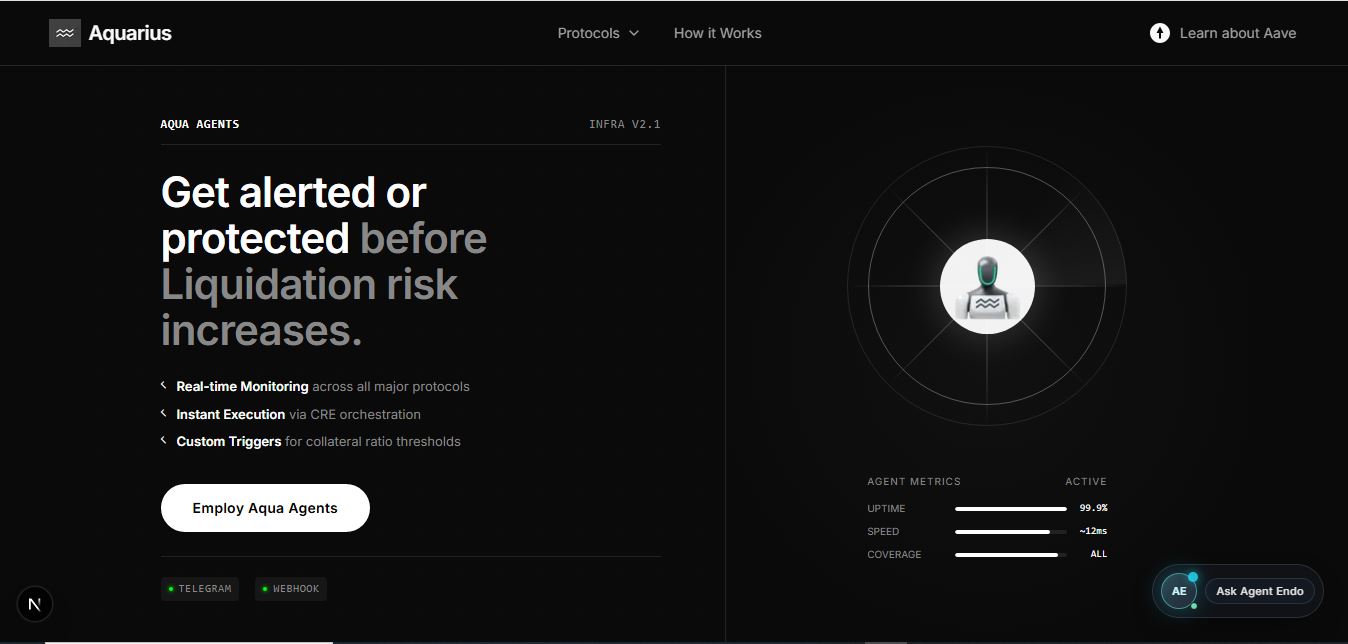
Aqua Agents continuously monitor positions and send alerts when risk escalates.
Alerts can be delivered via: Telegram Webhook, Web push
Option C — Autonomous Agent Mode
Users delegate mitigation authority to Aqua AI Agents under a selected protection policy.
When predefined risk thresholds are reached, the agent:
Executes repay or collateral reinforcement. and the agent is non-custodian and privacy focused.
Option D — Insurance Buffer Vault
(Includes Alerts + Autonomous Protection)
For users seeking additional resilience, Aquarius provides a tokenized vault buffer mechanism.
In this mode:
Users allocate capital into a protective buffer vault
When risk escalates, the system can draw from the vault
Collateral is automatically reinforced to prevent liquidation
"Importantly, vault funds are not idle."
The buffer is structured as a tokenized vault that generates yield, allowing users to maintain capital efficiency while securing downside protection.
This aligns protection with productive capital deployment.
rance Buffer Vau
Manual Monitoring (Dashboard Only
Maual Monitoring (Dashboard Only)
Progress during hackathon
During the Arbitrum Open House buildathon we focused on the agentic DeFi risk track end-to-end:
1. API & orchestration — Wired Arbitrum into the Aave risk engine and CRE workflow spine (chain=arbitrum). Shipped a one-shot agent-pack endpoint so judges can exercise monitor → score → CRE decision in one call.
2. On-chain enforcement — Implemented and deployed AquaAgentPolicyGuard on Arbitrum Sepolia with viem deploy scripts. The contract enforces per-action and daily USD bounds; it does not custody user funds. This is our on-chain proof for bounded autonomous mitigation.
3. Product surface — Built /protocol/aave/arbitrum (wallet connect, risk + CRE polling) and documented local + live reproduction in docs/hackathons/arbitrum-open-house.md.
4. Quality & honesty — Integration tests for the Arbitrum API path; explicit testnet-first posture (Sepolia guard now; mainnet Aave reads + production execution post-audit).
Live demo: https://aquarius-web.vercel.app/protocol/aave/arbitrum
Pre-seed / Early-stage fundraising — currently exploring grants, ecosystem funding, and strategic investment opportunities to accelerate development of Aquarius Protocol... moving the project from ZERO to ONE ⚡