
On-chain infrastructure for tokenizing physical machines on Arbitrum: from verified identity and NFT collateral through ERC-3643 security tokens and yield distribution.
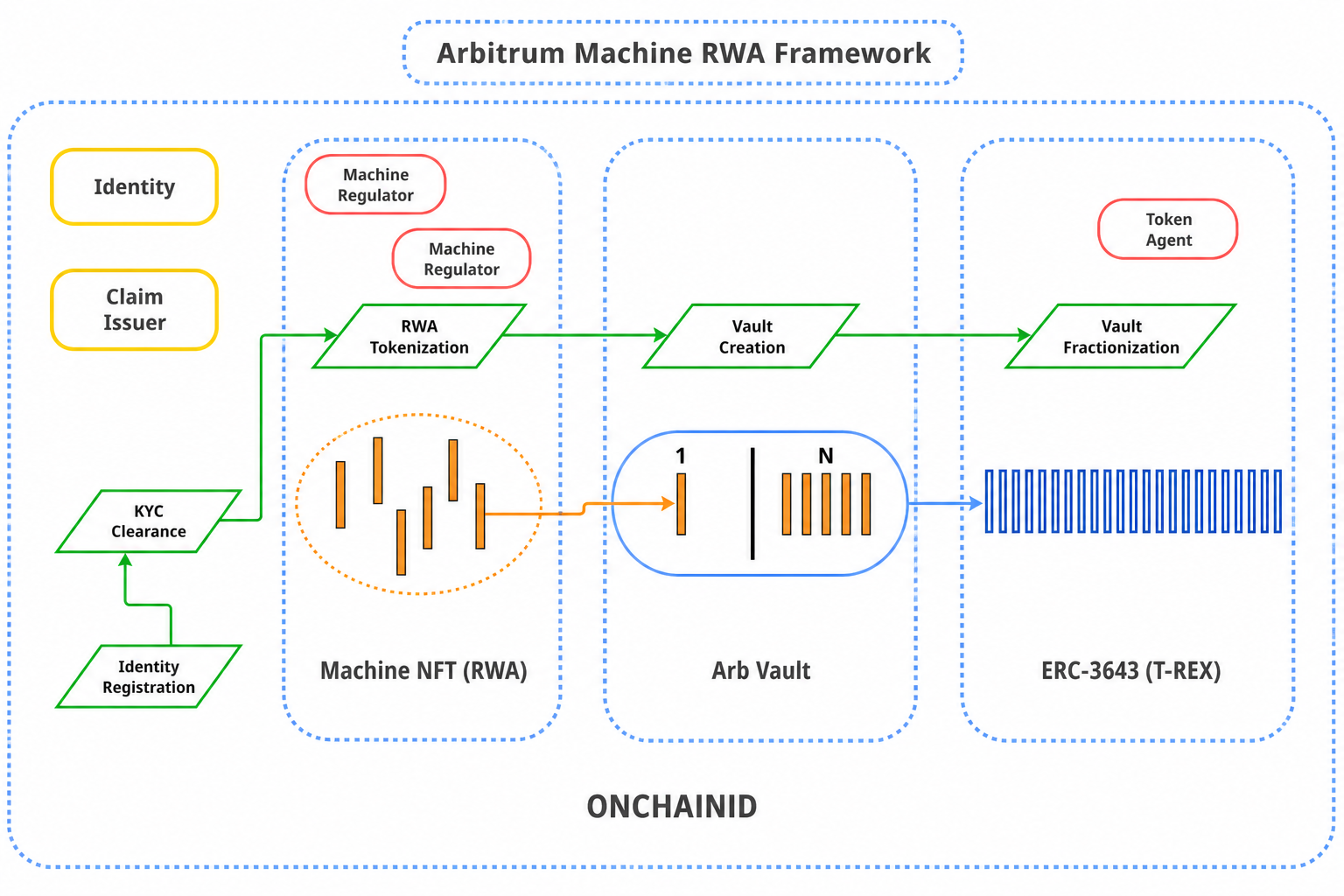
The Arbitrum Machine Real World Asset Framework is open source onchain infrastructure for representing physical machines as compliant digital securities on Arbitrum. It gives builders a standardized path from verified participant identity through machine registration, collateralization, fractional ownership, and automated yield distribution. The project addresses a practical shift in the machine economy: teams no longer ask whether a machine can be tokenized, but how to do it compliantly, reproducibly, and at scale.
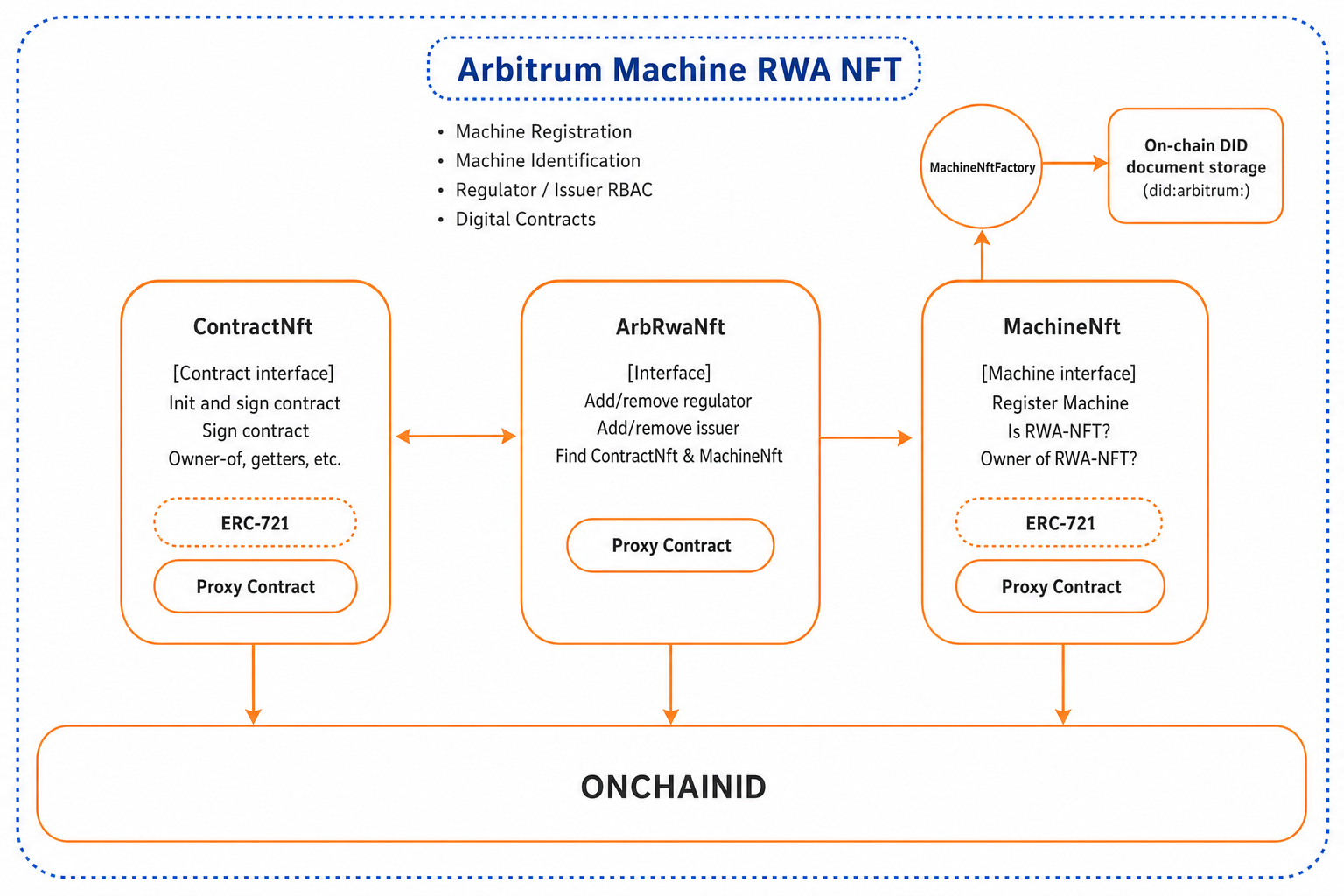
The framework rests on three established standards. ONCHAINID links wallet addresses to verified onchain identities and KYC claims. T-REX (ERC-3643) provides regulated security tokens whose transfers are enforced by a per vault Identity Registry. ERC-721 represents unique collateral as Machine NFTs for physical assets and Contract NFTs for multi party agreements. Together these primitives create an auditable link between real world equipment and programmable financial rights onchain.
Each machine follows a clear lifecycle. Participants first receive ONCHAINID identities and KYC claims so they can interact with vaults and security tokens. A Machine Issuer registers the physical asset as a Machine NFT with an embedded DID document that stores manufacturer, model, serial number, and other metadata. Operational and legal context, such as leasing, financing, or operating agreements, attaches through Contract NFTs that counterparties create, sign, and finalize onchain, with agreement documents hashed onchain and stored off chain (for example on IPFS). The Machine NFT and completed Contract NFT are deposited into an Arb Vault, which locks collateral and mints fractional ERC-3643 security tokens to verified investors. Revenue from machine operations can be deposited into a reward distributor and claimed pro rata by token holders according to ownership logic.
Compliance is embedded at the asset layer rather than bolted on at the exchange layer. Every vault maintains its own Identity Registry; only verified wallets can hold or receive security tokens. Trusted Claim Issuers sign KYC and role claims that the framework recognizes. Machine Regulators authorize Machine Issuers, who in turn register machines. This role separation allows regulators, marketplaces, compliance providers, and integrators to reason about the same machine record across venues while jurisdiction specific rules attach through claims, issuers, and off chain policy without rewriting the core contract architecture.
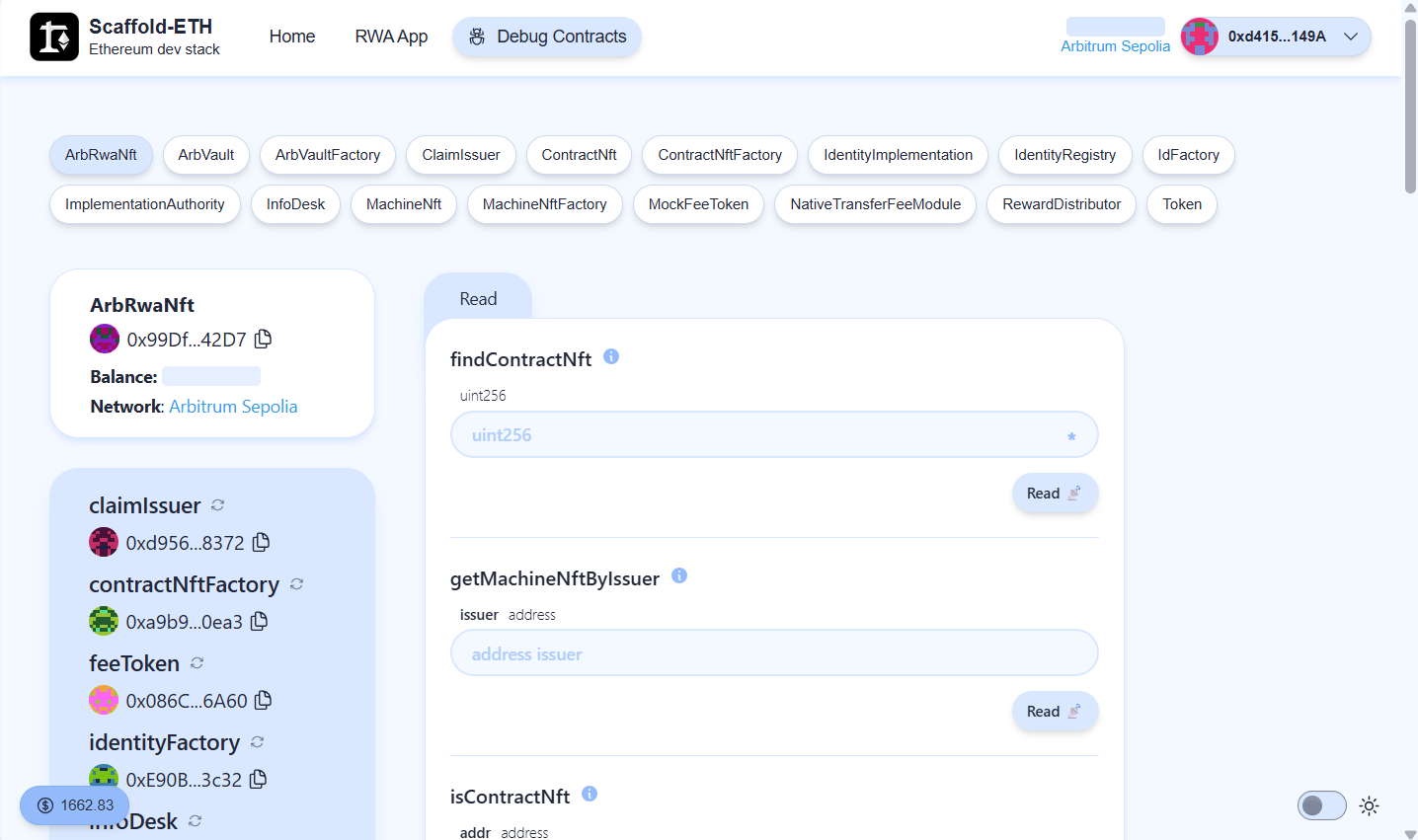
We set out to make machine tokenization reproducible and compliant on Arbitrum, not just a one off demo. Early work focused on core RWA smart contracts, real ONCHAINID integration, and a Scaffold-ETH frontend with deploy scripts, a guided /rwa app, and /debug for raw contract calls. That gave us a working path from identity and KYC through machine registration, contract NFT signing, vault setup, minting, transfers, and yield.
We then pushed to a live Arbitrum Sepolia demo: deploy and bootstrap tooling, manifest generation, demo assets, Pinata/IPFS for agreements, and frontend hooks so the full lifecycle could run on testnet without manual guesswork.
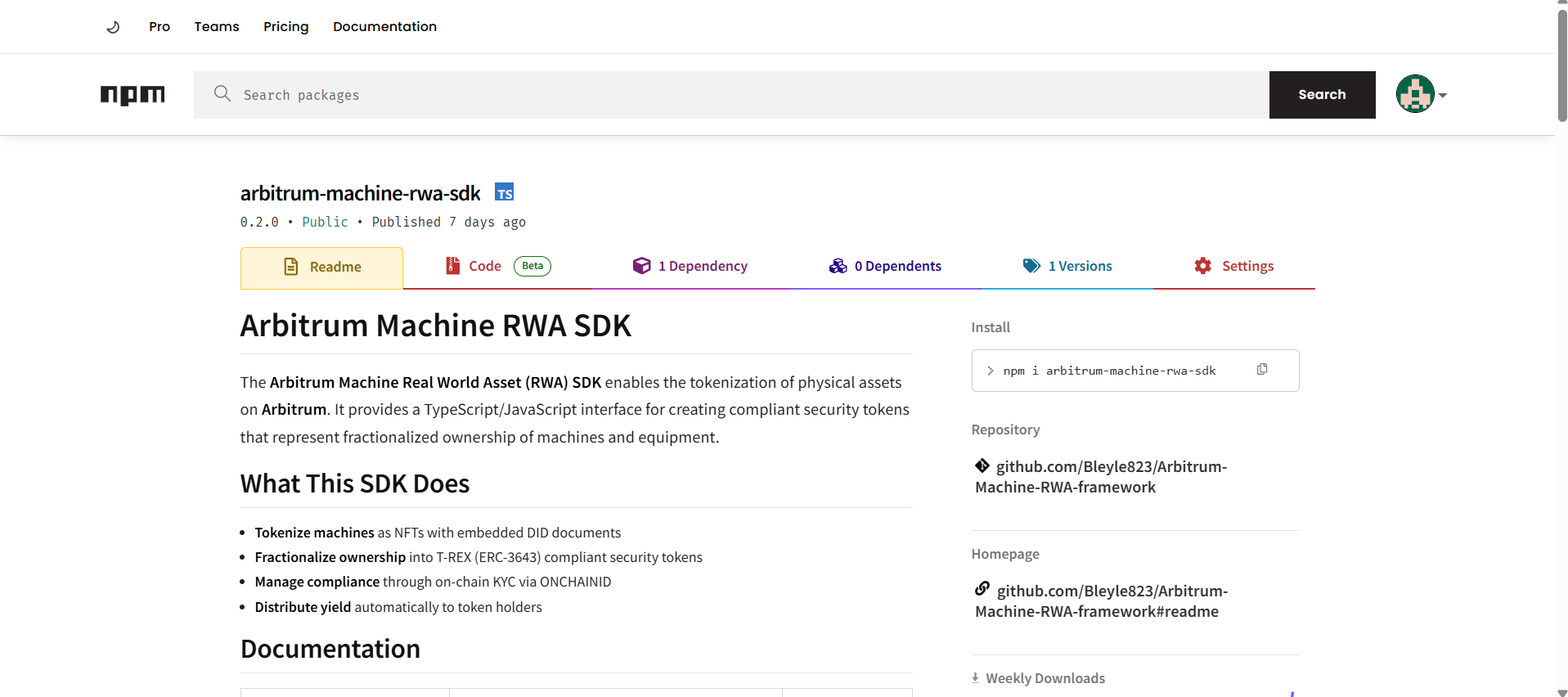
The main integrator deliverable was @arbitrum-machine/rwa-sdk: five modules (onchainid, mnft, cnft, vault, rwanft), bundled Sepolia addresses, and npm scripts to sync addresses, verify reads, and test writes. We fixed real Sepolia issues along the way (bigint token IDs, vault owned NFT approvals, and a two step yield flow for claimYield and claimYieldTo).
In the final stretch we added Mintlify docs (workflows, roles, API reference, manual testing for SDK and UI), expanded the monorepo README, and polished submission narrative. The result is a full stack project: Hardhat tested contracts, a Sepolia reference deployment, demo UI, npm SDK, and docs so evaluators can verify and walk through the pipeline quickly.
We have not raised external funding to date. The Framework has been built as an open source hackathon project without venture capital, grants, or private investment. All development, deployment on Arbitrum Sepolia, and documentation work has been self funded and carried out by the team during the hackathon period.
We are focused on shipping a working reference implementation, SDK, and demo on testnet first. We are now seeking funding to take the project beyond the hackathon reference implementation. Capital would support mainnet deployment on Arbitrum, production grade security audits, expanded SDK and integrator tooling, and pilot partnerships with machine operators, issuers, and distribution platforms. A core priority is working with regulators to acquire the relevant licenses needed to operate the Machine RWA framework in a compliant way across jurisdictions.