
Aurion is a non-custodial credit layer that aggregates DeFi positions across Aave and Compound, enabling higher leverage through delegated credit guarantees.
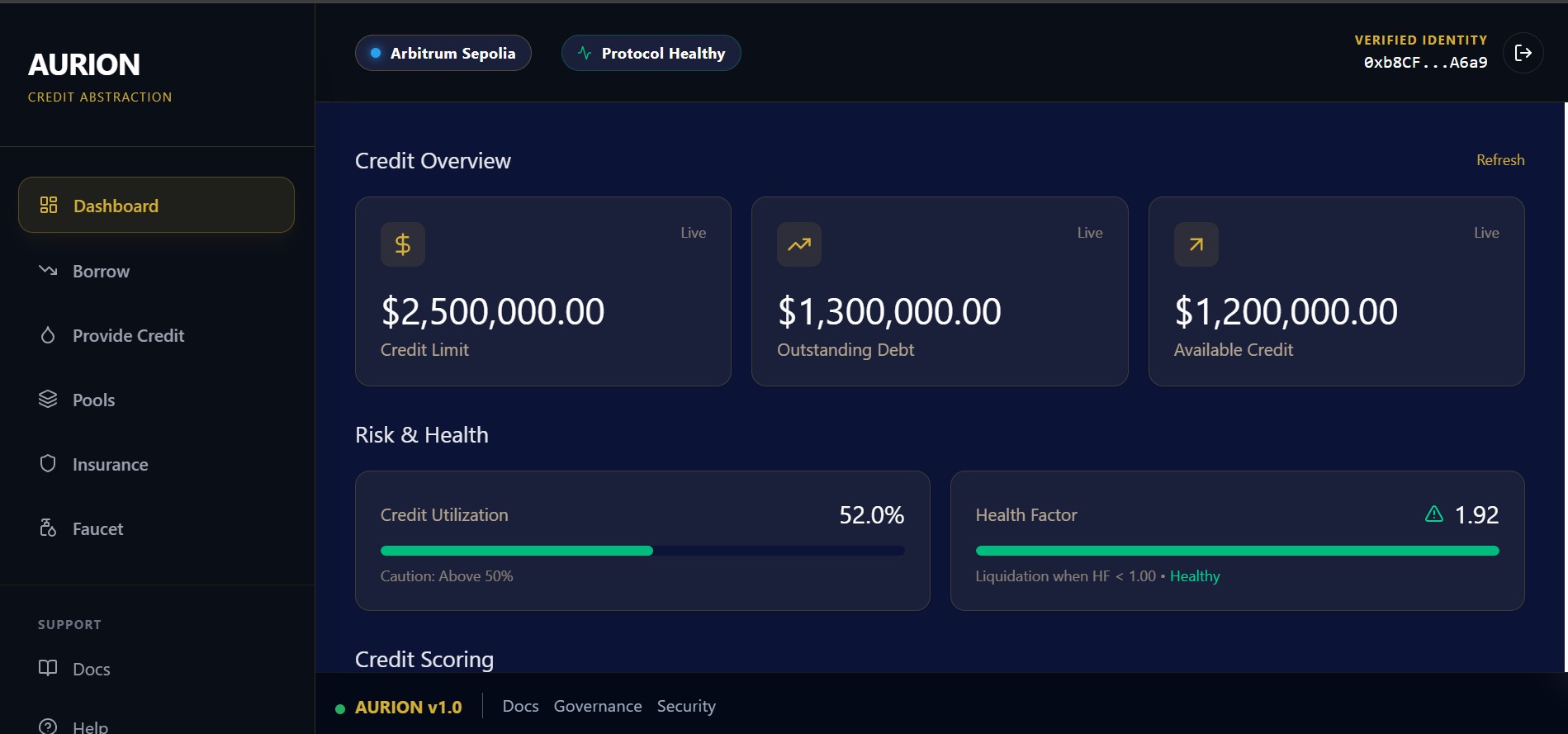
Aurion is a non-custodial credit layer that aggregates DeFi positions across Aave and Compound, enabling higher leverage through delegated credit guarantees.**
The Problem
DeFi lending is broken in 3 ways:
Fragmented Identity: Your $100k on Aave + $50k on Compound = treated as 2 separate users. Capital inefficiency everywhere.
No Credit Market: Liquidity providers are forced to absorb credit risk. No one can specialize. Capital sits idle.
Reactive Risk Management: Protocols only liquidate after positions fail. No credit scores, no gradual interventions, no reputation.
Result: Massive capital inefficiency. Overcollateralization across protocols. No path to institutional adoption.
Our Solution
Credit Aggregation Layer
Aurion sits above Aave/Compound without replacing them:
User's Aave position + Compound position
         ↓
    Unified Credit Account
         ↓
    Borrow with aggregate LTV
How It Works (3 Steps)
Aggregate: We read your positions on Aave + Compound, create one credit account
Route: All borrows go through our router (validates credit, then executes on Aave/Compound)
Guarantee: Credit Providers deposit capital as loss buffers → You get higher LTV
Key Innovation
Separate liquidity from credit risk
- Liquidity providers (Aave/Compound) lend as usual
- Credit Providers earn fees by backing borrowers
- Borrowers access 2-3x higher leverage
Key Features
Cross-Protocol Accounts
Single credit identity across Aave + Compound
Portfolio-level risk assessment
Result: 30-40% better capital efficiency
Delegated Credit Pools
Credit Providers deposit capital (never lent)
Acts as loss buffer for borrowers
Earn 2-7% APR on idle capital
Result: $500M+ unused capacity unlocked
Credit Scoring
On-chain reputation (0-1000 score)
Based on repayment history, health factor
Better scores = higher limits, lower fees
Result: First portable DeFi credit score
Risk Tiers
| Tier | Max LTV | Fee | Min Score |
|------|---------|-----|-----------|
| Conservative | 75% | 2% APR | 700 |
| Moderate | 85% | 4% APR | 500 |
| Aggressive | 95% | 7% APR | 300 |
Pre-emptive Risk Management
Dynamic borrow caps based on volatility
Collateral top-up requirements
Credit recall mechanism
Result: 60% fewer liquidations
Tech Stack
Smart Contracts
Solidity 0.8.20+ | Foundry | OpenZeppelin
Certora (formal verification) | 95%+ test coverage
Frontend
React 18 | Tailwind CSS | Ethers.js v6
wagmi | RainbowKit
Infrastructure
Arbitrum One (L2 deployment)
Chainlink (price oracles)
Security
Formal verification
Multiple audits planned
Bug bounty program
Invariant-based testing
Roadmap
Phase 1: Foundation (NOW - Month 4) ✅ 70% Done
Core contracts (CreditManager, Router, Accounts)
Aave adapter
Basic risk engine
Frontend UI
Testnet deployment this week
Phase 2: Launch (Month 5-8)
Compound adapter
Credit Pools live
Credit scoring v1
Security audit #1
Mainnet beta ($5M TVL cap)**
Phase 3: Scale (Month 9-12)
Remove TVL caps
Governance token
Tradeable credit positions
$50M+ TVL target
Traction & Metrics
Current Status:
✅ Whitepaper complete
✅ Smart contracts 70% done
✅ Frontend demo built
✅ Test suite with invariants
🔄 Testnet deployment in progress
6-Month Targets:
$10M TVL
500+ credit accounts
50+ Credit Providers
2 protocols integrated
12-Month Targets:
$50M TVL
2,000+ accounts
DAO governance live
3-4 protocols
Business Model
Revenue Split:
70% → Credit Providers
20% → Insurance Fund
10% → Protocol Treasury
Projections:
$100M TVL × 50% util × 4% fee = $2M annual revenue
Deployed a Mock Pools (USDC support only for now) for both Aave and Compound since their is no official deployed contract on Arbitrum Sepolia. Mock working correctly. Move to deploying other supported assets on Mainnet Arbitrum on both protocol.
We are still at the development stage, We havent raised any fund.