
Reputation-weighted, on-chain arbitration for chamas, ROSCAs, and informal trade partnerships piloted in East Africa, built on Arbitrum with Stylus (Rust) jury selection.
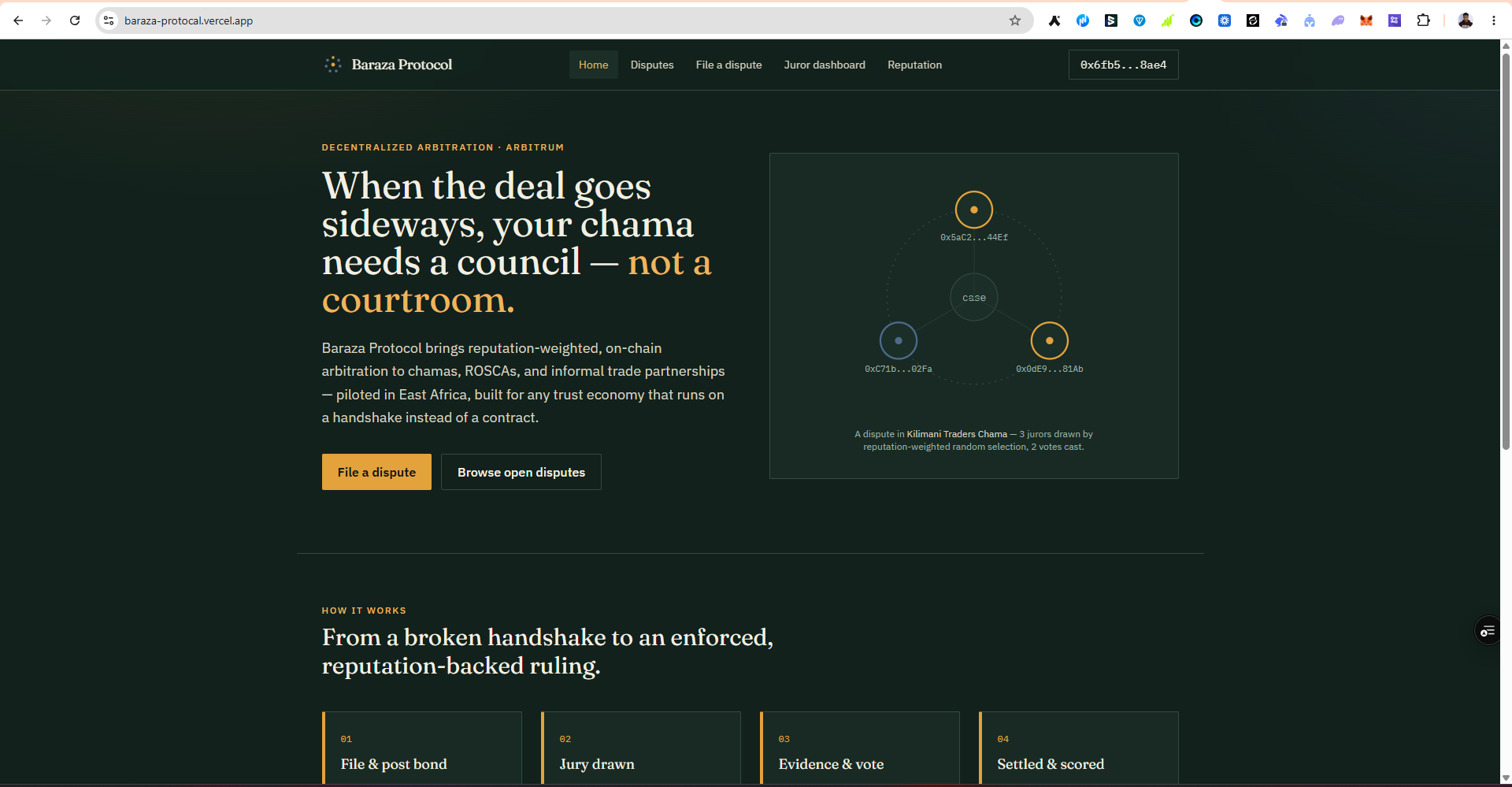
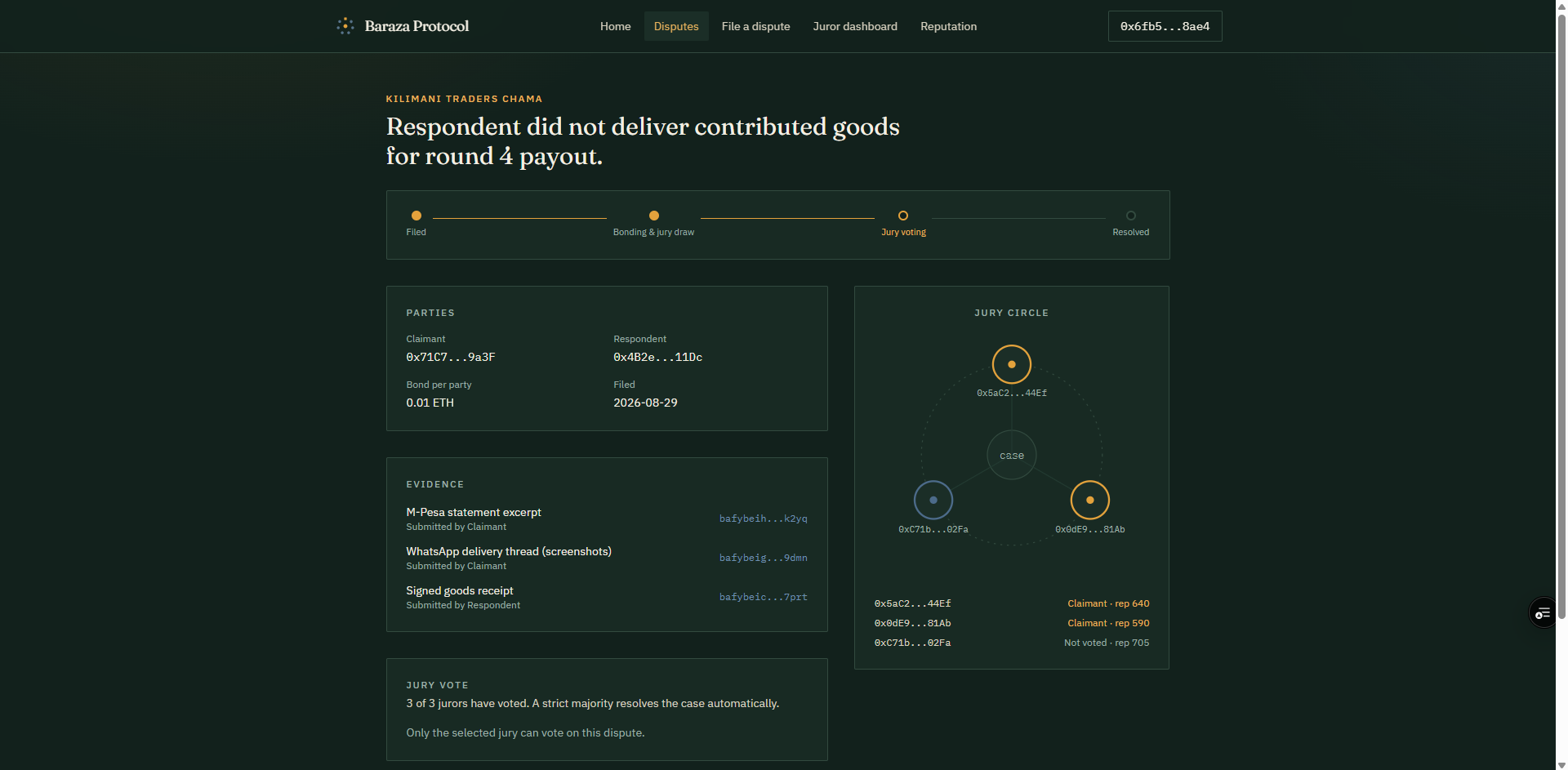
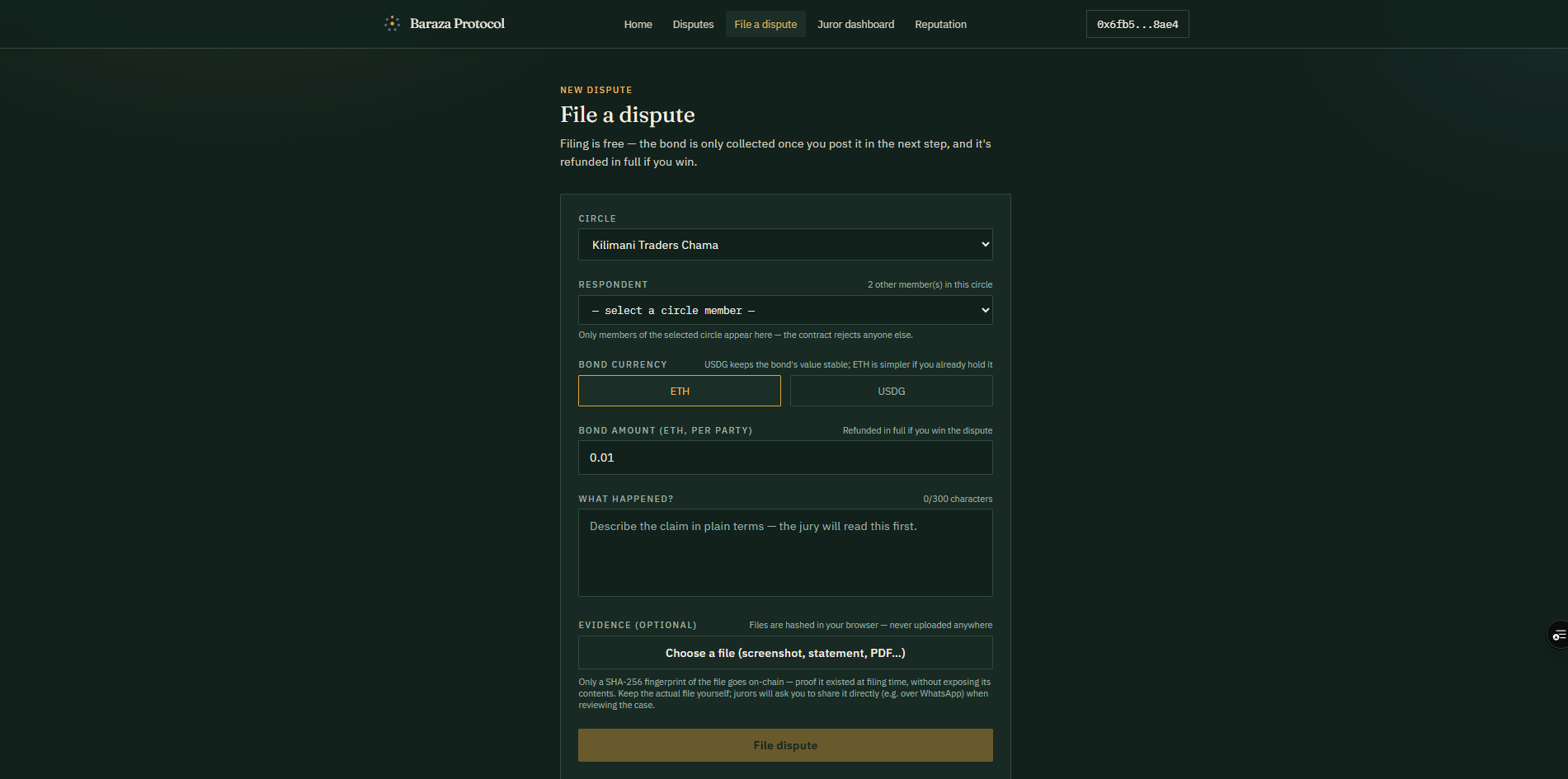
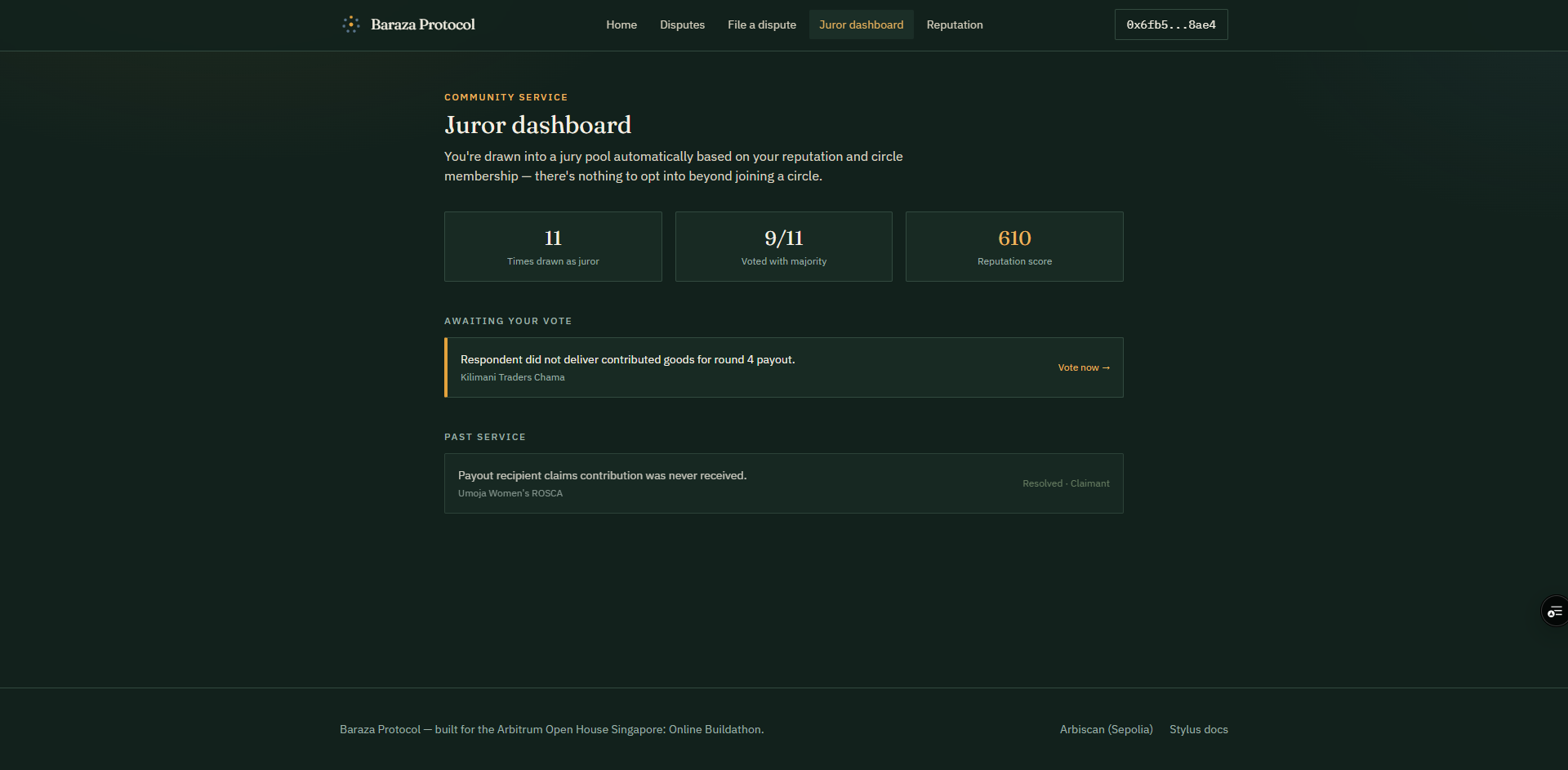
Baraza Protocol brings reputation-weighted, on-chain arbitration to chamas, ROSCAs, and informal trade partnerships — trust economies that run on a handshake, not a contract. When a dispute happens, both parties post a bond (via M-Pesa or a wallet), a Stylus (Rust) contract runs a commit-reveal, reputation-weighted random draw over the circle's own members to select a jury, and a majority vote resolves the case on-chain forfeiting the losing party's bond and updating both parties' soulbound reputation score.
Unlike generic on-chain arbitration (e.g. Kleros), Baraza is built for a non-crypto-native user: gasless filing, mobile-money bonds, and jurors drawn from people who actually know the circle, not anonymous global stakers.
Fully built from scratch and independently verified across contracts, backend, and frontend:
Smart contracts:
DisputeEscrow, BarazaRegistry, and ReputationSBT deployed and tested live on Arbitrum Sepolia, covering the complete dispute lifecycle: filing, bonding, jury selection, voting, resolution, and on-chain reputation updates.
Testing also surfaced and fixed a real edge case: a juror without a minted reputation profile could have made resolution revert permanently and strand both bonds. Jury selection now guarantees every juror has a profile.
Stablecoin bonds (Paxos USDG):
Bonds can now be posted in USDG as well as ETH, gated by an admin-controlled token allowlist so a dispute can't be denominated in an arbitrary token. Tested end to end against real deployed bytecode: file, approve, bond, jury draw, vote, resolve, payout (the winner receives 95% of the pot; 5% stays as the juror reward pool). Official Paxos addresses for Arbitrum Sepolia and Arbitrum One are wired in.
Stylus jury selection:
The reputation-weighted, commit-reveal draw algorithm is independently verified via a dependency-minimal Rust test crate (determinism, no duplicate jurors, zero-reputation floor all pass). The full stylus-sdk contract wrapper is written but not yet compiled/deployed — a Solidity MockJurySelector stands in for it today, with the real Stylus contract as the clear next milestone.
Backend:
Express API with an M-Pesa relayer ( Daraja-sandbox-ready). A payer confirms a bond by M-Pesa and the relayer records it on-chain, so the bonding step needs no wallet or gas from a non-crypto-native user. Gasless dispute filing via ERC-4337 account abstraction is designed for but not yet integrated.
Frontend:
React app with a custom visual identity built around the protocol's own metaphor: disputes render as a literal jury circle, not a generic dashboard. Live and fully connected to the deployed contracts.
This isn't a proof-of-concept scaffold — it's a working system, honest about the one piece still ahead of it.
No funds raised. Baraza Protocol is a hackathon entry no token, no fundraise. Open to grant or seed funding to continue development post-hackathon.