
RadTensor is a vendor-neutral radiology subnet on Bittensor that routes de-identified imaging exams from hospital PACS to competing AI miners, turning real-world imaging into TAO demand.
Detailed Project Description: RadTensor
RadTensor: a vendor-neutral radiology intelligence subnet on Bittensor that routes de-identified medical imaging exams from hospital PACS to a competitive marketplace of AI miners, turning mandatory real-world clinical volume into continuous TAO demand. It is the first subnet designed to convert existing enterprise healthcare budgets -- fiat dollars already allocated for AI imaging -- directly into usage-based, TAO-denominated revenue at scale.
Project Overview
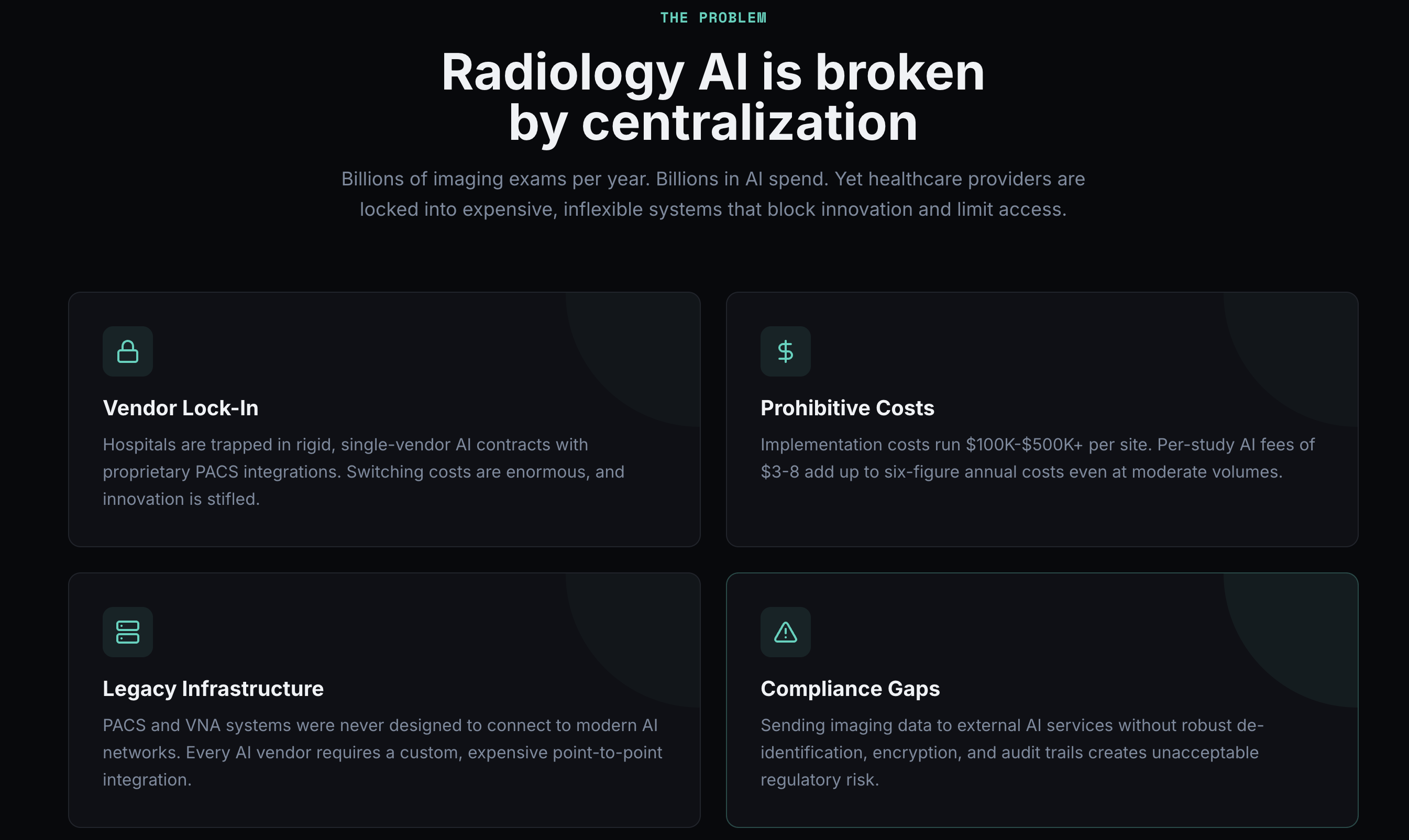
Diagnostic radiology generates approximately 3.6 billion imaging exams per year worldwide, underpinning a projected $45B+ AI medical imaging market by 2030. Yet today, access to AI for radiology is locked behind six-figure SaaS contracts, proprietary vendor integrations, and rigid single-provider deployments that leave most clinics and hospitals -- especially smaller facilities and rural centers -- entirely shut out. The existing cost structure is fundamentally broken: per-site implementation runs $150K-$500K, every PACS integration is custom-built, and institutions are locked into static models that cannot compete, improve, or be replaced without ripping out infrastructure.
RadTensor solves this by replacing centralized AI delivery with a decentralized, incentive-aligned marketplace. A patent-pending on-premise gateway (US Patent Application No. 63/720,155) sits alongside a hospital's existing PACS, strips all protected health information, applies adaptive encryption, and routes de-identified imaging tasks into the RadTensor subnet on Bittensor. Miners compete to process these tasks. Validators score every output. The best models earn TAO. The worst lose weight. Hospitals pay per exam instead of per contract. Nothing changes for the radiologist. Everything changes for the economics.
Core Mechanism: Radiology Proof-of-Effort
The subnet operates through a clinically grounded competitive loop between two primary actors:
Miners (The Intelligence Layer): Miners execute specialized radiology AI models on de-identified imaging tasks. Each miner can focus on specific modalities and task types -- chest X-ray triage, CT brain hemorrhage detection, mammography screening, QA on image orientation and labeling, anomaly flagging, or structured report assistance. Miner inputs are standardized: de-identified image data or derived feature tensors, minimal metadata (modality, body region), and a task specification. Outputs follow defined schemas including per-label pathology probabilities, anomaly flags, segmentation masks, calibration metrics, and uncertainty estimates.
Validators (The Verification Layer): Validators maintain gold-standard evaluation sets composed of labeled retrospective cases and curated public datasets. When miner outputs are received, validators score them against gold-standard labels, ensemble predictions, and cross-miner comparisons. Scoring operates on both short-term and long-term windows -- short-term for immediate adjustments, long-term for rolling weight updates and routing decisions. Validators also monitor for systematic bias, model drift, PHI leakage, and adversarial behavior. Validators whose scoring deviates from consensus have their own rewards reduced, ensuring alignment with clinical accuracy and network integrity.
Technical Innovation
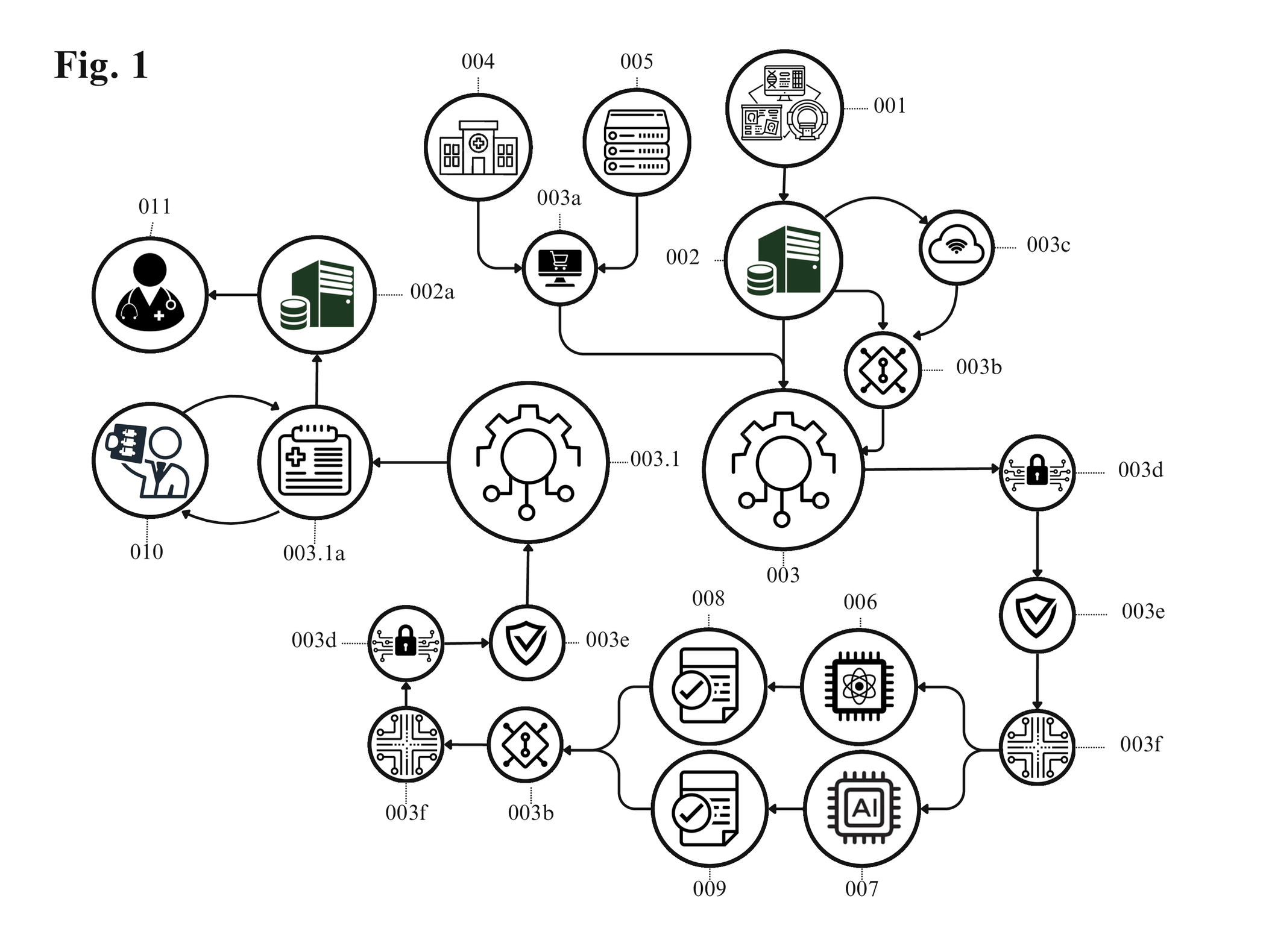
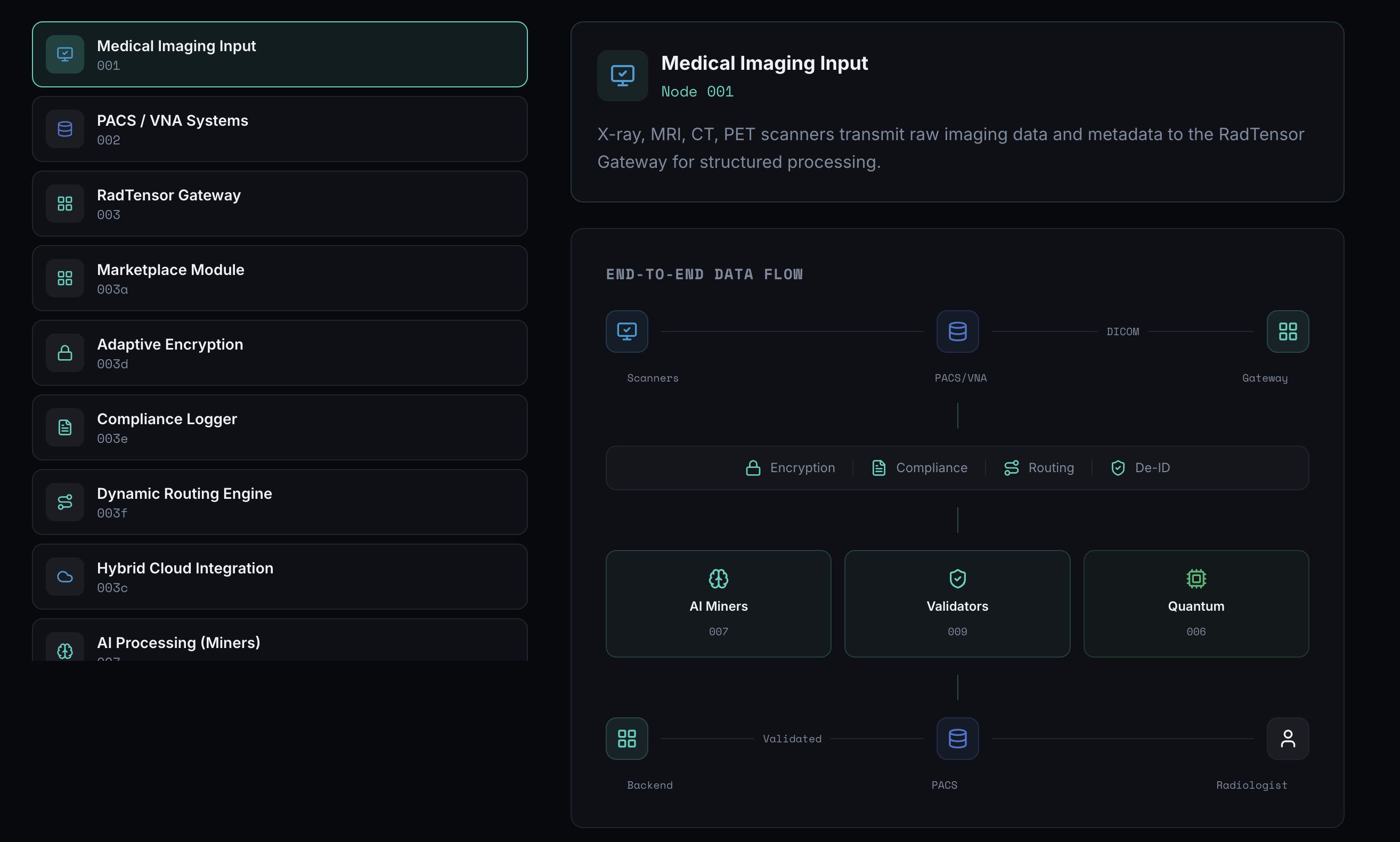
Patent-Pending Gateway Architecture: The RadTensor gateway (US 63/720,155) is a modular, six-component system comprising: Marketplace Selection (003a) for dynamic provider configuration, API Extensibility (003b) for cross-platform interoperability, Hybrid Cloud Integration (003c) for on-premise/cloud/edge deployment, Adaptive Encryption (003d) with quantum-resilient protocols, Compliance Logger (003e) with ledger-backed immutable audit trails, and Dynamic Routing Engine (003f) for intelligent task allocation based on miner performance, latency, cost, and regulatory constraints. PHI never leaves the hospital. Only de-identified tensors reach the subnet.
Anti-Gaming & Quality Safeguards: Canary jobs with known ground-truth labels are regularly injected to detect miners attempting to guess or copy outputs. Validators scan for PHI leakage patterns and systematic hallucination. Miners that consistently underperform, leak PHI, or exhibit adversarial behavior are slashed. The composite scoring function weights Diagnostic Accuracy at 60% (binary cross-entropy against gold-standard), Latency at 15%, Calibration Quality at 15% (expected calibration error), and Format Compliance at 10%.
Cross-Subnet Composability: RadTensor is designed for native integration with the broader Bittensor ecosystem. Inference-heavy subnets (Chutes-class) provide scalable GPU compute for miners. Coordination subnets (Affine-class) handle cross-subnet composition and safety. Indexing subnets support data retrieval. Optional quantum-compute subnets extend capabilities for noise reduction and optimization workloads. RadTensor does not operate in isolation -- it strengthens and draws from surrounding subnets.
Market Impact
RadTensor targets the most direct fiat-to-TAO conversion pipeline any subnet has proposed. Radiology imaging is not discretionary -- it is mandatory clinical infrastructure embedded in national health systems and insurance reimbursement structures. The budgets that fund these exams are already allocated. Even conservative scenarios demonstrate scale: at 0.1% of global imaging volume (~3.6M exams/year) with $3 net revenue per exam, the subnet generates ~$10.8M annually flowing into the Bittensor network. At 1% coverage, that figure exceeds $100M. Unlike speculative or crypto-native subnets, this revenue is backed by reimbursable clinical workflows with non-discretionary demand. RadTensor is designed to become one of Bittensor's primary external revenue engines.
Progress During Hackathon
Architecture & IP: Completed the full 205-section technical proposal derived from the patent-pending QRad gateway system (US 63/720,155). Defined all 14 architectural nodes (001-011, 003a-003f) with detailed specifications for marketplace selection, API extensibility, hybrid cloud integration, adaptive encryption, compliance logging, and dynamic routing.
Mechanism Design: Formalized the complete incentive framework including the radiology proof-of-effort protocol, composite scoring function (60% accuracy, 15% latency, 15% calibration, 10% compliance), canary job injection strategy, anti-gaming safeguards, validator consensus requirements, rolling weight updates via softmax, and four-way emission splits across miners, validators, data providers, and subnet treasury.
Subnet Template: Built the reference Bittensor subnet implementation including protocol.py (3 synapse types: RadTensorTask, HealthCheck, ComplianceAudit), neurons/miner.py with model registry and multi-task routing, neurons/validator.py with gold-standard scoring and on-chain weight setting, and reward.py with the full composite scoring function.
Suite Site & Documentation: Deployed a complete product suite site with interactive architecture explorer, mechanism design documentation, gateway specification, market analysis, go-to-market roadmap, and patent documentation. Published all code and documentation to GitHub.
Go-To-Market: Defined the three-phase strategy: Phase 1 (Proof of Value) targeting teleradiology groups and outpatient imaging centers, Phase 2 (Regional Penetration) through PACS vendor partnerships and enterprise imaging integrations, Phase 3 (Mature Scale) as a de facto standard routing layer for radiology AI.
Fundraising Status
Current Stage: Pre-Seed / Bootstrapping with patent-pending IP.
Status: Technical validation through the Bittensor Subnet Ideathon. The project is anchored by a patent-pending gateway architecture (US 63/720,155) controlled by the project lead, providing defensible IP that is unique among Bittensor subnet proposals.
Objectives: Seeking ecosystem support from the OpenTensor Foundation and Bitstarter Accelerator to fund testnet deployment, initial miner bootstrapping with synthetic radiology datasets, and first pilot integrations with early-adopter imaging facilities.
Future Plans: Upon successful advancement in the Ideathon, the immediate priority is testnet subnet registration, pilot deployment with 2-3 teleradiology or outpatient imaging partners, and a seed round to scale gateway infrastructure and build the initial gold-standard evaluation dataset library. The patent-backed gateway positions RadTensor for enterprise partnerships that no other subnet can replicate.
Status: Technical validation through the Bittensor Subnet Ideathon. The project is anchored by a patent-pending gateway architecture (US 63/720,155) controlled by the project lead, providing defensible IP that is unique among Bittensor subnet proposals.
Objectives: Seeking ecosystem support from the OpenTensor Foundation and Bitstarter Accelerator to fund testnet deployment, initial miner bootstrapping with synthetic radiology datasets, and first pilot integrations with early-adopter imaging facilities.
Future Plans: Upon successful advancement in the Ideathon, the immediate priority is testnet subnet registration, pilot deployment with 2-3 teleradiology or outpatient imaging partners, and a seed round to scale gateway infrastructure and build the initial gold-standard evaluation dataset library. The patent-backed gateway positions RadTensor for enterprise partnerships that no other subnet can replicate.
Current Stage: Pre-Seed / Bootstrapping with patent-pending IP.