
Frame0 turns scattered news and datasets into a typed knowledge graph that compounds with every run — built end-to-end on 0G. Every LLM call is signed by the 0G Compute router, every brief is anchored
The Problem
Crypto analysts, comms teams, and protocol researchers spend most of their week doing the same work manually: skimming Google Alerts, copying paragraphs into Notion, cross-referencing Twitter, posting summaries into Telegram, generating briefs for leadership, and trying to remember which article contained which claim when someone asks, “Are you sure that number is right?”
Three things break:
The work doesn’t compound
Every week starts from zero. The graph of who-funded-whom, who-regulates-whom, and what-was-said-when exists only in the analyst’s head and scattered documents.
The output isn’t verifiable
When leadership questions a claim, the analyst has to chase the original article from memory. There’s no signed receipt proving which sources and models generated a brief.
The tools are scattered
Google Alerts, Notion, Twitter lists, RSS readers, Telegram, Discord — every workflow is fragmented across different tools and contexts.
The crypto-native ecosystem feels this pain even more because information moves fast, sources are unconventional (Twitter threads, governance forums, on-chain events), and compliance expectations are increasing. Existing AI tools only help with summarization; they ignore the compounding layer entirely. Every summary is generated once and forgotten immediately.
Users enter a topic. The agent classifies it, creates a persistent watcher, and begins ingesting from selected sources. Every run produces:
An editorial brief written in the analyst’s voice
A growing typed knowledge graph with evidence-backed relationships
Alerts triggered by material changes
A signed inference trace for every LLM call
A verifiable content hash anchored to 0G Storage
When an alert fires, it pushes to Telegram. When someone questions a claim, users can click directly into the graph to inspect the original evidence and source article. When auditors ask where a number came from, the platform provides the trace ID and 0G Storage root hash.
Frame0 is built on 0G because the primitives required for a verifiable analyst desk already exist:
0G Compute for signed LLM inference
0G Storage for low-cost immutable anchoring
0G Chain for on-chain payments and access control
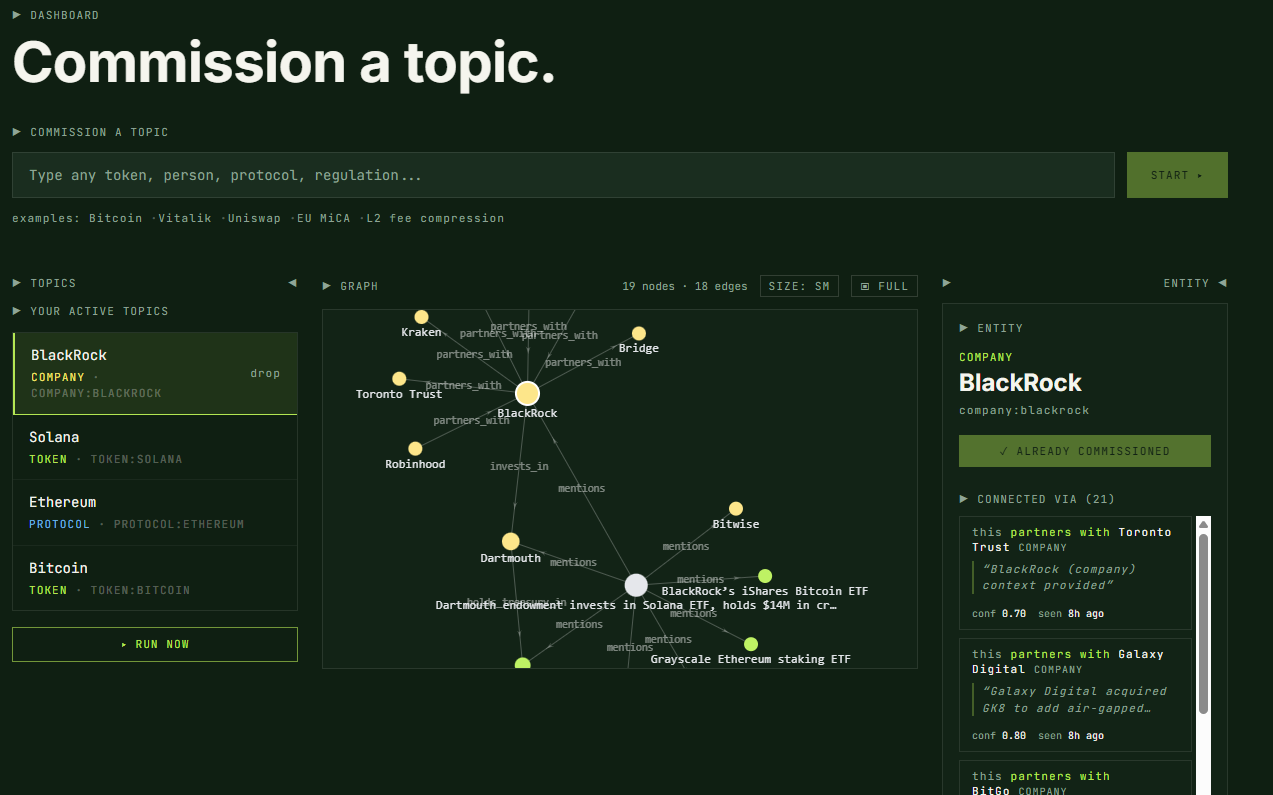
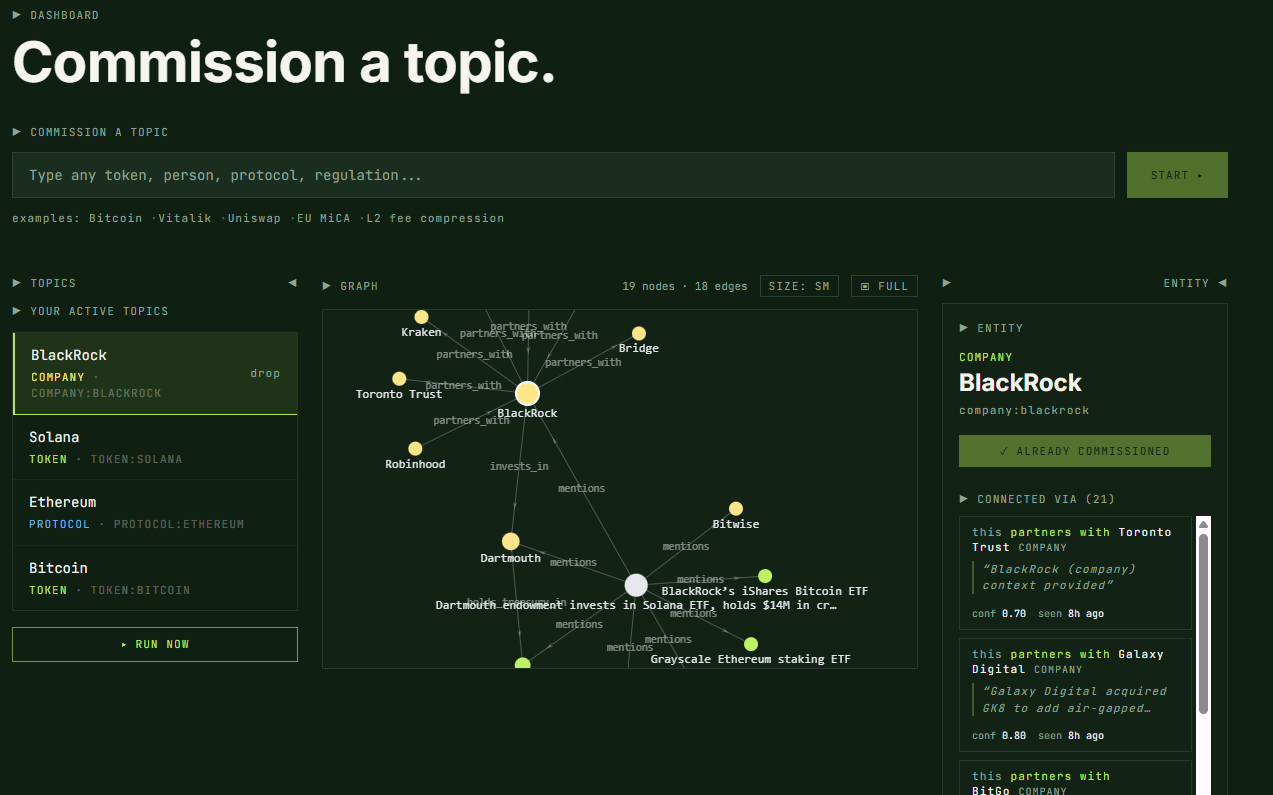
Knowledge Graph
Commission a topic
A single text input is classified into one of seven entity types:
Typed relationships
Sixteen relationship types are supported, including:
Articles as graph nodes
Every processed article becomes an event:article-* node connected through mentions edges to related entities, ensuring sparse extractions still build navigable graphs.
CoinGecko enrichment
Token and protocol entities include:
Live price
Market cap
24h / 7d change
All-time high
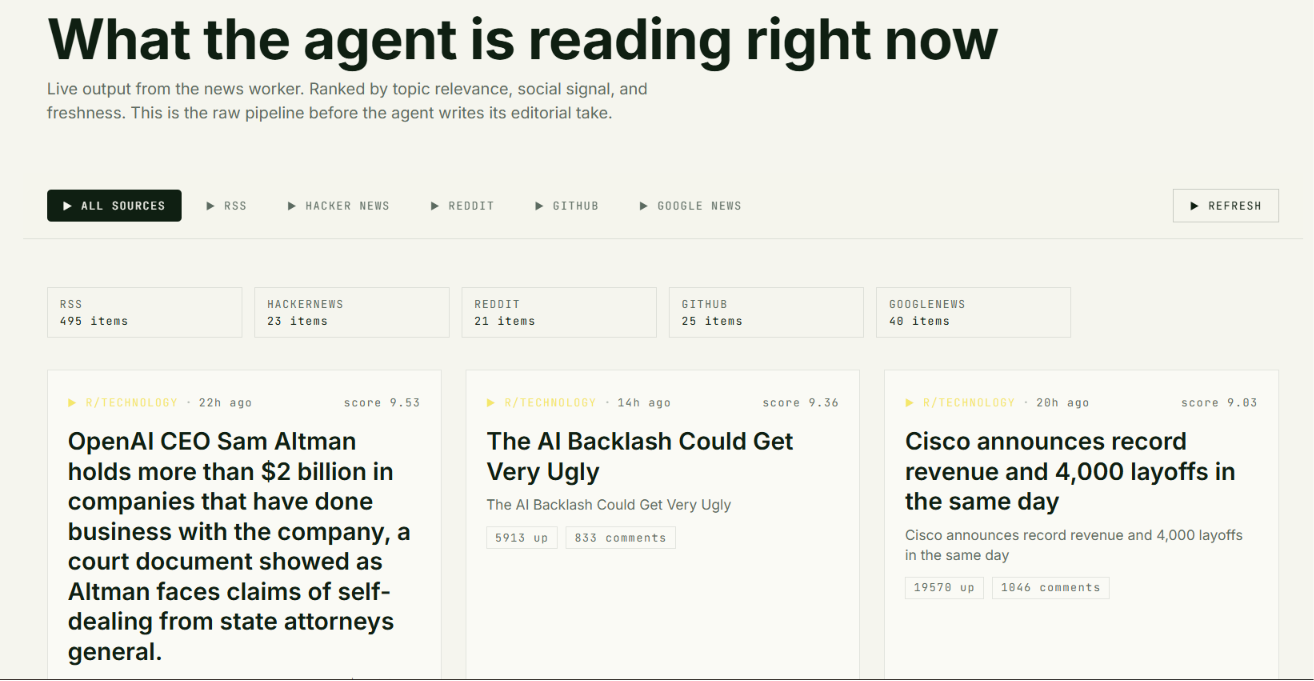
Editorial Agent
Per-run briefs
The system selects relevant articles and generates concise editorial summaries persisted alongside inference trace IDs.
7-day executive briefing
The last seven days of activity are condensed into an executive-level summary.
Chat with your graph
Users can query their commission directly. Responses are grounded strictly in:
Entities
Relationships
Briefs
Uploaded datasets
The system refuses answers outside available context.
Sources and Ingestion
Bring-your-own RSS and YouTube sources
Sources are attached per commission and merged into a shared ingestion pipeline.
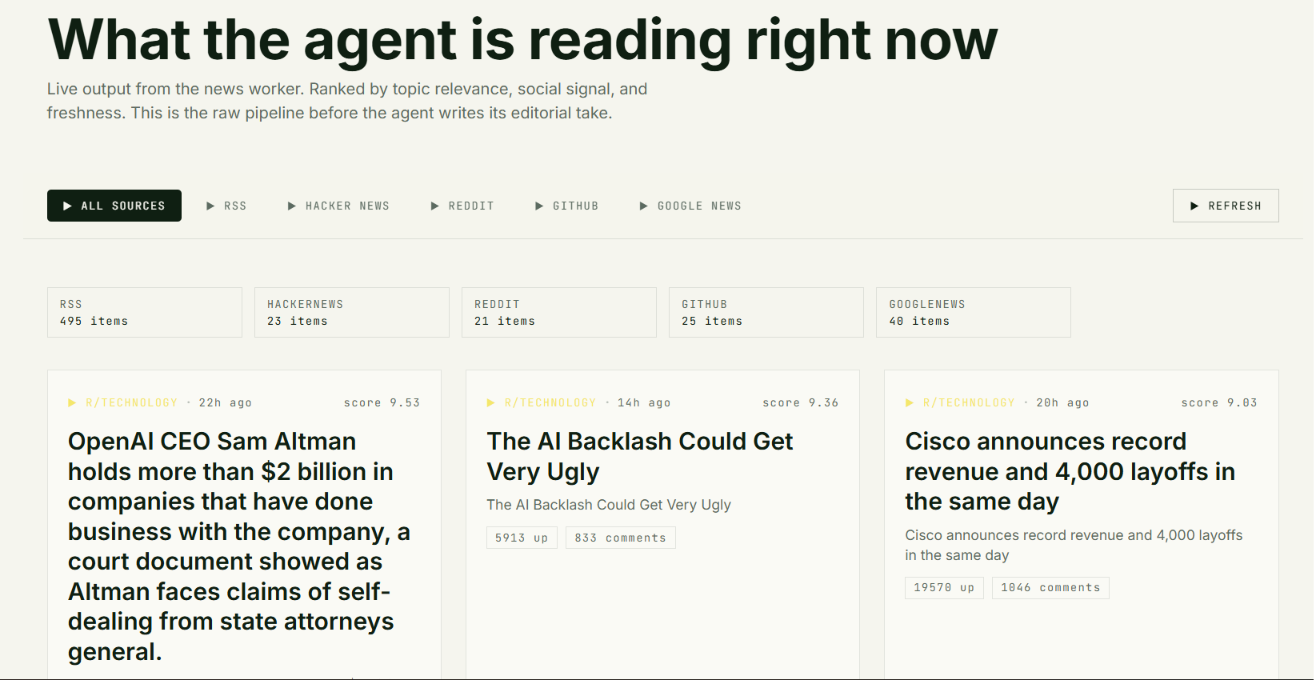
Google News fallback
When user-defined sources return nothing, the system automatically dispatches targeted Google News RSS queries.
CSV upload pipeline
Up to 20 rows per file
Each row passes through the same typed extraction engine
SHA-256 hash computed before inference begins
Editorial Agent Loop (The Core Flow)
Commission a topic → classify the entity → fetch news from cache, BYO RSS feeds, and Google News fallback → process up to 8 articles → generate editorial briefs → extract typed entities and relationships → persist with provenance → evaluate alerts → deliver notifications to app logs, webhooks, or Telegram.
Typed Knowledge Graph
7 entity types
Token
Protocol
Company
Person
Jurisdiction
Event
Topic
Schema-aware relationships
Domain/range validation rejects invalid relationships between entity types.
Articles as graph nodes
Every article becomes an event:article-* node connected through mentions edges, allowing sparse extractions to still create navigable graphs.
CoinGecko enrichment
Token and protocol entities include:
Market cap
24h / 7d price change
All-time high
User-Facing Surfaces
/dashboard
Live force-directed graph with commissions, entity exploration, and timeline view.
/chat
Per-commission Q&A grounded only in:
Entities
Relationships
Briefs
Uploaded datasets
Responses include model trace IDs and refuse when data is missing.
/sources
RSS feeds and YouTube ingestion merged with the global news cache.
/vault
Unified table of briefs, uploads, and content hashes with anchored-on-0G statistics.
/agent
Filterable audit log for:
Inference calls
Brief generations
Alert triggers
Upload events
Source additions
Alerts and Delivery
Delivery channels
In-app logs
Webhooks
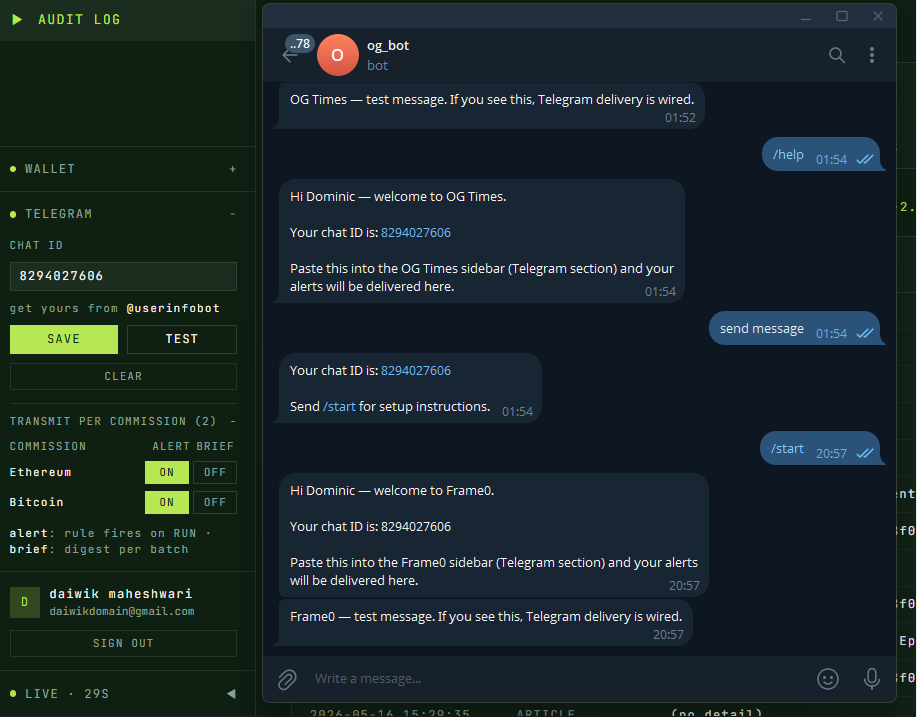
Telegram
Telegram subscriptions
Separate toggles for:
Alerts
Brief digests
Digests bundle multiple article updates into a single message.
Telegram onboarding bot@ogtimes_bot onboarding through /start.
Building this as a frontier in Knowledge Graphs and AI infra on 0g.
Applied for a16z and booked calls with clients on exploring the usecase beyond current compass.