
Community infrastructure for regenerative work. Record what you did, have your community verify it, and connect that record to funding. Offline-first app, passkey sign-in, public records on Arbitrum, and the people doing the work own the proof of it.
Green Goods is community infrastructure for regenerative work. A gardener records work with a photo in an app that works offline, a steward from the same community reviews it, and the approved work becomes a public record on Arbitrum. Those records build into impact certificates and feed the ways a community gets funded: DeFi endowment vaults, direct support through funding jars and commitment pools, and reports funders can check for themselves.
Four things keep regenerative work unfunded.
Proving the work costs more than doing it. Communities across the global south spend their time on reports instead of on the land.
The tools are built for NGOs with staff and good internet, not for a field worker on a mid-range phone during a power cut.
The platforms are centralized. The record of a community's work sits on someone else's server, under someone else's terms, and can be changed or lost. The community does not own it.
Funders cannot verify what they fund. So they fund less, fund later, or ask for more reports, which lands back on the same few people.
A garden is a community's workspace: its own onchain account, its roles, the kinds of work it tracks, its evidence and its funding.
Gardeners do the work. Stewards review it and run the garden. Evaluators assess outcomes. Funders support it. Community members add testimony.
Every piece of work becomes an EAS attestation on Arbitrum : work, then approval, then assessment. Evidence lives on IPFS. The record does not depend on our servers.
Everyone signs in with a passkey on a ZeroDev Kernel smart account with gas sponsored with Pimlico. Wallets are there for people who want them.
Funding is modular: Octant vaults for endowments, cookie jars for direct payouts, commitment pools for mutual promises, Hypercerts for impact certificates.
Tech and Sun in Nigeria, uses Green Goods to track the build-out of solar and internet infrastructure at local universities, and once a hub is running, to record the workshops and classes that happen inside. The same record that proves the panels went up proves the education that follows.
Impact reporting through chat, meeting users where they're at. Anyone with a role in a garden can DM the Green Goods agent on Telegram a story and photos. The agent works out the garden and the activity, asks only what is missing, shows the exact report, and publishes it to Arbitrum once they confirm. The first report is approved in the browser with a passkey or wallet. After that, reports go onchain from the chat under a permission the gardener controls revocable at anytime.
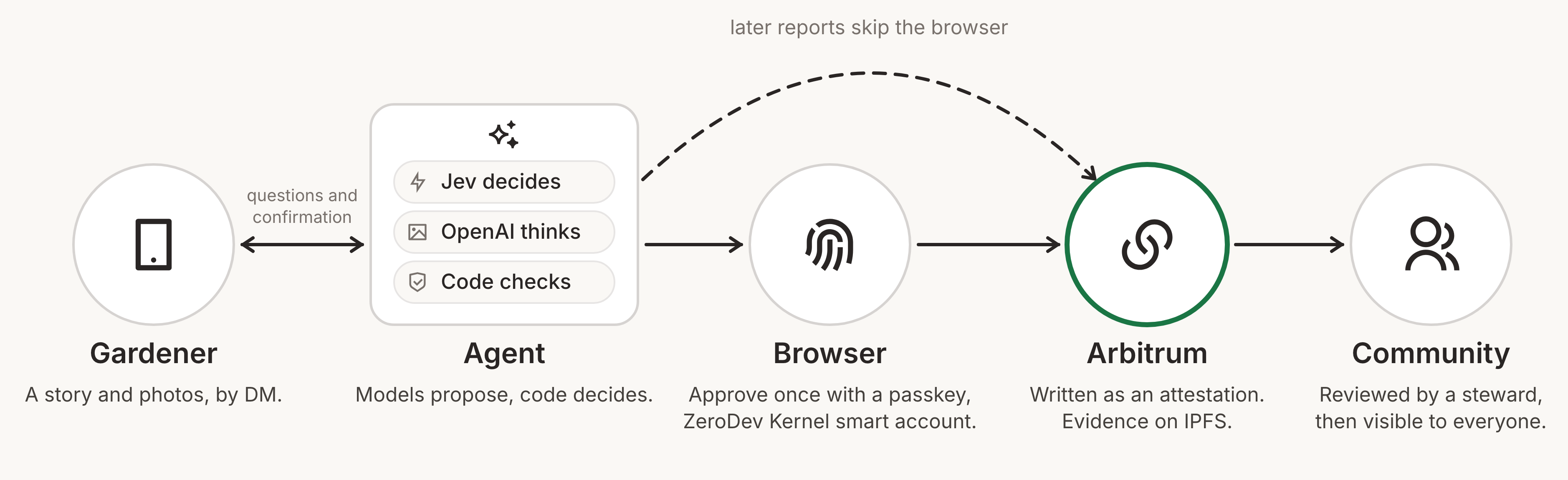
Jev makes the fast, typed decisions. OpenAI reads photos and documents. Code checks every proposal, and if a model fails the chat asks plain questions.
Telegram first. WhatsApp when Meta approves our account. The core does not depend on the chat provider.
WhatsApp, SMS, Discord and where our communities live next. Then the same agent for funding, so capital reaches the work from the same chat the reports arrive.