
INSTANT WIN — The distribution layer for tokenized assets The trillion-dollar problem nobody solved Tokenized assets are coming to Arbitrum at scale. Robinhood Chain will issue them. Institutions will mint them. And then somebody has to put them in the hands of real people — millions of them, most of whom have never installed a wallet. Right now, that layer does not exist. Every distribution tool today forces a choice: verifiable but crypto-only, or accessible but unprovable. A brand giving away 10,000 tokens picks a spreadsheet and a promise. A protocol doing an airdrop reaches the same 200,000 wallets everyone else reaches. The 3 billion people outside crypto stay outside. What we built INSTANT WIN is the rail between them. A campaign holds its prize in a verified contract on Arbitrum One. Winners are drawn by Chainlink VRF — nobody picks, not even us. Prizes are claimed straight from the contract, and claims can never be blocked. Every entry, every draw, every payout is on Arbiscan. And the entrant? They use their email. No wallet, no extension, no gas, nothing to install. Under the hood each person gets a real wallet, created invisibly, signing their own on-chain entry. This is the part everyone claims and almost nobody does honestly: no relayer stuffing entries in bulk. The contract requires each entry to come from its own participant, so the proof holds. Web2 in, proof out. One verified person, one entry — phone verification, zero cost per participant, no bot farms taking the prize. Live on Arbitrum One today Not a demo. Not a testnet. Deployed, verified, running. Lottery — 30-minute rounds, VRF draws, pull-payment prizes. Automated end-to-end by Chainlink CRE. Event Center — anyone runs a campaign. Prize modules for ERC-20, ERC-721 and ERC-1155, all deployed and verified, so a campaign can distribute any tokenized asset — including real-world assets issued on Arbitrum and Robinhood Chain. Four paths, one barrier — creators and entrants each choose wallet or no wallet. Phone verification is mandatory in all four. The platform never holds a prize it cannot prove it delivered. Core: 0xEA91eb545FBB7e82f0085ff30555ed06C1Baf739 Lottery: 0xB1935f2d6D0A8dEb7cfB074b17f179fd842d324a Don't believe us. Go check. Where this goes Physical prizes as NFT vouchers — a brand uploads a product, the platform mints the voucher, the winner redeems it in-store. Creator identity signed on-chain, so a winner denied a prize holds a contract, not a screenshot. A creator score built on confirmed deliveries — the one asset in this space that capital cannot buy and only time can build. Then the regulated entity, then licensing, then any platform instrument. In that order, never before it. Why now The rails for tokenized assets are being laid this year. The distribution layer is not. We built it, it runs, and it is the only one where the person receiving the asset does not need to know what a wallet is. Stack Solidity 0.8.21 / Foundry · Chainlink VRF v2.5 · Chainlink CRE · React + wagmi/viem · Vercel serverless · Supabase · Resend Four independent security audits. 425 tests. Migrations executed against a real Postgres before touching production. The proof is in the repo — as it should be.
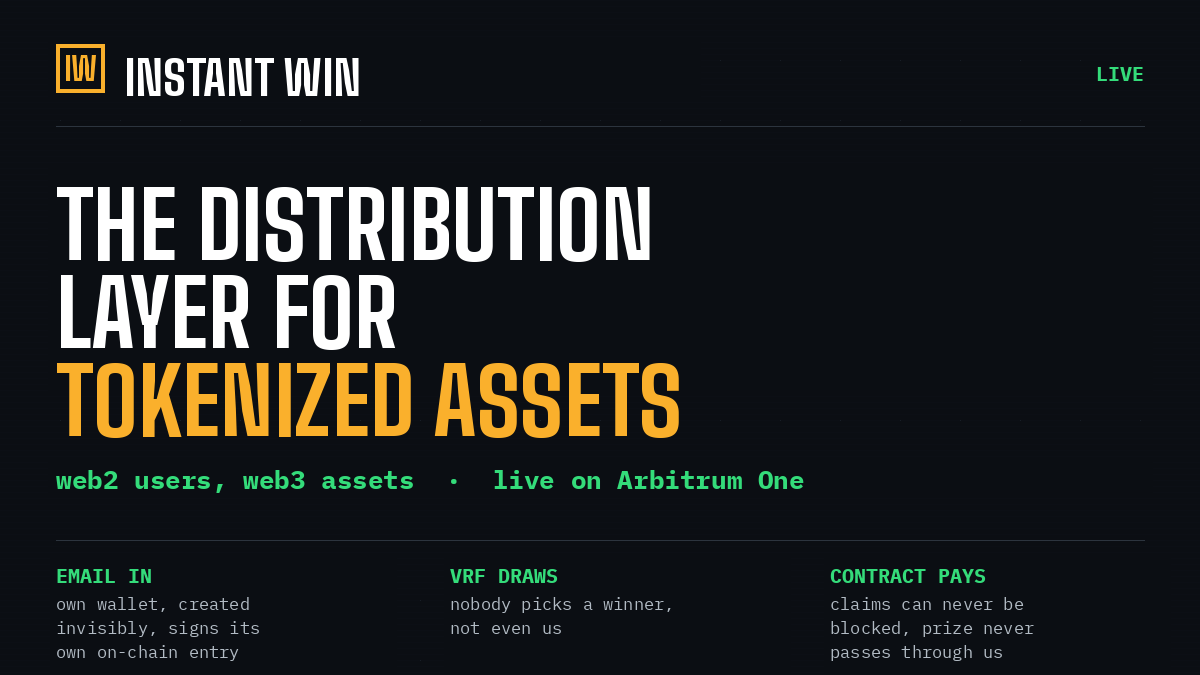
INSTANT WIN — The distribution layer for tokenized assets
The trillion-dollar problem nobody solved
Tokenized assets are coming to Arbitrum at scale. Robinhood Chain will issue them. Institutions will mint them. And then somebody has to put them in the hands of real people — millions of them, most of whom have never installed a wallet.
Right now, that layer does not exist.
Every distribution tool today forces a choice: verifiable but crypto-only, or accessible but unprovable. A brand giving away 10,000 tokens picks a spreadsheet and a promise. A protocol doing an airdrop reaches the same 200,000 wallets everyone else reaches. The 3 billion people outside crypto stay outside.
What we built
INSTANT WIN is the rail between them. A campaign holds its prize in a verified contract on Arbitrum One. Winners are drawn by Chainlink VRF — nobody picks, not even us. Prizes are claimed straight from the contract, and claims can never be blocked. Every entry, every draw, every payout is on Arbiscan.
And the entrant? They use their email.
No wallet, no extension, no gas, nothing to install. Under the hood each person gets a real wallet, created invisibly, signing their own on-chain entry. This is the part everyone claims and almost nobody does honestly: no relayer stuffing entries in bulk. The contract requires each entry to come from its own participant, so the proof holds. Web2 in, proof out.
One verified person, one entry — phone verification, zero cost per participant, no bot farms taking the prize.
Live on Arbitrum One today
Not a demo. Not a testnet. Deployed, verified, running.
Lottery — 30-minute rounds, VRF draws, pull-payment prizes. Automated end-to-end by Chainlink CRE.
Event Center — anyone runs a campaign. Prize modules for ERC-20, ERC-721 and ERC-1155, all deployed and verified, so a campaign can distribute any tokenized asset — including real-world assets issued on Arbitrum and Robinhood Chain.
Four paths, one barrier — creators and entrants each choose wallet or no wallet. Phone verification is mandatory in all four. The platform never holds a prize it cannot prove it delivered.
Core: 0xEA91eb545FBB7e82f0085ff30555ed06C1Baf739
Lottery: 0xB1935f2d6D0A8dEb7cfB074b17f179fd842d324a
Don't believe us. Go check.
Where this goes
Physical prizes as NFT vouchers — a brand uploads a product, the platform mints the voucher, the winner redeems it in-store. Creator identity signed on-chain, so a winner denied a prize holds a contract, not a screenshot. A creator score built on confirmed deliveries — the one asset in this space that capital cannot buy and only time can build.
Then the regulated entity, then licensing, then any platform instrument. In that order, never before it.
Why now
The rails for tokenized assets are being laid this year. The distribution layer is not. We built it, it runs, and it is the only one where the person receiving the asset does not need to know what a wallet is.
Stack
Solidity 0.8.21 / Foundry · Chainlink VRF v2.5 · Chainlink CRE · React + wagmi/viem · Vercel serverless · Supabase · Resend
Four independent security audits. 425 tests. Migrations executed against a real Postgres before touching production. The proof is in the repo — as it should be.