
Kongsi is a milestone-based financing platform that helps entrepreneurs access capital through transparent, evidence-backed project tracking and smart contract escrow.

Traditional crowdfunding platforms often provide limited transparency into how funds are used after a campaign is funded. Investors may have difficulty verifying whether project owners are executing their plans, meeting milestones, or using funds as intended. This information gap creates trust issues and makes it harder for investors to monitor the progress and risks of real-world projects.
For peoples the challenge is equally significant: they need capital to run productive activities but may struggle to demonstrate their progress and build a credible track record that potential funders can evaluate.
Kongsi is a milestone-based, blockchain-powered project financing platform designed to connect investors with productive real-world projects, starting with smallholder farmers and MSMEs.
Instead of focusing solely on tokenizing static assets, Kongsi focuses on verifiable project execution. Entrepreneurs submit project proposals with funding targets, operational plans, and milestones. As the project progresses, they upload supporting evidence that can be reviewed and recorded through an on-chain verification process.
Investor funds are held in a smart contract escrow and released in stages when predefined conditions are satisfied. Token holders can participate in on-chain voting to review submitted evidence, while the smart contract enforces the project's funding and release rules. If a project fails to meet its funding conditions or reaches a defined cancellation state, the contract applies the corresponding refund rules.
When a project generates revenue, payments can be distributed to eligible token holders according to predefined contractual terms and a transparent distribution mechanism.
By combining milestone-based funding, evidence-backed progress tracking, and programmable fund management, Kongsi aims to make productive financing more transparent and accountable. It gives investors a clearer view of project execution while helping farmers and small businesses present verifiable progress to potential funders.
Kongsi uses smart contracts to enforce funding conditions, manage escrow, record verification outcomes, and execute predefined fund-distribution rules. On-chain records make important project states and transactions independently auditable.
Built on Monad Testnet, Kongsi explores how an EVM-compatible environment can support an interactive financing workflow involving evidence submissions, voting, and conditional fund releases. Finally, the goal is to deliver a responsive user experience while keeping the core financing rules transparent and verifiable on-chain.
My journey to building Kongsi was not a straight line. It was a process of questioning assumptions, exploring possibilities, learning from research, and repeatedly rebuilding my understanding of what a meaningful RWA product should be.
I started with a broad question: how can blockchain make real-world assets more accessible to ordinary Indonesians?
My initial ideas included tokenized auctions, fractional ownership, and investment opportunities in assets such as property. But as I explored the RWA ecosystem, I realized that simply putting assets on-chain was not enough to create meaningful impact.
I began looking beyond tokenization itself. I explored research papers, YouTube tutorials, industry news, emerging trends, and existing blockchain projects to understand the problems that remained unsolved. I wanted to build something that addressed a real need in Indonesia rather than another token marketplace.
My thinking gradually shifted from Who can own an asset? to Who deserves access to capital, and how can investors trust the people they fund?
I explored financing challenges across several sectors, including MSMEs, agriculture, fisheries, and small rental-property businesses. Each sector had different needs, but one problem kept appearing: productive people need capital before their work generates revenue, while potential funders need credible information about how their money will be used.
This led me to investigate milestone-based financing, evidence verification, smart contract escrow, and tokenized economic rights. I began connecting these concepts into a single system rather than treating every industry as a separate product.
My progress was shaped by continuous learning and feedback. During offline sessions, conversations and guidance from mentors helped me challenge my assumptions, reconsider my priorities, and refine the direction of the project.
I revisited my ideas, reconsidered the role of tokenization, and questioned what blockchain should actually do in the product. I did not want to use blockchain merely as a marketing label. I wanted the smart contracts to enforce meaningful rules around funding, verification, and fund distribution.
The process involved long nights of research, discussion, coding, debugging, and rebuilding my ideas. Rather than committing to my first concept, I kept iterating until the problem, product mechanism, and technical implementation began to align.
Eventually, these explorations led me to Kongsi.
Instead of focusing solely on tokenizing static assets, Kongsi focuses on verifiable project execution. Farmers and MSMEs can present productive projects with funding targets, operational plans, and predefined milestones. Investors can evaluate the available evidence and monitor project progress.
My core mechanism combines smart contract escrow, milestone-based fund releases, evidence submission, and on-chain voting. Revenue generated by a project can be distributed according to predefined contractual terms.
The central idea is simple: financing should not end when funds are collected. Project execution and the evidence supporting it should remain visible throughout the funding lifecycle.
After defining the core mechanism, I began translating the concept into a working product.
Smart contracts: I developed Kongsi.sol to implement the core funding workflow, including escrow, token-weighted verification voting, milestone-based releases, refund rules, and revenue distribution.
Testing and deployment: I ran six Hardhat unit tests and deployed the contract to Monad Testnet, with source verification through Sourcify and transaction inspection through MonadVision.
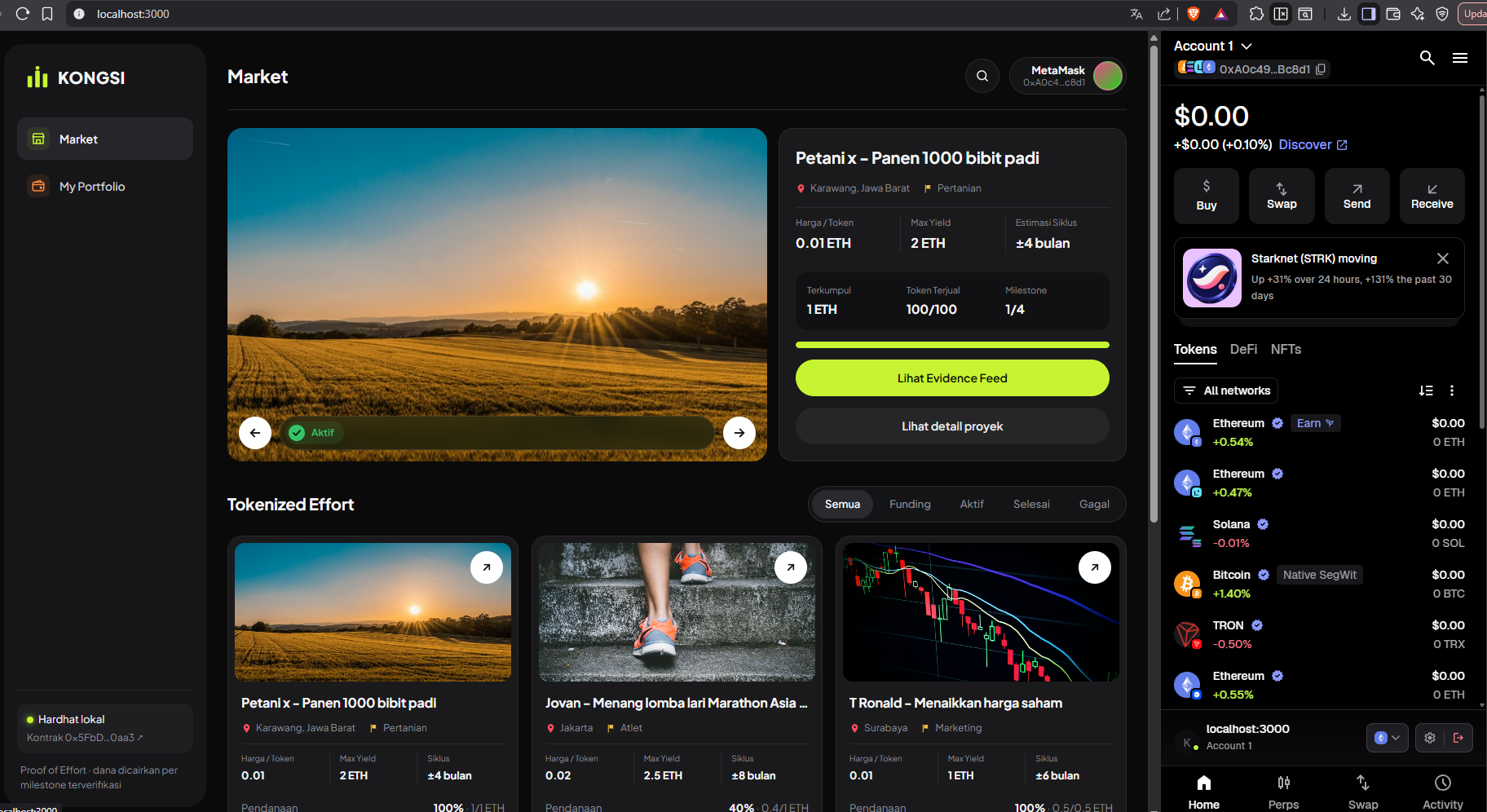
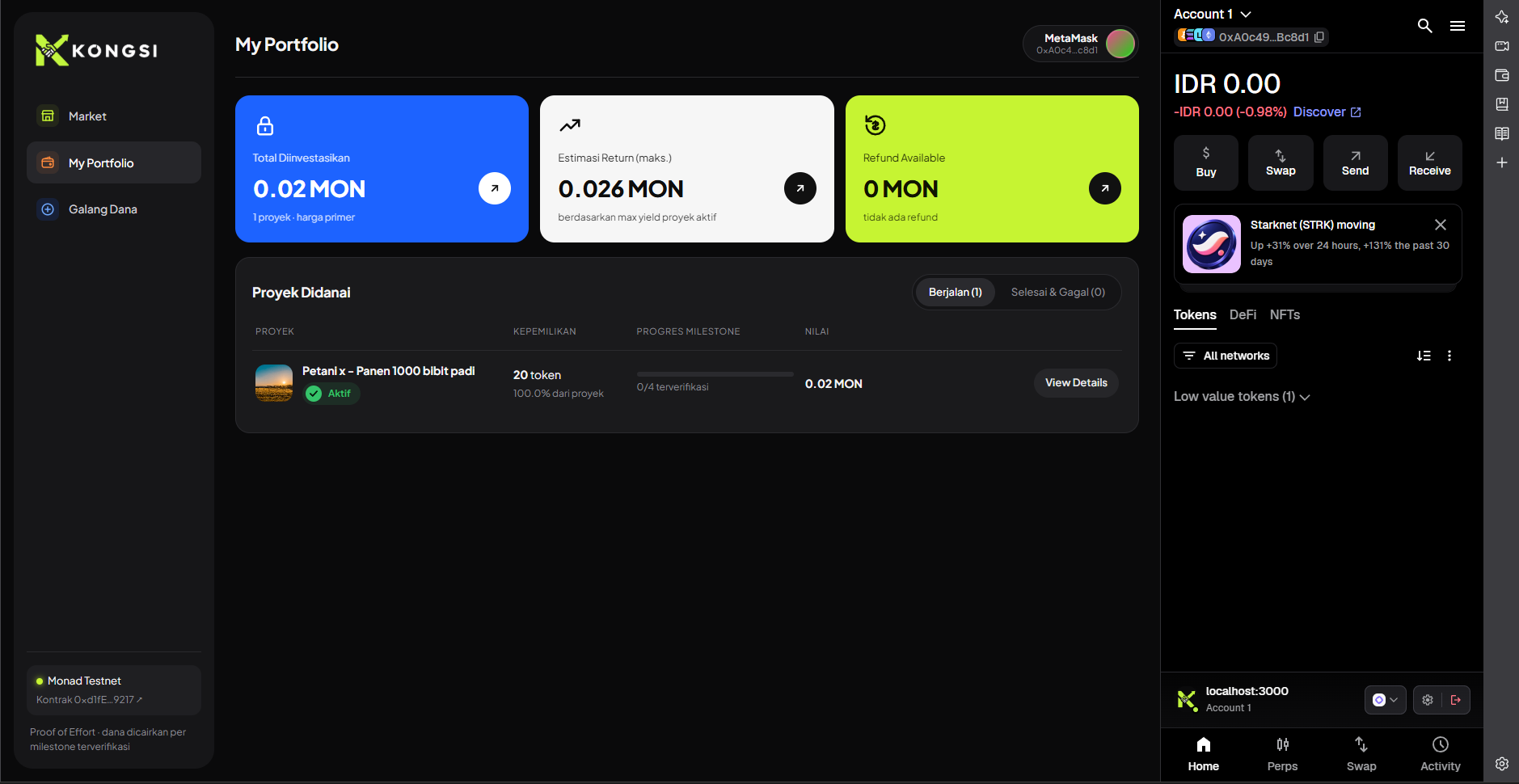
Frontend development: I built a responsive Next.js and Tailwind interface with a project marketplace, interactive evidence feed, entrepreneur profiles, and a fundraising flow with configurable milestones.
Web3 integration: I integrated ethers.js and MetaMask to connect the interface to the deployed contract, read contract state, and execute on-chain transactions.
Evidence and project history: I designed project metadata and evidence references to connect the user experience with on-chain project records.
These milestones represent my effort to move beyond a conceptual pitch toward a demonstrable financing workflow.
The most important lesson from this hackathon is that meaningful RWA innovation is not simply about creating tokens. It is about defining the rights those tokens represent, establishing credible evidence, managing real-world risks, and designing mechanisms that make funding more accountable.
I also learned that blockchain cannot independently verify every real-world event. Physical inspections, document reviews, and payment confirmations still require trusted verification processes. Smart contracts can enforce rules based on accepted evidence, but they cannot guarantee that a project will succeed.
Kongsi is my attempt to connect these realities with programmable on-chain financing.
What began as a collection of RWA ideas became a more focused vision: helping productive people access capital while giving funders better tools to understand project progress, verify evidence, and track how funding rules are executed.
Kongsi is not the result of my first idea. It is the result of repeatedly questioning that idea until I found a problem worth building for.
Kongsi is currently in the prototype and development stage. No external funding has been raised for the project so far.
The project is being developed independently as part of the hackathon, with a focus on validating its core concept: milestone-based project financing, evidence-backed progress tracking, and smart contract escrow.
The current priority is to demonstrate a working end-to-end prototype on Monad Testnet, gather feedback from mentors and potential users, and validate the financing workflow before pursuing external funding or a real-world pilot.
Future funding would support further smart contract development and security audits, user research with Indonesian farmers and MSMEs, verification partnerships, and the development of a compliant framework for real-world project financing.