
Autonomous ERC-7857 agent on Robinhood Chain (Arbitrum Orbit). LP Guardian uses TEE-verified AI to diagnose LP risks & secure migrations, providing verifiable on-chain liquidity protection.
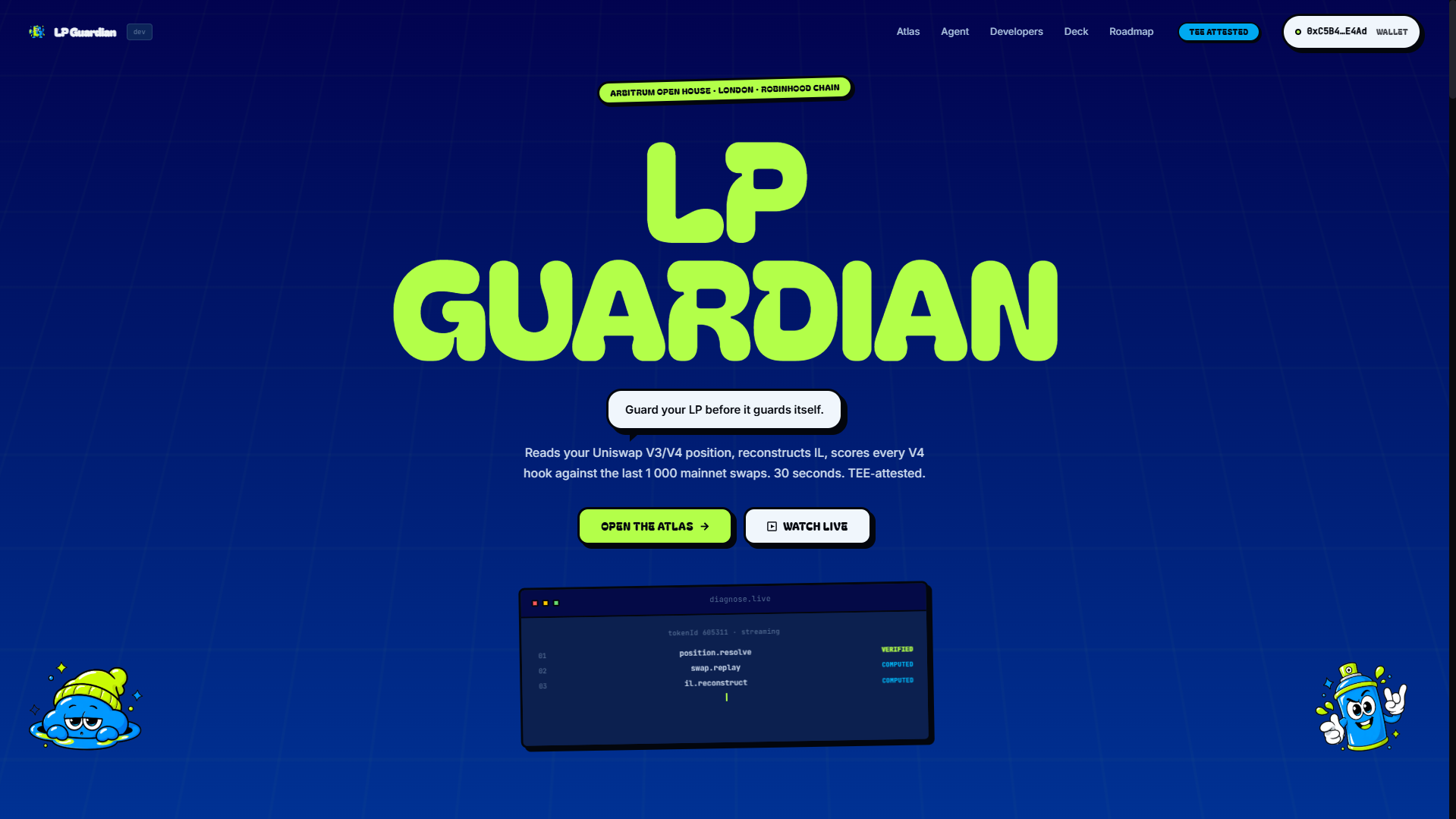
LP Guardian is the first autonomous multi-agent AI system designed to manage fragmented liquidity provider (LP) positions as a unified portfolio. Built on Arbitrum Orbit (Robinhood Chain) and powered by Arbitrum Stylus (Rust), LP Guardian brings verifiable intelligence (TEE) to DeFi liquidity management.
Managing LP positions today is complex and inefficient:
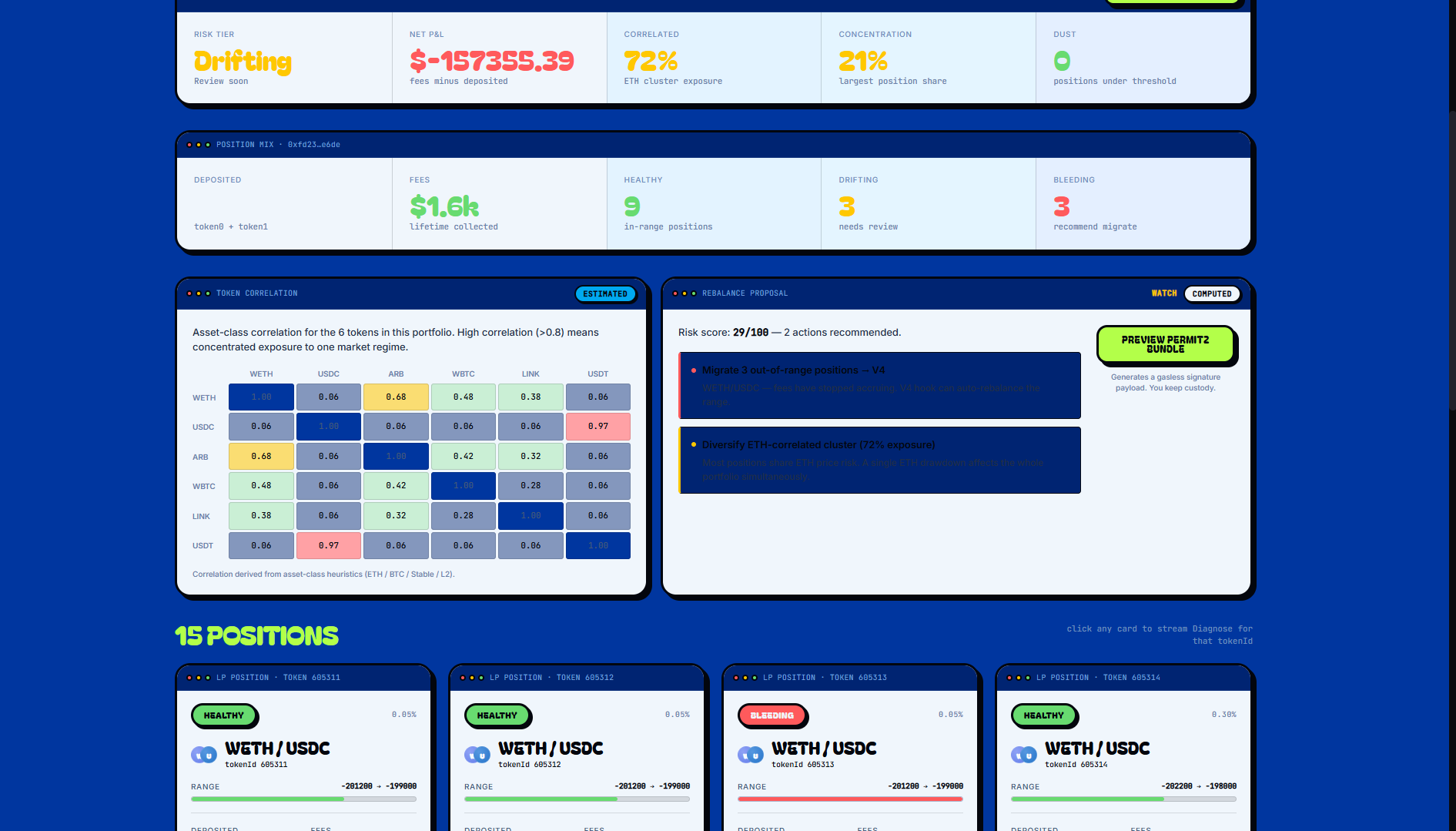
Correlation Blindness: Current tools only analyze positions in isolation. Users often don't realize that 5 different pools might share the same 90%+ risk correlation to ETH.
The Dust Position Trap: Small positions ($50–$200) are often abandoned because gas costs to close them exceed their value, leading to capital inefficiency.
Analysis Paralysis: APR and IL data are available, but there is no actionable answer to the most critical question: "When and how should I rebalance?"
We have implemented a 6-agent autonomous system where specialized agents collaborate to protect and optimize your portfolio:
Scan Agent: Aggregates LP positions across Uniswap V3/V4, Camelot, and Robinhood Chain.
Correlate Agent: Computes portfolio-wide correlation matrices using Stylus (Rust) to detect hidden concentration risks.
Simulate Agent: Runs swap replays and "what-if" scenarios to project risk-adjusted returns.
Optimize Agent: Generates optimal rebalance proposals, including automated consolidation of dust positions.
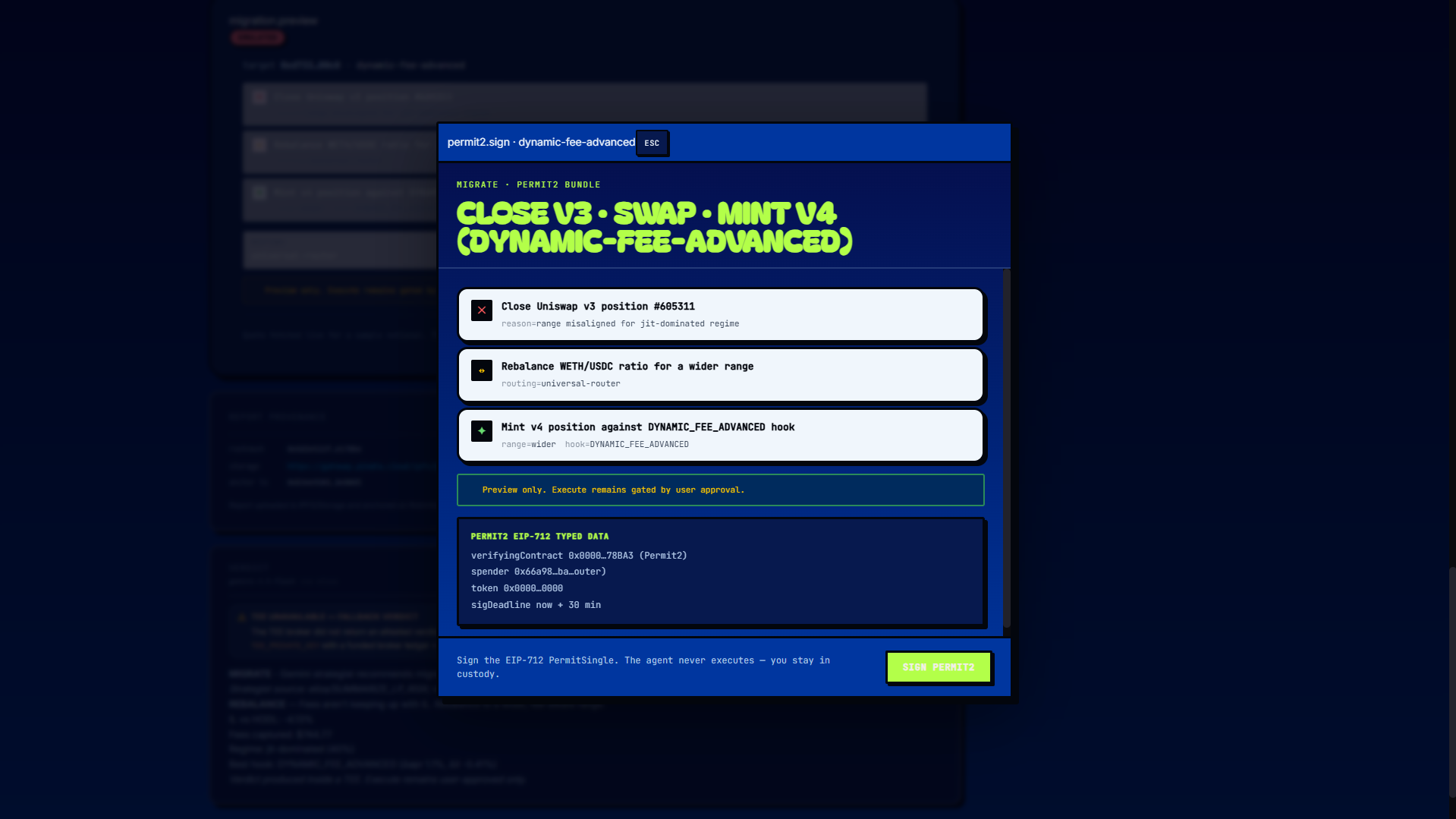
Execute Agent: Facilitates gasless, bundled execution via Permit2 once the user approves.
Monitor Agent: A 24/7 watchdog that triggers autonomous re-diagnosis during high price volatility.
Arbitrum Orbit (Robinhood Chain): Leveraged as a high-scale L3 for low-cost transactions and retail stock-token LP integration.
Arbitrum Stylus (Rust): Used for heavy computation (Correlation Matrices & IL Decomposition), achieving 10-100x faster execution and 30%+ gas savings compared to Solidity.
ERC-7857 (Verifiable Agent): Implements the latest standard for Intelligent NFTs (iNFTs) to store the Agent’s identity, memory roots, and reputation on-chain.
TEE (Phala Network): Ensures Verifiable AI. All diagnostic computations are performed in a Trusted Execution Environment, producing a signed report that proves the AI logic was not tampered with.
MCP (Model Context Protocol): Enables the Guardian to "talk" to and be called by other agents in the emerging AI Agent economy.
Our goal is to provide institutional-grade liquidity management for 28 million retail users (via Robinhood Chain). With LP Guardian, liquidity management is no longer a manual chore—it is a smart, secure, and autonomous portfolio managed by verifiable AI.
During this hackathon, we moved from a conceptual architectural design to a functional multi-agent MVP integrated with the Arbitrum ecosystem. Below are the key milestones achieved:
Defined the 6-Agent Orchestration Flow: Established the message bus protocol for Scan, Correlate, Simulate, Optimize, Execute, and Monitor agents.
Smart Contract Design: Finalized the ERC-7857 iNFT identity structure for the Guardian Agent on Robinhood Chain.
Tech Stack Lock: Successfully integrated Arbitrum Stylus (Rust) for the computation-heavy math layer.
Stylus Implementation: Developed the initial Rust contracts for Matrix Correlation and IL Decomposition, offloading heavy math from Solidity to WASM for 30%+ gas efficiency.
Permit2 Integration: Implemented the logic for gasless transaction bundling, allowing users to rebalance multiple LP positions with a single signature.
AI Model Upgrade: Fully migrated our reasoning engine to Gemini 1.5 Flash across the entire codebase for faster and more cost-effective portfolio diagnostics.
MCP Server (Model Context Protocol): Developed a functional MCP server allowing our agents to be called by external LLMs and other agents.
Scan Agent Development: Built the data pipeline to fetch live LP data from Uniswap V3 and Camelot subgraphs on Arbitrum.
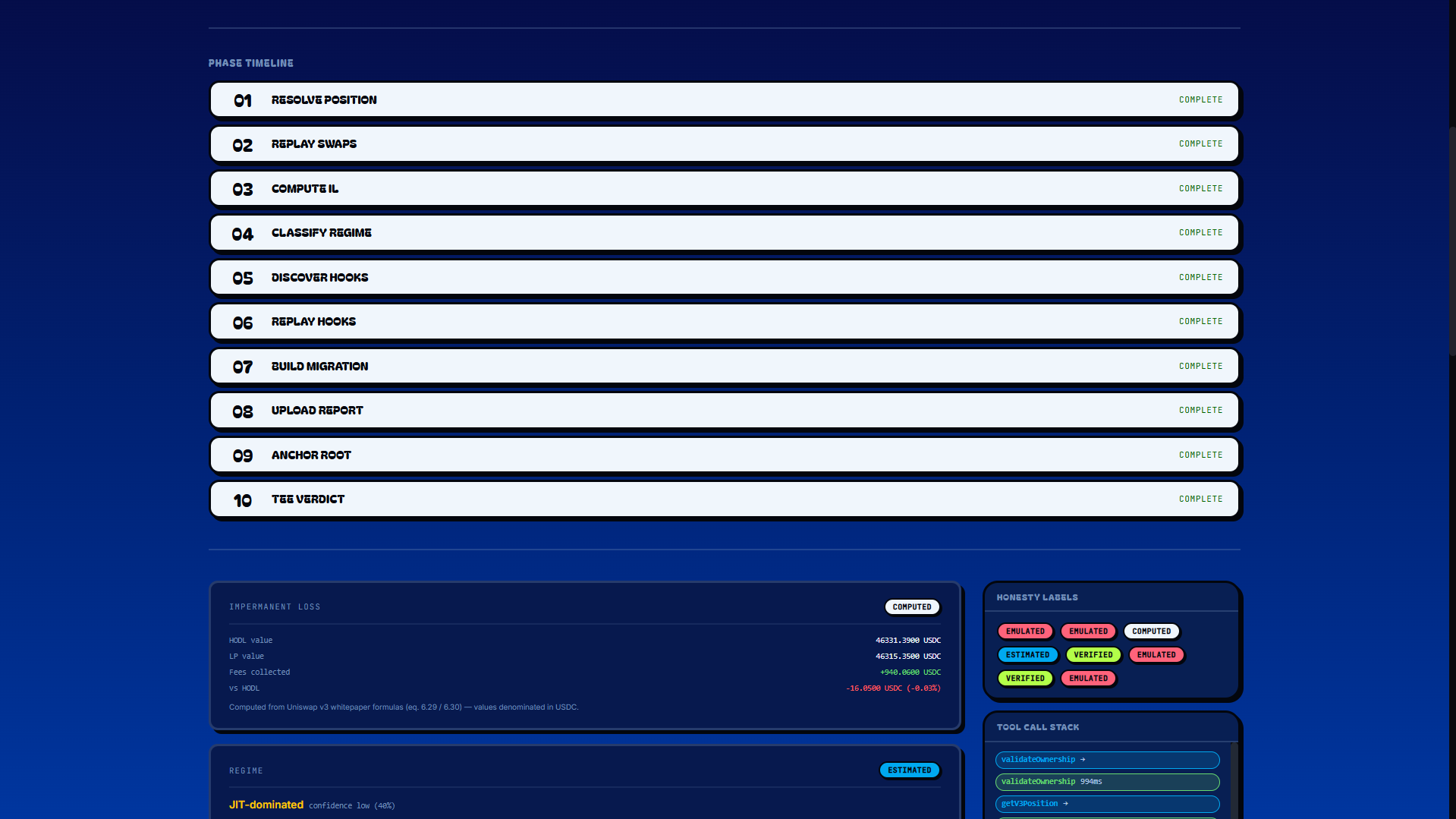
Dashboard Development: Built a React-based dashboard featuring a Real-time Diagnostic Stream (SSE) that shows the Agent's progress as it moves through the 6-phase pipeline.
TEE Proof Integration: Integrated Phala Network TEE stubs to sign diagnostic reports, ensuring the Agent’s verdict is verifiable and tamper-proof.
✅ Main Branch Synchronized: Core infrastructure is live on the main branch.
✅ Valid Model Connectivity: Successfully connected the agentic pipeline to the Gemini API.
✅ Stylus Math Layer: Initial Rust logic for correlation is ready for testnet deployment.
LP Guardian is currently in the early-stage bootstrapping phase. We have not raised any outside venture capital to date, as our primary focus has been on building a robust technical MVP and proving the concept of Verifiable AI Agents within the Arbitrum ecosystem.
📍 Current Funding Stage: Bootstrapped / Pre-Seed
We are currently seeking support in the following forms:
Ecosystem Grants: We are actively looking for grants from the Arbitrum Foundation and partners to accelerate the development of our Stylus (Rust) computation layer and TEE (Phala Network) integration.
Strategic Partnerships: We are interested in collaborating with DeFi protocols (like Uniswap, Camelot) and AI infrastructure providers to integrate LP Guardian as a standard security layer for retail liquidity providers.
Future Pre-Seed Round: Following a successful MVP launch on the Robinhood Chain (Arbitrum Orbit), we plan to open a strategic pre-seed round to scale our monitoring infrastructure and conduct security audits for our Permit2 bundling contracts.
Any funding or prize money received will be allocated towards:
Security Audits: Ensuring the safety of our autonomous rebalancing and bundling contracts.
Infrastructure Scaling: Expanding our Monitor Agent to support hundreds of concurrent portfolios.
Mainnet Deployment: Covering the initial deployment and operational costs on Arbitrum One and Robinhood Chain.