
Exit infrastructure for tokenized credit on Arbitrum. Investors receive USDG now through an agreed early exit; platforms repay later.
Lockgate gives credit platforms liquidity for scheduled withdrawals, so an eligible investor can receive USDG before the platform's next redemption window.
THE PROBLEM
An on-chain investment is not necessarily spendable cash. Credit platforms put capital to work financing businesses; withdrawal requests can wait for scheduled servicing or available repayment cash. An exit button needs funding, eligibility controls and enforceable terms behind it.
Our public-chain research, read on 2 October 2026, estimated $32.4M in open USD.AI redemption requests on Arbitrum and measured $38.62M in strategy-level pending withdrawals in Pareto's FalconX vault on Ethereum. These dated snapshots measure different parts of the redemption pipeline. Processed USD.AI requests had a count-weighted median wait of 13 days. Secondary-market discounts suggested a median implied annualized rate around 7.2% in the studied window. I used this market evidence alongside platform constraints and investor conversations to shape the pricing model.
HOW AN EXIT WORKS
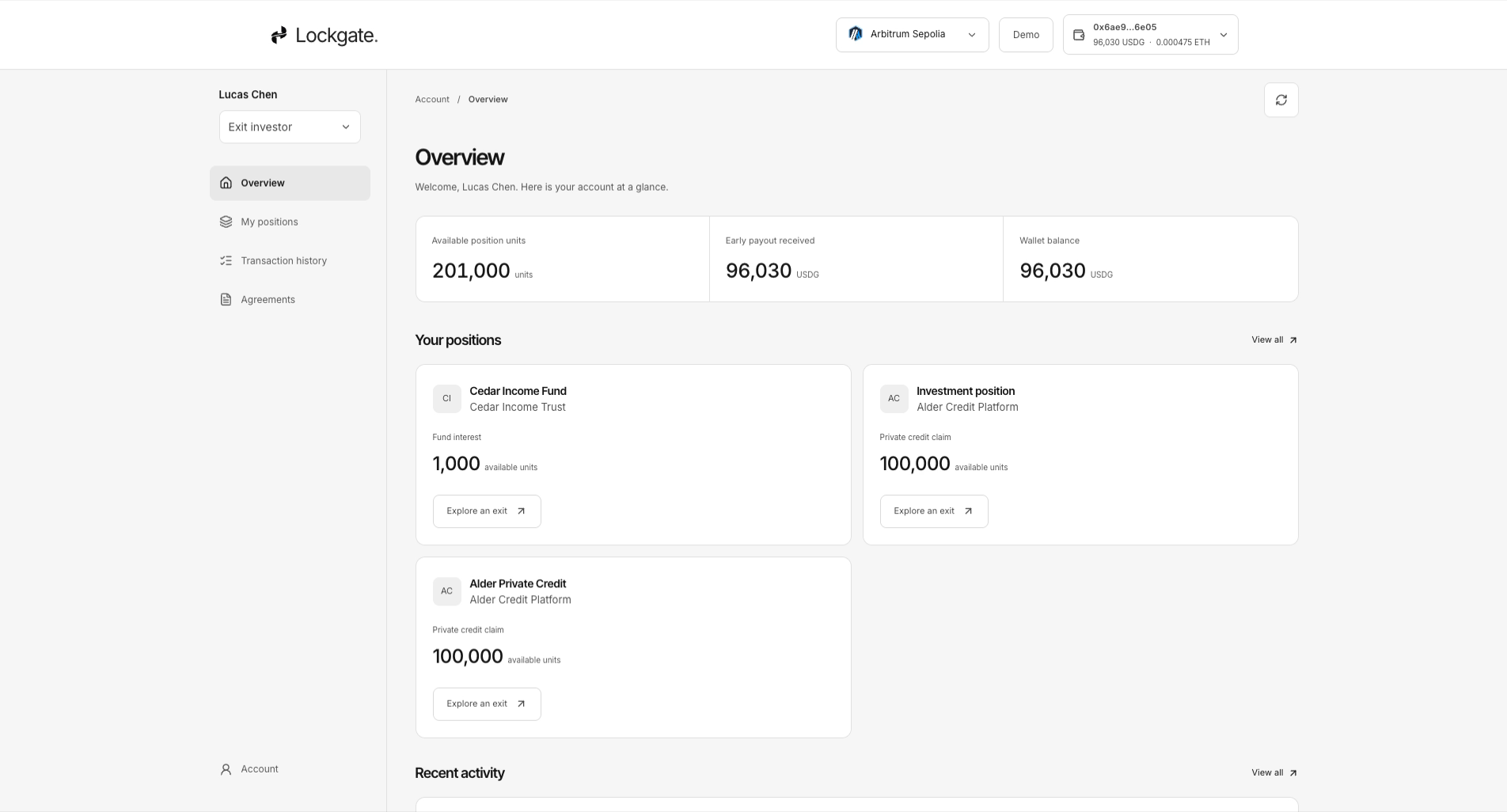
1. The investor reviews an eligible holding and compares waiting with an early-exit quote.
2. The quote states net USDG received now, the fee, expiry, funding source and legal route. An illustrative $10,000 exit with a $100 fee pays $9,900 now.
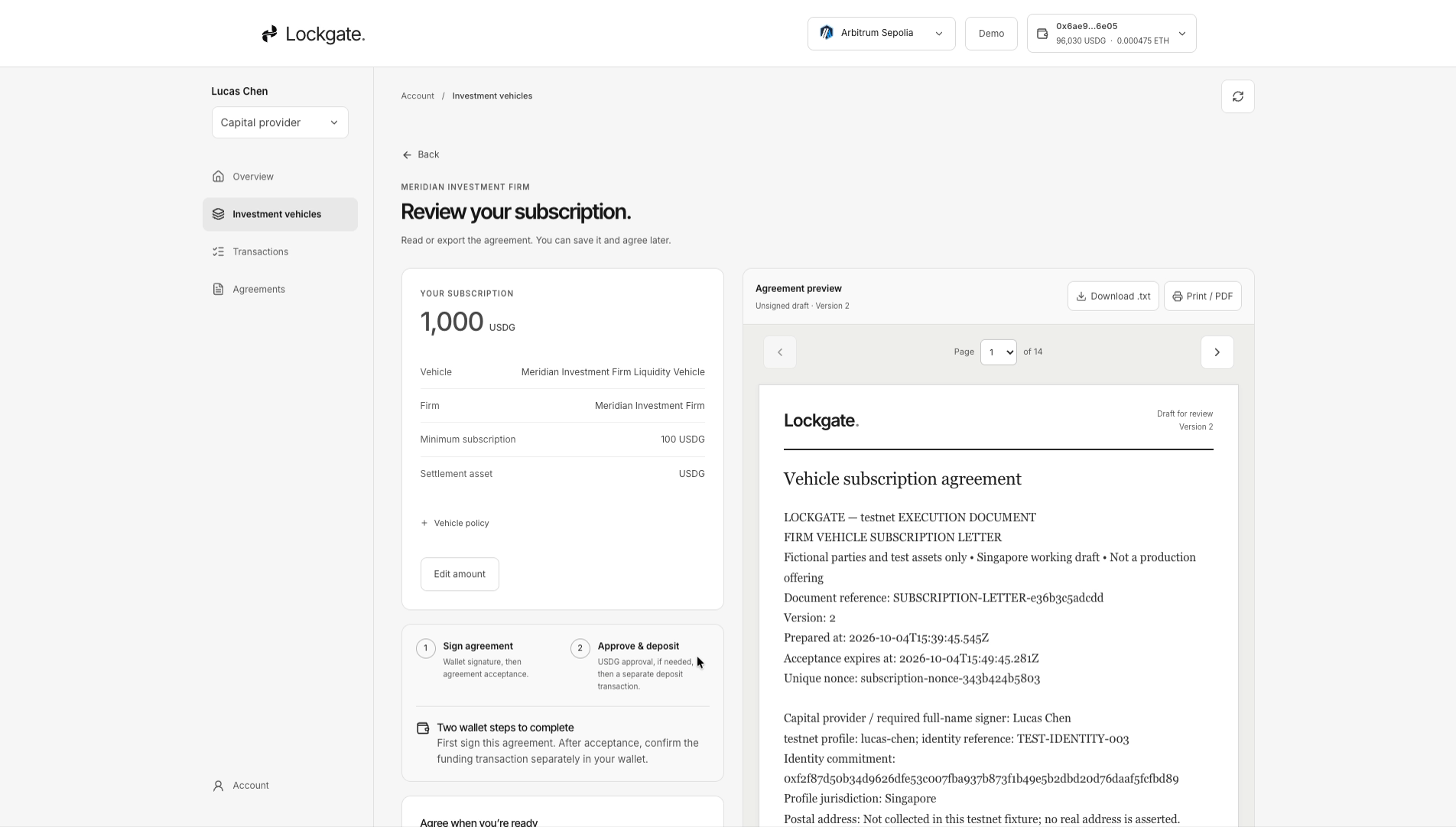
3. The investor agrees to the exact terms. Funding and settlement enforce ownership, eligibility, limits and available cash.
4. On the financing route, the investor's claim is discharged and the originator owes the agreed repayment. The deployed own-book facility receives repayment before the remaining redemption queue at the window. Where claim transfer is permitted, the newer product design instead supports a purchase by the funding vehicle; the agreement makes that distinction explicit.
5. Repayment replenishes capital for the next eligible exit. A delay is recorded and reserve/recovery rules apply; principal and repayment are not guaranteed.
WHO USES IT
Investors want a clear choice between waiting and receiving cash at a disclosed cost. Originators and credit platforms integrate the exit rail while retaining eligibility and underwriting controls. Capital partners review mandates, exposure and repayment rather than delegating unrestricted lending authority to software.
CAPITAL AND BUSINESS MODEL
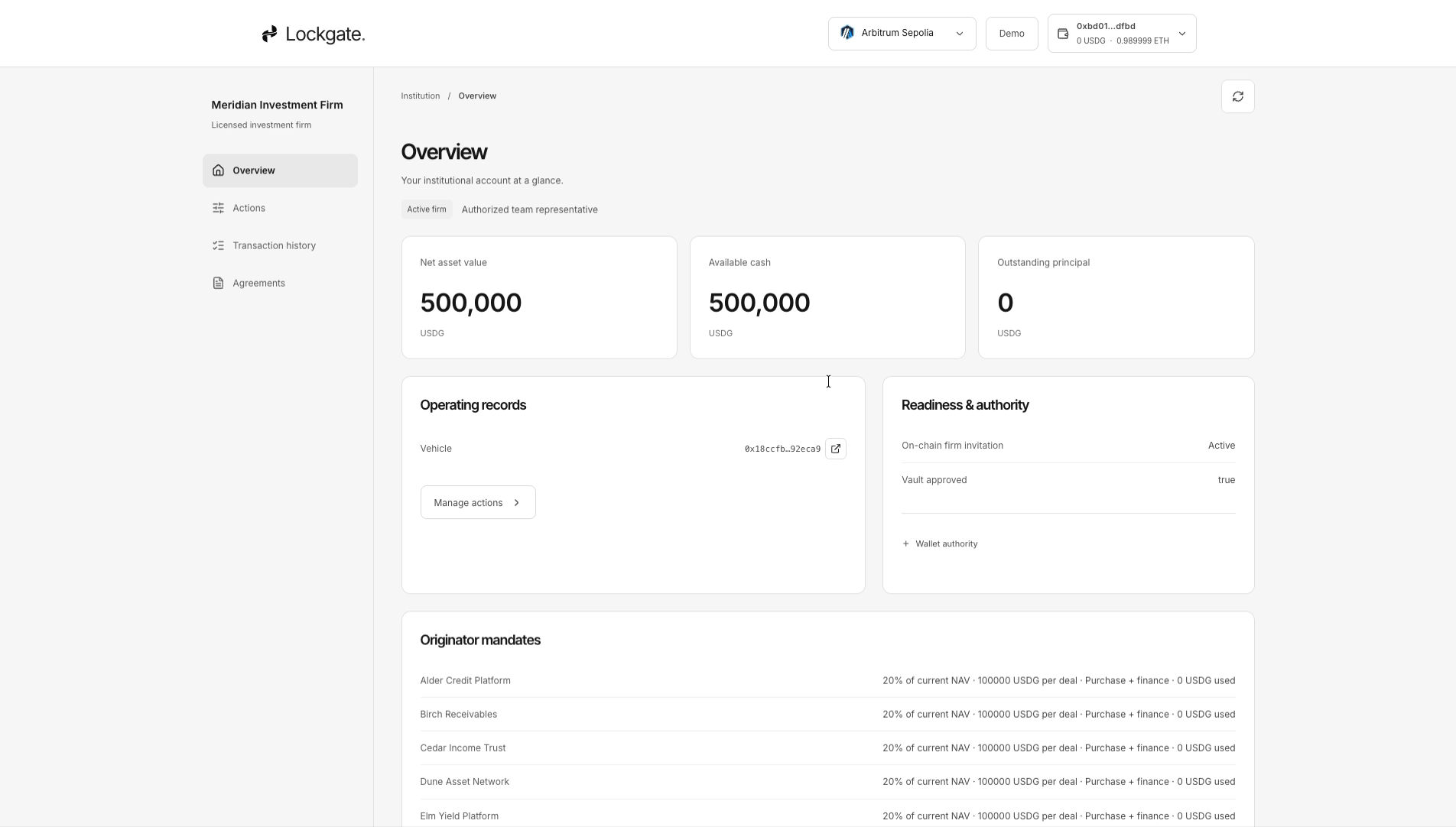
Stage one uses Lockgate's own capital to prove the payout-and-repayment loop. The proposed second stage lets eligible providers fund firm-managed vehicles with separate books and mandates. The firm controls deployment of capital; Lockgate supplies the pricing, agreement, settlement and monitoring technology. The commercial model is financing income on own-book advances, followed by technology fees for partner-operated infrastructure. Each facility has agreed pricing, underwriting criteria and a defined capital mandate. For scale only, $250,000 at 70% utilization and 9% annualized financing income produces about $15,750 gross per year before losses and costs; this is an illustration, not a forecast.
WHY ARBITRUM AND USDG
The existing credit-line contracts are deployed on Arbitrum Sepolia and use Paxos-issued testnet USDG for funding, payout and repayment. OpenZeppelin provides contract primitives and access control. Solidity and Foundry power the contracts and tests; TypeScript, React and viem connect the app, pricing engine and deployment tooling. Arbitrum is the intended settlement hub for repeatable credit exits. Authorized USDG issuance and supported cross-chain funding are expansion plans, not completed integrations. No Lockgate token is issued, and USDG balance rewards are not assumed in the economics.
VALIDATION AND DIFFERENTIATION
I researched and validated the problem before building Lockgate, as a solo founder during the Buildathon. Platform discussions established the operating and licensing constraints; investor conversations revealed how holders handle delayed exits; public-chain analysis measured actual redemption waits and secondary-market discounts. This evidence drove the shift from a general token-buying concept to a platform credit facility with explicit obligations and eligibility controls. Lockgate combines an exact investor payout with an accountable funding obligation, explicit mandates and repayment tracking. It targets scheduled liquidity gaps; it cannot make an impaired loan solvent.
WHAT JUDGES CAN VERIFY
Public app: https://open-house.lockgate.finance
Website: https://lockgate.finance
Arbitrum Sepolia credit line: https://sepolia.arbiscan.io/address/0xd80B6cD54Af98eEc49300259762c483d60F90111
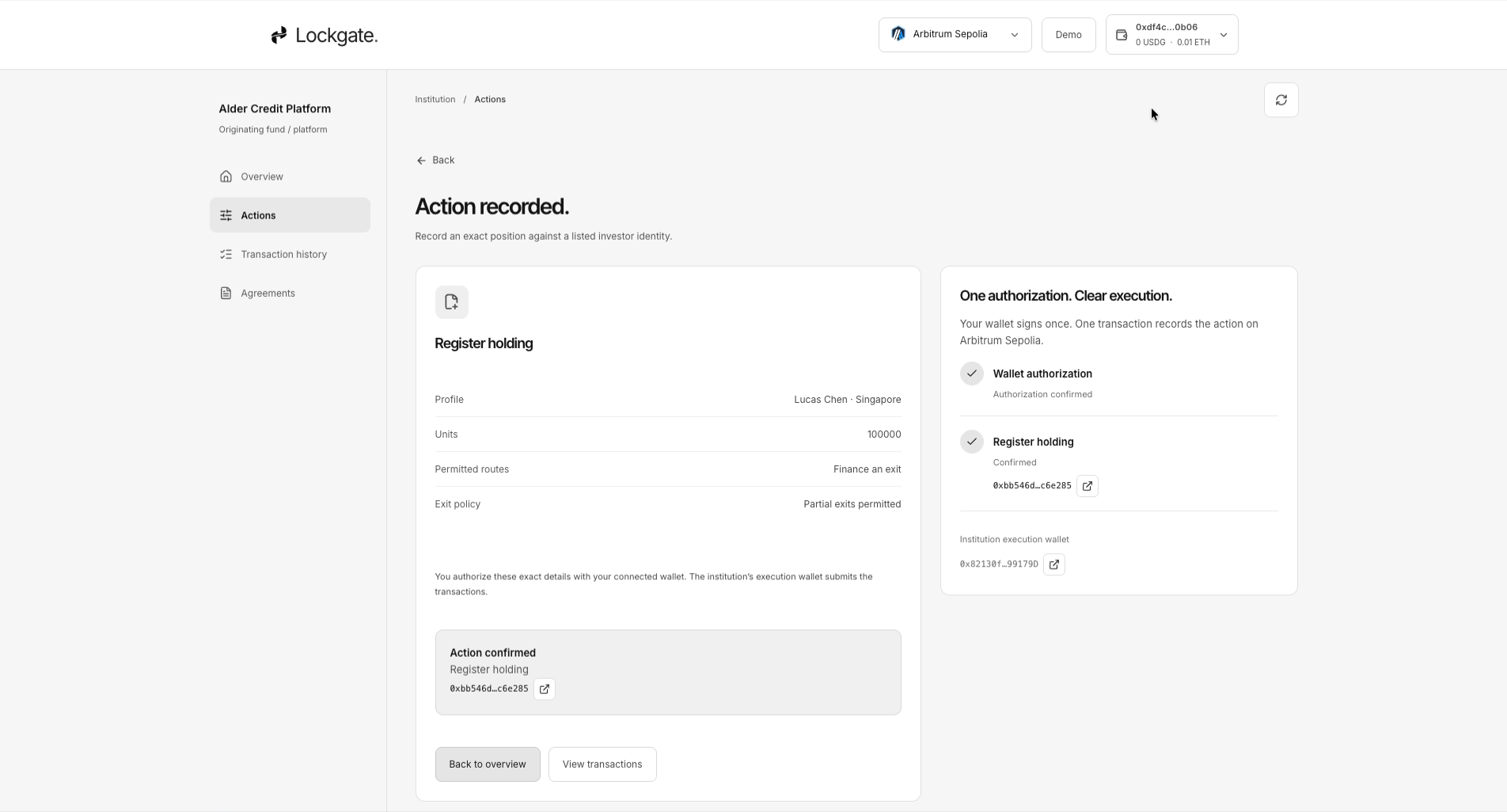
The public app reads deployed testnet balances and links to contract details. The newer identity, purchase/financing and firm-vehicle flows are demonstrated in a separate local TEST environment. The public app and linked addresses show the Arbitrum Sepolia USDG deployment.
NEXT STEPS
The next milestones are a narrowly scoped platform pilot, underwritten capital deployment and production rollout. TOKEN2049 outreach is focused on pilot scoping, issuer introductions and capital partners, with independent security and legal review built into the release process.
The entire product was researched, validated and built from scratch by me, Gabriel Antony, during the Buildathon. Lockgate is a solo-founder submission.
RESEARCH → VALIDATION → PRODUCT
27–28 September: researched redemption queues and tokenized-credit exits, developed the first concept and presented it for feedback.
28 September–1 October: conducted platform and investor discovery. Platform feedback on operating and licensing constraints drove the shift from token buying to a platform financing facility. Holder conversations informed the early-exit choice, exact payout and agreement flow.
1–2 October: implemented the Solidity credit line, platform reserve, pricing engine, queue-platform factory, partner vaults, router and credit-facility modules. Built the TypeScript engine, simulations, deployment harness and verification suite covering access control, stale NAV, exposure caps, settlement ordering and late repayment.
2 October: deployed own-book and partner rails on Arbitrum Sepolia with Paxos-issued testnet USDG. Analyzed redemption demand, observed wait times and secondary-market discounts to ground product and pricing decisions in dated chain evidence.
3–4 October: built investor, issuer, operator and partner journeys, with signed transaction evidence in local test environments. Published the Sepolia-facing app at https://open-house.lockgate.finance. The newer local TEST demo covers identity binding, exact agreements, purchase and financing routes, provider subscriptions and firm/originator workspaces.
CUSTOMER DEVELOPMENT AND ACQUISITION
Researched 162 distinct qualified prospects across ten lists. Historical campaign records contain 38 outreach touches across email, X, Telegram and Discord. The retained TOKEN2049 app census covers 22 people messaged and five replies, including four expressions of meeting interest or availability. The combined seven-day audit records at least 11 people replying across channels; these figures have overlapping scopes and are not added together.
Prepared 15 priority-contact dossiers and a focused Singapore plan: scope a platform pilot, meet capital and distribution partners, and turn relevant introductions into defined next steps. Customer dialogue directly shaped the product before implementation.
CONFIDENTIAL JUDGE EVIDENCE
Detailed conversations, reply text, outreach timelines, product decisions, prospect inventories and TOKEN2049 acquisition plans: https://open-house.lockgate.finance/judges
Password shared separately with the judging team. Client material is kept off the public project page and GitHub.
Built during the event: contracts, pricing/proposal engine, React/TypeScript app, website, simulations, deployment tooling and end-to-end tests. OpenZeppelin and other third-party libraries are dependencies. Demo and pitch videos are the remaining submission media.
Bootstrapped by solo founder Gabriel Antony. The next commercial milestone is an underwritten platform pilot, followed by pre-seed fundraising to scale capital deployment and partner-operated infrastructure.