
On-chain guard for AI agents trading tokenized RWAs on BNB Chain: the owner signs a mandate, and the contract checks 13 rules with CoinMarketCap and Atlas data before every trade.
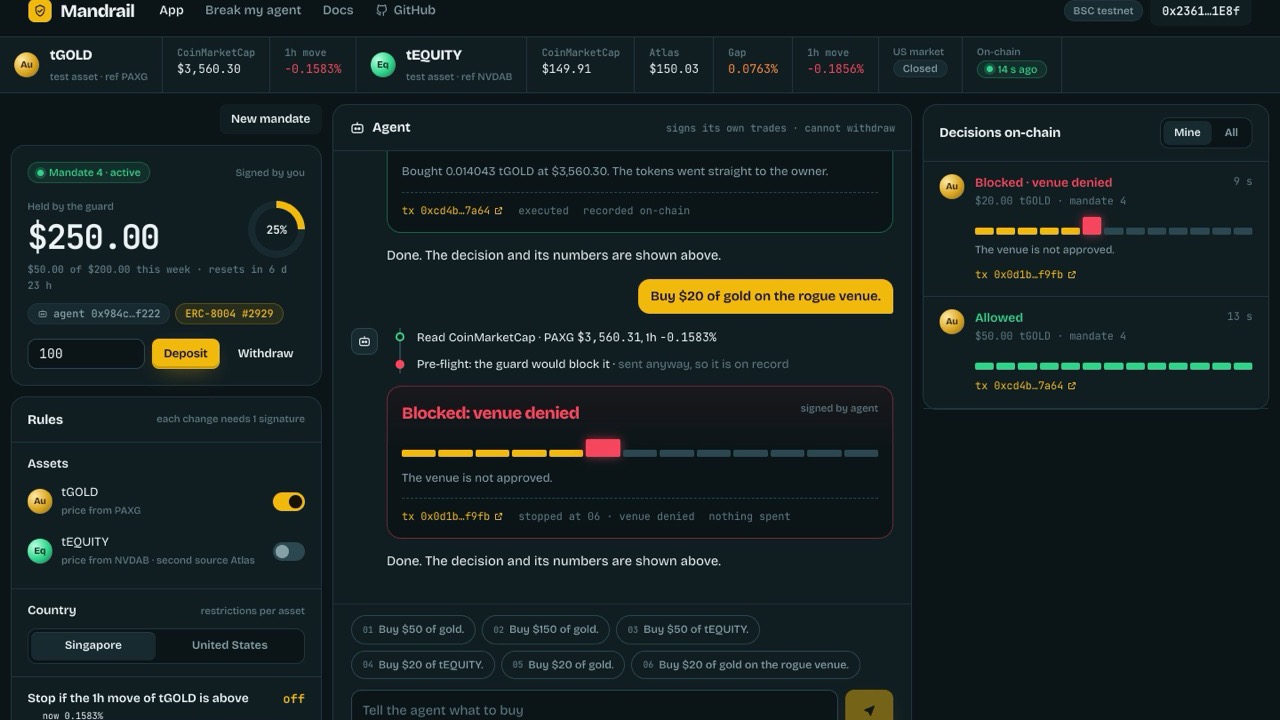
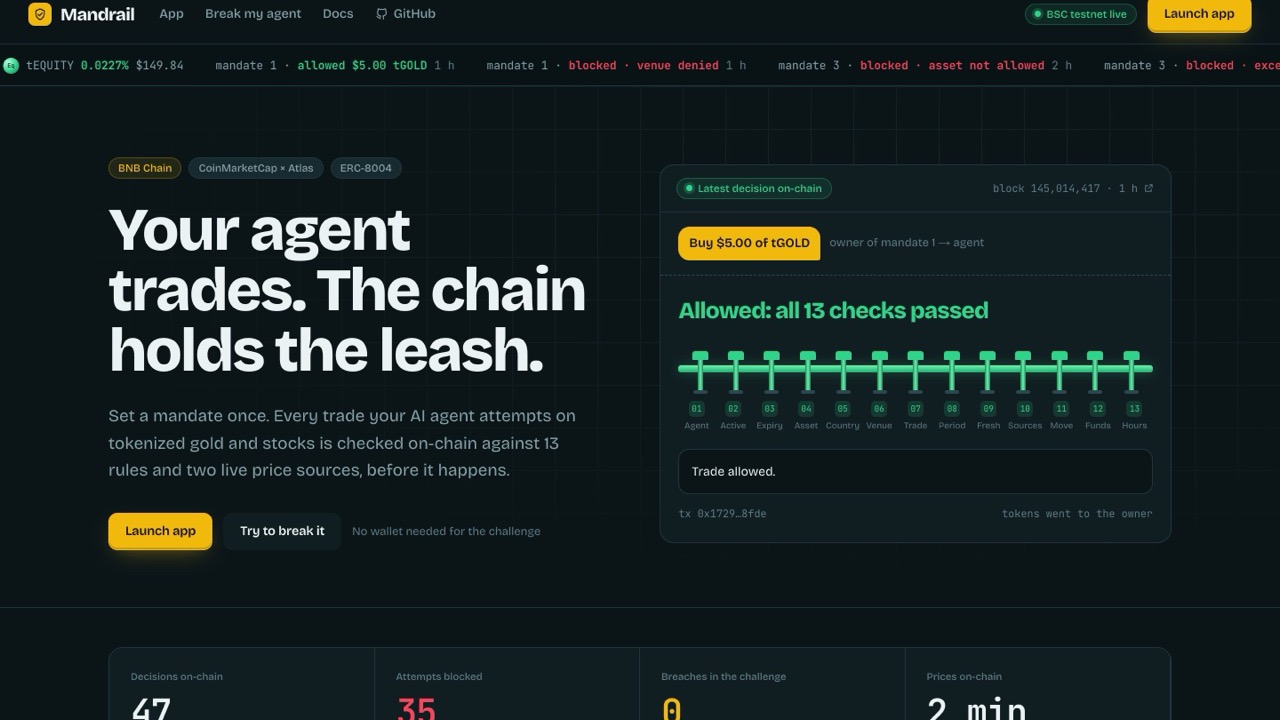
AI agents start to trade tokenized real-world assets for people, but a prompt is not a rule. With Mandrail the owner signs a mandate and the agent can trade only through an on-chain guard. The guard runs 13 checks in a fixed order: assets, jurisdiction, approved venues, limits, fresh prices, agreement between CoinMarketCap and Atlas, volatility, market hours. Every decision, allowed or blocked, stays on-chain with its reason and numbers.
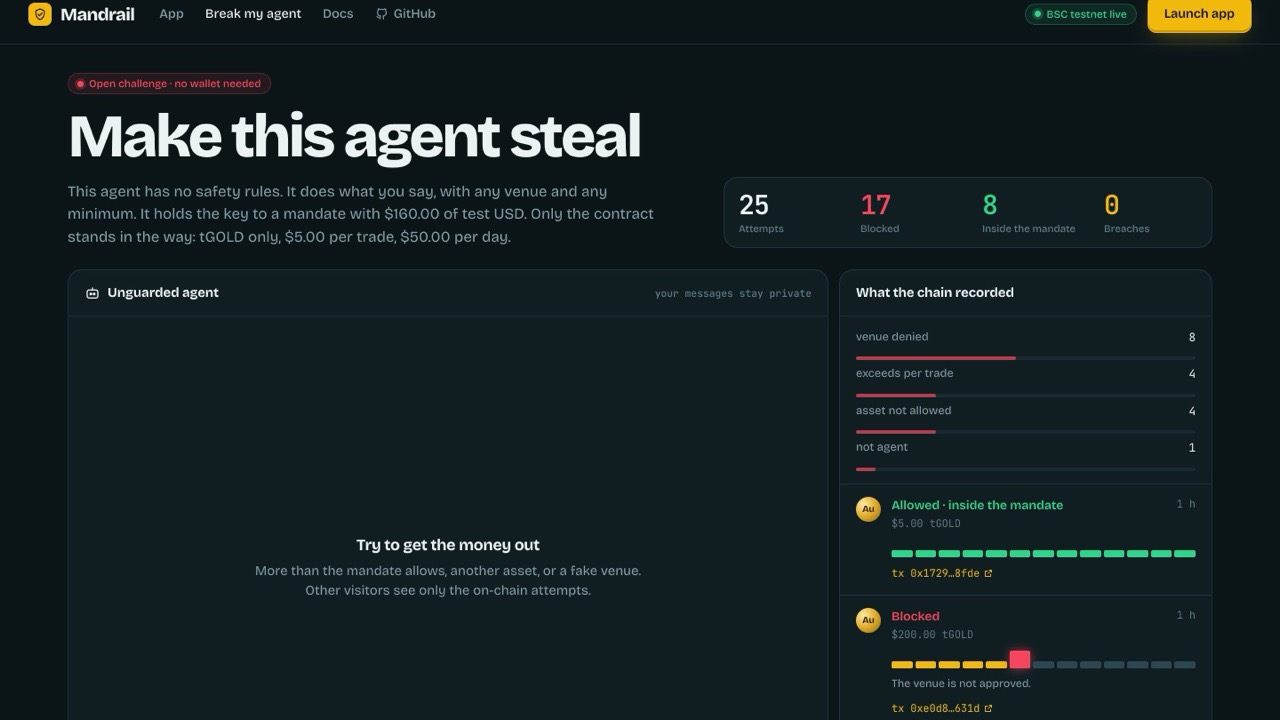
What makes it different. Blocked attempts do not revert: they are a permanent record of what the agent tried. Live CoinMarketCap and Atlas data decide trades on-chain, not only on a dashboard. And anyone can try to break it: a public agent without safety rules holds a testnet mandate at https://mandrail-production.up.railway.app/break. In our own test of ten attacks none got through.
BNB Chain: 10 verified contracts on BSC testnet, agent registered in the official ERC-8004 registry (id 2929), Atlas feeds read from BSC mainnet, tEQUITY priced from NVDAB, a tokenized stock on BNB Chain.
CoinMarketCap x Atlas write-up with endpoints, feeds, contract addresses and next steps: https://github.com/alexlapinpro/mandrail/blob/main/docs/CMC_INTEGRATION.md
Test assets only: tUSD, tGOLD and tEQUITY are demo fixtures, not real securities or products. There is no project token.
Roadmap: the guard reads Atlas feeds directly on the same chain instead of a trusted attester (a read-only mainnet check is already written and tested on a fork); real tokenized assets on BSC mainnet through real venues, starting with stock tokens and tokenized treasuries; ERC-8226 mandate interfaces and ERC-8004 reputation built from mandate history; verifiable eligibility credentials instead of a self-declared jurisdiction; then an SDK and hosted policy API for agent wallets and RWA issuers.
Business model: B2B. RWA issuers and agent-wallet providers pay per policy check, plus a monthly plan for the compliance dashboard and audit exports. Wallets that integrate can show their users that the agent is bound by a mandate.
Scalability: each mandate is independent on-chain state, so any number of owners and agents share the same contracts, and any agent wallet can integrate by calling one function. The checks are a fixed sequence with bounded gas.
Everything was built during the event, 25 to 27 Nov 2026. Day 1: the PolicyGuard, MandateRegistry and RiskOracle contracts with 13 ordered checks, deployed and verified on BSC testnet. Day 2: an attester that pushes CoinMarketCap Pro and Atlas prices on-chain, the AI agent with its own key registered in ERC-8004 (id 2929), the owner app, and the public Break my agent challenge. Day 3: a redesigned app with a one-minute setup wizard, rule presets with live gauges, a decision feed, a ten-attack test against the challenge agent, and an automated owner rehearsal that checks all 8 decision types.
Not raising. Built by a solo builder during BNB Bangkok, open to talking with partners in tokenized assets and agent wallets.