
Payments infrastructure for the borderless economy. One integration, local-currency pricing, stablecoin settlement, payouts in minutes.
Payment infrastructure for borderless ecconomy, built on Arbitrum and Robinhood Chain.
Merchants price in their local currency and get paid in a stablecoin. Payers bring whatever crypto they hold. Mayarin sits between the two, so the merchant never has to understand wallets, swaps, gas or finality. YOUR BUSINESS A WORLD OF WAYS TO PAY.
Live on testnet: https://mayarin.xyz
Accepting money across borders is still slow and expensive. Cards take 2–3% plus cross-border and FX fees, chargebacks put the risk on the merchant, and international transfers take days to settle. Customers who are paid in crypto, or who live where card and banking access is limited, are left out entirely.
Stablecoins fix the settlement itself. A dollar-pegged token moves globally in seconds for cents, the payment is final once it confirms, and the amount the merchant invoiced does not move. Supply is around $300B, and the biggest payment companies are already building on them.
- Fast and global. The same payment works from any country, around the clock, with no correspondent banks.
- Cheap. A payment on an Arbitrum chain costs cents, not a percentage of the sale.
- Final. No chargebacks after settlement, and no reserve held back by a processor.
- Programmable. Escrow, payouts and per-call billing for AI agents can be written into the payment itself.
The rails exist, but merchants still cannot use them. Prices are local. Customers hold many different assets on many chains. Merchants want one stablecoin. Without a clearing layer in between, every merchant becomes a payments engineer.
- Responsibility is scattered. The merchant's application ends up owning the checkout UX, wallet connection, rate quotes, swaps, gas, waiting for finality, and reconciliation.
- There is no single source of truth. On-chain evidence, payment state and accounting live in three places. They drift apart, and someone reconciles them by hand.
- Buyers have no protection. Finality cuts both ways: with no chargeback, a buyer who never receives the goods has nowhere to go.
- A new kind of payer has arrived. An AI agent cannot open an account, hold a card or manage gas, but it still needs to pay for each API call it makes.
Stablecoins already move trillions of dollars, but very little of that is real commerce. Issuance, reserves and distribution are solved. What is missing is the merchant's side: a way to take any asset in and pay out exactly what was invoiced.
Mayarin is one clearing layer between a local price and a stablecoin payout.
1. The merchant prices in SGD, USD, EUR, JPY, CNY, MYR, GBP, SAR or any other supported local currency.
2. The customer chooses which asset to pay with: ETH, USDC, USDG, PYUSD, EURC, or any payer asset the merchant has configured.
3. Mayarin locks the quote, so the merchant's payout cannot come in below the invoice.
4. Mayarin swaps on chain through Uniswap when the payer's asset differs from the settlement asset. The swap is exact-output and priced backwards from the invoice, so the merchant gets the exact amount or nothing moves.
5. The merchant receives the stablecoin it chose for that chain: USDG on Robinhood Chain, USDC or PYUSD on Arbitrum.
6. The records line up. Every payment produces on-chain evidence, a clearing event trail and balanced double-entry ledger postings.
Robinhood Chain is an Arbitrum Orbit L2 built for tokenized real-world assets. It launched on 1 July 2026 with USDG as its first natively issued stablecoin. USDG is issued by Paxos and backed by the Global Dollar Network, whose members include Robinhood, Kraken, Galaxy and Anchorage.
That gives Mayarin the settlement layer it needs:
- A regulated stablecoin, issued natively on the chain, for merchants to settle in.
- Cents per payment and fast finality. The quoted number does not move between checkout and settlement.
- One codebase on both chains. Robinhood Chain is Arbitrum technology, so every Mayarin contract is deployed at the same address on Arbitrum Sepolia and Robinhood Chain.
Each merchant chooses a settlement asset per chain: USDG on Robinhood Chain, and USDC or PYUSD on Arbitrum. Both USDG and PYUSD are issued by Paxos, so Mayarin is the merchant-facing layer on top of the Paxos and Arbitrum stack.
Every payment moves through the same pipeline:
Payment intent → Liquidity router → Clearing engine → Double-entry ledger → Settlement → Merchant paid
- Clearing engine. A nine-state machine: CREATED → QR_PARSED → PRICE_LOCKED → PAYMENT_PENDING → ASSET_RECEIVED → CLEARING → SETTLING → SETTLED → SUCCESS, with FAILED reachable from any state that is not terminal.
Every step is idempotent and resumable, and every transition writes an audit event in the same database transaction.
- Money is never a float. Every amount is a bigint count of an asset's minor units, from 2-decimal fiat through 18-decimal tokens. Rates and fees are integers.
- Nothing changes a balance directly. Value moves only through balanced double-entry postings. An unbalanced posting is rejected.
- A webhook is a signal, not the truth. It wakes the engine, which then reads the authoritative state from the chain. A spoofed or replayed webhook cannot settle a payment.
Value can move along three execution paths, chosen per payment:
- Contract path. The payer pays into PaymentRouter, which swaps if needed and pays the merchant in the same transaction.
- Deposit-match. Each payment gets its own counterfactual deposit address from DepositForwarderFactory. A chain watcher waits for the asset to arrive before the payment is cleared.
- x402. An AI agent signs one authorization for an exact amount. Mayarin verifies it, broadcasts it, reads the result back from the chain and clears the ledger before the agent gets its response. The agent needs no account, no API key and no gas.
A crypto payment cannot be charged back, so Mayarin builds protection into the contract layer itself.
- Every protected payment gets its own escrow, created by EscrowFactoryV2. Funds are held until the buyer confirms, or released automatically by a keeper once the protection window ends.
- Disputes are fair to both sides. Opening a dispute requires a bond. An arbiter reviews an evidence thread and can split the funds instead of making an all-or-nothing call.
- The buyer's history counts. A wallet that keeps losing disputes loses access to buyer protection.
- Merchants see everything on a disputes page, and operators work from an arbiter console.
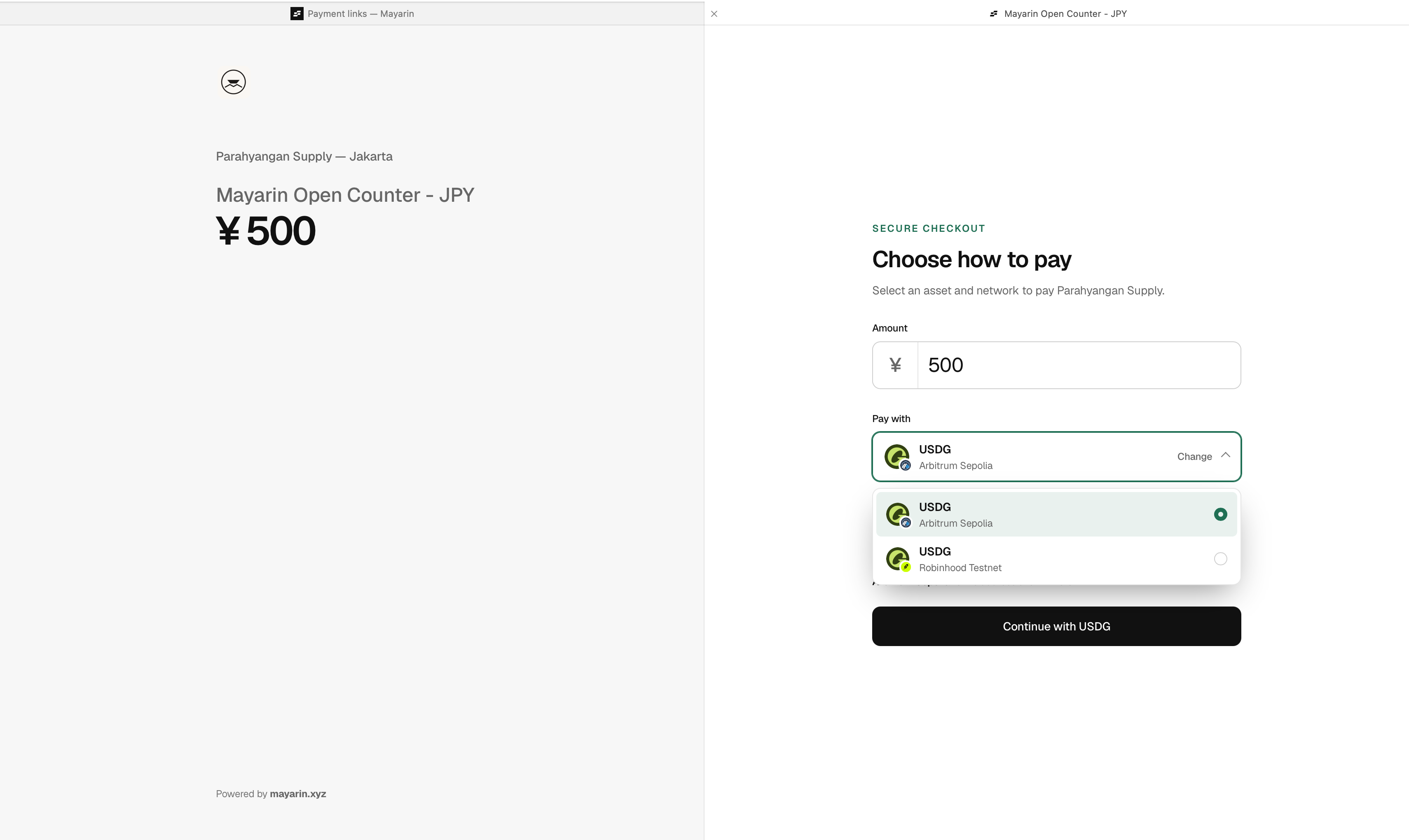
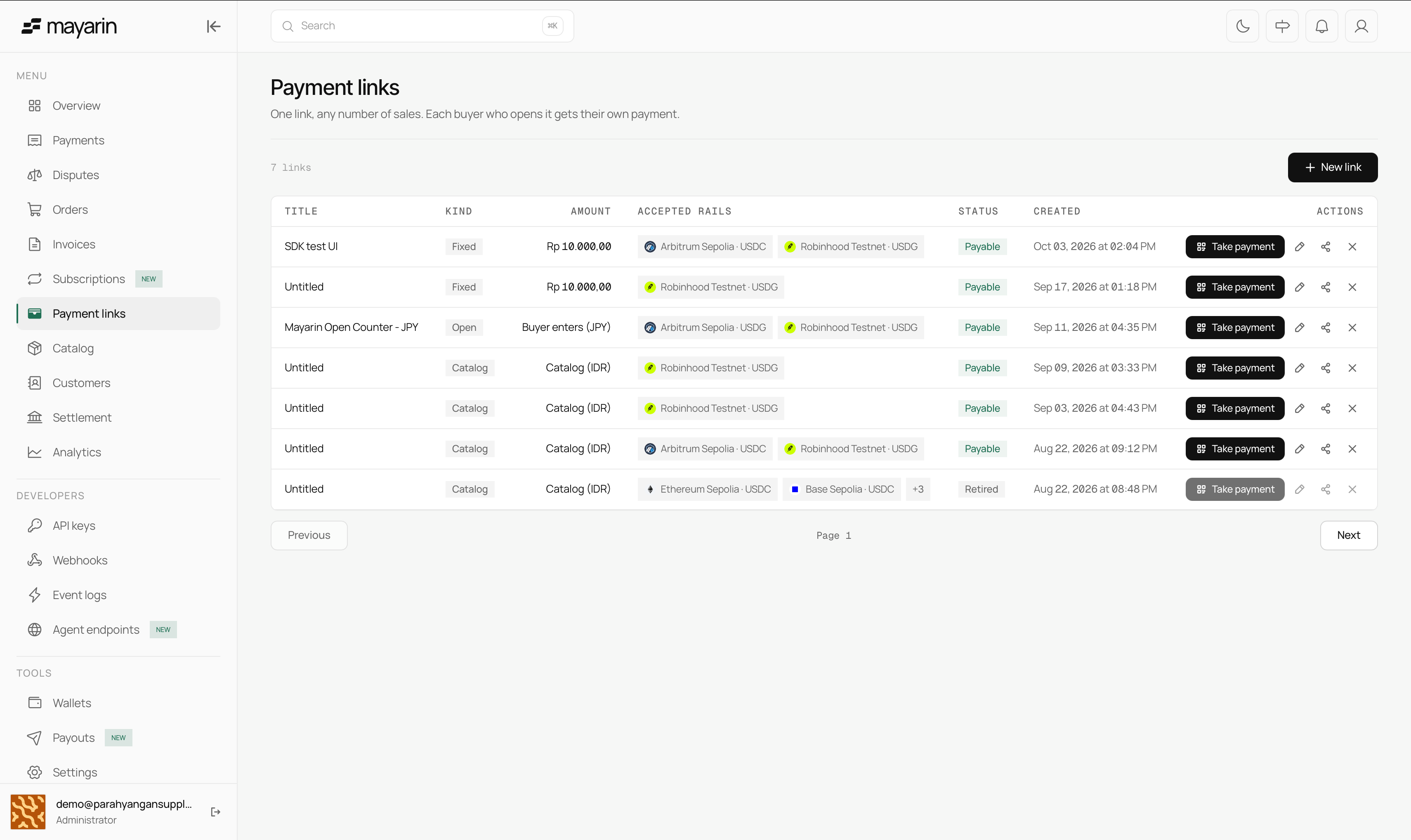
- Hosted checkout and payment links, priced in local currency
- A static QR code for in-person counters, or a code per payment
- Numbered invoices and receipts as PDFs, with the merchant's logo
- Subscriptions billed weekly, monthly or yearly, each cycle paid in any supported asset
- Batch stablecoin payouts to up to 100 recipients in one transaction, through PayoutBatcher
- A managed Safe wallet per merchant. The merchant stays an owner and can remove Mayarin on its own, and withdrawals only go to wallets the merchant has verified
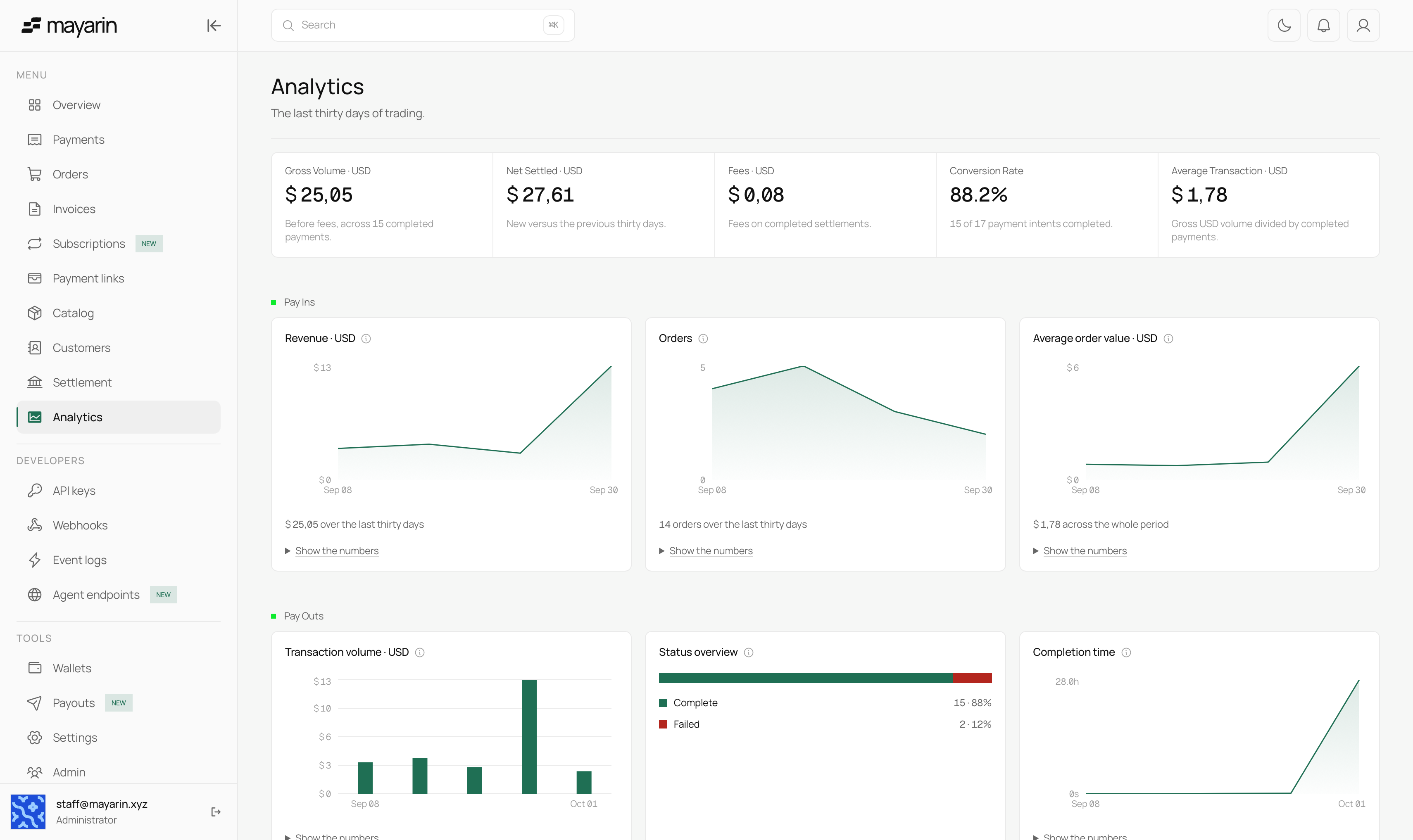
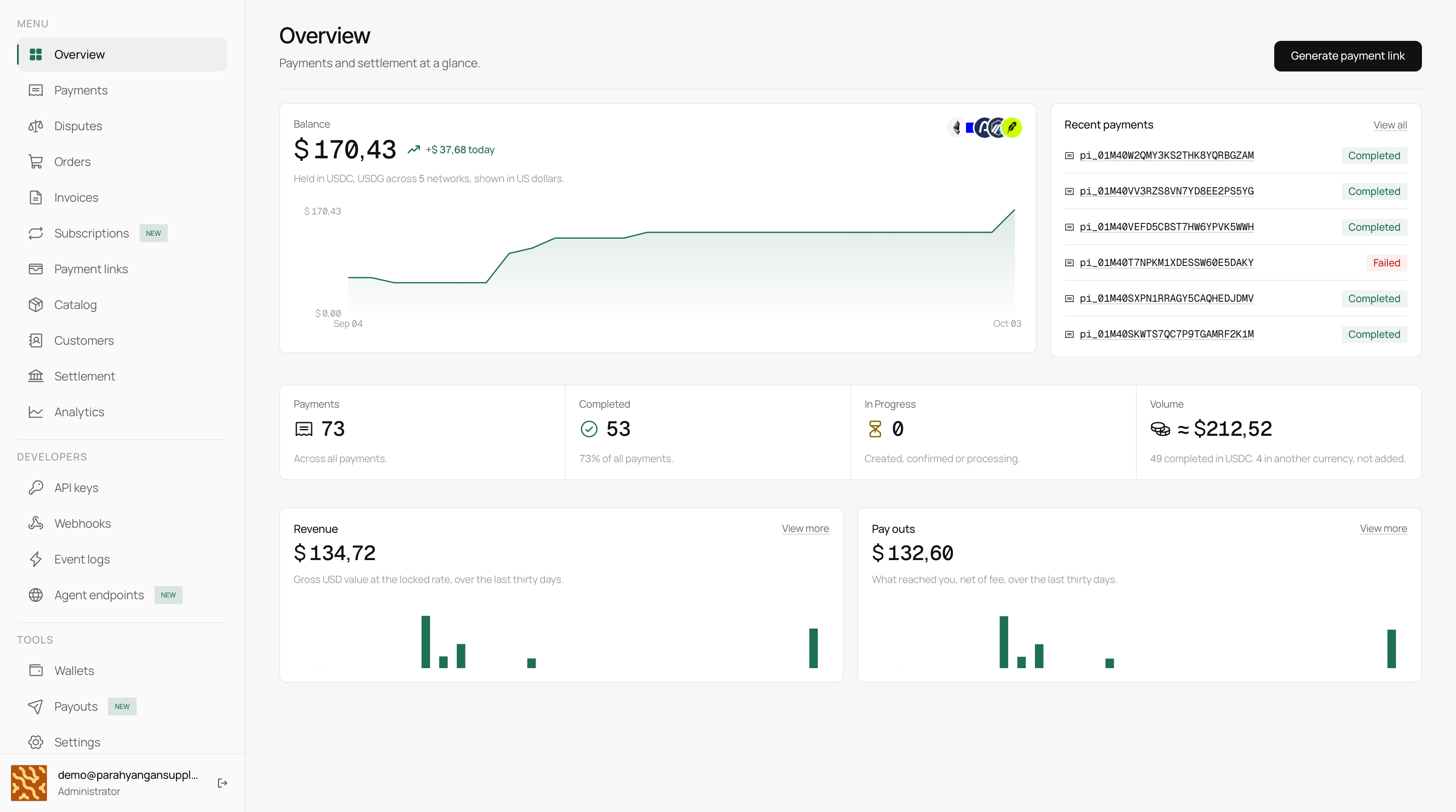
- A dashboard with analytics in USD, CSV export, notifications and "you got paid" emails
- A TypeScript SDK and React components on npm: @mayarin/sdk](https://www.npmjs.com/package/@mayarin/sdk) and @mayarin/react](https://www.npmjs.com/package/@mayarin/react)
- A WooCommerce plugin, and signed webhooks that confirm each order
- E-commerce and retail: checkout in any supported asset, and payouts to sellers and affiliates
- Travel and hospitality: bookings taken at a locked rate
- Gaming: top-ups with no chargebacks, and payouts to players and creators
- Freelancers, agencies and professional services: cross-border invoices and monthly retainers
- SaaS and memberships: recurring billing with invoices and receipts
- Fintech wallets and trading platforms: spend a balance at any merchant, and batch withdrawals
- AI agents and APIs: charge per API call over x402
- And many more
- Private settlement and shielded on Arbitrum: each payment settles to a one-time stealth address only the merchant can link to itself, and a viewing key lets an auditor read the books
- Arbitrum One mainnet launch, settling in USDG, PYUSD and USDC
- Agentic commerce: spending mandates, budgets and agent-to-agent payments
- Treasury and FX: automated conversion and rebalancing across stablecoins and networks
- Everything above runs on testnet. Mainnet is planned and we have 10 waitlist merchants that want to try on mainnet.
- Testnet liquidity pools do not reflect real market depth, so the oracle deviation guard is widened on testnet.
- Fiat rails (QRIS, bank transfer) and the fiat off-ramp are later phases with their own custody setup.
- Arbitrum Sepolia and Robinhood Chain support, with the settlement asset chosen per chain (USDG on Robinhood Chain, USDC and PYUSD on Arbitrum)
- PaymentRouter, TimelockController, DepositForwarderFactory, EscrowFactoryV2 and PayoutBatcher deployed to both chains
- Buyer protection: escrow, dispute bond, split resolution, payer dispute standing, arbiter console and keeper auto-release
- Batch payouts, subscriptions, invoice and receipt PDFs, CSV export, and analytics in USD
- A redesigned checkout, merchant notifications, and an onboarding tour
- @mayarin/sdk and @mayarin/react published to npm