
a quality-proof protocol that anchors cryptographic commitments of industrial inspection results on Arbitrum, using zero-knowledge proofs to verify compliance without exposing proprietary data
PANDU: Trustless Quality Verification
The Problem
Industrial buyers face a fundamental trust problem: how do you verify that a batch of steel, chemicals, or manufactured components actually meets specifications? Today's quality certificates are PDFs that can be forged, databases that can be altered, and audit trails controlled by the very parties being audited.
When a structural failure occurs - a collapsed building, a failed pipeline - tracing accountability through opaque supply chains is nearly impossible. The buyer trusted a piece of paper. The paper lied.
For manufacturers, the challenge is equally significant: they need to prove quality compliance to win contracts, but sharing raw inspection data exposes proprietary processes to competitors.
The Solution: PANDU - Proof of Quality
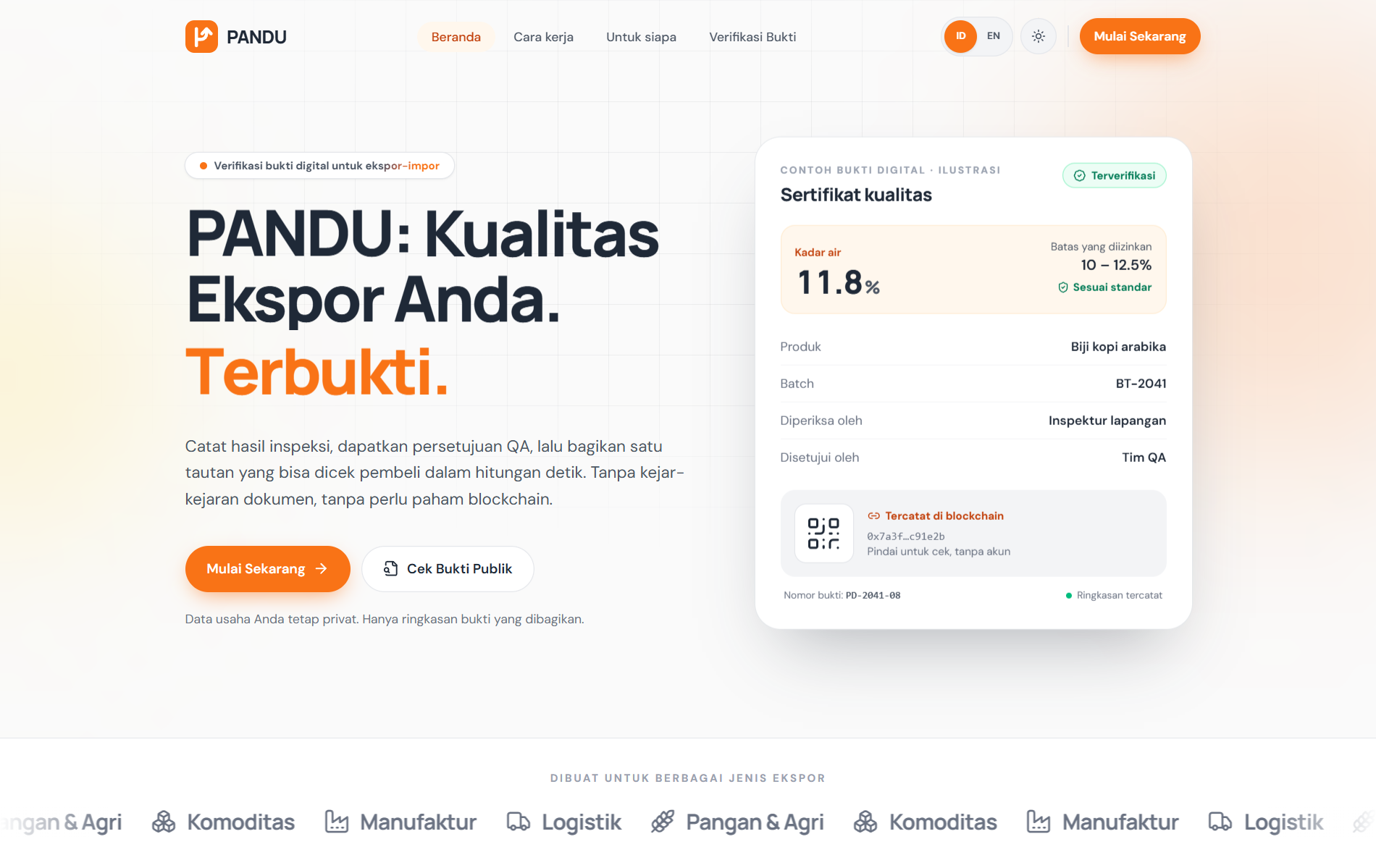
PANDU is a blockchain-powered quality verification protocol designed to make industrial quality claims independently verifiable, starting with manufacturing batch inspections.
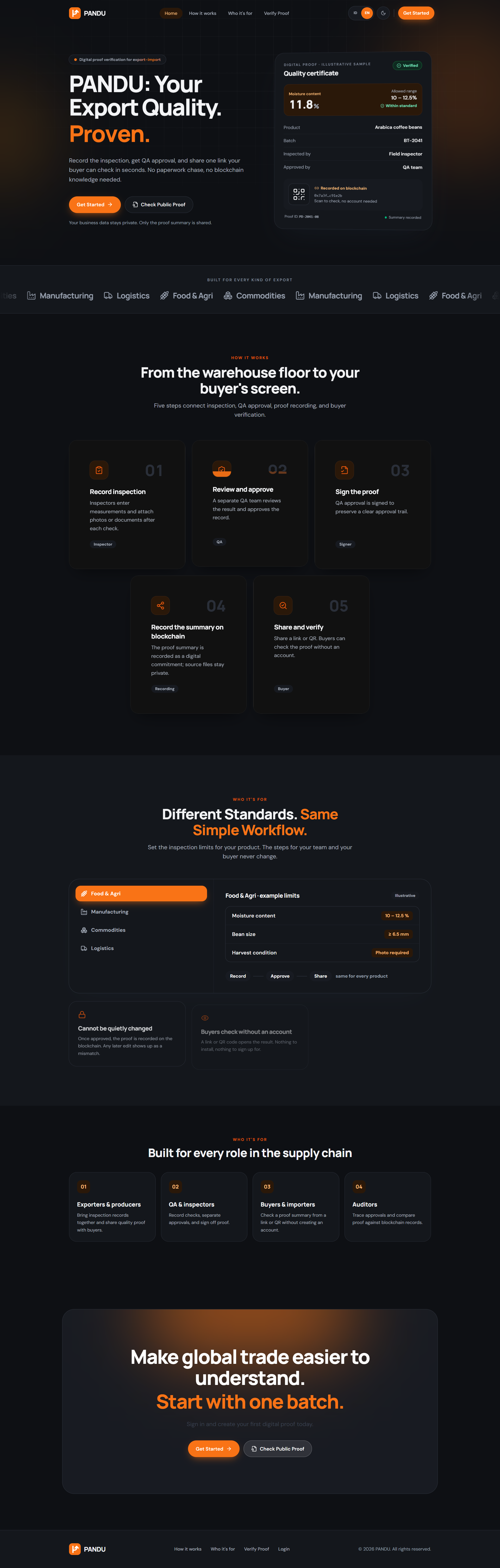
Instead of trusting centralized databases, PANDU creates tamper-evident quality proofs. QC inspectors input batch measurements, evidence documents are encrypted and stored on IPFS, QA managers approve via EIP-712 signatures, and a cryptographic commitment is anchored on Arbitrum.
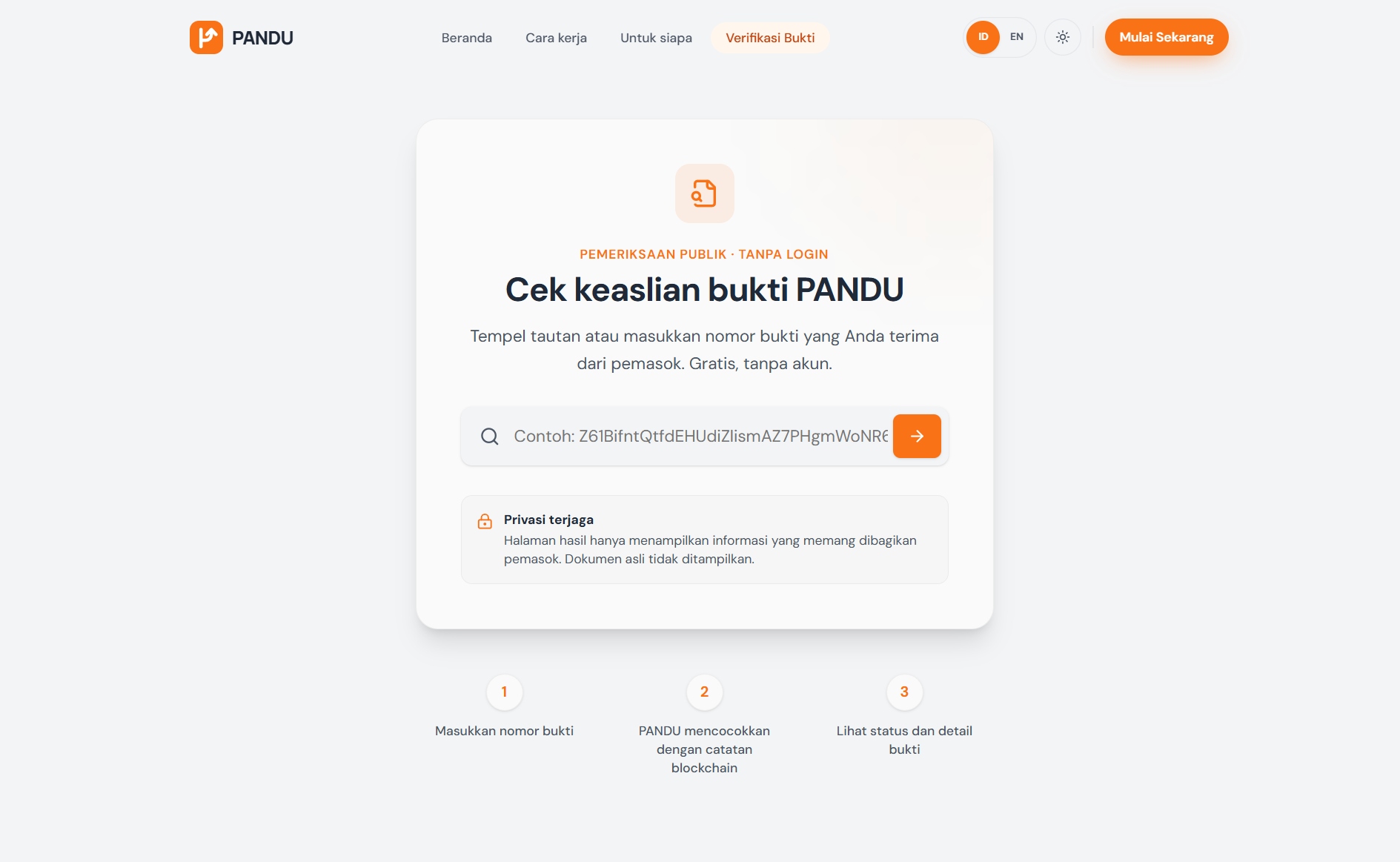
Anyone - buyers, regulators, insurers - can verify onchain that a quality claim was made at a specific time and has not been altered since. No wallet or login required for verification.
By combining client-side encryption, deterministic hashing, and onchain commitments, PANDU aims to make industrial quality claims transparent and accountable. It gives buyers cryptographic certainty about product quality while helping manufacturers prove compliance without exposing trade secrets.
Why Blockchain and Arbitrum?
PANDU uses smart contracts to enforce proof integrity, manage revocation, and record verification outcomes. On-chain commitments make quality claims independently auditable - no single party can alter history.
Built on Arbitrum, PANDU leverages low transaction costs for frequent proof anchoring while inheriting Ethereum's security. The goal is to make onchain quality verification economically viable for high-volume industrial use cases.
Zero-knowledge proofs via RISC Zero take this further: verifiers can confirm that inspection criteria were met without accessing the underlying proprietary data at all.
Progress During Hackathon - From Blueprint to Protocol
Starting from the Blueprint
We began with the PANDU Master ERP Blueprint v1.5, a comprehensive specification for an industrial quality and traceability ERP with an independent blockchain verification layer. The blueprint defined the product scope, smart contract interface, MVP roles, and a deterministic 3-minute demo flow.
Our first task was translating this specification into working code - not just reading the blueprint, but questioning every assumption in it.
Smart Contract Development
We developed PANDUQualityRegistry.sol implementing the frozen blueprint interface:
- anchorProof with EIP-712 issuer signatures and duplicate prevention
- revokeProof for both direct and gasless (signed) revocation
- getProof, isValid, and verify for public verification
- Role-based access control (Relayer, Issuer, Pauser roles)
- ERC-1271 smart wallet signature support
We wrote comprehensive Foundry tests covering anchoring, duplicate rejection, unauthorized access, revocation flows, and event emissions.
Zero-Knowledge Integration
The blueprint mentioned blockchain commitments but did not specify how to handle data confidentiality. We integrated RISC Zero zkVM to generate proofs that inspection criteria were met without revealing raw measurements.
This was the key innovation: transforming PANDU from a simple "hash on blockchain" system into a privacy-preserving verification protocol.
Frontend and Relayer
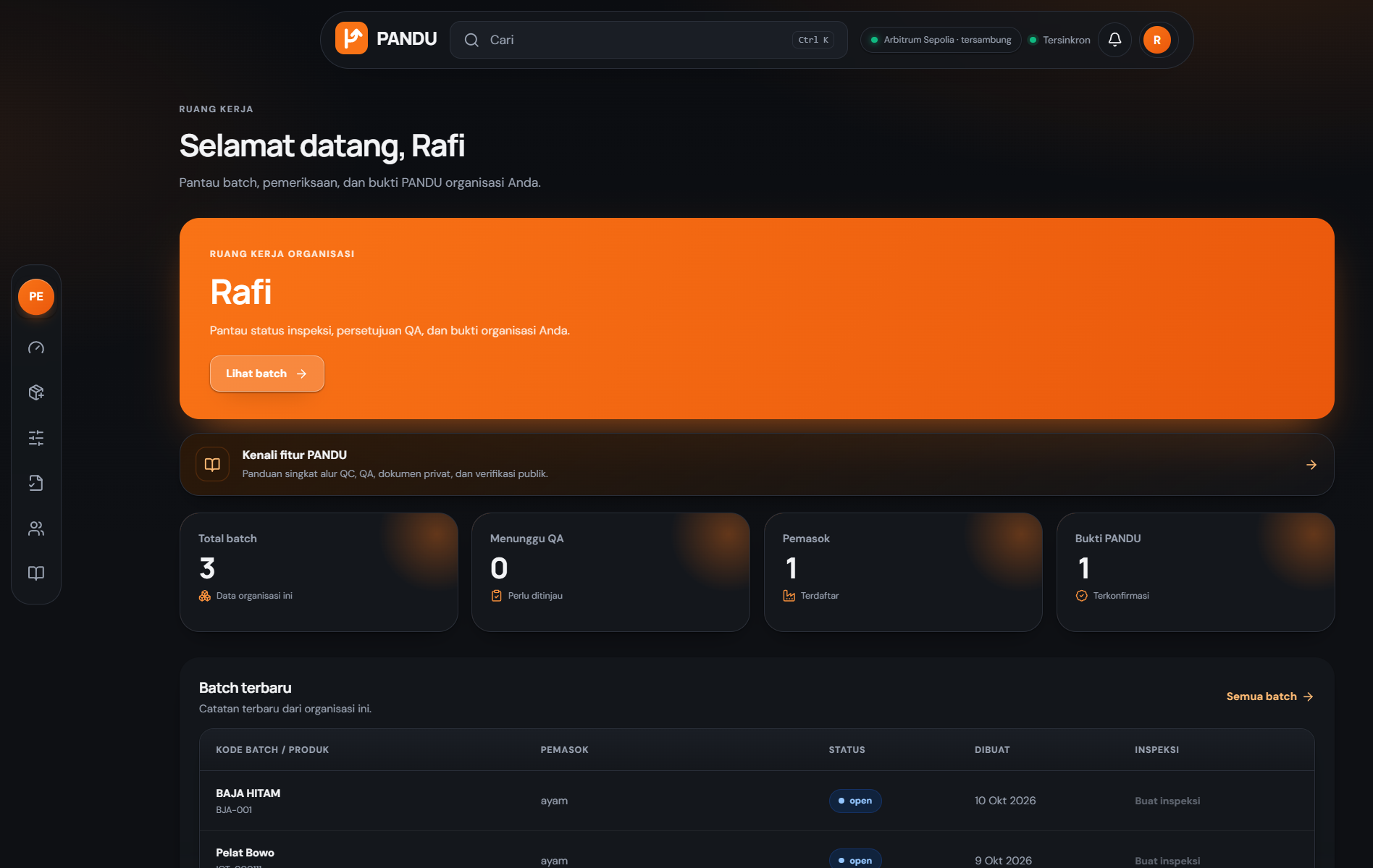
We built the quality proof flow: batch creation, inspection input, evidence upload with client-side AES-GCM encryption, IPFS storage via Pinata, and a gasless relayer service that submits transactions on behalf of users.
What We Learned
The most important lesson is that industrial blockchain adoption is not about replacing ERPs - it is about adding a trust layer that ERPs cannot provide alone. Centralized systems are efficient for operations but cannot offer tamper-evident guarantees.
We also learned that zero-knowledge proofs are not just a privacy feature - they are the key to unlocking blockchain adoption in industries where data confidentiality is non-negotiable.
PANDU is our attempt to bridge the trust gap in industrial supply chains with cryptographic certainty.
Fundraising Status
PANDU is currently in the prototype and development stage. No external funding has been raised for the project so far.
The project is being developed as part of the hackathon, with a focus on validating its core concept: tamper-evident quality proofs with zero-knowledge privacy.
The current priority is to demonstrate a working end-to-end prototype on Arbitrum Sepolia, gather feedback from mentors and industry practitioners, and validate the quality verification workflow before pursuing external funding or a real-world pilot.
Future funding would support smart contract security audits, RISC Zero circuit optimization, user research with Indonesian manufacturers, and development of integrations with existing ERP systems.