
Web3 Decision Intelligence ASP for OKX.AI Simulate any on-chain decision (fees, tokenomics, governance, migrations) against synthetic economic actor personas derived from real on-chain behavior.
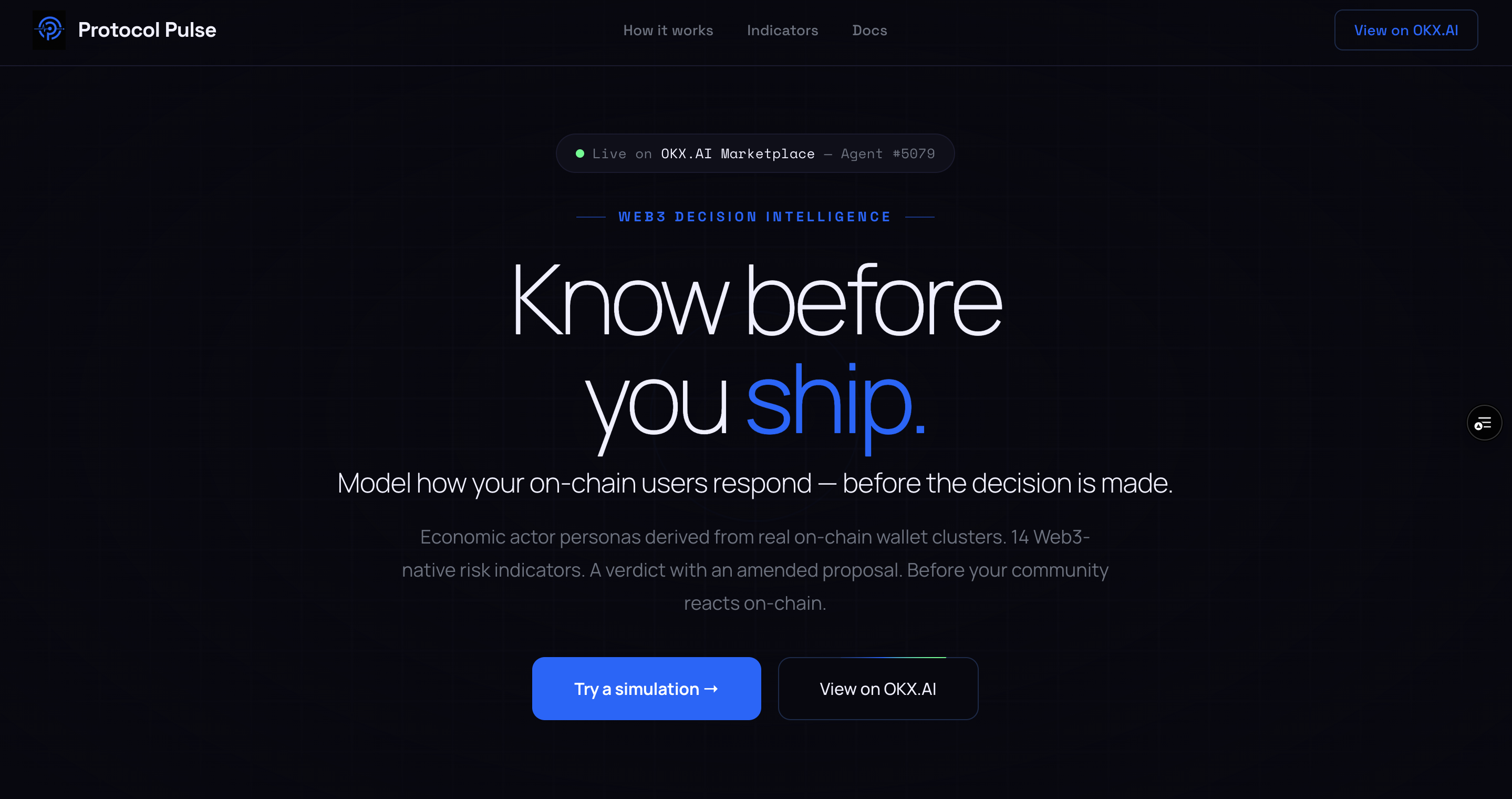
Protocol Pulse simulates how your real on-chain user base reacts to any governance decision — before you ship it. Feed it a protocol and a proposed change, and it returns economic actor personas derived from actual wallet clusters, 14 Web3-native risk indicators, a Go/Caution/Pivot verdict, and — if the decision needs work — an amended proposal ready to re-simulate.
Live on OKX.AI as Agent #5079. Live on the web at [protocol-pulse-psi.vercel.app]. Full source on GitHub.
DAOs and protocol teams ship governance decisions blind. A fee change, an emission cut, a collateral parameter update — these get voted on and pushed live, and the team finds out whether it was the right call only after the community reacts on-chain. By then the TVL has already left, the fork has already happened, or the proposal has already failed.
There is no existing tool that answers the question: if we make this exact change, what will our actual users do?
That's the gap Protocol Pulse fills.
You give Protocol Pulse two things: a protocol name and a decision in plain English. For example:
Protocol: Uniswap Decision: "Introduce a 1% protocol fee on all swaps, redirecting 100% of LP fee revenue to the DAO treasury."
Protocol Pulse then:
Pulls real on-chain wallet data for that protocol via subgraph queries and Covalent enrichment
Clusters wallets into economic actor personas — not demographic guesses, but behavioral archetypes derived from actual position size, leverage, governance participation, and wallet age
Simulates how each persona reacts to the specific decision — behavioral prediction, confidence score, capital impact in dollars
Computes 14 Web3-native risk indicators — Liquidity Flight Risk, Cascade Risk, Mercenary Capital Index, Proposal Survival Probability, Competitor Capture Rate, and more
Returns a verdict — GO, CAUTION, or PIVOT — with a plain-English rationale
If PIVOT, generates an amended proposal optimized to reduce the exact risks identified, ready to re-simulate
The output isn't a static report. It's a decision-ready deliverable, formatted as markdown, delivered directly through the A2A conversation.
Three layers, cleanly separated:
NestJS Backend (Orchestration)
    ↓ ↑
Python ML Engine (Intelligence)
    ↓ ↑
OKX.AI A2A Agent (Marketplace Interface)Subgraph queries against Uniswap V3 and Aave V3 deployments on Arbitrum One, ordered by liquidity/position size rather than arbitrary ID, so the wallets discovered are actually active participants, not dust
Covalent enrichment — parallel, batched, rate-limited requests that pull token balances, LP positions, and transaction history per wallet, with retry-on-429 backoff
Stratified sampling — wallets are bucketed into Whale / Shark / Retail tiers by position size, then sampled proportionally so the persona clustering downstream isn't skewed toward either whales or dust
Dust filtering — wallets below a meaningful USD threshold are excluded before clustering so they don't dilute the signal
Protocol-native persona blueprints — Uniswap generates Market Makers, MEV Searchers, Yield Chasers, and Governance Delegates. Aave generates Stablecoin Loopers, Institutional Depositors, Liquidators, and Conservative Lenders. The persona taxonomy itself changes based on the protocol's actual economic structure, not a generic template
Rich behavioral context per persona — each persona carries a primary economic objective, a yield exit threshold, a likely migration target, governance participation level, and a historical behavior summary — not just a fee-sensitivity float. This is what lets the simulation reason like "this persona exits when APR drops more than 7%, has migrated to Aerodrome before, currently carries 2.3x leverage" instead of a vague sentiment score
Per-persona behavioral simulation — each persona's reaction is predicted individually: hold, withdraw, migrate, sell, vote against, or de-risk, each with a confidence score and a dollar-denominated capital impact
14 indicator computation — pure statistical aggregation across all persona predictions, weighted by cluster size so a whale's reaction counts more than a thousand retail wallets
Verdict engine — threshold-based Go/Caution/Pivot logic, followed by LLM-generated rationale and, on Pivot, an amended proposal specifically targeted at the highest-risk indicators
Runs as a persistent process on a dedicated server (not a laptop, not a serverless function that sleeps)
Polls the OKX.AI marketplace for incoming task requests via the XMTP-based okx-a2a daemon
Parses natural-language task descriptions into structured protocol/chain/decision parameters using an LLM call
Applies for the task, triggers the simulation pipeline, polls for completion, and delivers the formatted markdown report back through the same A2A channel — fully autonomous end to end
Also exposes an MCP-compatible endpoint with x402 payment support, so other agents can call simulate_proposal directly as a paid tool call, not just through conversational negotiation
Run a real, aggressive Uniswap proposal — a 1% flat protocol fee redirecting 100% of LP revenue to treasury — and watch:
Personas generate live: Professional Market Maker, MEV Searcher, Governance Delegate, Yield Chaser, each with real position sizes pulled from Arbitrum
The simulation feed scrolls through individual persona reactions in real time
The verdict drops: PIVOT. $205,038 in modeled liquidity flight risk within 7 days. Mercenary Capital Index at 54.7% — over half the capital base is purely yield-driven and will leave. Proposal Survival Probability at 73.7%
Protocol Pulse doesn't stop at "no." It generates an amended proposal — a tiered fee structure exempting retail flow, grandfathering existing LPs for 30 days — specifically designed to bring the risk indicators back into acceptable range
That amended proposal can be re-simulated with one call, and the before/after indicators are compared side by side
That loop — simulate, verdict, amend, re-simulate — is the part nothing else in the OKX.AI marketplace does. Every other decision-support tool in this space is either a data feed, a verification layer, or a single-shot signal. Protocol Pulse is the only one that argues back.
The obvious version of this product uses an LLM to predict behavior directly and calls it done. That produces generic, unconvincing output — every persona sounds the same regardless of protocol.
The actual hard problem, and the one Protocol Pulse solves, is building the persona intelligence layer correctly: turning raw wallet activity into economic identities with real objectives, real historical behavior, and real exit thresholds — so that the simulation has something specific to reason from. That required:
Fixing subgraph queries to surface active, meaningful wallets instead of arbitrary IDs
Building protocol-specific persona taxonomies instead of one generic set
Separating deterministic clustering (Python, pure math) from LLM-generated narrative (reasoning, rationale) so outputs are consistent and auditable
Building a resilient on-chain data pipeline that survives rate limits, partial failures, and sparse data without silently degrading into fabricated output — the system fails loudly and states its confidence level rather than guessing
Layer | Technology |
|---|---|
Backend orchestration | NestJS, Prisma, PostgreSQL |
On-chain data | The Graph subgraphs (Uniswap V3, Aave V3 — Arbitrum One), Covalent API |
ML / Intelligence | Python, FastAPI, LLM-assisted persona and rationale generation |
Agent runtime | Python agent process, |
Payments | x402 protocol, USDT on X Layer |
Frontend | Next.js, deployed on Vercel |
Infra | AWS EC2, pm2, nginx, Cloudflare Tunnel (HTTPS termination) |
Live on OKX.AI: https://okx.ai/agents/5079
Web demo: [protocol-pulse-psi.vercel.app]
GitHub: [github.com/zeekalph/protocol-pulse]
X post: [https://x.com/Crid_IV/status/2081761417632338166?s=20]
Finance Copilot / Software Services — Web3 decision intelligence for DAOs, protocol teams, and DeFi investors making governance and parameter changes.
Built for the OKX.AI Genesis Hackathon — July 2026