
Quiver
A quant desk for AI agents: ten pay-per-call services — arbitrage-free options analytics, transaction-safety, DEX microstructure, and more — over x402 on X Layer. Desk-grade math an agent can verify.
Videos
Tech Stack
Description
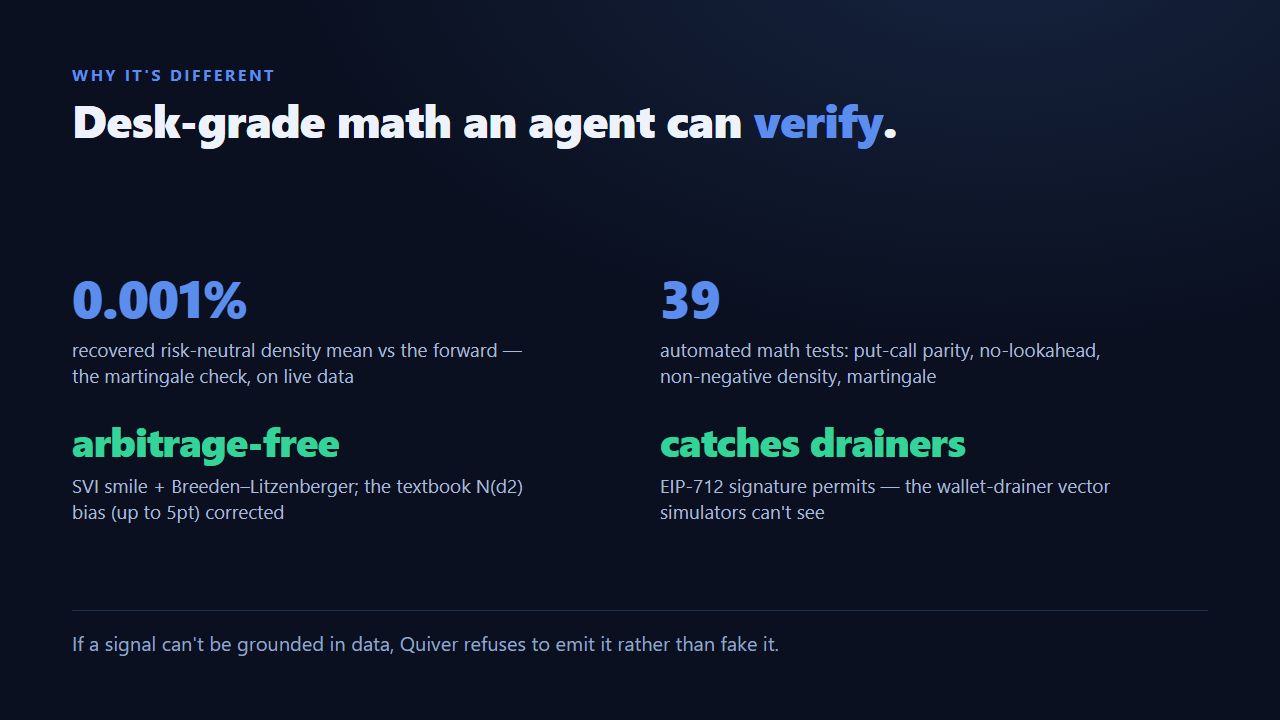
Quiver is a quant desk for AI agents. Autonomous trading and wallet agents can now pay for services in-band over x402, but little worth paying for exists, and most agent-facing tools return numbers that can't be verified. Quiver closes that gap with ten pay-per-call services that implement the methods a real trading desk or security team would run, held to a stated bar: proven by 39 automated tests, grounded in live data, and refused rather than faked when a signal can't be grounded.
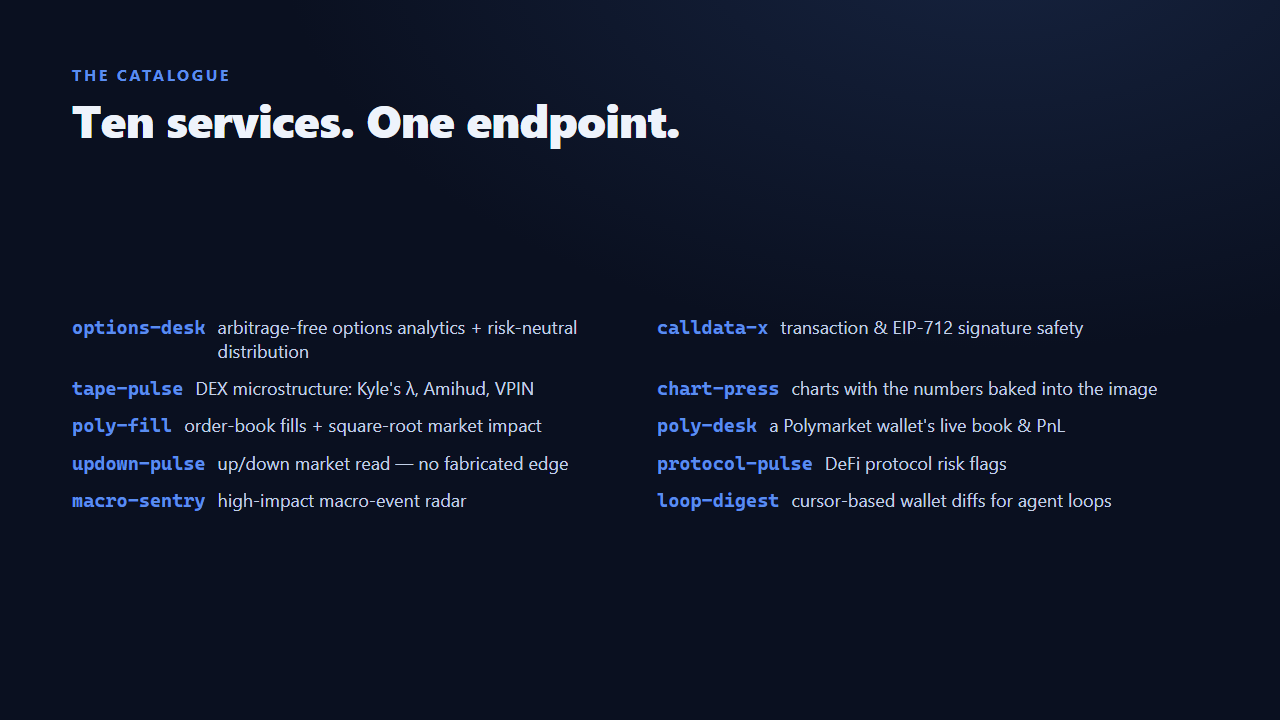
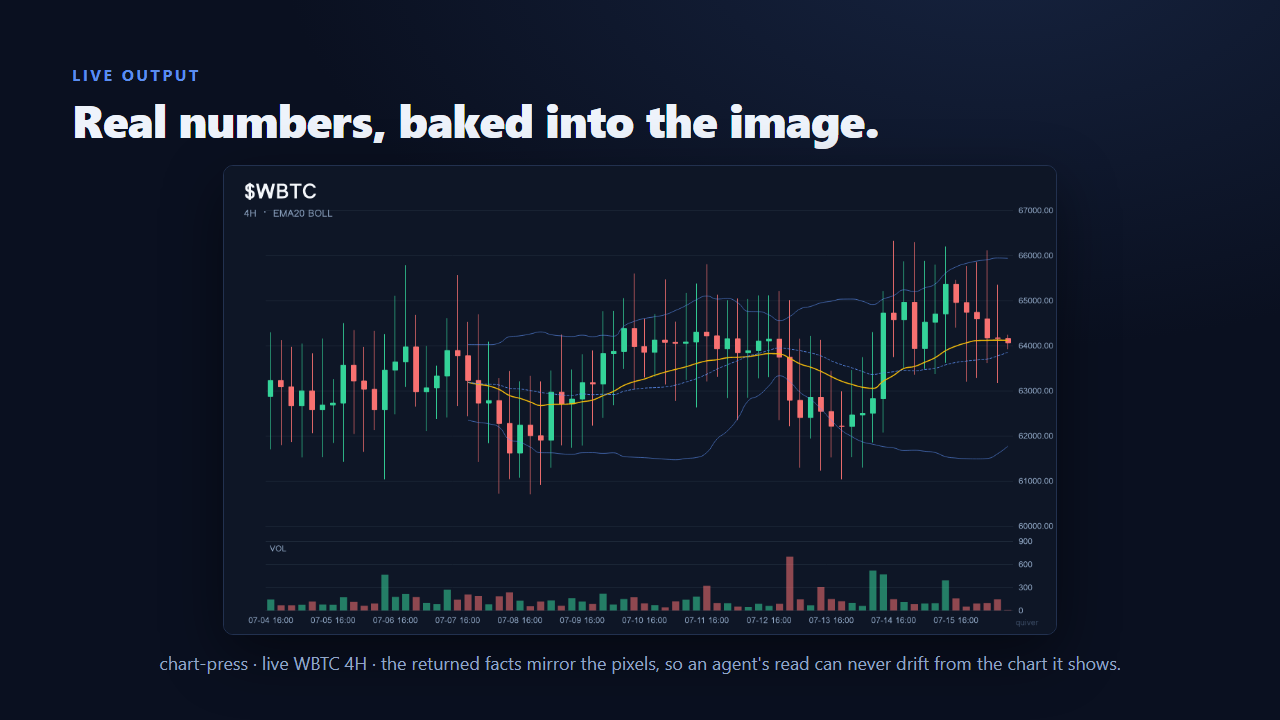
The services span options analytics (an arbitrage-free, Breeden–Litzenberger-correct risk-neutral distribution — its mean reproduces the forward to 0.001% on live data — plus greeks, dealer gamma, variance risk premium), transaction & EIP-712 signature safety (a DANGER/SAFE verdict that catches the wallet-drainer patterns simulators structurally miss), live DEX microstructure (Kyle's λ, Amihud, VPIN), prediction-market execution (order-book fills + square-root impact), DeFi protocol risk, a macro-event radar, charts with the numbers baked into the image, and cursor-based wallet diffs — all from one endpoint.
Registered on-chain as ERC-8004 agent #5152 on X Layer, priced per call over x402, with real paid usage. Full methodology and 66 references: https://quiver-production-c3a8.up.railway.app/paper OR https://drive.google.com/file/d/1FI8P9NW30HvDky8dijjQ9_OYS4rktCFw/view?usp=sharing
Progress During Hackathon
We started from one observation: agents can now pay over x402, but almost nothing is worth paying for, and most agent tools return unverifiable numbers. We vetted candidates against a floor — a real recurring need, an identifiable caller, durability past the demo — and built the ten that survived.
The standard was set higher than a demo needs, and it paid off. The textbook N(d2) probability was the first thing we caught: biased up to five points on a skewed smile, so we replaced it with the Breeden–Litzenberger figure over an arbitrage-free SVI surface. We added EIP-712 signature analysis for the drainer vector simulators can't see. Pointing finished code at live markets exposed more — an illiquidity estimator returned 10⁹ on a memecoin from sub-cent dust; a proxy detector misread USDC — and each was fixed. We locked the math with 39 tests, registered the ASP on-chain (#5152), and built a demo where an AI agent hires Quiver to make a real trade decision.
Fundraising Status
Not fundraising. Self-funded, built for the OKX AI Genesis Hackathon; the ten services are live and generating real pay-per-call revenue on X Layer.