
A deterministic orchestrator that scans smart contracts, simulates attacks, proves every result cryptographically, and stores immutable audit reports on-chain via Stylus on Arbitrum. No LLM override.
RAXC — Autonomous Exploit Intelligence Core
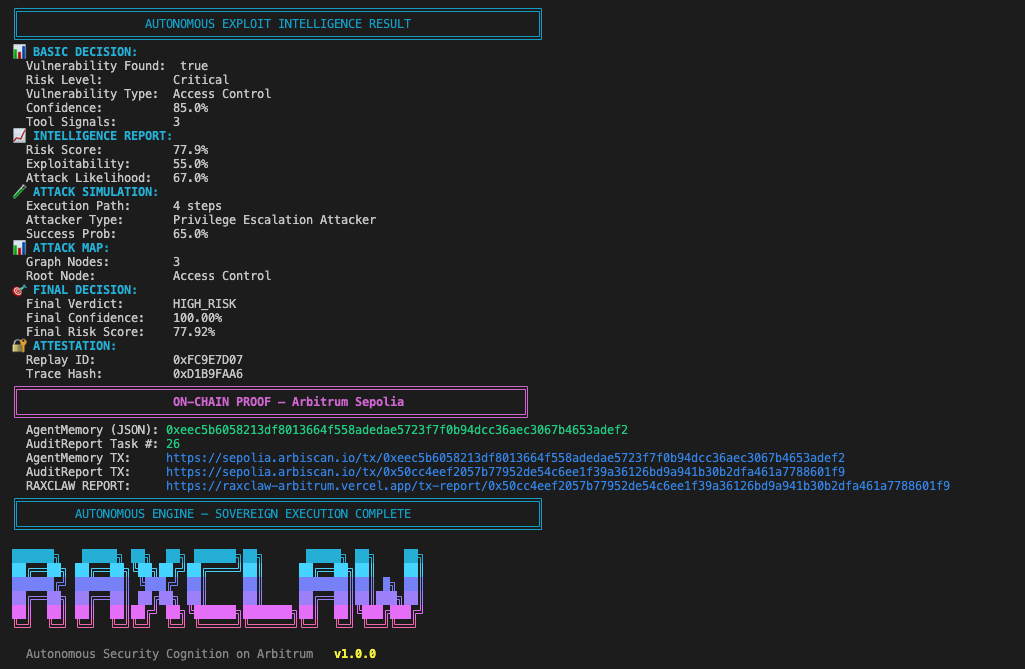
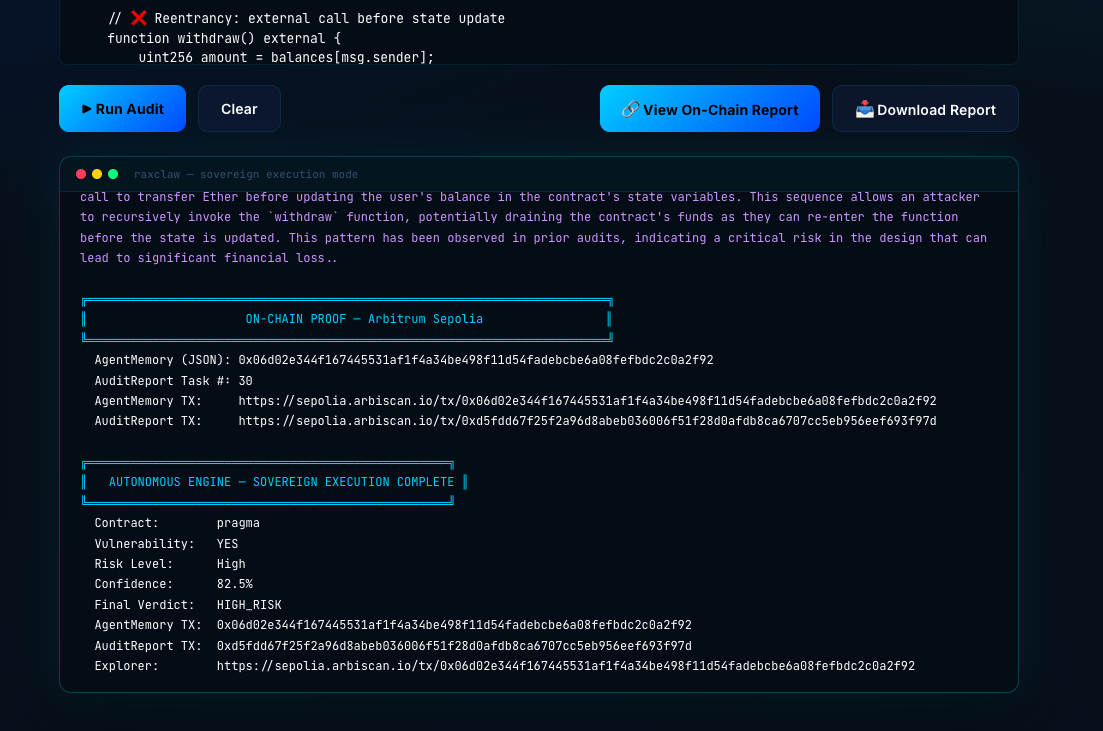
A deterministic multi-agent orchestrator that scans smart contracts for vulnerabilities, simulates attacks, cryptographically proves every result, and writes immutable audit reports on-chain via Stylus (Rust → WASM) on Arbitrum Sepolia. No LLM override. No hallucinations. Verifiable forever.
THE PROBLEM
DeFi protocols are bleeding. In 2025 alone, exploits stole $1.8 billion across 474 confirmed incidents — the worst year ever. Traditional audits cost $10-50K per contract, take weeks, and rely entirely on human review. AI-powered scanners exist, but they're ChatGPT wrappers that hallucinate findings, can't prove results, and leave zero permanent record.
HOW IT WORKS
RAXC is not an LLM — it's a sovereign execution engine with a deterministic 14-phase pipeline. 8 parallel analysis tools run simultaneously including RAG semantic search across 782 real DeFi exploits, static pattern detection, access control checks, and flash loan detection. A SignalNormalizer filters noise. A ConsensusEngine aggregates weighted multi-agent votes — the LLM is just one input, not the authority. An AttackSimulationEngine generates VM-like execution paths with state transitions. A GraphConstructionEngine builds deterministic attack DAGs. A ConsistencyEngine acts as a 4-way gatekeeper that blocks any decision where simulation, graph, and tool signals don't align. A ConfidenceEngine is the single source of truth. A FinalDecisionEngine is the single authority — no tool, agent, or LLM can override it. An AttestationEngine produces cryptographic replay IDs and execution trace hashes. Every audit produces a replay ID and trace hash — same input, same output, every time. The full report is written permanently on-chain via Stylus on Arbitrum Sepolia.
ARCHITECTURE
Backend: TypeScript + Bun + Hono WebSocket server
CLI: Ink/React terminal UI compiled via esbuild
Vector Search: Qdrant Cloud — 782 exploits, HNSW-indexed
LLM: OpenAI GPT-4o-mini + text-embedding-3-small
On-Chain: Custom Stylus contracts (Rust → WASM) on Arbitrum Sepolia — AgentMemory (token-based memory) and AuditReport (task-based audit trail)
Frontend: Next.js 14 on Vercel with live WebSocket terminal
Deployment: Fly.io (backend) + Vercel (frontend)
KEY DIFFERENTIATORS
• Not a ChatGPT wrapper — the LLM is step 8 of 14, not the decision-maker
• Deterministic — same contract always produces identical results
• Cryptographically verifiable — every audit has attestation with trace hash
• On-chain immutable — reports stored permanently on Arbitrum Sepolia
• Stylus-native — Rust compiled to WASM, not Solidity
• Real DeFi data — 782 exploit vectors from DeFiHackLabs + DeFiVulnLabs
• Live in production — wss://raxclaw-arbitrum.fly.dev/ws
LINKS
Demo: https://youtu.be/KCB8SH8YXvo
Frontend: https://raxclaw-arbitrum.vercel.app
GitHub: https://github.com/JFKongphop/raxclaw-arbitrum
On-Chain: https://sepolia.arbiscan.io/tx/0x65ce22f4a49a75e6544675cbe0ab969da25830f0234e0d03cf0a05db68a8b740
TECH STACK
TypeScript · Bun · Hono · React · Ink · Next.js · OpenAI · Qdrant · Stylus · Rust · WASM · Arbitrum · Viem · Docker · Fly.io · Vercel