
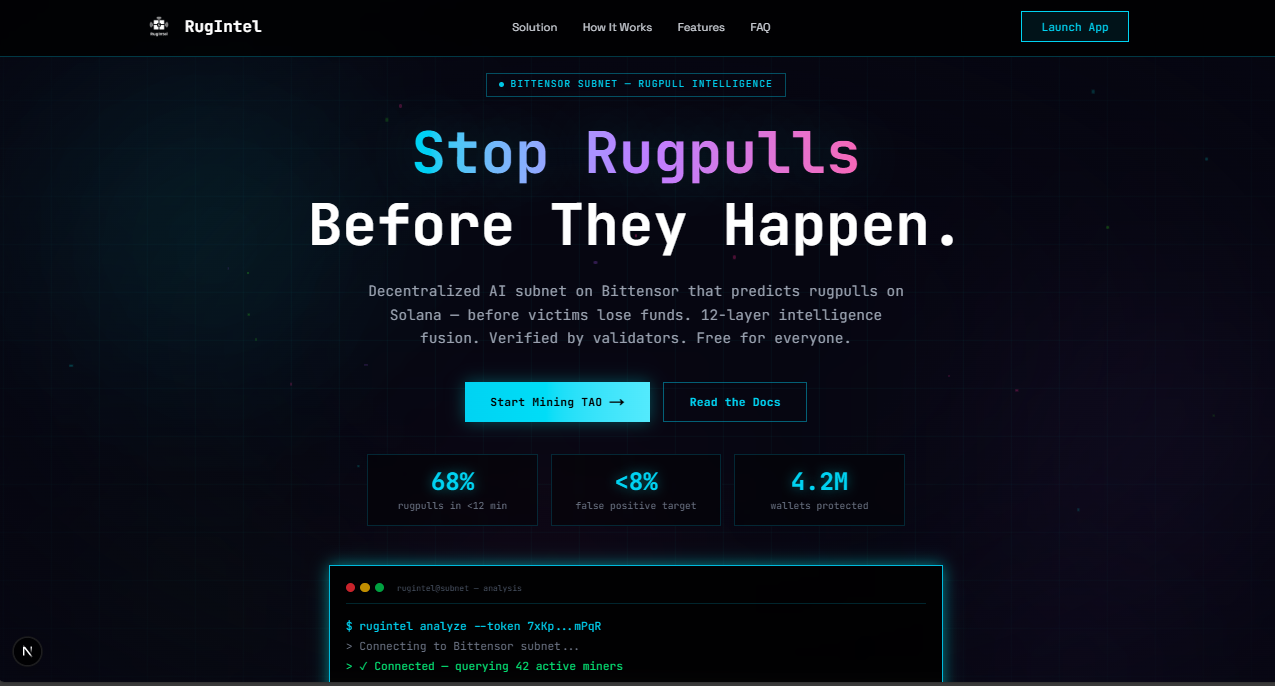
RugIntel: Bittensor subnet where miners earn TAO for accurately predicting Solana rugpulls. Decentralized intelligence protects users.
https://planningasa.notion.site/RugIntel-2fd5481f20dc80a7815dd8a80690467b
Miners compete to produce accurate risk assessments using a proprietary 12-Layer Signal Fusion architecture. Validators independently verify predictions against 24-hour on-chain ground truth outcomes and assign weights proportional to accuracy. Through Yuma Consensus, TAO emissions are automatically distributed to the most accurate intelligence producers.
RugIntel transforms the $500M+ annual rugpull problem into a continuous, sustainable TAO demand engine — while keeping protection free for retail users.
Solana’s memecoin ecosystem launches over 10,000 new tokens per day. Approximately 87% are abandoned or rugpulled within 30 days, draining an estimated $500M+ annually from retail investors.
Existing tools — RugCheck.xyz, TokenSniffer, DexScreener, GMGN.ai — are fundamentally reactive. They detect damage after it occurs. Even combined, they maintain an estimated 18% false negative rate, meaning nearly 1 in 5 rugpulls go undetected.
The structural problem:
Static — Detection heuristics lag 2–4 weeks behind evolving scam tactics
Reactive — They observe collapse rather than predict intent
Expensive — $500+/month API costs exclude retail access
Centralized — Single points of failure that can be gamed or shut down
RugIntel redefines rugpull protection as a decentralized intelligence market.
Intelligence is the commodity.
Miners produce it.
Validators verify it.
Yuma Consensus rewards accuracy with TAO.
This is not a security tool with token rewards added on. It is Bittensor’s native paradigm applied directly to DeFi security: a self-improving intelligence market where accuracy determines economic power.
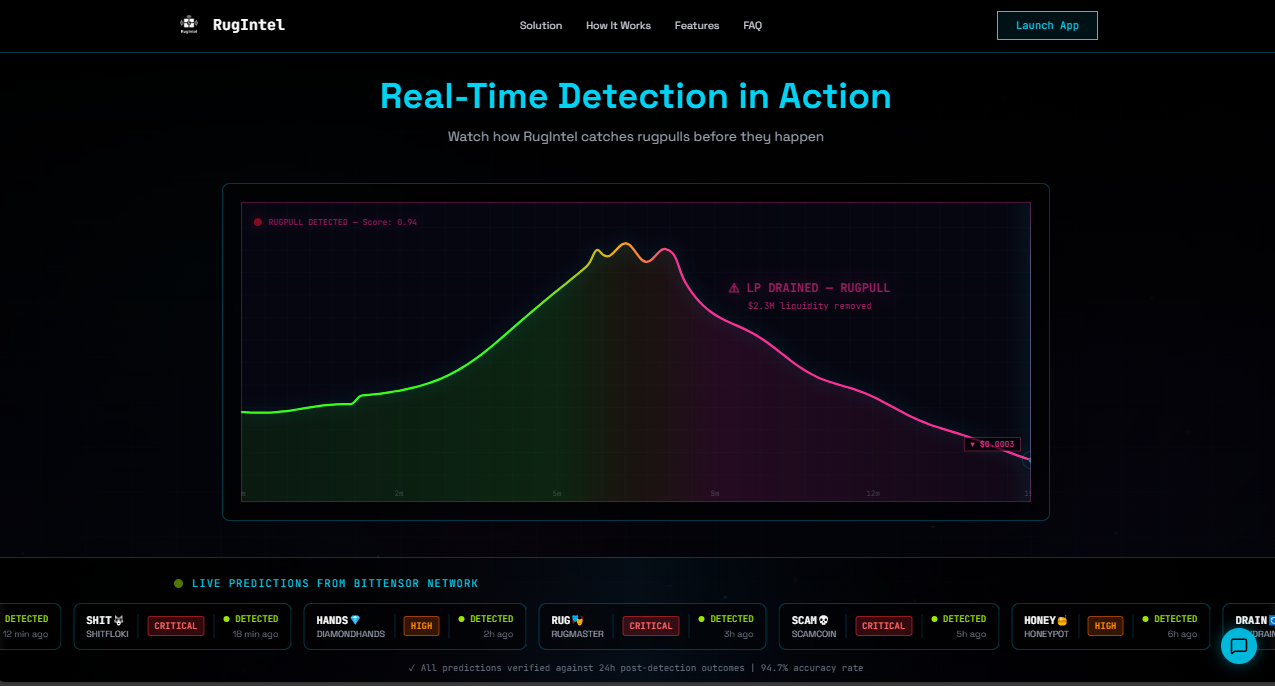
Importantly, 68% of rugpulls occur within 12 minutes of token launch. RugIntel is engineered to detect malicious intent — not just market collapse — within that critical window.
The subnet operates through an incentive-aligned competitive loop between two actors:
Miners run off-chain Python processes executing analysis across 12 non-overlapping intelligence layers. Each miner exposes an Axon endpoint queried through the RugIntelSynapse protocol.
Input:
Token address
Launch timestamp
Output (standardized schema):
Risk score (0.0 – 1.0)
Confidence interval
Supporting evidence per layer
Estimated time-to-rugpull
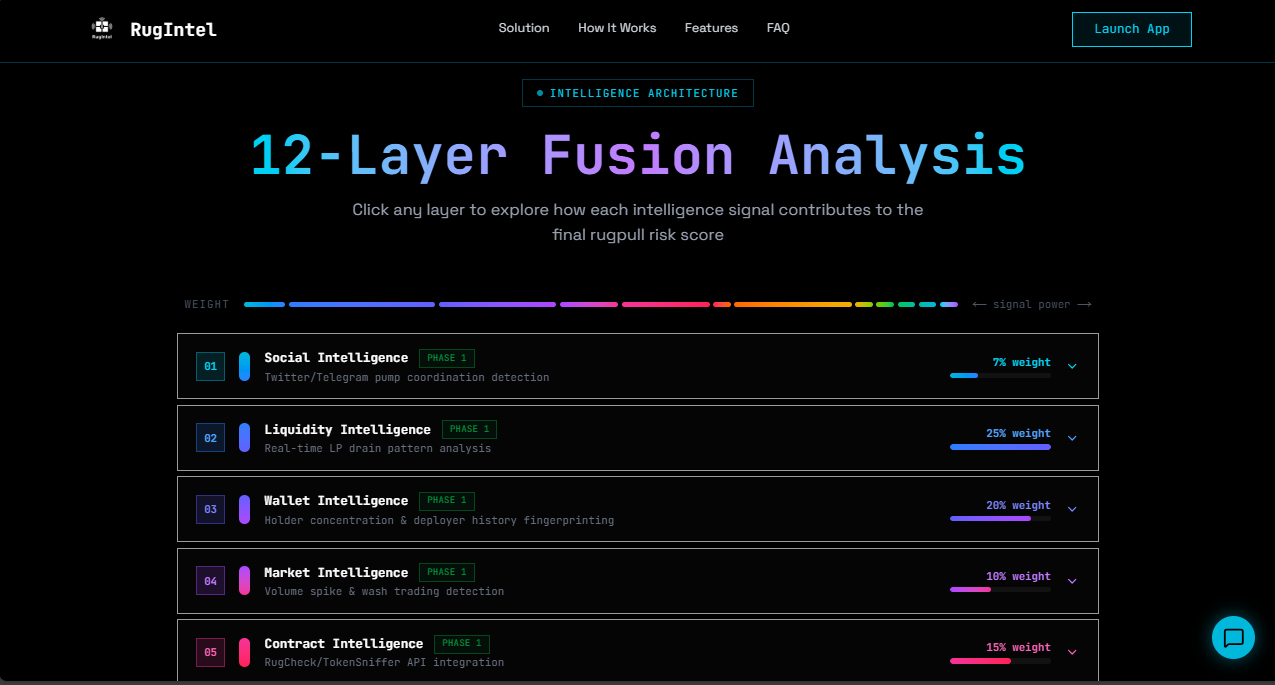
Layer 1: Social Intelligence — Detects coordinated pump campaigns by identifying >10 newly created Twitter/Telegram accounts posting identical shill messages within 5 minutes. Bot ratio calculation flags artificial hype before organic interest emerges.
Layer 2: Liquidity Intelligence — Monitors real-time liquidity pool dynamics on Raydium and Orca. Flags unlocked liquidity, LP drain patterns exceeding 15% within 2 minutes, and ratio decline signals indicating imminent collapse.
Layer 3: Wallet Intelligence — Analyzes holder concentration and deployer history. Flags tokens where top holder controls >50% supply or dev wallet sells >20% holdings within 5 minutes. Includes fund flow tracing to detect sock puppet wallets.
Layer 4: Market Intelligence — Identifies abnormal volume spikes (>100x baseline within 2 minutes) and wash trading patterns. Cross-references price action with order book depth to distinguish organic pumps from manipulative activity.
Layer 5: Contract Intelligence — Integrates RugCheck.xyz and TokenSniffer APIs for real-time contract forensics. Detects mint authority retention, freeze functions, honeypot mechanisms, and backdoor withdrawal capabilities.
Layer 6: Visual Intelligence — Scans token logos and metadata for AI-generated artifacts using CLIP-ViT similarity analysis. Detects typosquatting attempts mimicking legitimate projects through difflib string matching and color palette cloning.
Layer 7: Temporal Intelligence — Models behavioral economics patterns including FOMO peak detection and quiet period analysis. 68% of rugpulls occur within 12 minutes post-launch; this layer predicts collapse timing based on historical pattern matching.
Layers 8–11: Advanced Detection (Phase 2) — Cross-chain intelligence tracking bridge patterns to Ethereum/Base, MEV/bot detection identifying sandwich attacks, tokenomics forensics uncovering hidden mint functions, and exchange flow analysis monitoring CEX deposit coordination preceding pumps.
Layer 12: Adversarial Learning — Meta-cognition engine that learns from every missed rugpull. Performs post-mortem analysis, automatically rebalances layer weights for novel attack vectors, and flags patterns 85%+ different from historical corpus for validator review.
Signals are combined using calibrated predictive weights:
Liquidity 25%
Wallet 20%
Temporal 20%
Contract 15%
Market 10%
Social 7%
Visual 3%
This produces a unified composite risk score.
Validators independently query multiple miners per token and compare predictions against 24-hour on-chain ground truth using:
Solana RPC
RugCheck API
DexScreener data
Two scoring windows operate:
Short-term:
Immediate weight adjustments
Long-term:
Rolling accuracy reputation using softmax-weighted historical performance
Validators whose scoring deviates from ground truth lose influence through Yuma Consensus.
Accuracy directly determines TAO rewards.
No manual distribution.
No central authority.
Everything enforced by the subtensor blockchain.
composite_score =
accuracy_score * 0.60 +
latency_score * 0.20 +
confidence_score * 0.15 +
format_score * 0.05If a miner predicts a rugpull with ≥0.85 confidence at least 5 minutes before occurrence:
→ 1.3× accuracy multiplier
This economically prioritizes pre-collapse detection.
Layer 12 creates a network-wide learning loop:
Post-mortem analysis of missed rugpulls
Automatic weight rebalancing
Novel pattern escalation (>85% deviation from historical corpus)
Validator-assisted feedback integration
This removes the 2–4 week adaptation lag that central tools suffer from.
Miners are financially incentivized to discover new scam patterns first.
Discovery = TAO revenue.
Challenge injection (known-outcome tokens)
Cross-miner ensemble validation
Stake-weighted validator slashing
Penalties for false neutrals on critical risk scores
$500M+ annual rugpull losses (Solana only)
4.2M active retail wallets exposed
Institutional demand for real-time risk APIs
Projected Year 1 MRR (conservative 1% budget capture):
Institutional API: $108k/month
Retail Pro: $50k/month
Subnet Emissions: $13–15k/month
Total: $170k+/month
Free Tier:
10 alerts/month, Telegram bot access
Pro Tier ($99/month):
Unlimited alerts, portfolio dashboard, database access
Institutional Tier ($499/month):
Webhooks, auto-cancel integration, validator access
B2B API:
$0.001 per call + $500/month base
White-label SDK:
$5k setup + 15% revenue share
20% of subnet emissions flow into treasury for:
Miner subsidies
Bug bounties
Grants
Marketing
The subnet is designed to be self-sustaining without VC dependency.
Completed :
Full subnet architecture using Yuma Consensus
TwelveLayerFusion engine (parallel execution)
7 of 12 intelligence layers fully implemented
Miner and validator neuron logic
Full documentation suite
Next.js landing page with AI-powered chatbot
Interactive token scan page with 12-layer breakdown
Objectives:
Testnet subnet registration
Miner bootstrapping
Wallet/DEX pilot integrations
Expansion to full 12-layer coverage
Target:
$500k seed round for institutional data pipeline and validator expansion.