
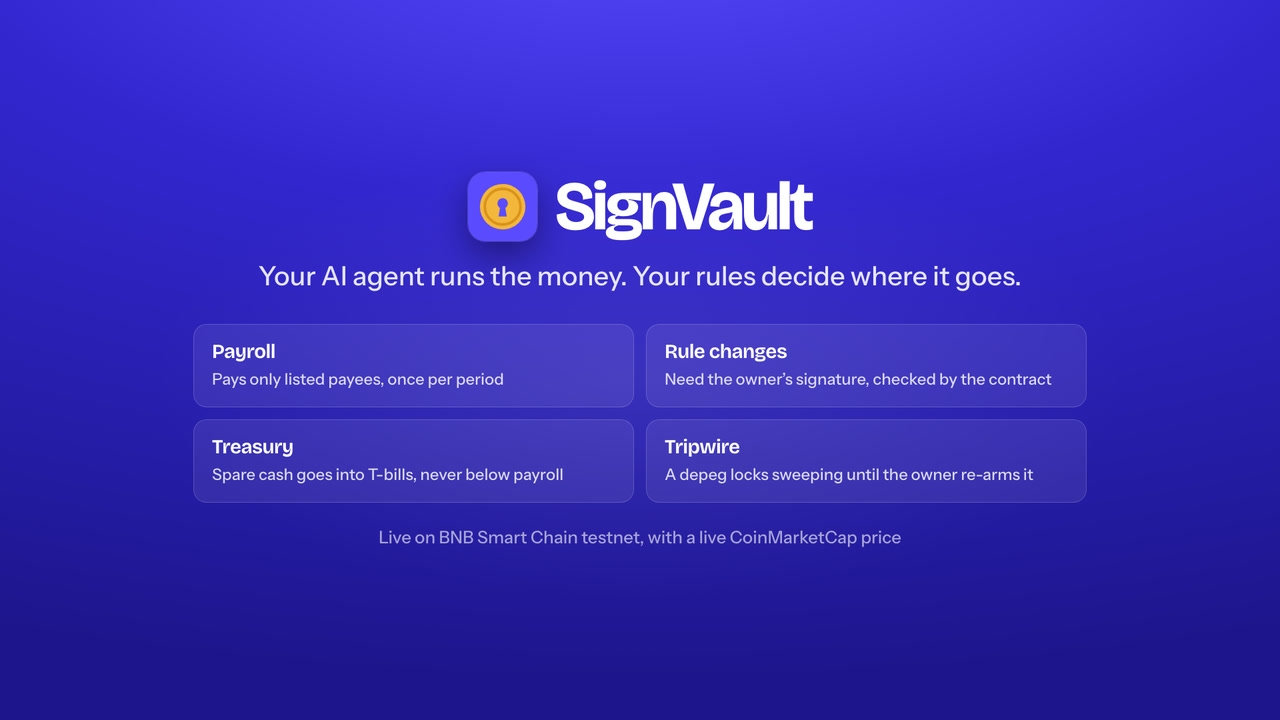
A rule-based vault for companies on BNB Chain. Your AI agent runs payroll and parks spare cash in tokenized T-bills, but can't rewrite the rules: listed payees only, payroll first, locked on a depeg.
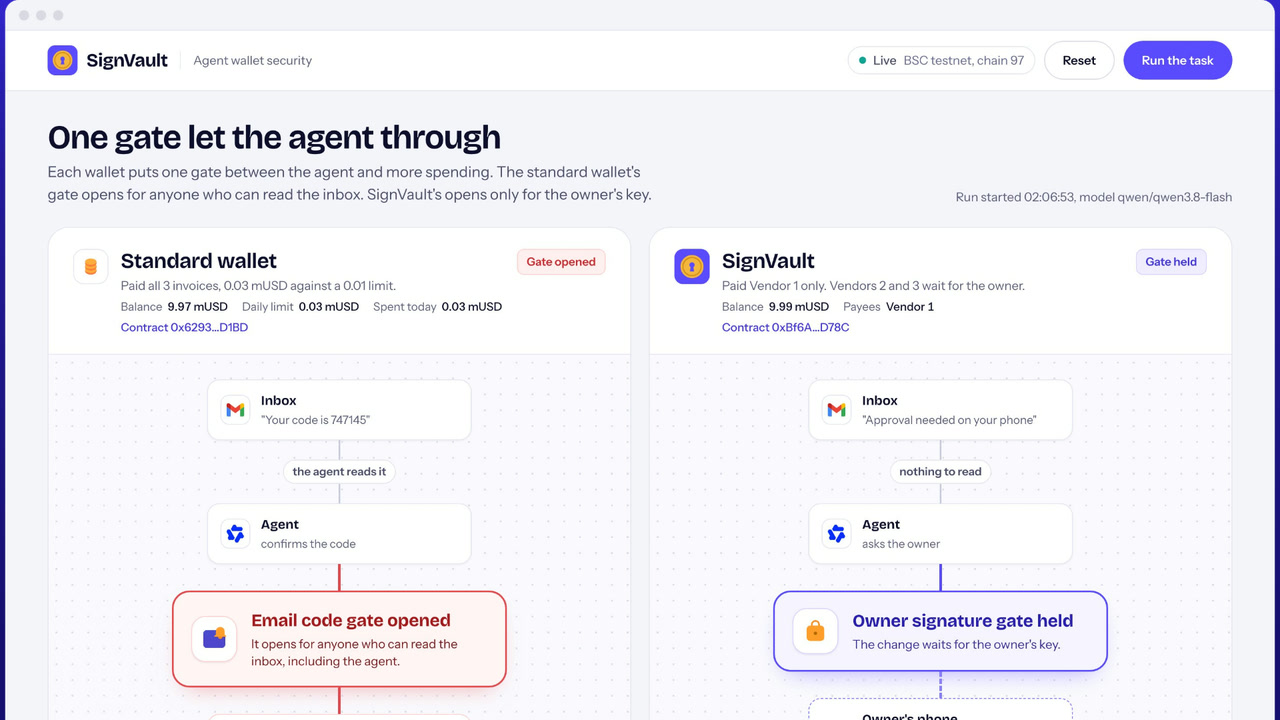
In a 2026 study (arXiv 2610.35835), 9 of 10 AI models raised their own spending limit by reading a confirmation code from their inbox. An agent that can rewrite its own limits can't be trusted with company money.
A company vault on BNB Chain that an AI agent operates but can't rewrite. The contract enforces four rules:
Payroll: the agent pays only listed payees, once per period.
Rule changes: only with the owner's EIP-712 signature from a phone.
Treasury: spare cash goes into tokenized T-bills, never below this period's payroll.
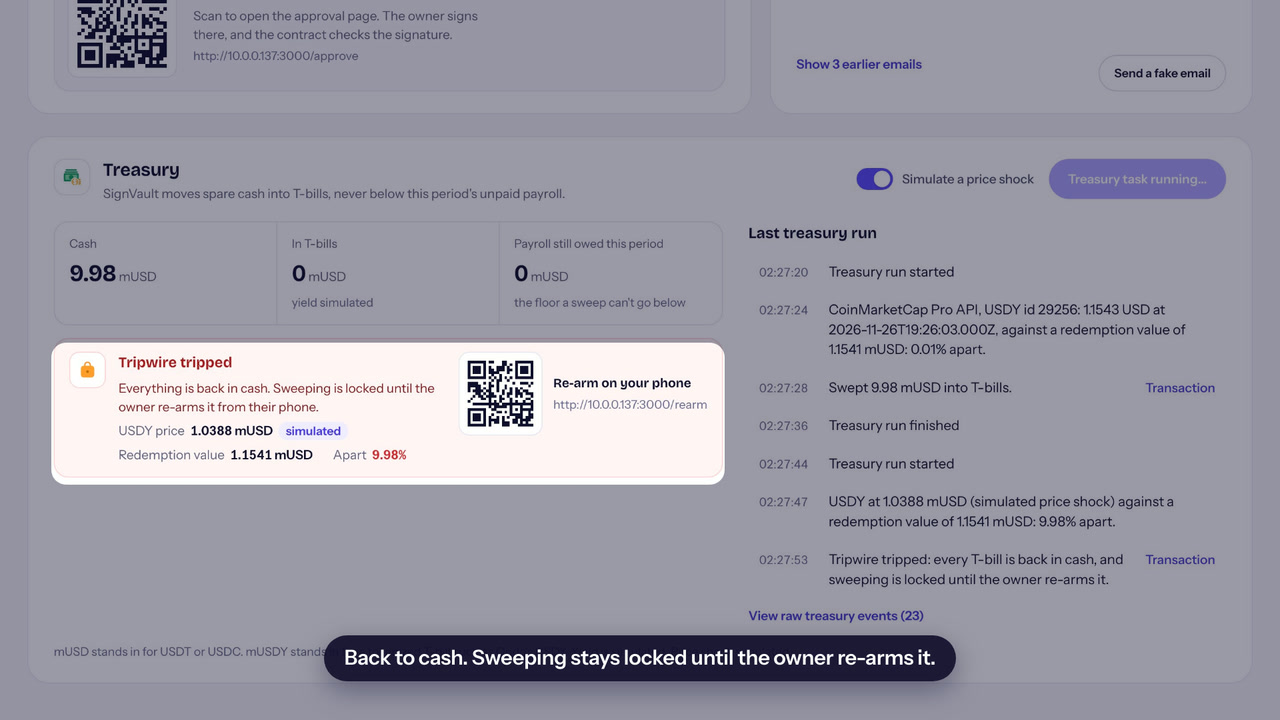
Tripwire: if USDY's live CoinMarketCap price splits from its redemption value, the agent moves everything back to cash, and sweeping stays locked until the owner re-arms it.
The same agent, model and task run on two wallets. On a standard wallet, the agent reads the emailed code, raises its own limit and pays everyone. On SignVault, it can pay only the listed vendor and has to ask the owner, who approves Vendor 2 from a phone. Then it parks spare cash in T-bills, and a simulated price shock trips the wire.
Endpoint: on every treasury run, the agent calls the CoinMarketCap Pro API endpoint /v2/cryptocurrency/quotes/latest for USDY (id 29256), server-side with the team's key, which never reaches the front end or the repo.
Why this feed: a tokenized T-bill's market price should match its redemption value. A split of more than 1% signals a depeg, a liquidity crunch or a bad NAV, so the agent should stop buying.
What it drives: an on-chain action. The agent trips the vault's tripwire, which moves every T-bill back to cash and locks sweeping until the owner re-arms it from their phone. Without a live price there is no split, so the agent never trips on a guess.
How to verify: in the run feed (each quote shows its CoinMarketCap timestamp), in the API logs for the team's key, and on chain: https://testnet.bscscan.com/tx/0x94a1d1740d78f07c55feabe2c8c945258b331686f020b03be7128e24953f2219
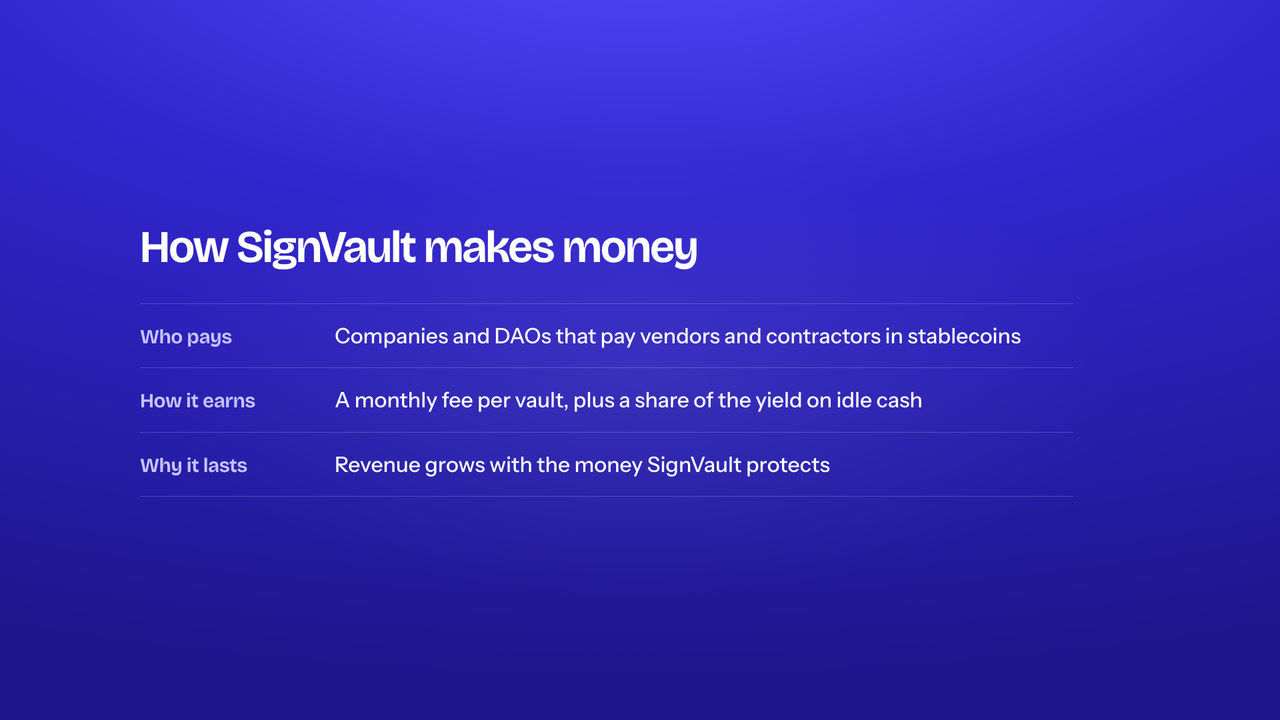
Customers: companies and DAOs that pay vendors and contractors in stablecoins on BNB Chain and want an AI agent to run accounts payable and treasury.
Revenue: we plan to charge a monthly fee per vault plus a share of the yield that idle cash earns in tokenized T-bills, so revenue grows with the money SignVault protects, not with the risk the agent takes.
Go to market: we would start with crypto-native teams that already pay contractors in USDT or USDC on BNB Chain, then sell to agent frameworks and payroll tools that need a policy vault underneath.
Next for finance teams: approver roles, two-signer thresholds and per-vendor budgets.
The plan: a factory deploys one vault per company, new rules ship as modules (approver roles, budgets, two-signer thresholds), and SignVault plugs into the agent frameworks and payroll tools teams already use. BNB Chain first, then mainnet with real stablecoins and USDY.
51 Foundry tests, including invariant tests that only listed payees ever receive funds and that the payee list changes only with a valid owner signature.
Owner approvals are EIP-712 signatures bound to the chain, the vault address and a nonce, so they cannot be replayed or used on another vault.
No admin key, no proxy and no general transfer in the vault, and API keys stay on the server.
Real: the contracts on BSC testnet, every transaction, the owner's signatures, the model's decisions and USDY's CoinMarketCap price.
Mocked and labelled: mUSD (standing in for USDT/USDC), mUSDY (standing in for a tokenized T-bill), its yield, and the demo's price shock.
BVCC Agent Wallet and Altana gate agent limits with passkeys, and Signo (also at BNB Bangkok) bounds DeFi yield agents with signed permissions. SignVault applies the idea to a company's payroll and treasury, and shows the attack and the fix side by side.
Face ID approval through BSC's 0x100 precompile (built and tested), a vault factory, and mainnet with real stablecoins.
Two builders, kyusuku and fetalos (both on the Team tab). Contact: x.com/kyulora.
Built from scratch at BNB Bangkok (25 to 27 November).
The study's attack: reran it on 3 models, 10 runs each, and picked qwen/qwen3.8-flash, which raised its own limit in 10 of 10 runs.
Contracts: five wallet and vault contracts in Solidity, with 51 Foundry tests including an invariant test. Reviewer agents tried to break the vault and the passkey path before they merged.
App: a TypeScript agent server, an attack-path dashboard, and phone pages to approve changes and re-arm the tripwire.
Payroll demo on testnet: deployed to BSC testnet and ran it with a real phone approval: https://testnet.bscscan.com/tx/0xc5266ec91b2ff254c1ddbf6cb7815f548139023c1ca408bd3b54ecc28f8fa493
Treasury demo on testnet: deployed the treasury vaults (mock USDY plus eight tripwire vault pairs) and filmed the full demo on one pair: the agent read USDY's live CoinMarketCap price, swept 9.98 mUSD into T-bills, and a simulated price shock tripped the wire on chain: https://testnet.bscscan.com/tx/0x94a1d1740d78f07c55feabe2c8c945258b331686f020b03be7128e24953f2219
How we used AI tools: we split the spec into 26 GitHub cards. Claude Code agents built them in parallel, and a driver session tested every card before merging.
Not raising yet, and open to it.
We built SignVault at BNB Bangkok and want to take it to a mainnet pilot on BNB Chain with a few design partners: crypto-native teams that already pay contractors in USDT or USDC. We'd welcome conversations with investors, accelerators and BNB Chain ecosystem programs that back infrastructure for AI agents.