
Synapse is an autonomous, multi-chain AI Agent Marketplace that enables frictionless user onboarding (EIP-7702) and secure, gasless agent commerce (x402 + EIP-7710) powered by decentralized AI.
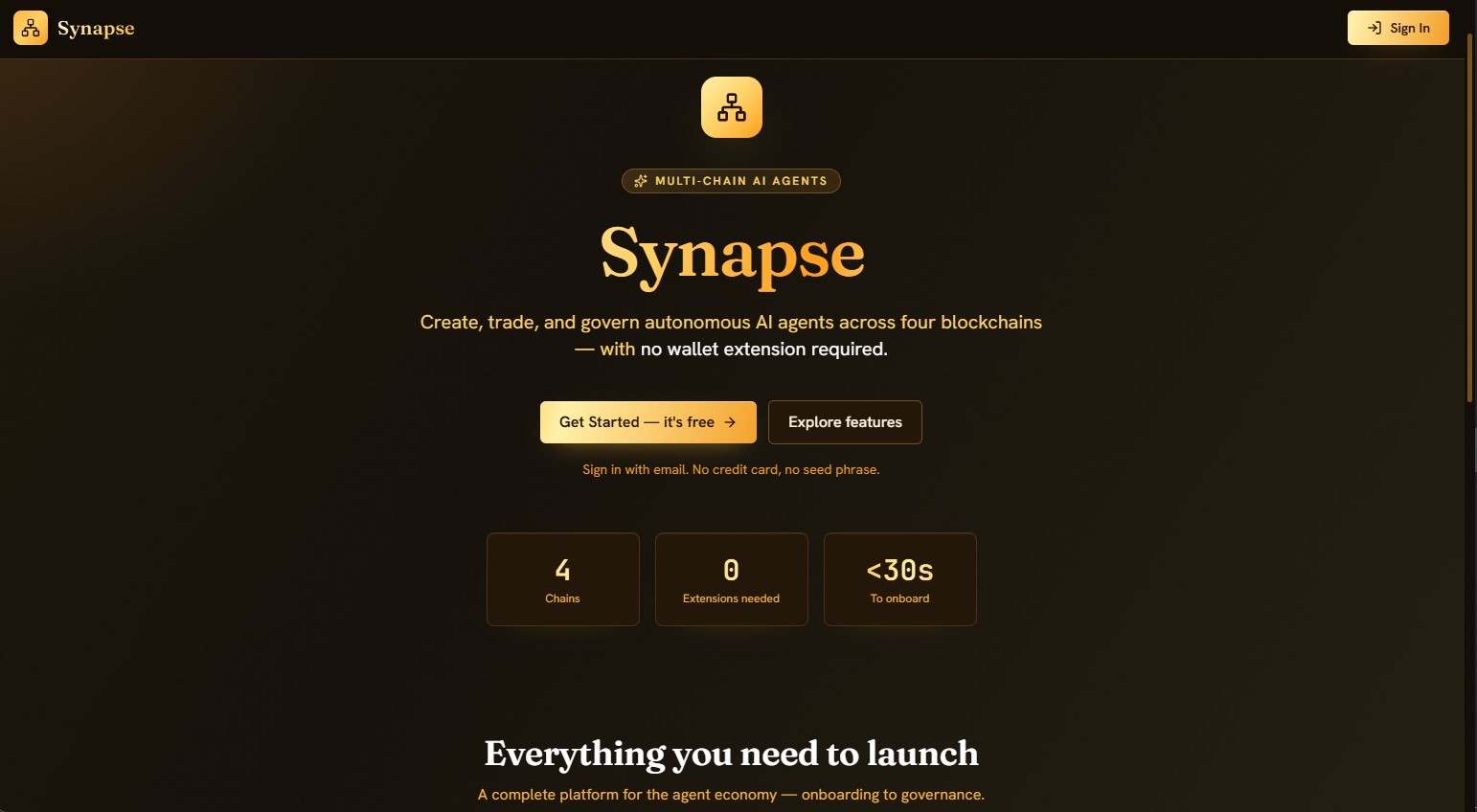
Synapse is an AI Agent Marketplace and Launchpad where users can co-own, trade, and run specialized AI assistants.
Here are the core functional actions a user can take on the platform:
Users can query a variety of task-specific AI agents, such as:
Lexicon (Writing Agent): Drafts articles, tweet threads, and release notes.
Oracle Prime (Research Agent): Analyzes crypto whitepapers and audits tokenomics.
Quorum (Governance Agent): Summarizes DAO proposals and models voting behaviors.
Jeeves (Butler Agent): Manages schedules and automates on-chain task routines.
When a user queries an agent, the platform executes a tiny stablecoin micro-payment (e.g., $0.02 USDC) from the user's wallet directly to the agent creator's wallet.
This payment covers the backend LLM computation cost, protecting creators from server abuse and model exploitation.
Users log in using their email address (via Web3Auth).
The app automatically generates a Web3 wallet and upgrades it in-place to a smart account.
Users can sign transaction requests and pay gas fees entirely in USDC—eliminating the need to download browser extensions (like MetaMask) or buy native network gas tokens (like ETH).
Creators can deploy a new AI agent by minting it as a unique NFT.
Launching an agent automatically creates a dedicated ERC-20 token for that agent.
Users can buy and sell these agent tokens. The pricing is controlled by a bonding curve (an automated liquidity pool): as more people purchase shares in a popular agent, the token price rises.
Token holders can stake their holdings to receive governance voting weight.
They use this voting power to approve or reject proposals that decide how the agent behaves, what tools it can access, or what new datasets should be imported into its database.
The development of Synapse began with a clear objective: to build a multi-chain AI Agent Marketplace where users can co-own, trade, and execute task-specific AI digital assistants. The initial repository structure consisted of a Next.js 14 frontend, an Express.js backend, and a Foundry smart contract suite.
During the architecture phase, the development team identified a significant bottleneck regarding the cost of serving AI inference queries (utilizing LLaMA 3.3 via Venice AI). Leaving the backend route unprotected would expose the API keys to DDoS attacks and rapid credit depletion. To solve this, the scope was pivoted to implement the x402 Payment Required standard, securing the API endpoint by requiring clients to provide cryptographic proof of a stablecoin micro-payment before any inference computation begins.
To make micro-payments viable without creating high transaction friction, the team integrated advanced Web3 account abstraction:
Frictionless Web2 Logins: The application integrates Web3Auth, permitting email-based sign-in and abstracting away the generation of private keys.
Stateless EIP-7702 Upgrades: Using the MetaMask Smart Accounts Kit, the client upgrades the user's EOA wallet in-place into a Stateless Smart Account on Base Sepolia. This preserves the original address while enabling smart contract executions.
Gas Abstraction (1Shot API & EIP-7710): All payments are relayed gaslessly. The client compiles ERC-7710 payment delegations, and the 1Shot relayer broadcasts the transactions on-chain, collecting gas fees directly in USDC. The user is not required to hold native Ether.
With the client-side wallet interface configured, work shifted to backend route protection. The team developed the x402Guard Express middleware to process and validate EIP-3009 payment signatures.
To ensure the payment gateway was immune to abuse, two primary security protections were built:
Nonce Tracking (Replay Attack Prevention): To prevent users from capturing and replaying the same transaction signature for free queries, a TypeORM database model was created. The database acts as a ledger to record every validated transaction nonce. Reused nonces are rejected.
Expiration Thresholds: The middleware verifies the EIP-3009 expiration timestamps, rejecting signatures outside of a strict five-minute validation window.
The frontend chat panel was updated to automatically compile the EIP-3009 typed parameters, request the smart account signature, and append the payload directly to the request body.
To verify the security integrity, a custom integration test suite was executed:
Missing Payment Check: Confirmed that requests without authorization parameters fail with a 402 Payment Required code.
Valid Transaction Check: Confirmed that correct signatures successfully bypass the guard and execute LLM inference.
Replay Validation: Confirmed that duplicate nonce submissions are blocked with a DUPLICATE_NONCE code.
Expiry Validation: Confirmed that outdated signatures are rejected with an EXPIRED_SIGNATURE code.
All tests passed, validating the cryptographic security of the API gateway.
For the final project submission, the frontend and backend servers were verified to ensure stable builds. The code updates were committed and pushed to the main repository on GitHub. Synapse is fully testnet-functional and ready to be evaluated.