
A Private Execution Layer for Confidential Transactions on Mantle
Veilocity is a privacy infrastructure layer purpose-built for Mantle L2 that solves one of blockchain's most critical limitations: the complete lack of financial privacy on public ledgers. Every transaction on Ethereum and its L2s is visible to everyone - exposing balances, counterparties, and transaction patterns to front-runners, competitors, and chain analysts.
The numbers tell the story: over $1.3 billion was extracted through MEV in 2023 alone - value stolen because transactions are public before they're confirmed. Institutional OTC desks handle $10+ billion monthly in crypto trades, yet every large order leaks information that sophisticated actors exploit. This isn't just a privacy concern; it's an economic attack vector that costs users real money every single day.
This transparency makes blockchain adoption impractical for institutions, enterprises, and privacy-conscious users. Companies can't pay salaries on-chain without exposing compensation to competitors. Trading firms can't execute strategies without being front-run. Regular users can't transact without their entire financial history being one click away on a block explorer.

Veilocity introduces a novel architecture that cleanly separates private execution from public settlement. The core insight is that you don't need to see transaction details to verify they're correct - zero-knowledge proofs let us prove correctness without revealing anything else.
1. Deposit: Users deposit MNT into a shielded pool by submitting cryptographic commitments to the VeilocityVault smart contract on Mantle. The commitment is Poseidon(secret, amount)- observers see that someone deposited, but cannot link it to an identity.
2. Private Transfer: Inside the pool, transfers happen entirely off-chain - zero transactions, zero events, zero gas, zero visibility. The sender proves they have sufficient balance and generates a nullifier (preventing double-spends) without revealing which account they control.
3. Withdrawal: Users generate a ZK proof demonstrating ownership of funds without revealing their account. The contract verifies the proof (~300k gas, ~$0.01 on Mantle) and releases funds. The withdrawal cannot be linked to any specific deposit - the cryptographic relationship is broken by design.
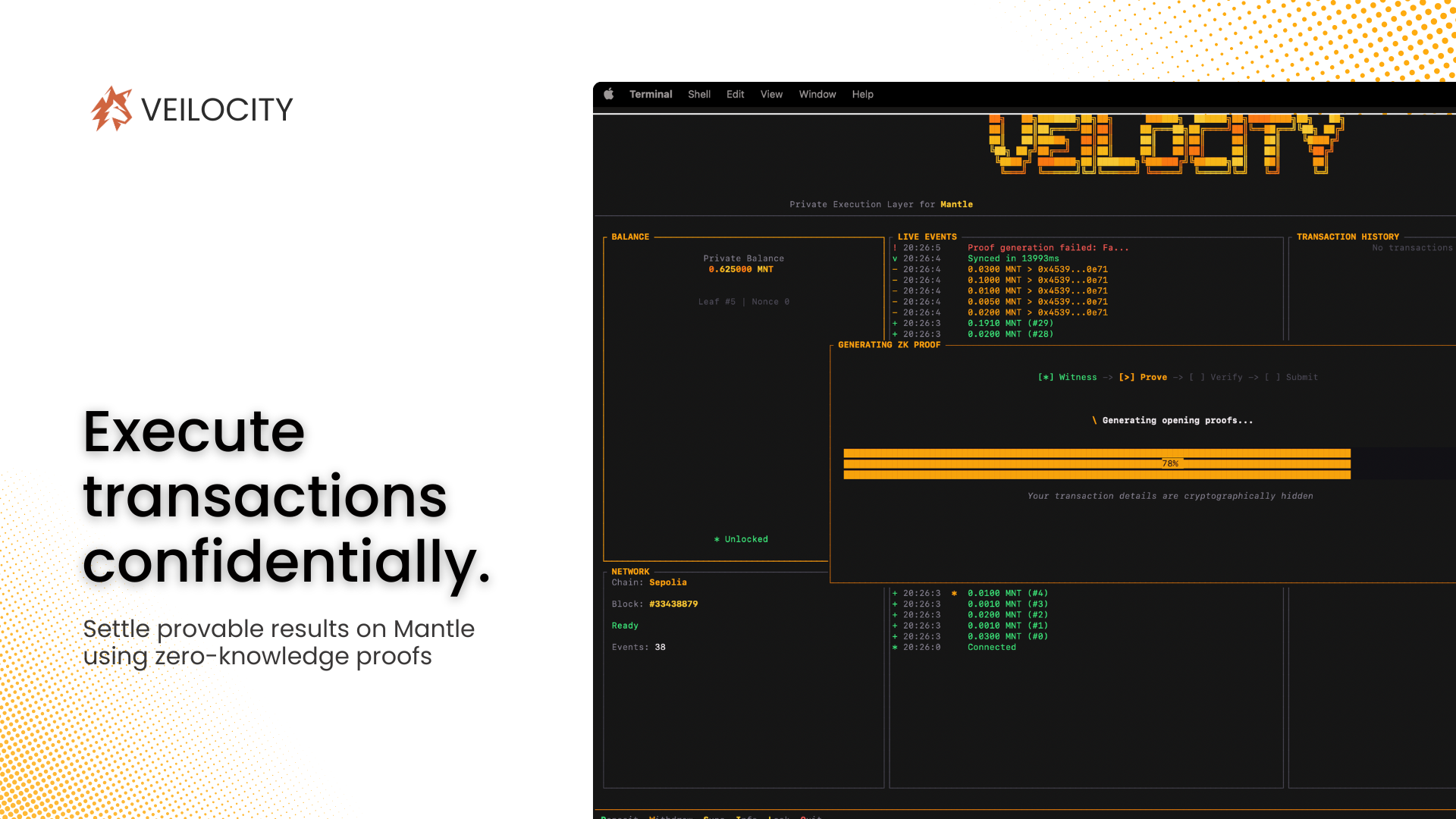
The system is built on battle-tested cryptographic primitives optimized for the EVM:
COMPONENT | SPECIFICATION | WHY IT MATTERS |
Hash Function | Poseidon (BN254) | ~250 constraints vs ~30,000 for SHA-256 in circuits |
Merkle Tree | Depth 20 | Supports 1,048,576 accounts with 20-hash proofs |
Proof System | UltraPlonk | ~2KB proofs, ~300k gas verification, universal setup |
Curve | BN254 (bn128) | Native Ethereum precompiles for efficient verification |
Deposit circuit: ~500 constraints (sub-second proving)
Withdrawal circuit: ~8,000 constraints (2-5 second proving)
Transfer circuit: ~15,000 constraints (5-10 second proving)
Performance on Mantle:
Deposit gas cost: ~60,000 gas (~$0.004)
Withdrawal gas cost: ~300,000 gas (~$0.02)
Private transfer cost: $0 (completely off-chain)
What makes Veilocity unique is its position as infrastructure rather than a competing chain. We don't ask users to bridge to a new ecosystem or trust a new consensus mechanism. Veilocity adds privacy to Mantle's existing security model - users inherit Ethereum's finality guarantees through Mantle's rollup architecture while gaining institutional-grade financial privacy.
Mantle is the ideal home for privacy infrastructure:
Low gas costs make privacy practical - withdrawals cost cents, not dollars
$500M+ TVL and growing DeFi ecosystem with zero native privacy solutions
Ethereum security inheritance through the rollup architecture
First-mover advantage - no other privacy layer exists for Mantle
Veilocity enables use cases previously impossible on public chains:
Private OTC Settlement: Large trades execute without leaking to front-runners or competitors
Confidential Payroll: Companies pay salaries without exposing compensation structures
Supply Chain Finance: B2B payments without revealing business relationships or volumes
Private DeFi: Lending positions protected from liquidation hunters, trading without copy-traders
Gaming Economies: In-game currencies and NFT ownership hidden from manipulation
Treasury Management: Corporate holdings invisible to competitors
PROPERTY | MECHANISM | ADVERSARY |
Fund Safety | ZK proof required for withdrawal | Cannot forge valid proofs |
No Double-Spend | Nullifier registry on-chain | Same nullifier rejected |
Balance Integrity | Circuit constraint b ≥ a | Cannot prove false statement |
Ownership Auth | Secret in proof H(s)=pk | Only holder can derive pk |
Unlinkability | Separate hash constructions | Preimage resistant |
What attackers cannot do:
Forge proofs (cryptographically impossible)
Link deposits to withdrawals (hash preimage resistance)
See account balances (never on-chain)
Double-spend funds (nullifier tracking)
Front-run private transfers (completely off-chain)
It is still in MVP mode, where we have achived the stats locally, it is not perfect. Good things take time.
Link: https://www.veilocity.xyz/